Khafre
Khafre — an illustrated history story. 10 illustrated pages, free to read on Wonder Egypt.
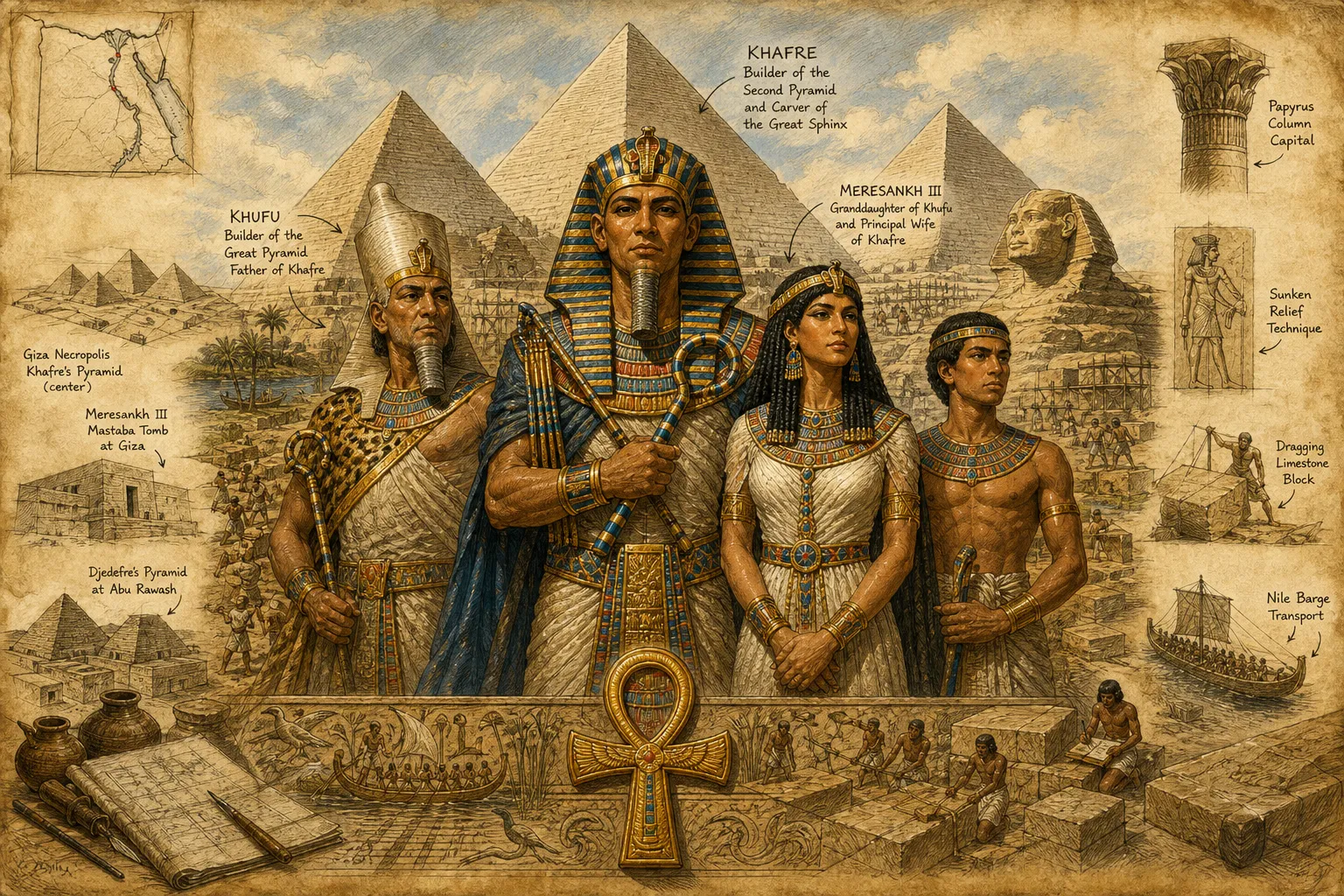
Page 1
Khafre, son of the prodigious Khufu, inherited a kingdom already shaped by colossal ambition. Ascending to the throne around 2558 BC, after the brief interregnum of his half-brother Djedefre, Khafre sought not merely to emulate his father but to surpass his legacy in enduring stone. His reign, spanning approximately 26 years, saw the completion of the Giza plateau as an eternal necropolis, crowned by his own pyramid, strategically placed to appear taller than its predecessor. But it is his greatest innovation, the carving of the Great Sphinx from the very bedrock of his quarry—the first colossal statue of its kind—that cemented his image as a divine ruler, a protector standing sentinel over the ages. He built an iconography of the king as a god on earth, a monumental vision that shaped the identity of Egypt for millennia. His principal wife, Meresankh III, a granddaughter of Khufu, was a woman of immense influence and royal lineage, bearing him his successor, Menkaure, who would complete the triad of Giza's monumental tombs. Khafre left behind not just structures, but a sacred landscape that endures as the face of ancient Egypt.
Page 2
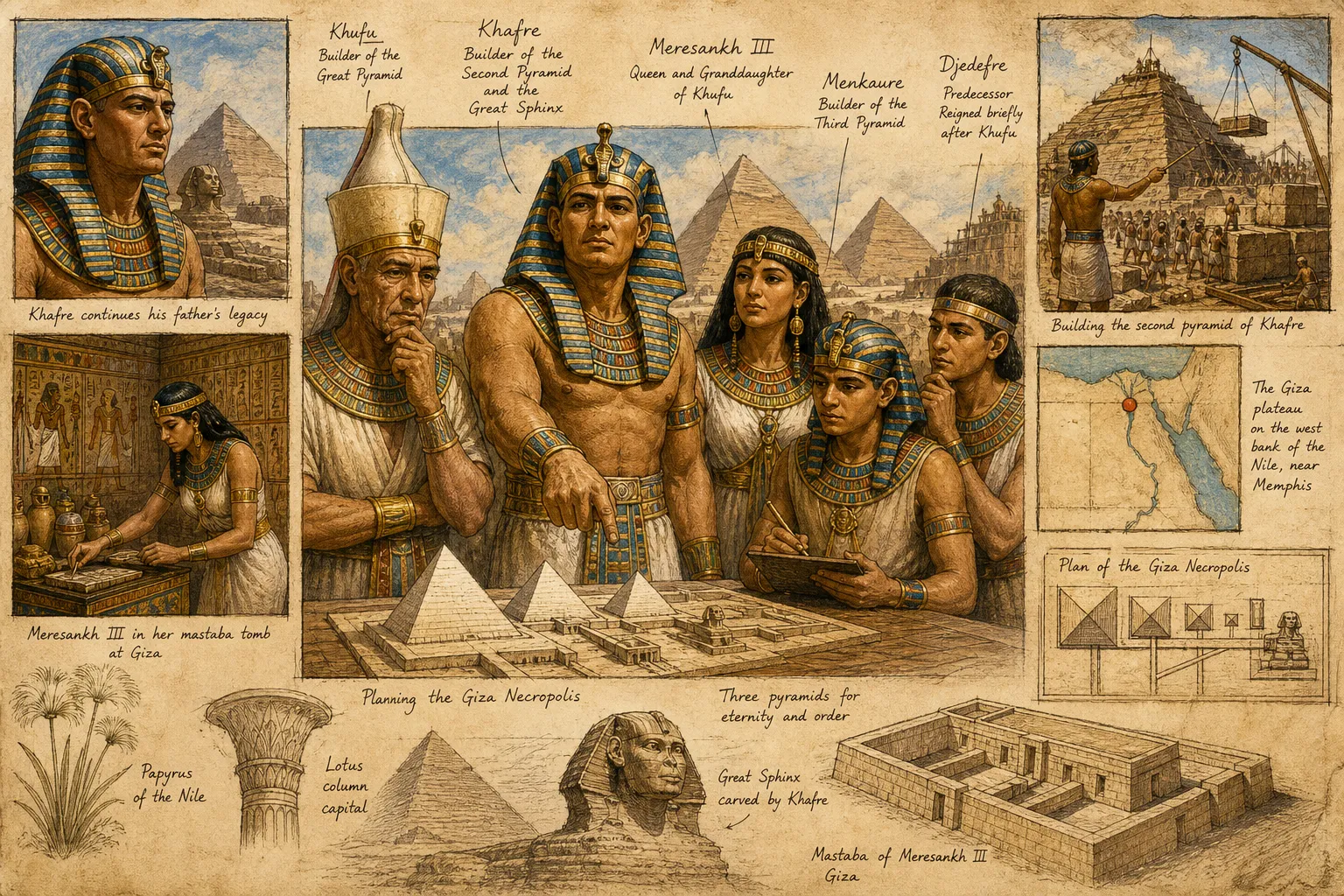
From the polished red granite of his audience hall in Memphis, King Khafre gazes through a tall, narrow slit window. The distant, shimmering silhouette of his father Khufu's Great Pyramid dominates the horizon, a monolithic challenge to his own ambition. Khafre feels the weight of this inheritance, the expectation to not merely rule but to build with comparable, enduring splendor. His half-brother Djedefre's brief and less impactful reign had concluded, leaving the throne to Khafre and the immense responsibility of maintaining the divine order. The kingdom is stable, yet the resources required for a new monumental undertaking are vast, demanding unwavering devotion and unparalleled organization. Khafre knows his legacy will be carved not from the achievements of his predecessors, but from his own unique vision for eternity.
Page 3
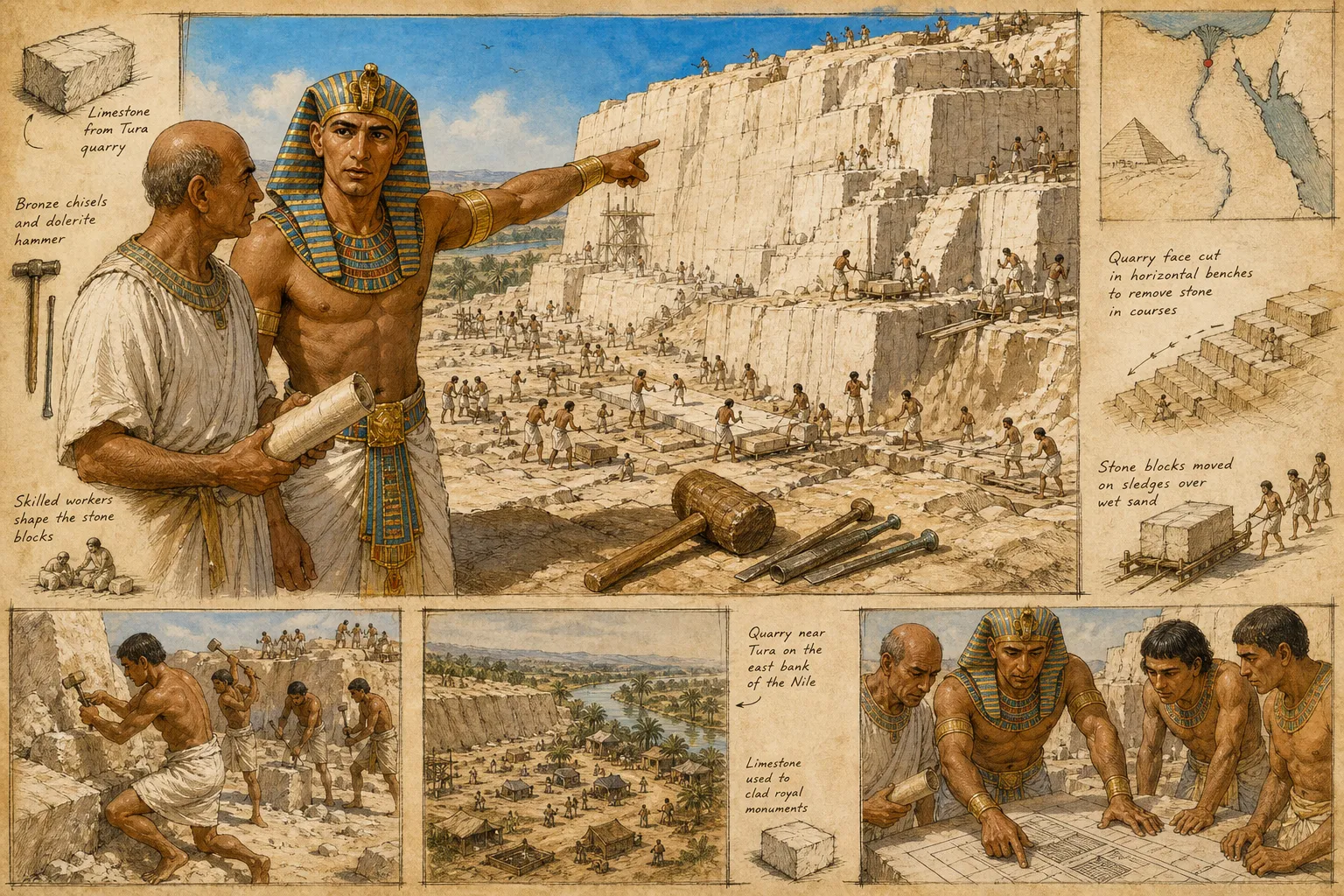
Dust rises in fine clouds as King Khafre stands amidst the Giza quarry, the air thick with the metallic tang of sweat and stone. Massive limestone blocks, destined for his pyramid, are being hewn from the bedrock. Yet, his eyes are drawn to an immense, untouched outcropping—a natural ridge of stone that resisted removal. A vision takes hold: not merely a block, but a living form, a guardian. He confers with his chief architect, a stout, elderly man whose brow is perpetually furrowed with calculations. The King's hand sweeps across the rock, outlining the powerful body of a lion, its head crowned with his own divine countenance. This, he declares, will be the greatest sentinel, a fusion of royal power and leonine might, carved directly from the earth, looking towards the rising sun. It is a conception unlike any before, a promise of eternal vigilance.
Page 4
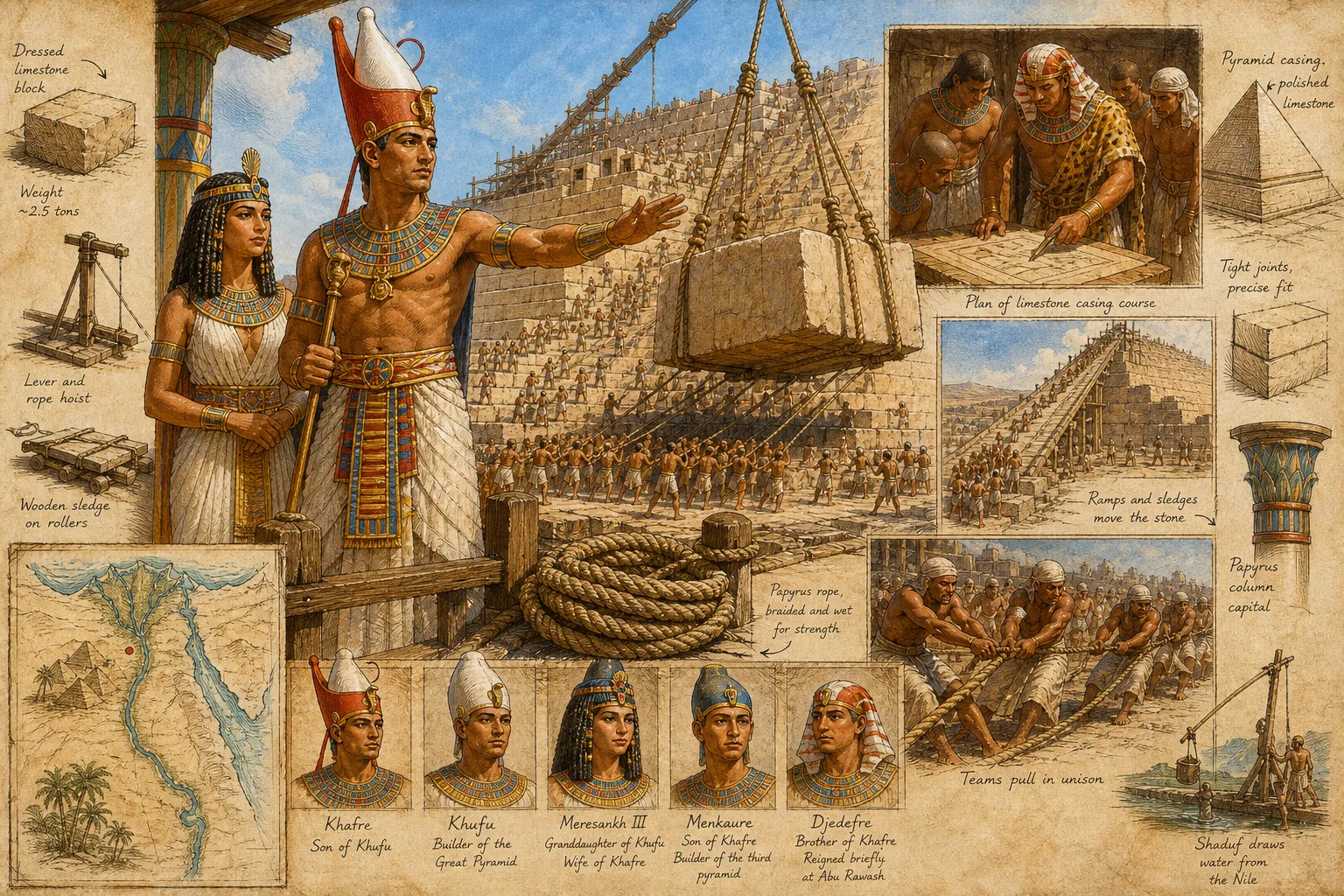
High on the Giza plateau, the enormous ramp leading to Khafre's pyramid is a hive of ceaseless activity. King Khafre, now wearing the double crown of Upper and Lower Egypt, stands on a scaffold, overseeing the precise placement of a colossal casing block of Tura limestone. The air vibrates with the rhythmic chants of thousands of laborers, the creak of timber, and the groan of ropes. Below him, the plateau stretches, dotted with smaller mastabas and the burgeoning outlines of his mortuary and valley temples. His wife, Queen Meresankh III, elegant in fine pleated linen, stands nearby, observing the scale of her husband's endeavor, understanding its profound spiritual and political implications. The king's pyramid is rising, asserting its dominance over the landscape, appearing to pierce the heavens even higher than his father's monument, a testament to his divine authority and engineering prowess.
Page 5
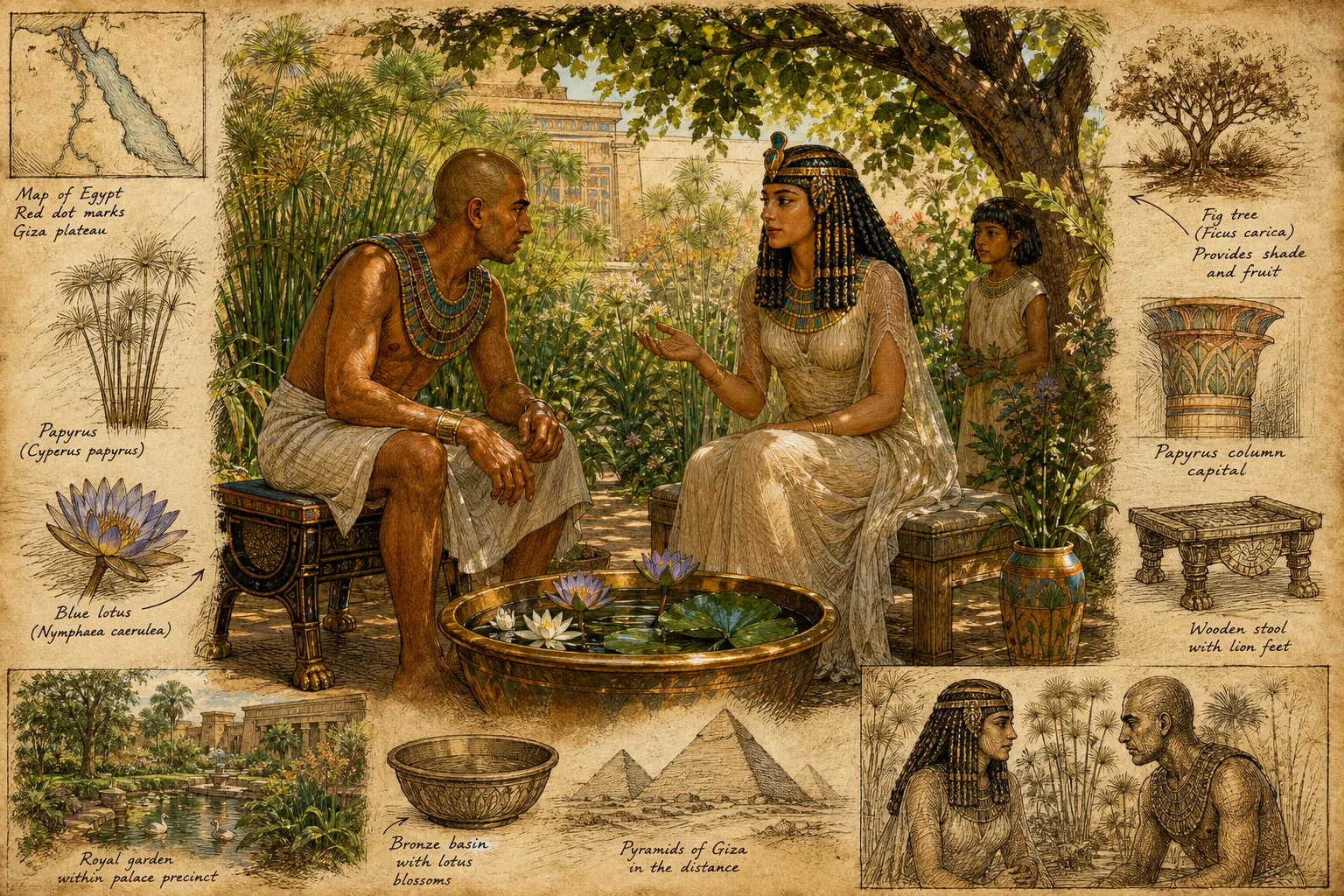
Cool, scented breezes rustle the papyrus reeds in the royal gardens of Memphis. King Khafre, his ceremonial regalia set aside for the intimacy of his private residence, sits upon a carved ebony stool. He listens intently as Queen Meresankh III, adorned in a gossamer white linen gown, speaks with measured words, her intelligence evident in her sharp insights. She discusses the management of their vast estates and the complexities of court politics, her counsel invaluable. Nearby, their young son, Prince Menkaure, observes from behind a flowering acacia tree, mimicking his father's serious expression, absorbing the quiet power exchanged between his royal parents. The weight of future kingship rests upon his small shoulders, subtly guided by the strength of his mother and the wisdom of his father. This is where the kingdom's future is nurtured, away from the public eye.
Page 6
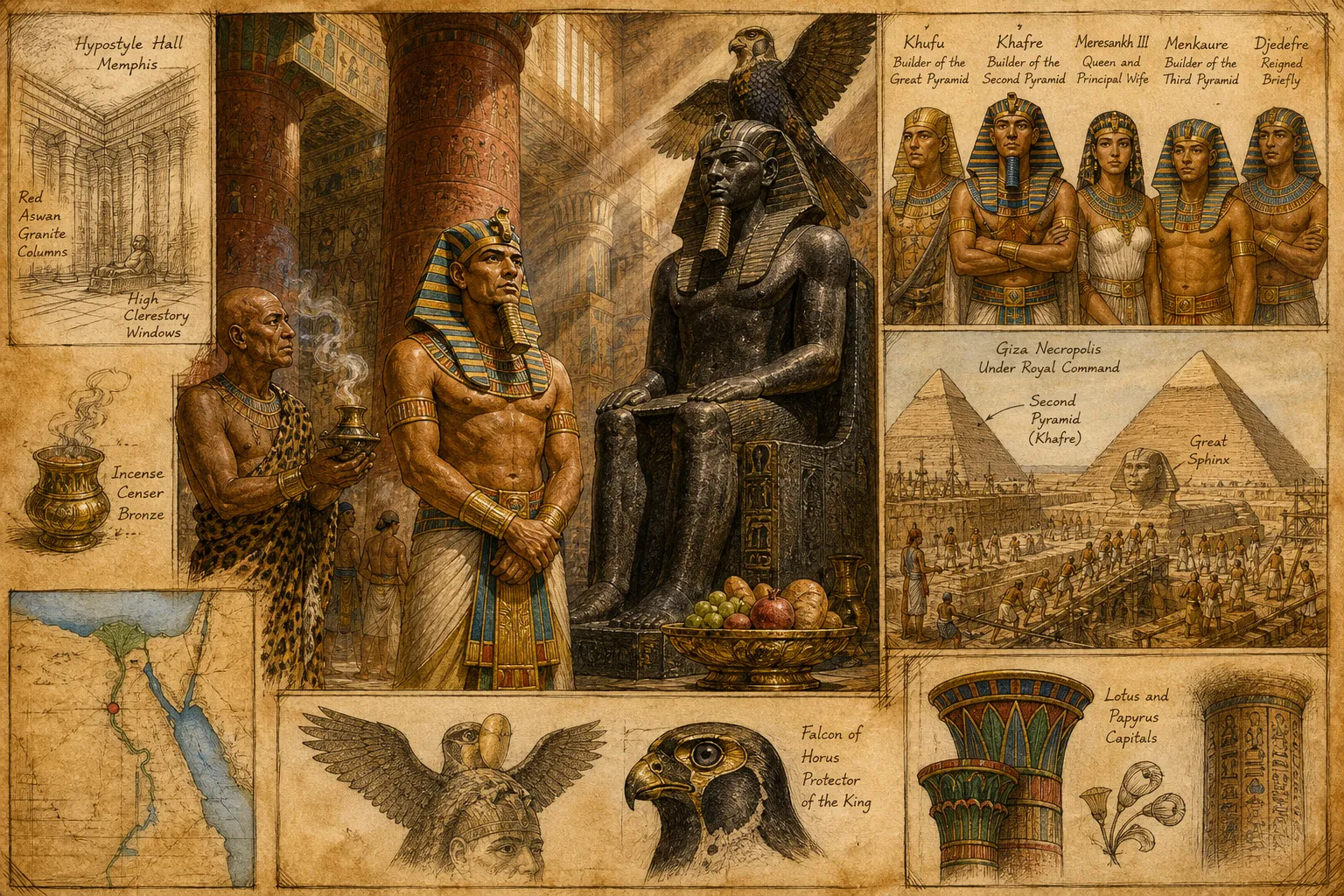
Within the heart of his newly completed Valley Temple, a place of profound stillness and polished stone, King Khafre participates in a solemn ceremony. The massive hall, constructed of gleaming red Aswan granite and pure alabaster, resonates with the low murmurs of priests and the distant drone of ritual chants. Khafre, clad in the full regalia of kingship, stands before a colossal statue of himself, carved from dark diorite, a falcon god Horus embracing his head. The High Priest of Ptah, a venerable man with a shaved head and a leopard-skin robe, offers incense, its sweet smoke curling towards the high, narrow clerestory windows. This ritual solidifies Khafre's divine status, presenting him as a living god, a manifestation of order and cosmic balance on earth. His presence here, amidst these monumental forms, merges man and deity, king and cosmos, for all eternity.
Page 7
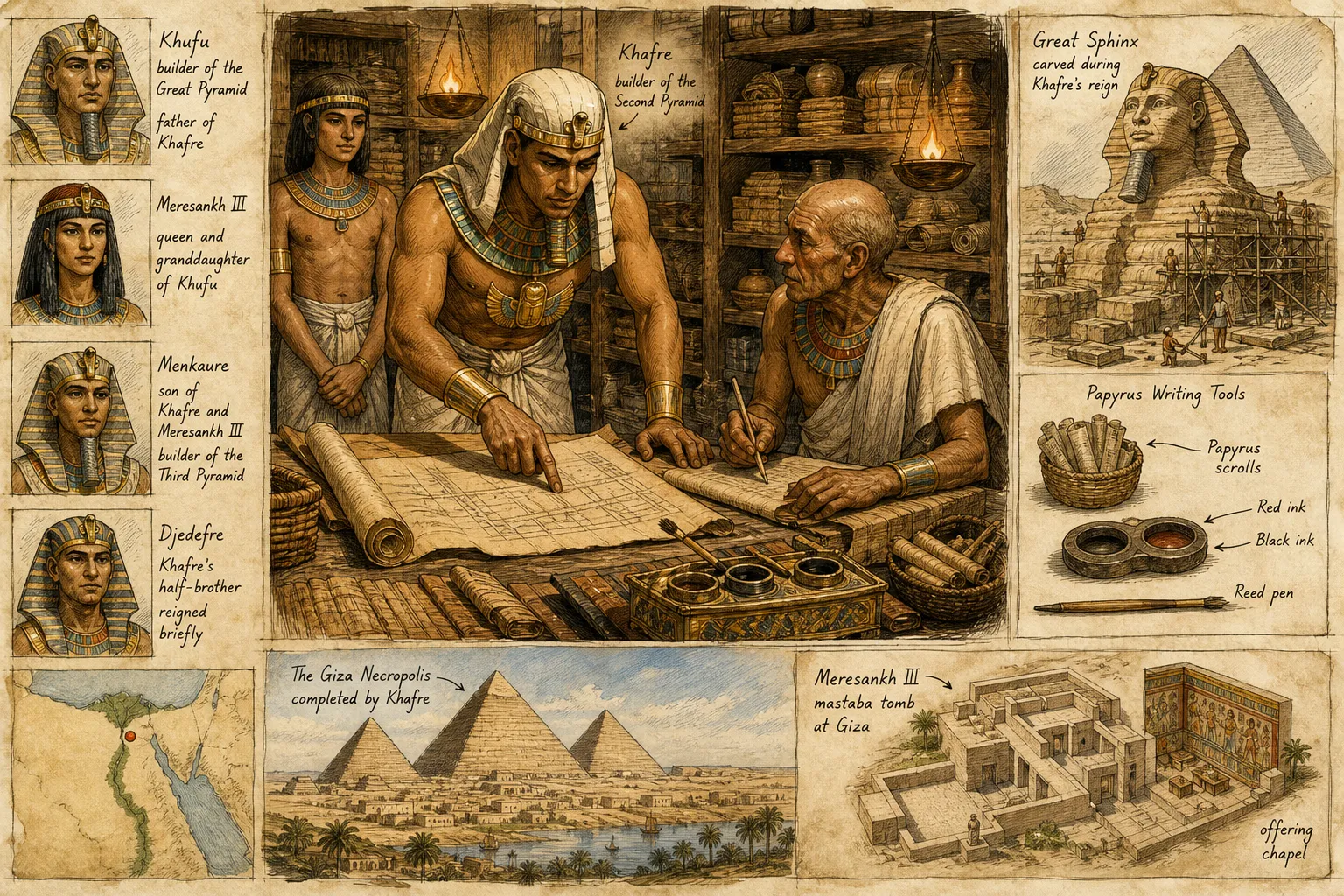
In a bustling scribe's office within the royal palace, the air is thick with the scent of papyrus and ink. King Khafre, now a seasoned ruler, leans over a low wooden table, examining a meticulously inscribed scroll. He instructs a senior royal scribe, a meticulous man with sharp eyes and calloused fingers, on the precise wording of a decree concerning the allocation of grain from the Delta. Young Prince Menkaure, a tall, serious youth now, stands a respectful distance behind his father, quietly observing the intricate dance of administration. He watches the scribe's swift hand, the careful unrolling of documents, the subtle power conveyed in his father's measured tones. This is the apprenticeship of kingship, learning the minutiae of governance that underpins the colossal structures and divine pronouncements. The future of Egypt rests not only on stone, but on the careful management of its earthly affairs.
Page 8
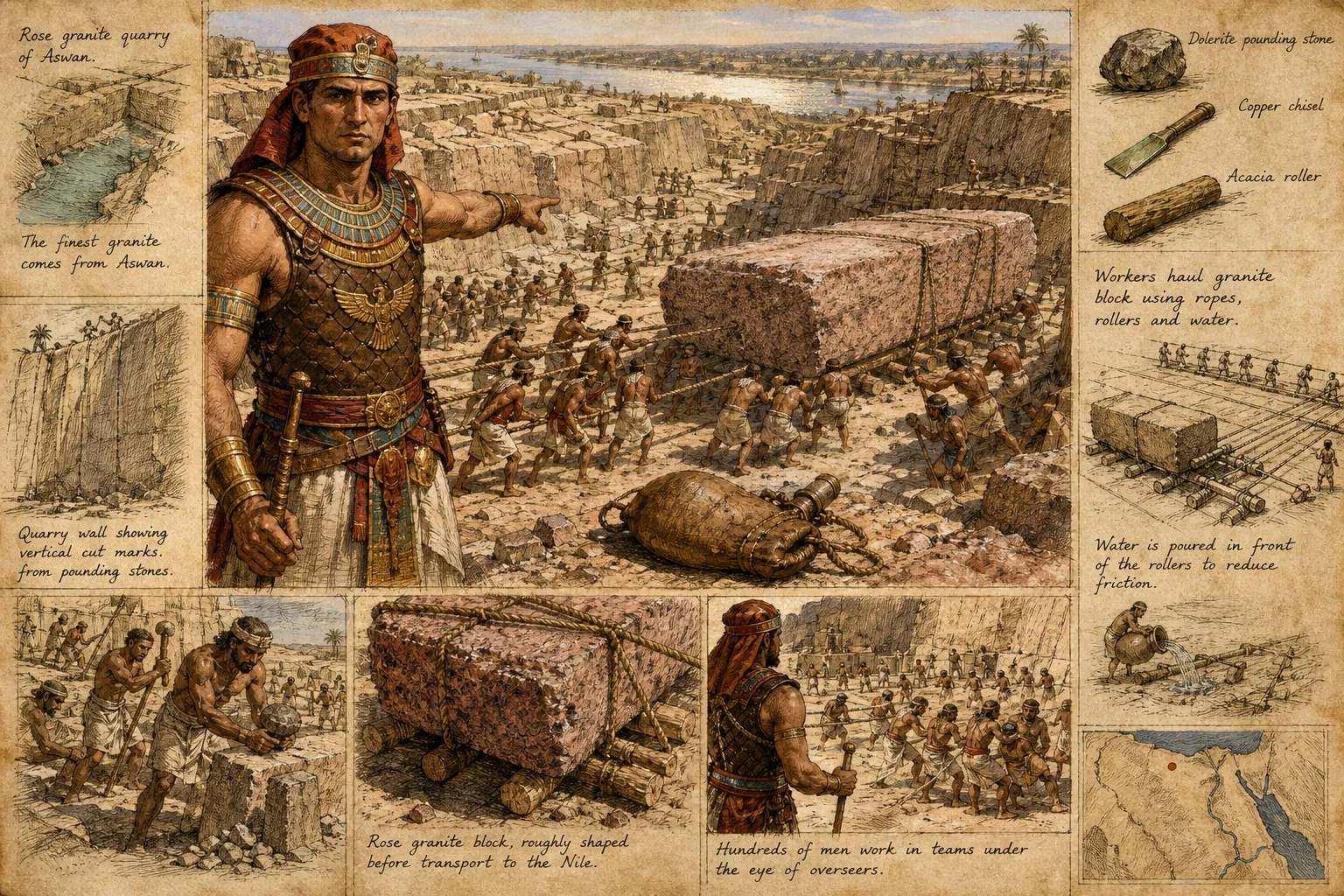
Far to the south, at the rugged granite quarries of Aswan, the relentless sun beats down on a scene of monumental human effort. Hundreds of laborers, their bodies slick with sweat, strain against thick ropes, attempting to dislodge a vast, newly cut block of rose granite from the bedrock. The air is filled with the dull thud of stone hammers and the sharp crack of wedges. A royal general, a stern-faced man in practical leather armor, oversees the brutal work, his gaze unforgiving. He carries the authority of King Khafre, ensuring the flow of precious material for the king's temples and statuary continues unabated. Each colossal block, destined for Giza, represents months of toil, countless lives spent, and the unyielding will of a pharaoh determined to build for eternity, regardless of the cost in human terms. This immense undertaking is the hidden foundation of Egypt's monumental splendor.
Page 9
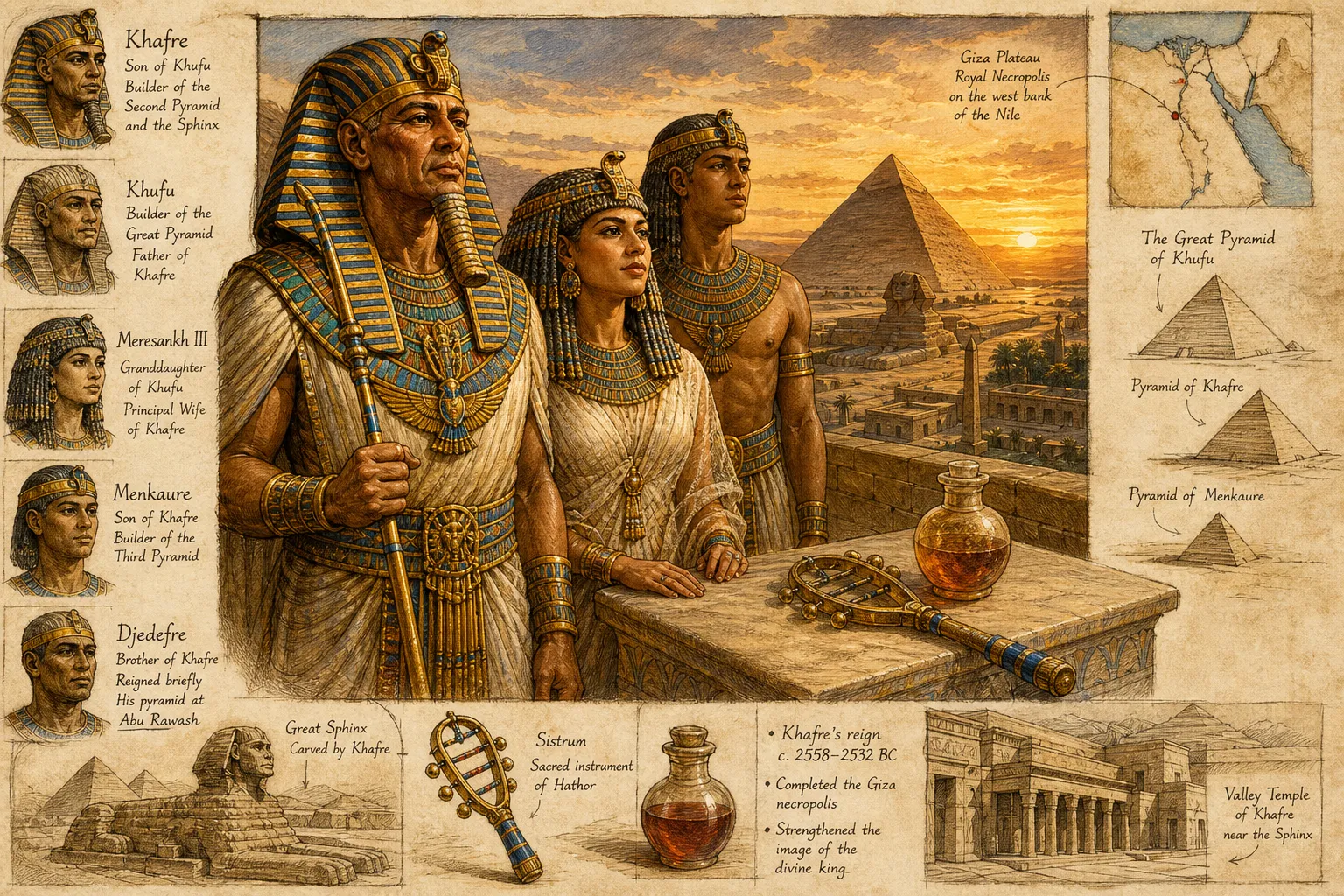
On a newly constructed terrace high on the Giza plateau, King Khafre, now older, his strong face etched with the wisdom of years, surveys his life's work. Before him stretches the colossal necropolis: his pyramid, perfectly aligned, the grandeur of its polished casing stones still visible at the apex; his mortuary and valley temples; and, most profoundly, the majestic Great Sphinx, its lion's body and human face gazing eternally eastward. Beside him stands Queen Meresankh III, her presence a quiet strength. Their son, Prince Menkaure, a man grown, stands with them, inheriting not just a throne, but a landscape forever altered by his father's vision. The sun begins its slow descent, bathing the desert and the monuments in a warm, golden light. This is the culmination of divine will and human endeavor, a testament to a king who dared to carve his image into the very fabric of the earth, an imperishable statement for all time.
Page 10
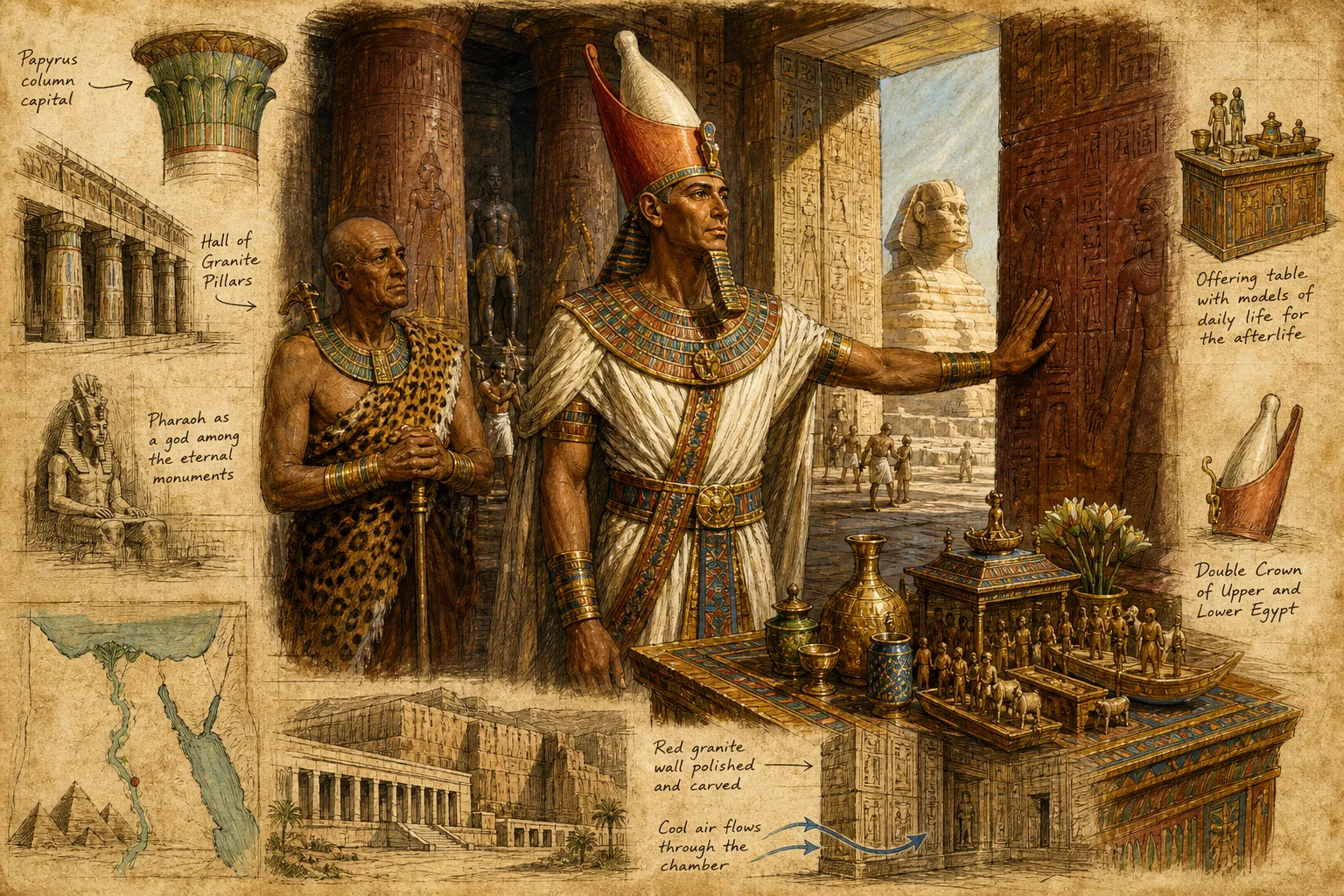
Years have passed since King Khafre joined the gods in the Field of Reeds. Now, King Menkaure, his son, stands within the silent, cool chambers of his father's mortuary temple. The vast, somber space, with its colossal red granite pillars, echoes with the soft rustle of a senior priest's leopard-skin robe. Menkaure touches a polished stone wall, a tangible link to the colossal ambition that shaped his reign. Beyond these sacred walls, the Great Sphinx stands sentinel, its gaze fixed on the eternal dawn, weathering the relentless desert winds. Khafre's monuments, more than mere tombs, are living statements of divine kingship, enduring long after the memories of men have faded. They continue to proclaim the power of the pharaoh, a colossal and unwavering legacy of the Old Kingdom, a testament to a king who carved eternity from stone.
About this story
- Audience: general readers
Read Wonder Egypt on your phone
Wonder Egypt is available on Android. Get Wonder Egypt on Google Play.