Tutankhamun
Tutankhamun — an illustrated history story. 10 illustrated pages, free to read on Wonder Egypt.
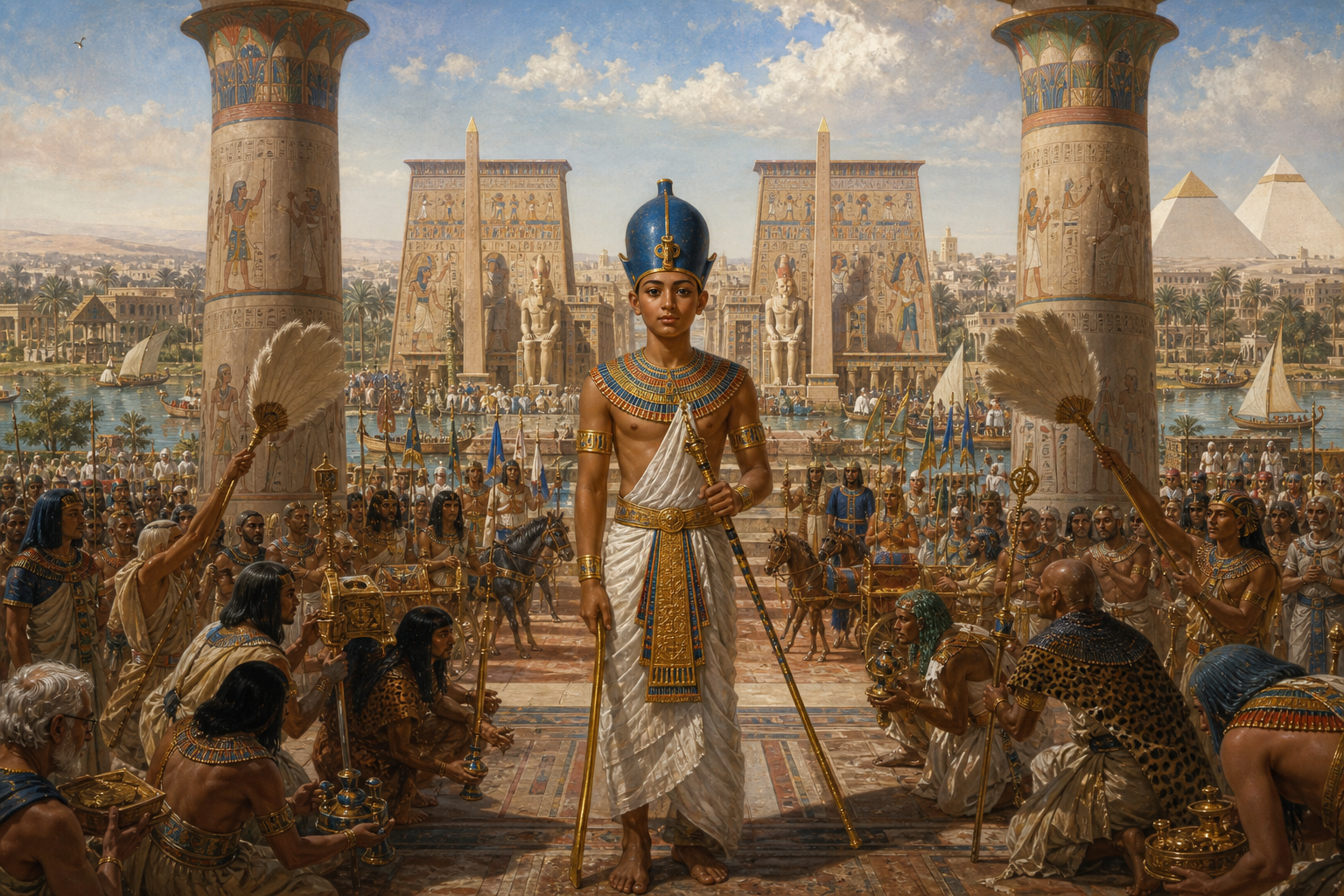
Page 1 — The Boy Who Became Pharaoh

In the year 1332 BC, a boy of about nine years old ascended to the throne of Egypt, inheriting from his illustrious but controversial predecessor, Akhenaten. The grand hall at Thebes, with its towering columns and intricate reliefs, buzzed with anticipation as courtiers whispered about the fragile boy-king, Tutankhamun, son of Akhenaten and possibly Kiya or Nebetah. His slight frame and frail health were evident, a poignant contrast to the weight of the crown he bore. His ascension marked a pivotal return to tradition, reinstating the polytheistic practices dismantled by his father. Under the watchful eyes of seasoned advisors like Ay, his trusted advisor and successor-in-waiting, and Horemheb, the formidable general, Tutankhamun embarked on a journey to heal the fractures in Egyptian society. His wife, Ankhesenamun, played a crucial role, navigating the complex alliances and influences within the court. Although his reign lasted just under a decade, the boy-king's legacy would transcend his time, immortalized by the discovery of his remarkably intact tomb, a treasure trove that captivated the modern world.
"We must restore what was lost," Ay urged, his eyes fixed on the young pharaoh. "The people need to see the gods in their rightful place."
Page 2 — Restoration of the Old Gods

With the reign of Tutankhamun came the reinstatement of the old gods, such as Amun, Osiris, and Ra, whose temples and statues had been desecrated during Akhenaten's rule. At the vast precincts of Karnak Temple, the air was filled with the scent of incense and the echoing chants of priests seeking to appease the deities. The young king, though frail and reliant on a cane, was a symbol of hope for a nation yearning for stability. Under the careful guidance of Ay and Horemheb, the arduous task of restoring these important religious symbols began in earnest. Scribes meticulously documented each divine decree, while artisans and laborers, clad in linen tunics, diligently chiseled and painted, repairing the damage inflicted during the Amarna period. The clink of tools and the low hum of prayer filled the air, as the sacred precinct bristled with activity, a testament to the resilience of a people eager to return to tradition.
"Bring the true faith back to the people," Horemheb commanded the artisans. "Let our temples shine once more in the glory of Amun."
Page 3 — The Queen's Counsel

Ankhesenamun, the queen and wife of Tutankhamun, was more than a figurehead in the palace. Her role as a partner in the affairs of state was crucial, especially during a time riddled with political challenges. Within the lush and secluded garden of the royal palace in Memphis, an oasis amid the city's heat, she and Tutankhamun often walked together, discussing the affairs of their realm. The fragrance of blooming lotus floated in the air, mingling with the melodies of distant flutes from the palace, creating a serene backdrop for their conversations. Her wisdom and political acumen were vital in maintaining the delicate balance between the old guards of power and the emerging new order. Clad in a simple yet elegant wrap-around dress, her hair adorned with gold bands, she moved with an air of grace and confidence. It was in these private moments, away from the prying eyes of the court, that they strategized on their kingdom's future, laying plans quietly in the verdant shade.
"Our enemies watch and wait," Ankhesenamun whispered. "We must show them unity and strength."
Page 4 — The General's Ambition

In the military camp set up beyond the banks of the Nile, General Horemheb stood surveying his troops with a keen eye. The vast expanse of the desert stretched out before him, a harsh and unforgiving landscape that tested the mettle of all who dared to traverse it. His eyes focused on the distant horizon where Egypt's enemies loomed as ominous shadows. Clad in a bronze cuirass over a linen tunic, the general's commanding presence was further enhanced by the aura of authority and ambition that surrounded him. The camp was a hub of activity, a small city of tents where soldiers sparred vigorously, preparing for the possibilities of war. Horses were readied, their harnesses gleaming in the sun. Wooden training swords clashed rhythmically, a testament to the discipline instilled within the ranks. Horemheb's loyalty to the young pharaoh was unwavering, yet he harbored aspirations of his own, visions of a future shaped by his hand. As the sun dipped low, casting long shadows across the encampment, he knew that Egypt's destiny might hinge upon the strength and cunning of its military might.
"Strength is the only currency our enemies understand," Horemheb declared, rallying his men. "Prepare yourselves, for Egypt marches forward."
Page 5 — The Treasures of the Treasury

Within the labyrinthine chambers of the treasury at Memphis, Maya, the fastidious overseer, devotedly inventoried the riches of Egypt. His role was pivotal, as the kingdom's wealth secured the stability essential for the numerous restorations initiated by Tutankhamun. The treasury was a realm of opulence, with rows of golden statues and intricately beaded necklaces laid with precision. Fine textiles in a myriad of colors and textures were stacked high, and Maya, in his tailored linen kilt and wide collar of lapis and gold, moved among them with practiced ease. His sharp eyes scanned papyrus scrolls listing the assets under his unwavering supervision. The clinking of gold resonated as artisans sorted treasures earmarked for the king's tomb, ensuring that not a single corner of the treasury was left unscrutinized. Sunlight streamed through narrow windows high above, casting stripes of light across the stone floors. In this solemn responsibility, Maya understood the profound weight of his duty. Each artifact, each piece of gold, was a testament to the resilience of a kingdom determined to reclaim its former glory.
"These treasures must speak of our king's greatness for centuries to come," Maya instructed the scribes. "Their placement is paramount."
Page 6 — The Tomb in the Valley

In the arid expanse of the Valley of the Kings, men labored with determination, their sweat testament to the toil required to carve the eternal resting place for Tutankhamun. The searing sun overhead was unforgiving, baking the limestone cliffs and the barren earth below. Here, amid the echoes of chisels striking stone, the tomb that would become the most famous in history took shape. Overseen by architects and laborers alike, each stroke of the chisel symbolized the gratitude and reverence the Egyptian people held for their young pharaoh. The artisans, clad in simple brown kilts and headcloths to ward off the sun's intensity, worked with relentless care. Their craft was not just for a king but for eternity, every hieroglyph etched with precision, narrating the journey that would carry Tutankhamun to the afterlife. Others applied vivid pigments, bringing to life scenes of gods and divine rites with vibrant color. The dust hung heavy in the air, a tangible reminder of the sweat and skill required in this sacred endeavor. As the sun dipped lower, long shadows stretched into the tomb, marking not only a place of death but a symbol of eternal life.
"Each stroke must honor him," directed the head scribe, "for this is his gateway to eternity."
Page 7 — The Return to Thebes

In the thriving city of Thebes, the air buzzed with anticipation as Tutankhamun and his entourage made their regal return. The city, richly adorned and vibrant with life, echoed with the jubilant sounds of celebration—music, cheers, and the lively calls of traders hawking their wares. Tutankhamun, seated regally on a gilded chariot, surveyed the city that symbolized both the spiritual and political heart of his realm. Dressed in state regalia, the young king donned the khepresh, a symbol of royal authority, with a gold cobra poised elegantly at the brow. Despite his slight figure and marked limp, he exuded the dignity and presence expected of a pharaoh. The procession was grand, a spectacle of opulence and unity, with attendants, musicians, and soldiers lining the streets in a display of loyalty and reverence. Thebes, with its towering temples and bustling market squares, stood as a testament to the enduring legacy of his efforts to restore faith and tradition. As the sun set, casting a golden glow across the city, it was clear that Tutankhamun's reign, though brief, had set a course for renewal and continuity, echoing the eternal cycle of life.
"Behold, Thebes!" Tutankhamun exclaimed, his voice young yet full of resolve. "A city reborn with the glory of the gods."
Page 8 — A Legacy Sealed in Gold

In the dimly lit chamber of the royal workshop, artisans labored tirelessly to complete the exquisite golden death mask of Tutankhamun, destined to become one of history's most famous artifacts. This icon, representing the pharaoh's serene and eternal visage, was a masterwork of artistry and devotion. Under the flickering light of oil lamps, craftsmen clad in simple white kilts polished and engraved the gold with meticulous care, ensuring every detail was executed to perfection. Inlays of lapis lazuli and turquoise were placed with precision, their rich hues adding depth and significance. The clinking of metal tools resonated through the stone chamber, a testament to the skill and dedication of those who toiled. The mask's serene expression captured the young king's essence, a visage of peace after a life of privilege intertwined with burden. The air was rich with the smell of heated metal and beeswax, building the aura of sacred creation. As the artisans applied the finishing touches, it became clear that this creation would not only honor Tutankhamun but also serve as his eternal guard, immortalizing him for the ages.
"Every detail must be perfect," instructed the master craftsman. "This mask will guard him in the afterlife."
Page 9 — A King's End and an Empire's Wake

The court of Egypt gathered in hushed tones as the news of Tutankhamun's sudden death spread through the halls of the royal palace in Amarna. At just nineteen, the boy king's reign had come to an abrupt end, leaving many to ponder the mysteries shrouding his demise—was it a tragic accident or something more sinister? The implications for the kingdom's future weighed heavily on the minds of his advisors and officials, including Ay and Horemheb, as they convened to deliberate their next steps. The air in the grand hall was thick with the scent of incense, a somber accompaniment to the tense discussions unfolding. Courtiers dressed in somber attire consulted ancient scrolls, their voices hushed and solemn as they debated the succession. The slight form of the king now lay at rest, a poignant reminder of the fleeting nature of life and power. As the sun set, casting long shadows across the palace, the question lingered: what would become of the legacy that Tutankhamun had begun to build, and how would Egypt navigate the uncertainties that lay ahead?
"His death leaves a void," Ay lamented. "But we must ensure that his vision for Egypt endures."
Page 10 — Immortality in the Valley of the Kings

Long after his brief reign ended, Tutankhamun's name emerged from the sands of time to captivate the modern world through the remarkable discovery of his tomb. In the Valley of the Kings, a place of whispers and echoes of the past, British archaeologist Howard Carter unveiled the untouched resting place of the young pharaoh in 1922. As the sealed stone door was painstakingly breached, treasures beyond imagination were revealed to the astonished eyes of the world, preserving the legacy of a king whose life had seemed almost forgotten. Gold, jewels, and artifacts lay within, each piece telling a story of ancient Egypt's grandeur and its people's devotion. The discovery reverberated around the globe, resurrecting Tutankhamun's image as a symbol of ancient opulence and mystery. His intact tomb, a time capsule of the New Kingdom's glory, offered an unparalleled glimpse into the distant past, captivating historians and laypeople alike. The young pharaoh's afterlife journey, meticulously crafted by artisans of a bygone era, was immortalized not only by his artful burial but by the enduring fascination his life, death, and resurrection commanded on the world stage.
"I see wonderful things," Carter reportedly murmured, peering into the mystery of the tomb.
About this story
- Audience: general readers
Read Wonder Egypt on your phone
Wonder Egypt is available on Android. Get Wonder Egypt on Google Play.