The Battle of Gettysburg (1863, USA)

The Battle of Gettysburg (1863, USA) — an illustrated history story, featuring George Meade, Jefferson Davis, Robert E. Lee, set in USA. 10 illustrated pages, free to read on Wonder History.
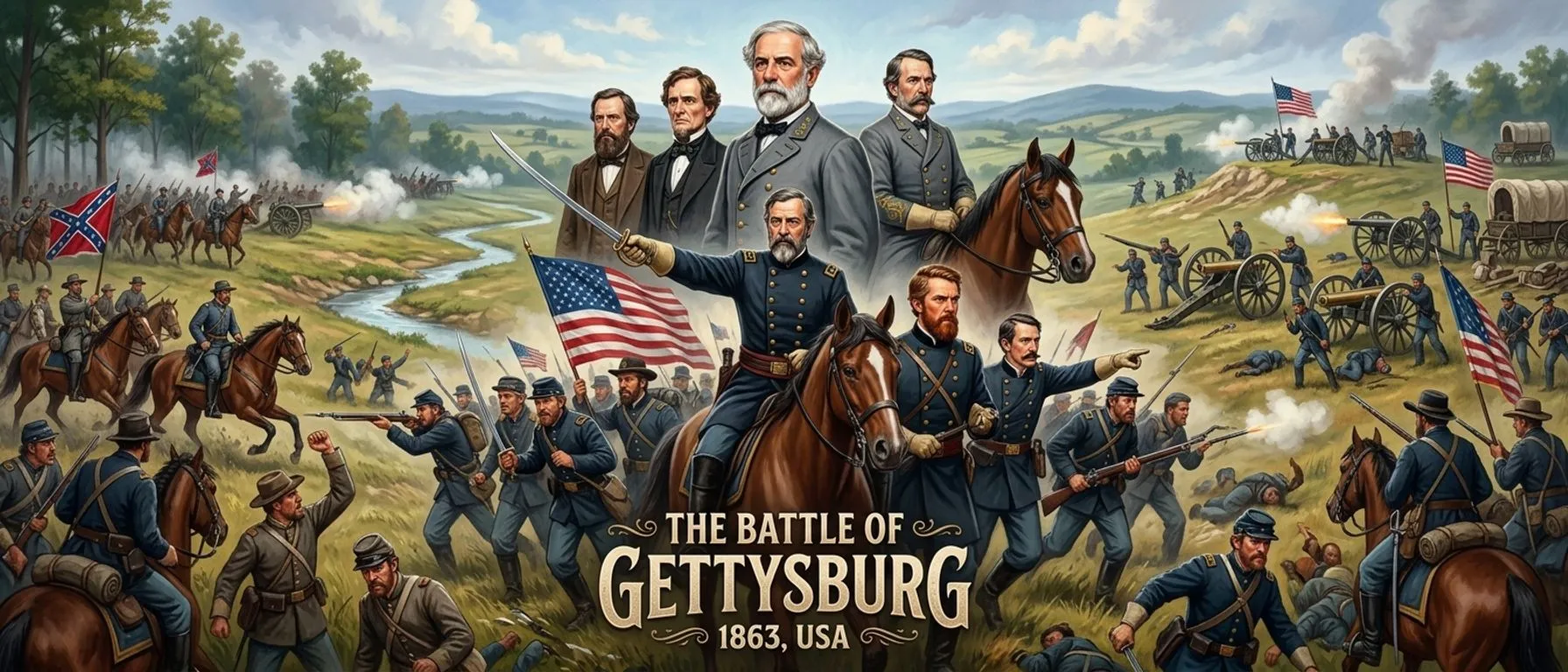
The Battle of Gettysburg (1863, USA) — book cover — Wonder History
The Battle of Gettysburg (1863, USA) — an illustrated history story, featuring George Meade, Jefferson Davis, Robert E. Lee, set in USA. 10 illustrated pages, free to read on Wonder History.

Page 1

Union cannons roared across the fields, tearing through Confederate lines. Soldiers fell on both sides, the air thick with smoke and the screams of the wounded.
Union cannons roared across the fields, tearing through Confederate lines. Soldiers fell on both sides, the air thick with smoke and the screams of the wounded. How did these rolling hills of Pennsylvania become a graveyard for so many?

Union cannons roared across the fields, tearing through Confederate lines. Soldiers fell on both sides, the air thick with smoke and the screams of the wounded. How did these rolling hills of Pennsylvania become a graveyard for so many?

Page 2

Months earlier, Jefferson Davis addressed the Confederate Congress in Richmond. "We seek no conquest, nor do we desire to uproot or disturb any institution of…
Months earlier, Jefferson Davis addressed the Confederate Congress in Richmond. "We seek no conquest, nor do we desire to uproot or disturb any institution of this continent," he proclaimed, his voice ringing with conviction. Yet, beneath the surface of political rhetoric, the Confederacy was struggling, and a bold move was needed. "General Lee, the fate of our nation rests upon your shoulders," Davis said, his eyes filled with desperation, as he handed Lee his orders.

Months earlier, Jefferson Davis addressed the Confederate Congress in Richmond. "We seek no conquest, nor do we desire to uproot or disturb any institution of this continent," he proclaimed, his voice ringing with conviction. Yet, beneath the surface of political rhetoric, the Confederacy was struggling, and a bold move was needed. "General Lee, the fate of our nation rests upon your shoulders," Davis said, his eyes filled with desperation, as he handed Lee his orders.

Page 3

General John Buford, scouting ahead of the Union army, surveyed the crossroads town of Gettysburg. "This ground is key," he muttered to his aide, his gaze…
General John Buford, scouting ahead of the Union army, surveyed the crossroads town of Gettysburg. "This ground is key," he muttered to his aide, his gaze sweeping across the rolling hills. "If we lose this, we lose the high ground. They shall not pass!" Buford ordered his men to dig in and prepare for the inevitable assault. He knew they would face the enemy's advance in the morning.

General John Buford, scouting ahead of the Union army, surveyed the crossroads town of Gettysburg. "This ground is key," he muttered to his aide, his gaze sweeping across the rolling hills. "If we lose this, we lose the high ground. They shall not pass!" Buford ordered his men to dig in and prepare for the inevitable assault. He knew they would face the enemy's advance in the morning.

Page 4

Robert E. Lee, confident in his army's past victories, dismissed General James Longstreet's cautious advice. "The enemy is there, and I am going to attack him…
Robert E. Lee, confident in his army's past victories, dismissed General James Longstreet's cautious advice. "The enemy is there, and I am going to attack him there," Lee declared, pointing at the Union lines on Cemetery Ridge. Longstreet, a stout man in his early 40s with a full beard and a determined expression, argued for a strategic maneuver.

Robert E. Lee, confident in his army's past victories, dismissed General James Longstreet's cautious advice. "The enemy is there, and I am going to attack him there," Lee declared, pointing at the Union lines on Cemetery Ridge. Longstreet, a stout man in his early 40s with a full beard and a determined expression, argued for a strategic maneuver. "We should move around and force them to attack us, General!" he responded, his voice filled with urgency, but Lee would not be swayed.

Page 5

As the sun rose on July 2nd, fierce fighting erupted on Little Round Top. Colonel Joshua Chamberlain, commanding the 20th Maine, found his regiment at the far…
As the sun rose on July 2nd, fierce fighting erupted on Little Round Top. Colonel Joshua Chamberlain, commanding the 20th Maine, found his regiment at the far left of the Union line. "We are facing the enemy, boys. We are facing the enemy!" Chamberlain shouted. His men, outnumbered and running low on ammunition, braced for a desperate defense.

As the sun rose on July 2nd, fierce fighting erupted on Little Round Top. Colonel Joshua Chamberlain, commanding the 20th Maine, found his regiment at the far left of the Union line. "We are facing the enemy, boys. We are facing the enemy!" Chamberlain shouted. His men, outnumbered and running low on ammunition, braced for a desperate defense.

Page 6

With their ammunition exhausted, Chamberlain made a fateful decision. "Bayonets!" he roared, his voice hoarse from shouting.
With their ammunition exhausted, Chamberlain made a fateful decision. "Bayonets!" he roared, his voice hoarse from shouting. "Charge!" The 20th Maine surged down the hill in a desperate bayonet charge, catching the Confederates by surprise. The rebel yell echoed through the trees as the two sides clashed in a bloody melee. The hill became a scene of carnage, with the fate of the battle hanging in the balance.

With their ammunition exhausted, Chamberlain made a fateful decision. "Bayonets!" he roared, his voice hoarse from shouting. "Charge!" The 20th Maine surged down the hill in a desperate bayonet charge, catching the Confederates by surprise. The rebel yell echoed through the trees as the two sides clashed in a bloody melee. The hill became a scene of carnage, with the fate of the battle hanging in the balance.

Page 7

On July 3rd, General Lee ordered a massive assault on the center of the Union line: Pickett's Charge. As thousands of Confederates advanced across the open…
On July 3rd, General Lee ordered a massive assault on the center of the Union line: Pickett's Charge. As thousands of Confederates advanced across the open field, General George Meade watched from Cemetery Ridge. "They are coming. They are coming," he said calmly to his staff, his face grim. Meade ordered his artillery to open fire, unleashing a storm of iron upon the advancing Confederate ranks.

On July 3rd, General Lee ordered a massive assault on the center of the Union line: Pickett's Charge. As thousands of Confederates advanced across the open field, General George Meade watched from Cemetery Ridge. "They are coming. They are coming," he said calmly to his staff, his face grim. Meade ordered his artillery to open fire, unleashing a storm of iron upon the advancing Confederate ranks.

Page 8

The Confederate assault faltered under the intense Union fire. Soldiers fell by the hundreds, their dreams of victory turning into a nightmare.
The Confederate assault faltered under the intense Union fire. Soldiers fell by the hundreds, their dreams of victory turning into a nightmare. As the survivors retreated, General Lee, witnessing the carnage, cried out, "It is all my fault!" He knew that this defeat would forever alter the course of the war.

The Confederate assault faltered under the intense Union fire. Soldiers fell by the hundreds, their dreams of victory turning into a nightmare. As the survivors retreated, General Lee, witnessing the carnage, cried out, "It is all my fault!" He knew that this defeat would forever alter the course of the war.

Page 9

After the battle, Abraham Lincoln visited the Gettysburg battlefield. Standing amidst the graves, he delivered a powerful address.
After the battle, Abraham Lincoln visited the Gettysburg battlefield. Standing amidst the graves, he delivered a powerful address. "'The world will little note, nor long remember what we say here, but it can never forget what they did here,'" Lincoln declared, quoting himself from the Gettysburg Address. His words, etched in stone, would inspire generations to come.

After the battle, Abraham Lincoln visited the Gettysburg battlefield. Standing amidst the graves, he delivered a powerful address. "'The world will little note, nor long remember what we say here, but it can never forget what they did here,'" Lincoln declared, quoting himself from the Gettysburg Address. His words, etched in stone, would inspire generations to come.

Page 10

Gettysburg proved to be a turning point. The Union victory shattered Confederate morale and momentum. Though the war would rage on for two more years, the…
Gettysburg proved to be a turning point. The Union victory shattered Confederate morale and momentum. Though the war would rage on for two more years, the Confederacy's chances of success dwindled after that fateful battle. History, indeed, had been written on the fields of Gettysburg.

Gettysburg proved to be a turning point. The Union victory shattered Confederate morale and momentum. Though the war would rage on for two more years, the Confederacy's chances of success dwindled after that fateful battle. History, indeed, had been written on the fields of Gettysburg.

About this story

  • Historical figures: George Meade, Jefferson Davis, Robert E. Lee
  • Location: USA
  • Period: Modern
  • Audience: general readers

Questions and answers

Questions and answers about The Battle of Gettysburg (1863, USA)

Read Wonder History on your phone

Wonder History is available on Android. Get Wonder History on Google Play.

More Wonder History stories

All Wonder History stories · Open the library