The Battle of Midway (1942, United States)
The Battle of Midway (1942, United States) — an illustrated history story, featuring Admiral Chester Nimitz, Admiral Isoroku Yamamoto, Admiral Chūichi Nagumo, set in United States. 10 illustrated pages, free to read on Wonder History.
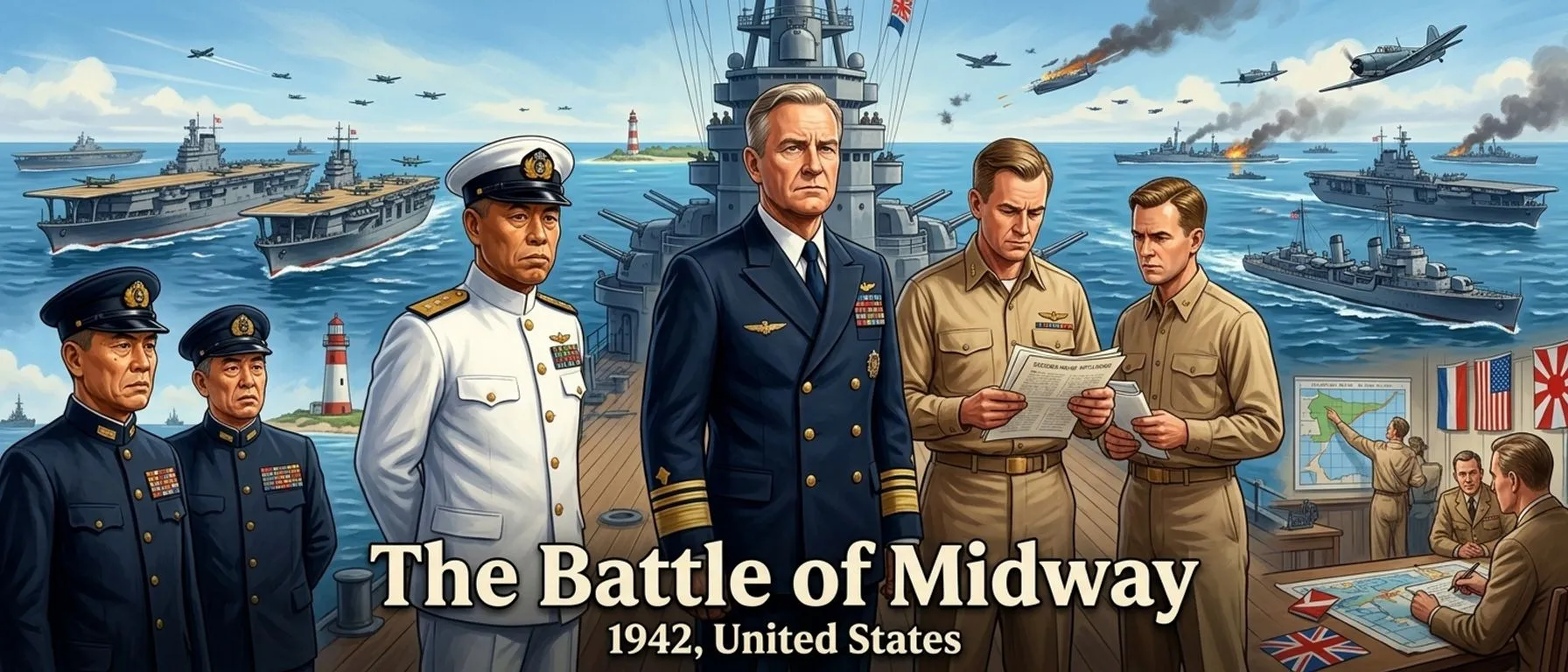
Page 1

In the vast expanse of the Central Pacific, during the spring of 1942, the fate of nations hung precariously. The United States, a rising naval power, watched its vulnerable outposts and distant territories, while the formidable Imperial Japanese Navy sought to expand its dominance across the ocean. On the isolated atoll of Midway, a vital American military base and a lonely lighthouse stood sentinel, its beam sweeping across waters that would soon witness a pivotal confrontation. This remote island was about to become the crucible where the future of the Pacific theater would be forged, ultimately shifting the balance of power decisively.
Page 2

Aboard his flagship, Yamato, Admiral Isoroku Yamamoto, a dignified man in his late 50s with thinning black hair slicked back, meticulously tailored white uniform, and piercing dark eyes, addressed his senior officers with grave intensity. "Our strike on Pearl Harbor has awakened a sleeping giant," he declared, gesturing firmly at a detailed naval chart spread across the table. "I fear all we have done is to awaken a sleeping giant and fill him with a terrible resolve." His strategy was clear: lure the depleted American fleet into a decisive battle near Midway Atoll, crushing their remaining carrier strength.
Page 3

Miles away, within the lonely lighthouse structure adapted as Station Hypo, Commander Joseph Rochefort, a focused man in his early 40s with unruly dark brown hair and plain khaki naval work uniform, hunched over a cluttered desk, peering through thick spectacles. "The Japanese have changed their codes, but the patterns remain," he muttered, pushing another stack of decoded intercepts towards his Intelligence Officer, a young man in his early 30s with neatly combed black hair, wearing a clean khaki naval work uniform. "We've noticed a recurring reference to 'AF', but its true meaning remains veiled. This variable is crucial to their next move."
Page 4

"We must confirm 'AF' is Midway," Rochefort announced, looking up from his notes, his eyes sharp behind his spectacles. "Send an unencrypted message reporting a critical water distillation plant failure on Midway Atoll; mention the island needs fresh water immediately." The Intelligence Officer, his expression alert, quickly scribbled down the directive. Within hours, Japanese intercepts carried a new message: "AF is short of water," revealing their target with undeniable clarity.
Page 5

In the underground command center at Pearl Harbor, Admiral Chester Nimitz, a stern-faced man in his late 50s, average height, fit build, with neat, short gray hair, listened intently to Commander Rochefort's detailed report. "So, 'AF' is indeed Midway, and their attack force is massive," Nimitz stated, his thoughtful expression firm as he looked at a large tactical map. "Our intelligence has granted us a crucial advantage; we will use it to adapt. We must deploy our remaining carrier fleet to surprise them, despite our numerical inferiority."
Page 6

Meanwhile, Admiral Chūichi Nagumo, a weary man in his early 50s with short, receding black hair, paced the deck of his flagship, Akagi, as his mighty carrier strike force steamed confidently towards Midway. "Our planes will eliminate their defenses, then devastate the island's installations," Nagumo explained to an Imperial Navy Officer standing rigidly beside him. "There is no sign of the American fleet, confirming our surprise. We hold the initiative in this engagement."
Page 7

On the morning of June 4th, the first wave of Japanese planes launched their devastating attack on Midway Atoll. American scout planes, however, spotted Nagumo's carriers far earlier than anticipated, forcing Admiral Nimitz's carriers to launch their aircraft. "The enemy must be caught off guard!" shouted a US pilot over his radio, as waves of American torpedo bombers and dive bombers streaked towards the Japanese fleet, suffering brutal losses from anti-aircraft fire and Zero fighters.
Page 8

As Nagumo wrestled with re-arming his planes with land-attack bombs, critical intelligence of American carriers finally reached him. "Reverse course! Re-arm with anti-ship ordnance immediately!" he commanded, his voice strained. Yet, it was too late. American dive bombers, having endured heavy losses, descended from the clear skies above. They found the Japanese carriers Akagi, Kaga, and Soryu with fuel lines exposed and bombs stacked on deck, triggering massive explosions that tore through the ships.
Page 9

Admiral Nagumo, his face etched with despair, watched from a destroyer as his once-mighty carriers became infernos. "Our glorious fleet, decimated!" he cried, slamming his fist against a railing, while the Imperial Navy Officer beside him stood in stunned silence. Admiral Nimitz, receiving the news at Pearl Harbor, merely nodded, his resolve firm. "Press the advantage; the fight is far from over, but the tide has turned. Every man fought with exceptional bravery and skill."
Page 10

The Battle of Midway, fought from June 4th to 7th, 1942, proved to be the turning point of the Pacific War. With four of its fleet carriers lost, the Imperial Japanese Navy suffered a catastrophic blow from which it would never fully recover. The decisive American victory, fueled by exceptional intelligence and courageous execution, shifted the strategic initiative to the Allies. The lonely lighthouse on Midway, once a mere beacon, now stood as a silent testament to the ingenuity and sacrifice that altered the course of history, its light forever symbolizing the dawn of a new era in the Pacific.
About this story
- Historical figures: Admiral Chester Nimitz, Admiral Isoroku Yamamoto, Admiral Chūichi Nagumo
- Location: United States
- Period: Modern
- Audience: kids (ages 6–12)
Questions and answers
Questions and answers about The Battle of Midway (1942, United States)
Read Wonder History on your phone
Wonder History is available on Android. Get Wonder History on Google Play.