The Long Walk of the Navajo (1864)
The Long Walk of the Navajo (1864) — a history story. 10 illustrated pages, narrated, free to read on Wonder History.
Page 1
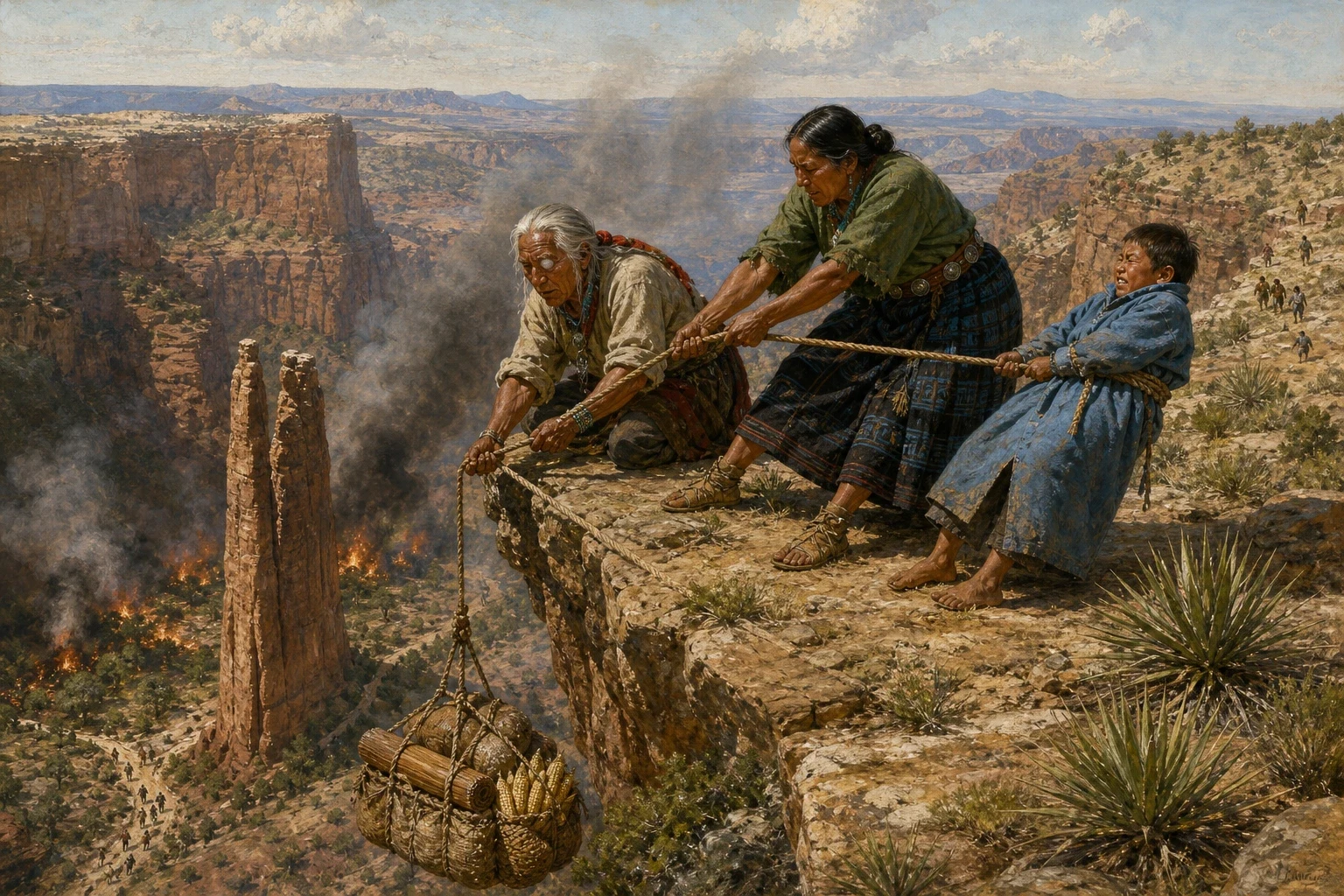
The old man knelt at the rim with his knotted hands wrapped twice around the yucca rope, feeding it inch by inch over the lip of stone. Below, Spider Rock rose twin-spired out of the gorge, and past it, eight hundred feet down the canyon floor, black smoke boiled off the peach orchards the soldiers had put to the torch. Asdzą́ą́ Nez braced her broad shoulders against a boulder, hauling the slack taut as the bundle — seed corn, her half-finished loom, two wool sacks — swung and scraped against the cliff face. Hashké clung to the rope's end where it was lashed around his waist, bare feet skidding on gravel, leaning his whole small weight back to hold the line steady. The bundle dropped another body-length, caught the wind, spun, and knocked against the rock with a soft thud before settling into the dark crevice. Hastiin Tsosie's milky eye caught the firelight rising off the valley as he grunted the rope lower, inch by inch, until it went slack in his hands.
Page 2
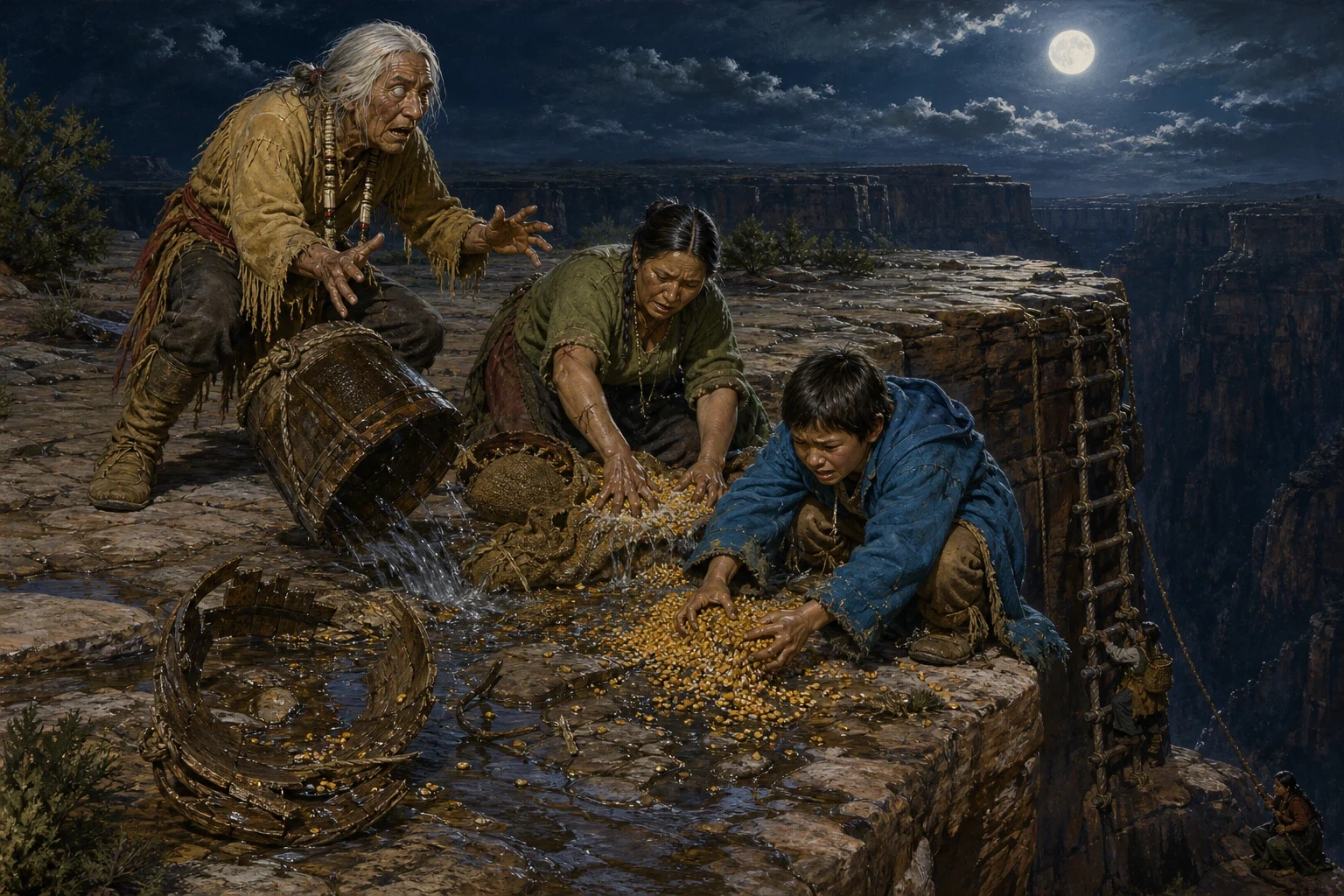
The ladders ran up the cliff face in a crooked chain, cottonwood poles lashed with yucca cord, each rung worn slick. Hastiin Tsosie stood braced at the lip, passing buckets hand over hand from the climber below him to his daughter. Asdzą́ą́ Nez's arms shook with each weight but she did not stop, swinging bucket after bucket across the gap to Hashké, who crouched by the corn sacks, reaching up to catch them against his chest. The moon lit the canyon in cold silver, eight hundred feet of empty air below the ladder's last lashed rung. Then a slick-wet handle twisted in the old man's grip. The bucket dropped, spun once, and slammed against the rock ledge, bursting into staves and spraying water across the last dry corn sacks before anyone could grab them back. Hashké lunged, hands scrabbling at the soaked burlap, but the damage was done. Asdzą́ą́ Nez dropped to her knees beside him, pulling the sacks open, feeling the grain already swelling wet.
Page 3
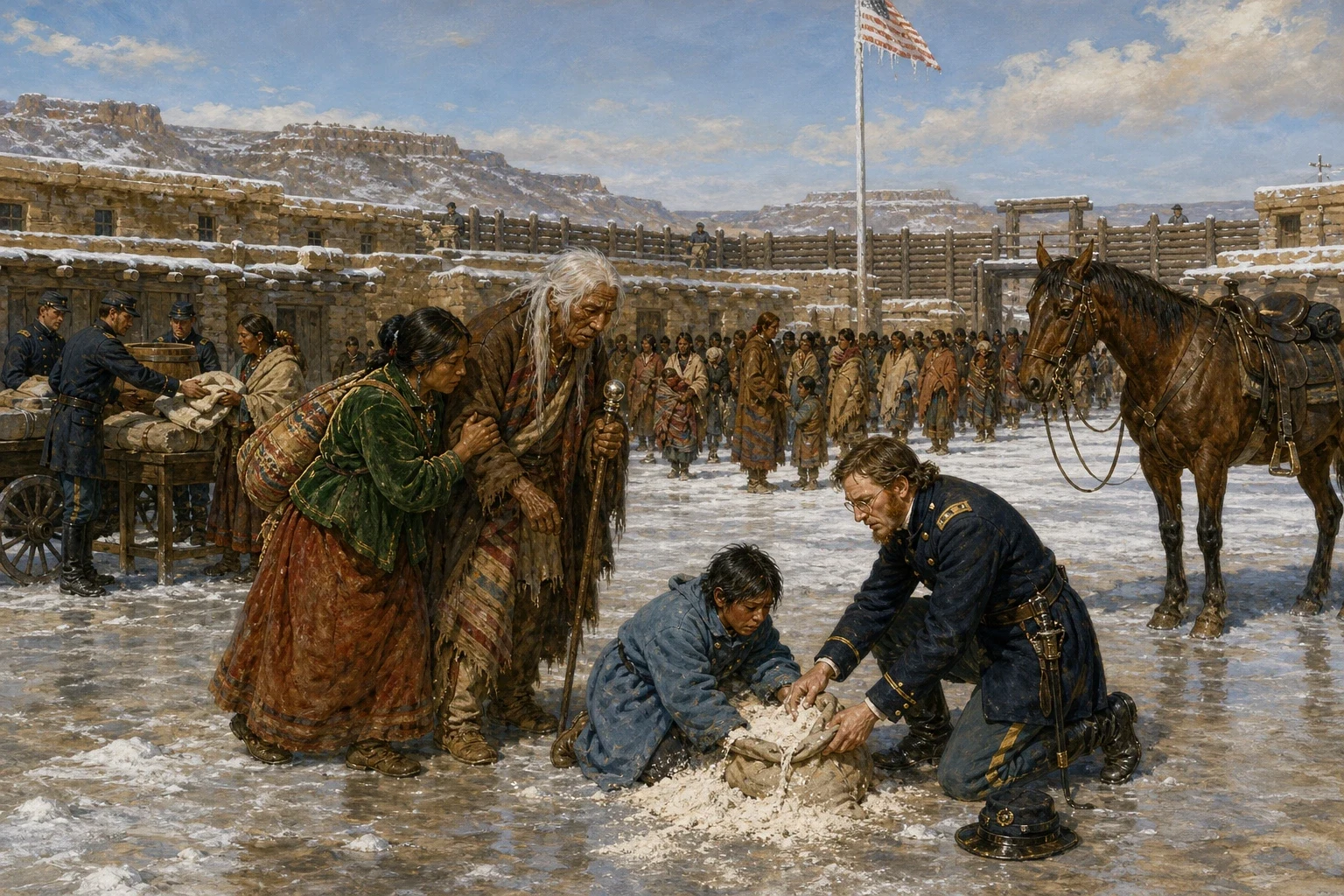
They came down out of the rocks with their ribs showing, and the fort swallowed them into a line of hundreds shuffling past frozen adobe walls toward the ration tables. The flagpole stood stiff with ice, its rope frozen into a white rod. Hastiin Tsosie leaned hard on his staff, each step a small collapse he caught himself from. Asdzą́ą́ Nez gripped his elbow, steadying him over the ruts. Ahead, Hashké bent double, dragging a flour sack twice his own size across the frozen ground, heels skidding, arms shaking with the weight. The sack caught on a frozen rut and burst, flour exploding upward in a pale cloud, scattering white across the black ice. Hashké dropped to his knees with a cry, clawing at the spilling grain. Lieutenant Bram swung down off his horse before it had fully stopped, boots cracking the crust, and dropped to his knees beside the boy, scooping flour back into the torn sack with his bare hands, packing it tight despite the cold biting his skin raw.
Page 4
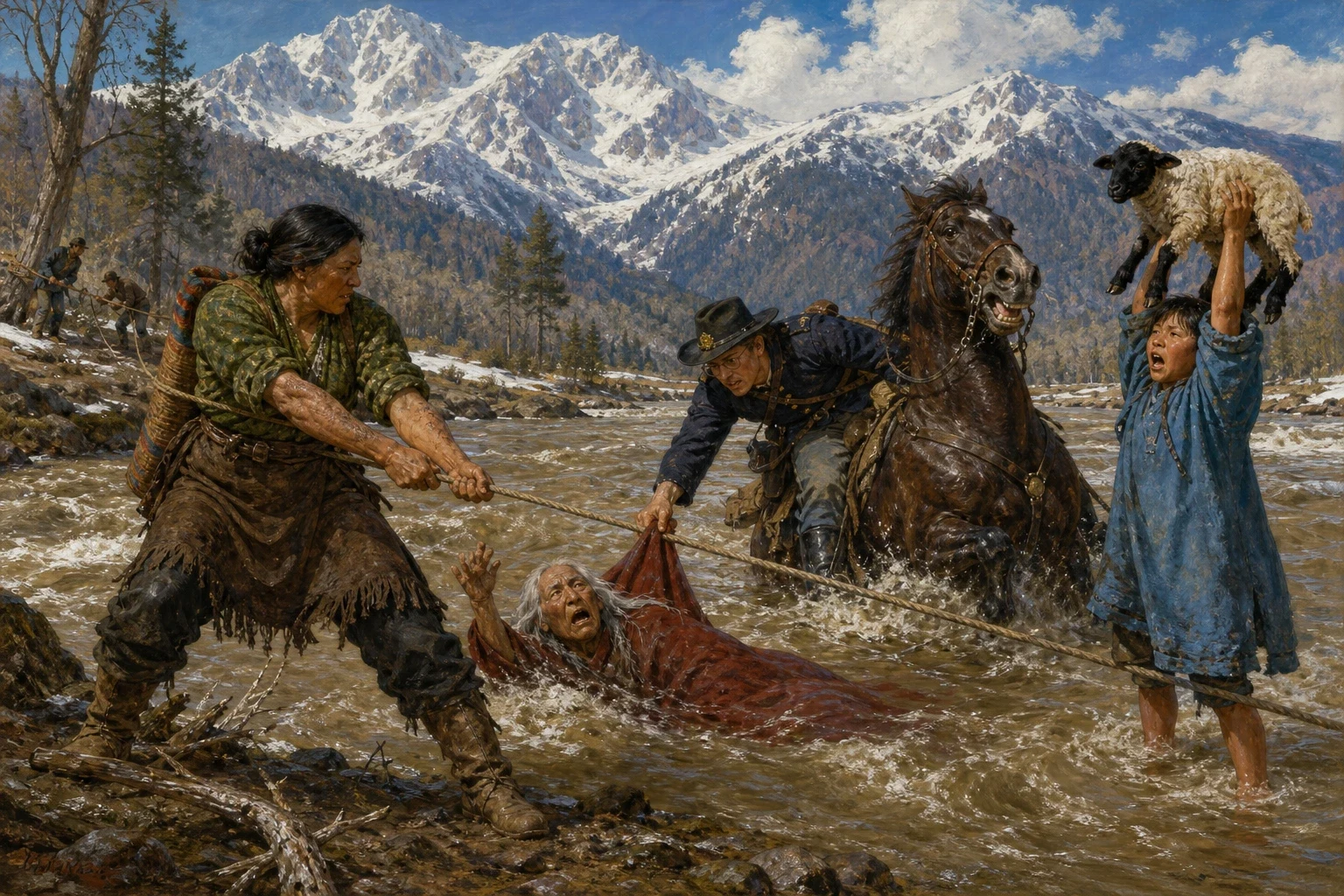
The rope spanned the Río Grande bank to bank, chest-deep with snowmelt the color of iron. Hastiin Tsosie gripped it with both gnarled hands, but a surge of current rolled over his shoulders and tore his feet from the gravel bed. He went under, blanket ballooning, staff lost downstream in an instant. Asdzą́ą́ Nez screamed his name and threw her whole weight back on the rope, her scarred forearm cording tight, boots digging furrows in the mud of the bank. Bram wheeled his horse without a word and drove it crashing into the current, water exploding white around the animal's chest, leaning low from the saddle to hook two fingers into the sodden wool of the old man's blanket. Hashké stood frozen at the shallows only a breath, then hoisted the bleating lamb high over his head, out of the spray, shouting encouragement he could not even hear over the roar. The horse staggered, found footing, and dragged the old man coughing toward the bank, where Asdzą́ą́ Nez fell to her knees hauling the rope the last body-length in.
Page 5
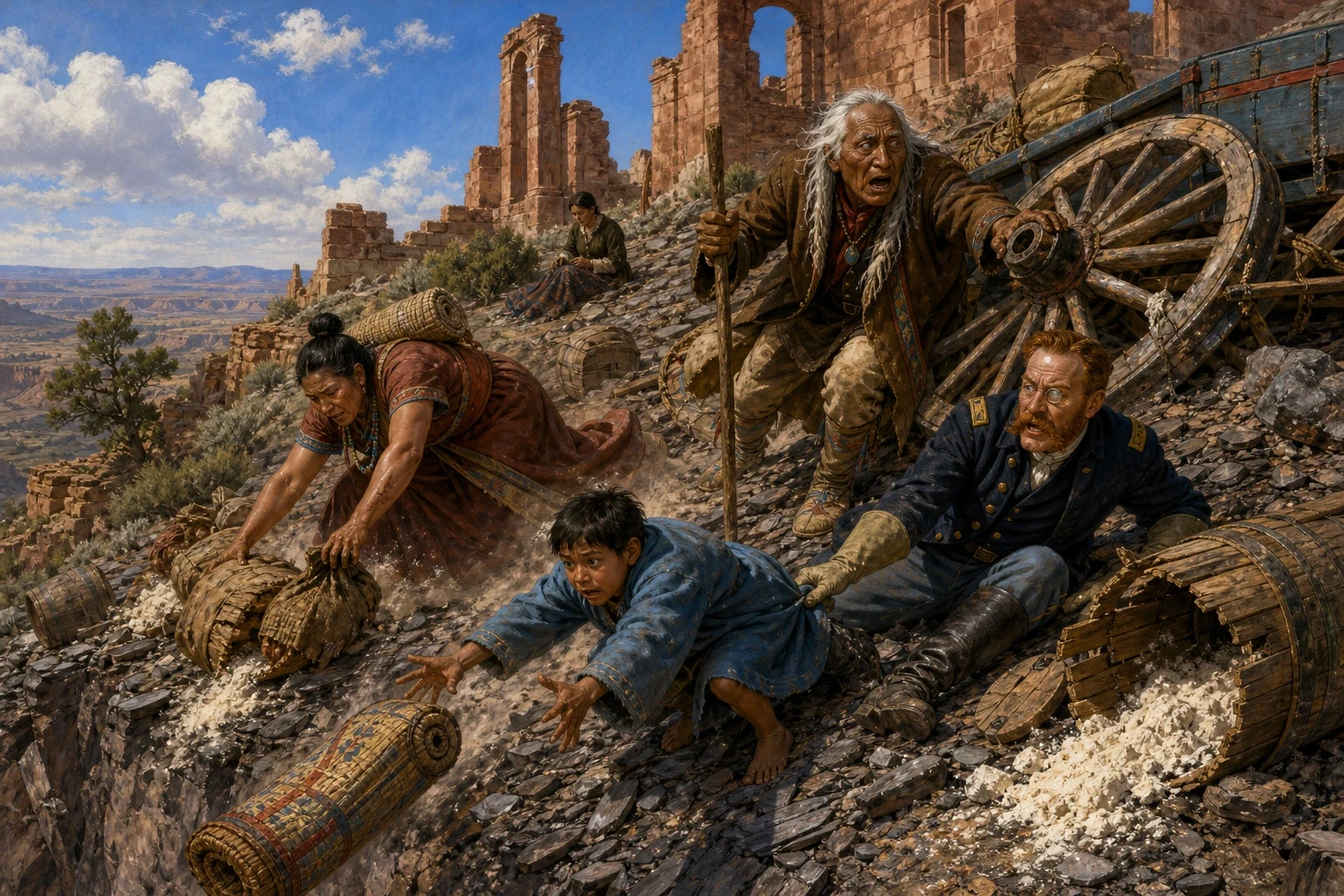
The crack came like a rifle shot. The wagon's rear axle snapped under its own weight on the stony grade, and the whole bed lurched sideways, spilling barrels and bundles down the shale slope beneath the ruined mission's roofless red walls. Hashké dropped the lamb's rope and ran after the loom-roll bouncing end over end toward the rocks. Asdzą́ą́ Nez lunged down the slope after him, skidding on loose stone, her blanket snagging on brush. Hastiin Tsosie braced himself against a fallen wagon-wheel taller than his chest, staff planted, shouting for the boy to mind his footing. A barrel smashed against a boulder below, staves bursting, flour exploding white across the shale. Bram threw himself from his saddle and slid down on his heels, catching Hashké's arm just as the boy overreached for the loom-roll teetering on the edge of a drop twice his own height. Together they hauled it back from the brink, the old man calling down through the dust, his daughter already gathering spilled bundles against her hip.
Page 6
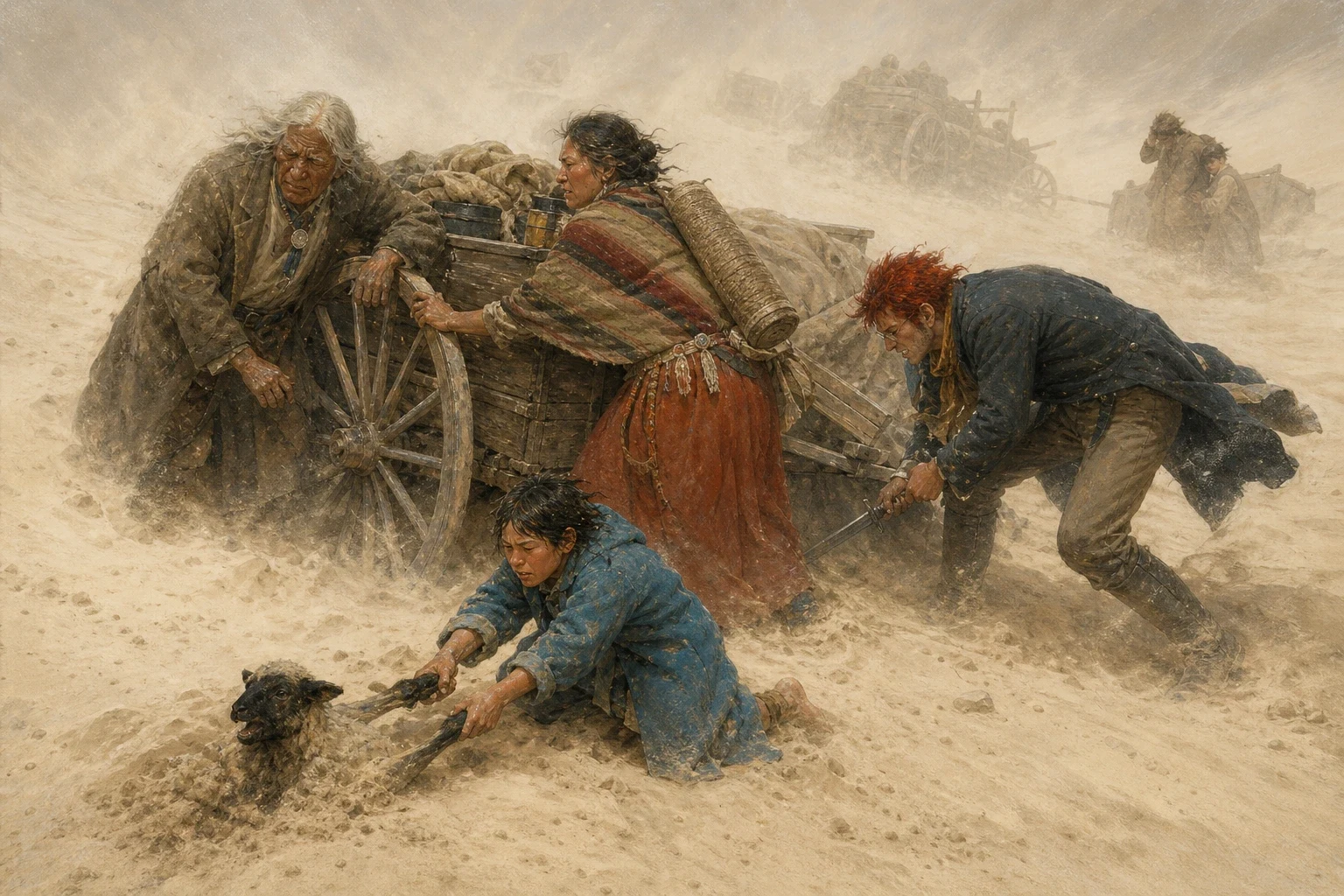
The wind came out of nowhere, a wall of white grit that swallowed the column mid-step. One moment the handcarts creaked in a line a mile long; the next, nothing but stinging dust and shapes. The lamb screamed and bolted sideways, dragged from under Hashké's arm, vanishing into the churn. He went after it on hands and knees, clawing through a rising dune, fingers raking grit until he felt wool and hauled the animal out by its forelegs, coughing, eyes streaming. Nearby, the family's handcart had sunk to its axle in blown sand, buried past the hubs. Bram, hatless now, his red hair whipping flat, bent double against the gale and jammed his sabre scabbard under the wheel rim, heaving down on it like a lever until the cart groaned free. Asdzą́ą́ Nez planted herself between her staggering father and the worst of the blast, gripping the cart's wheel with both hands, bracing him behind it with her own body as sand hissed past them both.
Page 7
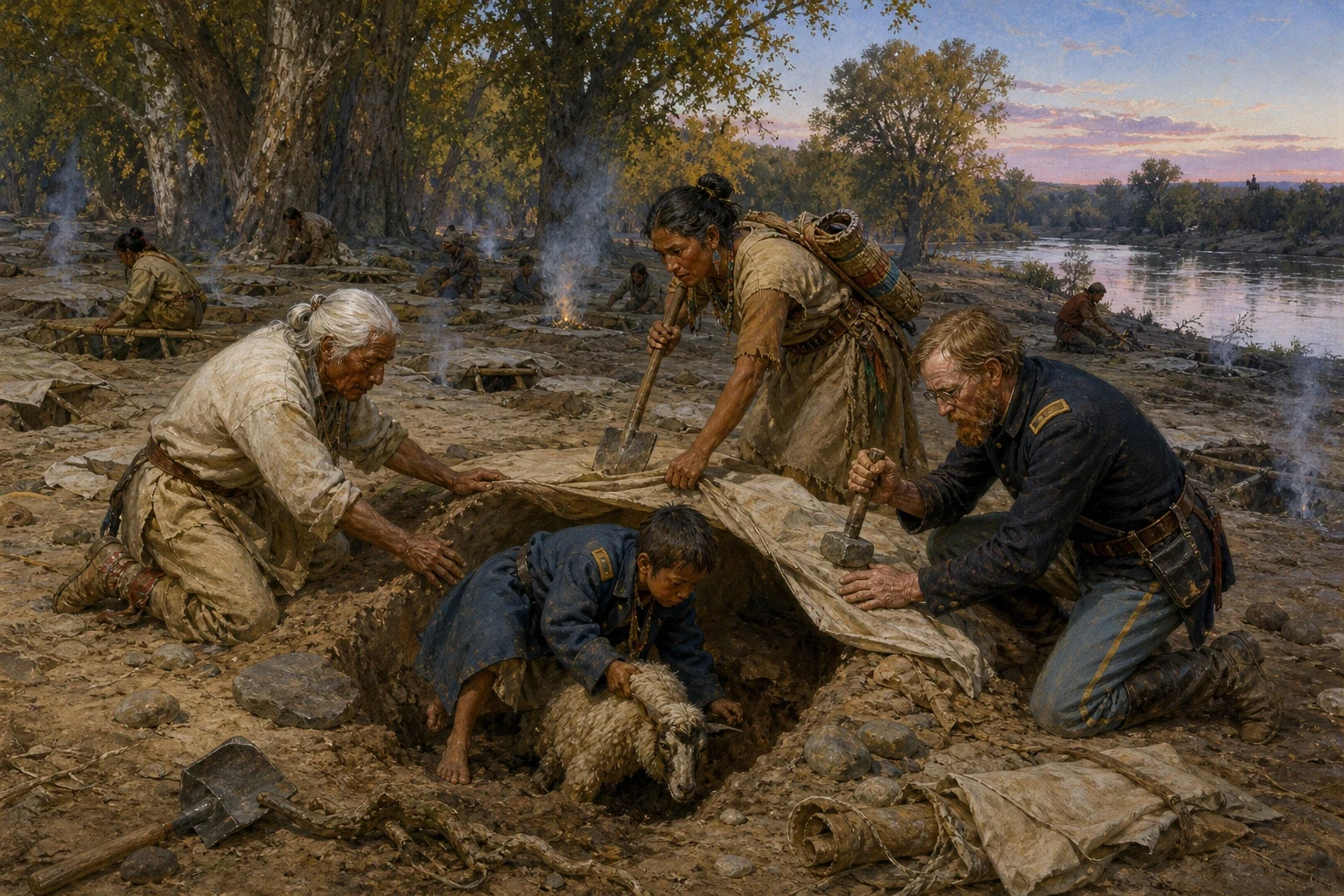
The broken shovel had lost half its blade, so Hashké scraped with the mesquite root instead, clawing sandy earth loose in fistfuls while Asdzą́ą́ Nez widened the pit with the shovel's jagged stub. Hastiin Tsosie knelt at the edge, too weak to dig, pressing the walls flat with his palms so they would not collapse. Bram came at dusk leading his horse, a bundle of stolen wagon canvas slung over the saddle. He dropped it into the pit and said nothing of how he'd gotten it past the quartermaster. Together he and Asdzą́ą́ Nez stretched the canvas over the hole, Bram hammering stones onto its edges with the flat of his hand while she hauled the far corner taut. Hashké crawled inside first, testing the low roof with his back, and the lamb — grown thinner, no longer a lamb but not yet a ewe — bleated at the pit's mouth until he dragged her in after him. Around them, for a mile along the riverbank, smoke rose from hundreds of identical scraped holes, thin grey threads against the cottonwoods.
Page 8
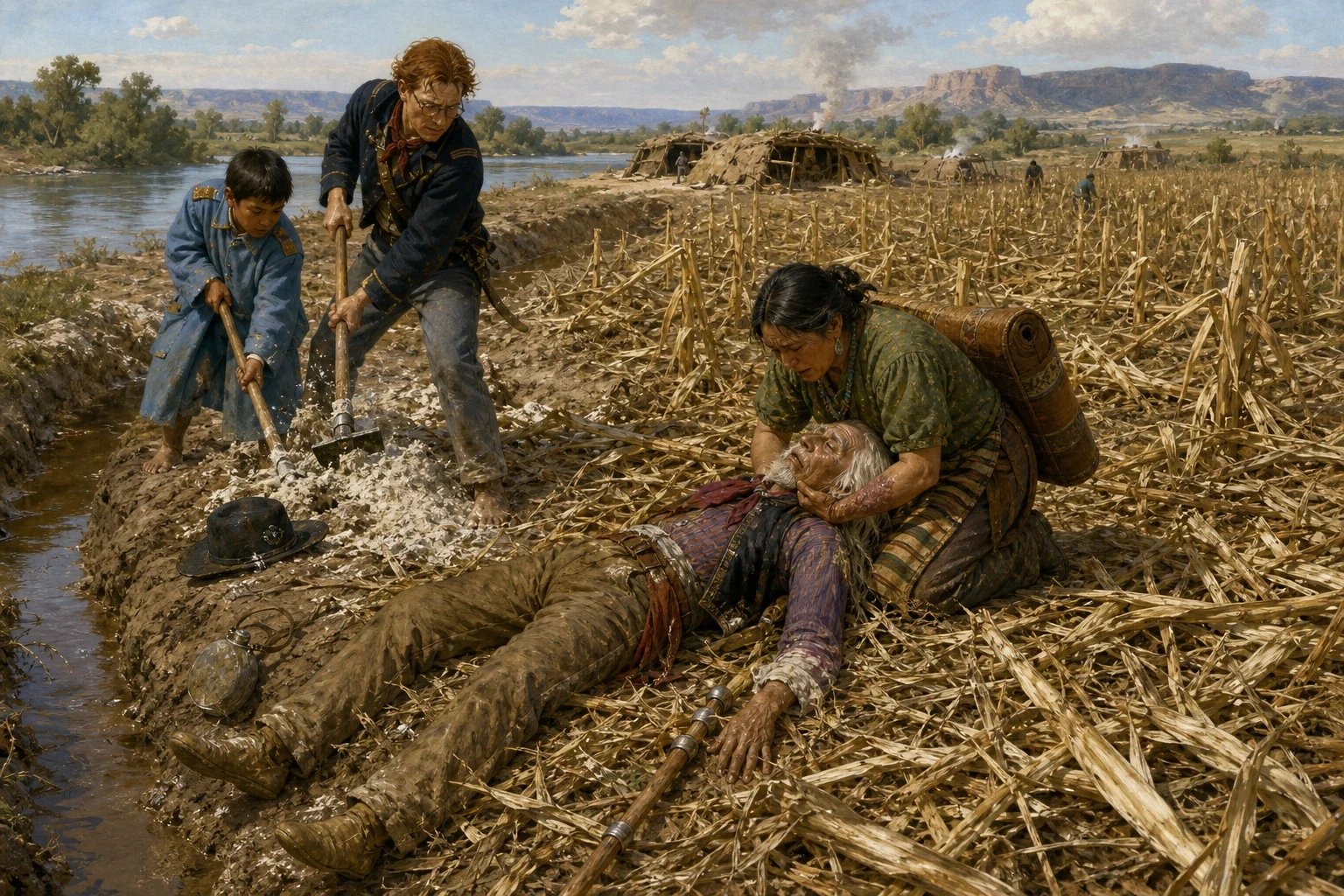
The corn stands hollow, stalks gray and papery where cutworms have eaten the hearts out row by row. Hastiin Tsosie walks the furrows leaning hard on his staff, feeling for solid ground with his moccasin soles. His knees buckle without warning. He drops between two ruined stalks, the staff falling from his hand into the dirt. Asdzą́ą́ Nez screams and drops to her knees beside him, gathering his head into her lap, pressing her scarred forearm against his chest to feel for breath. By the time Hashké comes running, barefoot, lamb forgotten somewhere behind, the old man is still. Bram arrives at a flat run from the ditch bank, tears his hat off, kneels, and finds no pulse at the wrist. There is nothing left to do but dig. By evening the two of them, boy and soldier, swing a mattock together against the ditch bank's crust of white gypsum, cracking it in sheets like old paint, sweat cutting lines through the dust on their faces, while Asdzą́ą́ Nez kneels at the grave's edge and cuts a lock of her father's white hair with her belt knife, wrapping it in a scrap of red wool.
Page 9
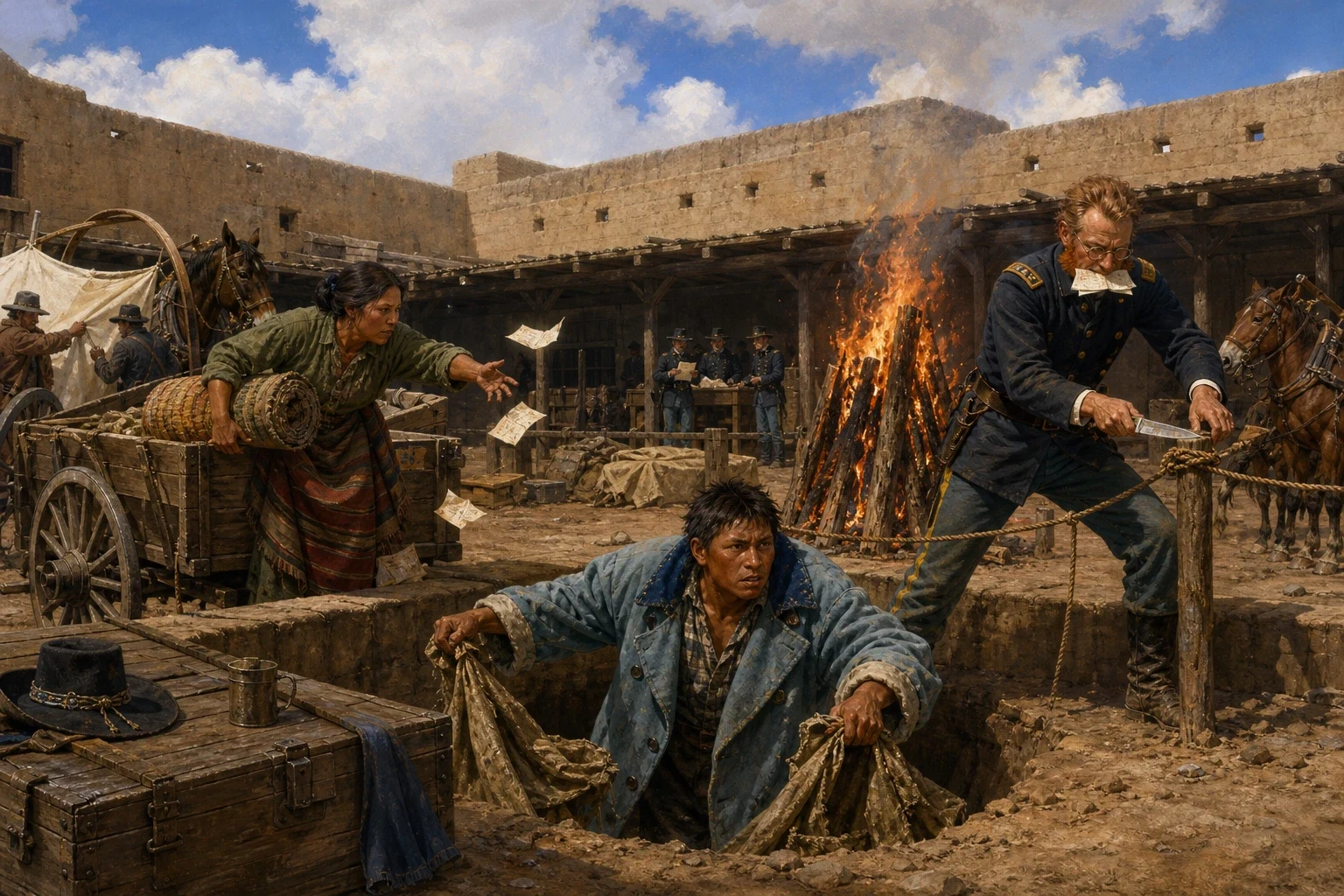
The word comes down the line under the officers' portal — signed, done, free — and the whole camp breaks apart at once like ice cracking on the Pecos. The wiry boy, fifteen now, taller, scrambles down into the dugout pit and tears the canvas roof loose with both fists, stones that weighted it tumbling and thudding into the sand. He hauls the sagging posts out one by one, dragging them across the dirt to the bonfire already roaring waist-high, and heaves them in with a grunt, sparks spitting upward. The broad-shouldered woman kneels by the mule wagon, its bed hip-high, lifting the heavy loom roll into her arms and wedging it between sacks, then snatching the fluttering stack of ration tickets off the ground before the wind takes them, stuffing them under a strap. The red-whiskered lieutenant stands at the picket line, discharge papers clamped in his teeth, sawing the rope with his knife until the horses toss free, then grabs the loose end and coils it fast around his fist.
Page 10
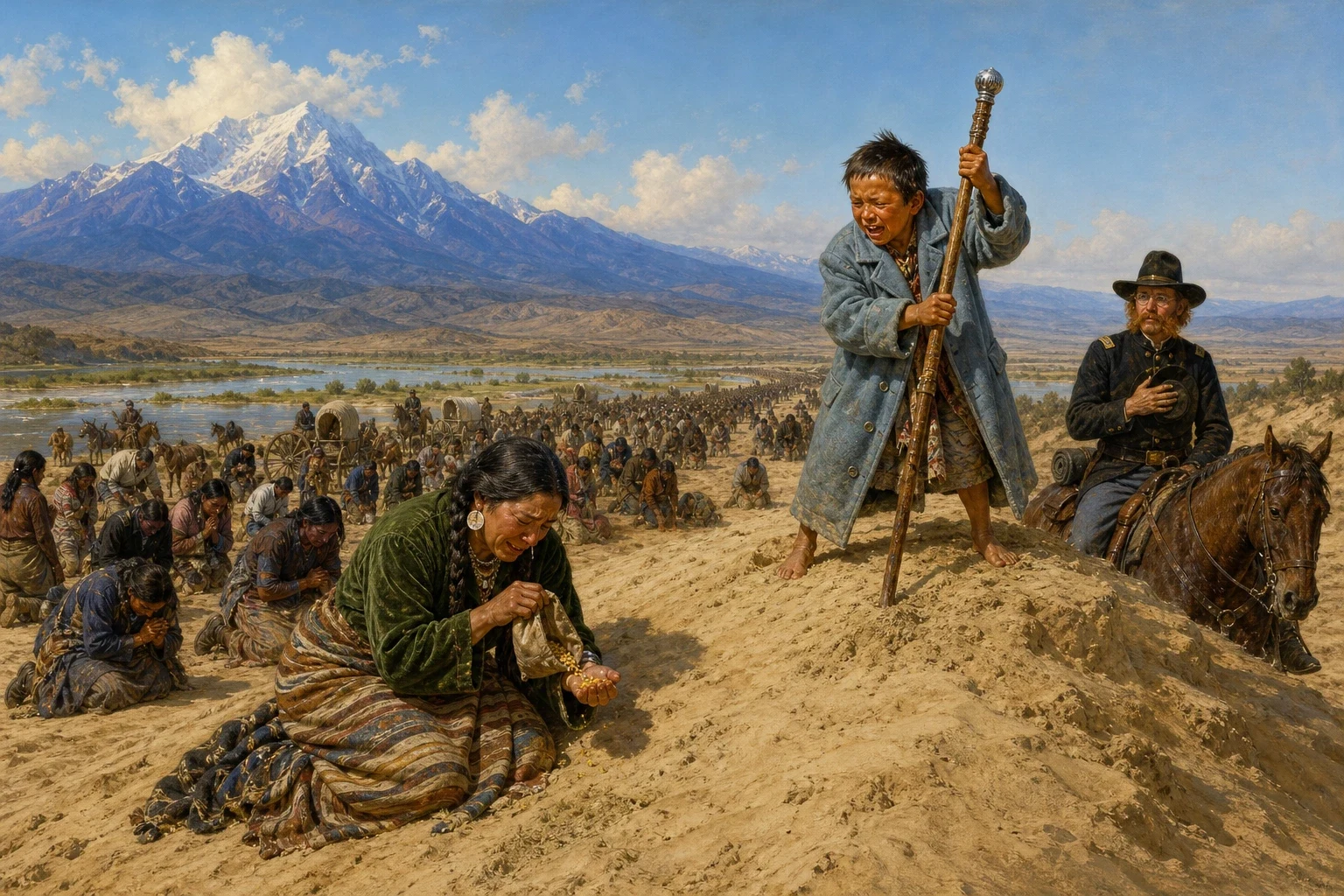
Six weeks of walking burns down to a single breath when the column crests the sand hill and the blue shoulder of Tsoodził rises on the horizon. The people drop to their knees in the loose sand, old men and children alike, and for a moment no one speaks. Then Hashké breaks from the kneeling line and runs, bare feet churning the sand, up the last rise with his grandfather's staff gripped in both fists. At the crown he slams the silver knob down, driving the juniper shaft into the crest until it stands alone against the sky. Below, Asdzą́ą́ Nez kneels and fumbles the drawstring of the buckskin pouch at her throat loose with trembling fingers, and pours the hoarded seed corn — kernels saved through flood and sandstorm and her father's grave — into her son's open palm. Lieutenant Bram reins his horse still at the foot of the hill, removes his dusty hat, and says nothing, watching the staff stand against the mountain.
About this story
- Audience: general readers
- Format: 10 illustrated pages, narrated, free to read on Wonder History
Read Wonder History on your phone
Wonder History is available on Android and iPhone and iPad. Get Wonder History on Google Play · Get Wonder History on the App Store.