The Meiji Restoration — Japan (1868, Japan)
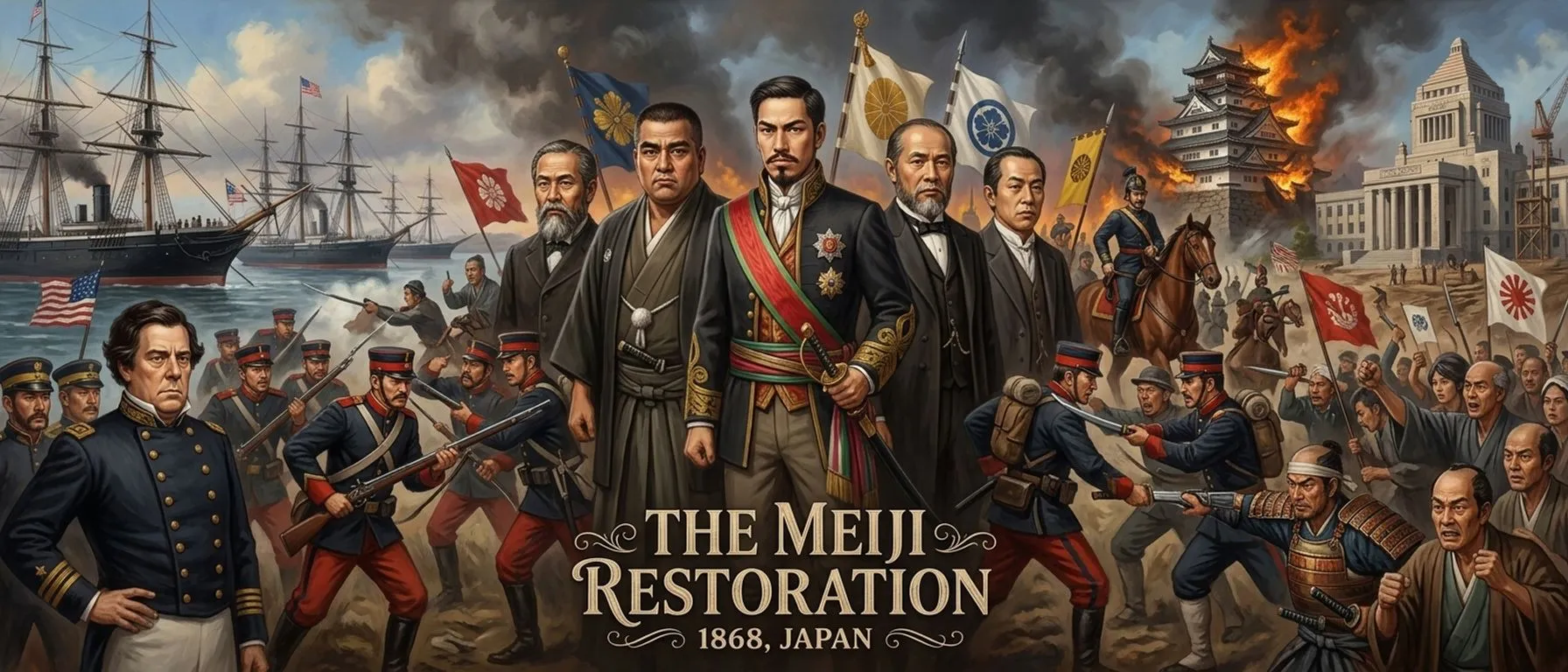
The Meiji Restoration — Japan (1868, Japan) — an illustrated history story, featuring Emperor Meiji, Saigō Takamori, Okubo Toshimichi, set in Japan. 10 illustrated pages, free to read on Wonder History.
Page 1

October 23, 1868: Emperor Meiji, the young symbol of a changing Japan, stands amidst the grand halls of Kyoto, while Saigō Takamori, the revered 'Last Samurai', observes from the shadows with a stoic expression. Okubo Toshimichi, a pragmatic reformer, confers with Ito Hirobumi, a key figure in the modernization effort. Commodore Matthew Perry's arrival fifteen years prior forced Japan's hand, but how did this nation, once closed off from the world, transform so rapidly? Where did this ambition for modernization truly begin, in a society steeped in centuries of tradition?
Page 2

In 1853, Commodore Matthew Perry's 'Black Ships' appeared in Edo Bay, their steam engines churning the water. Perry declared, his voice booming across the harbor, 'We come bearing a letter from the President of the United States, demanding trade!' A samurai official, sweat beading on his brow, clutched his katana, unsure if they should resist or yield to this powerful foreign force.
Page 3

Kido Takayoshi, an advocate for reform, whispered to Ito Hirobumi, 'We cannot remain isolated, Ito-san. The world is changing, and Japan must adapt or be consumed.' Ito nodded, his expression thoughtful, 'But how can we modernize without losing our soul, Kido-san? Our traditions are sacred.'
Page 4

In 1868, the Boshin War ignited as pro-imperial forces clashed with Tokugawa loyalists. Saigō Takamori, leading the imperial troops, raised his katana and bellowed, 'For the Emperor! For a new Japan!' His soldiers, armed with rifles and swords, charged towards the enemy lines, a wave of determined faces.
Page 5

Iwasaki Yataro, a rising industrialist, presented a blueprint to Okubo Toshimichi, 'With your support, we can build factories, modernize our infrastructure, and make Japan a power to be reckoned with!' Okubo studied the plans, a flicker of ambition in his eyes, 'Very well, Iwasaki-san. Let us show the world what Japan is capable of.'
Page 6

Emperor Meiji, now a young man in his early twenties, addressed his council, 'We must learn from the West, but we must never forget who we are. Let us embrace progress, but preserve our values.' He adopted Western clothing, and cut his samurai topknot, as an example of Japan's adaptation.
Page 7

Saigō Takamori, now disillusioned, approached Okubo Toshimichi, his voice laced with disappointment, 'We fought for a new Japan, Okubo-dono, but is this truly what we envisioned? Are we becoming just another Western imitation?' Okubo, his face hardened by pragmatism, replied, 'We must do what is necessary to survive, Saigō-dono. Sentimentality has no place in this new era.'
Page 8

In 1877, Saigō Takamori led the Satsuma Rebellion, a final stand against the rapid westernization. As he raised his sword, a quote from Confucius echoed in his mind: 'Real knowledge is to know the extent of one's ignorance,' he thought, realizing the path he was on was doomed to fail. The rebels, armed with swords and outdated rifles, charged bravely toward the modern imperial army.
Page 9

After a crushing defeat, Saigō Takamori, wounded and surrounded, performed seppuku, ending his life with honor. His loyal followers wept, their faces etched with grief and respect for their fallen leader. The dream of a traditionalist Japan faded with him.
Page 10

In the decades that followed, Japan emerged as a modern industrial power, its cities bustling with factories and railways. Children in Western-style uniforms attended schools, learning new sciences and technologies. The Meiji Restoration had transformed Japan forever, its legacy echoing through generations.
About this story
- Historical figures: Emperor Meiji, Saigō Takamori, Okubo Toshimichi
- Location: Japan
- Period: Modern
- Audience: general readers
Questions and answers
Questions and answers about The Meiji Restoration — Japan (1868, Japan)
Read Wonder History on your phone
Wonder History is available on Android. Get Wonder History on Google Play.