The Siege of Vienna (1683, Europe)
The Siege of Vienna (1683, Europe) — an illustrated history story, featuring Count Ernst Rüdiger von Starhemberg, Kara Mustafa Pasha, King Jan III Sobieski, set in Europe. 10 illustrated pages, free to read on Wonder History.
Page 1
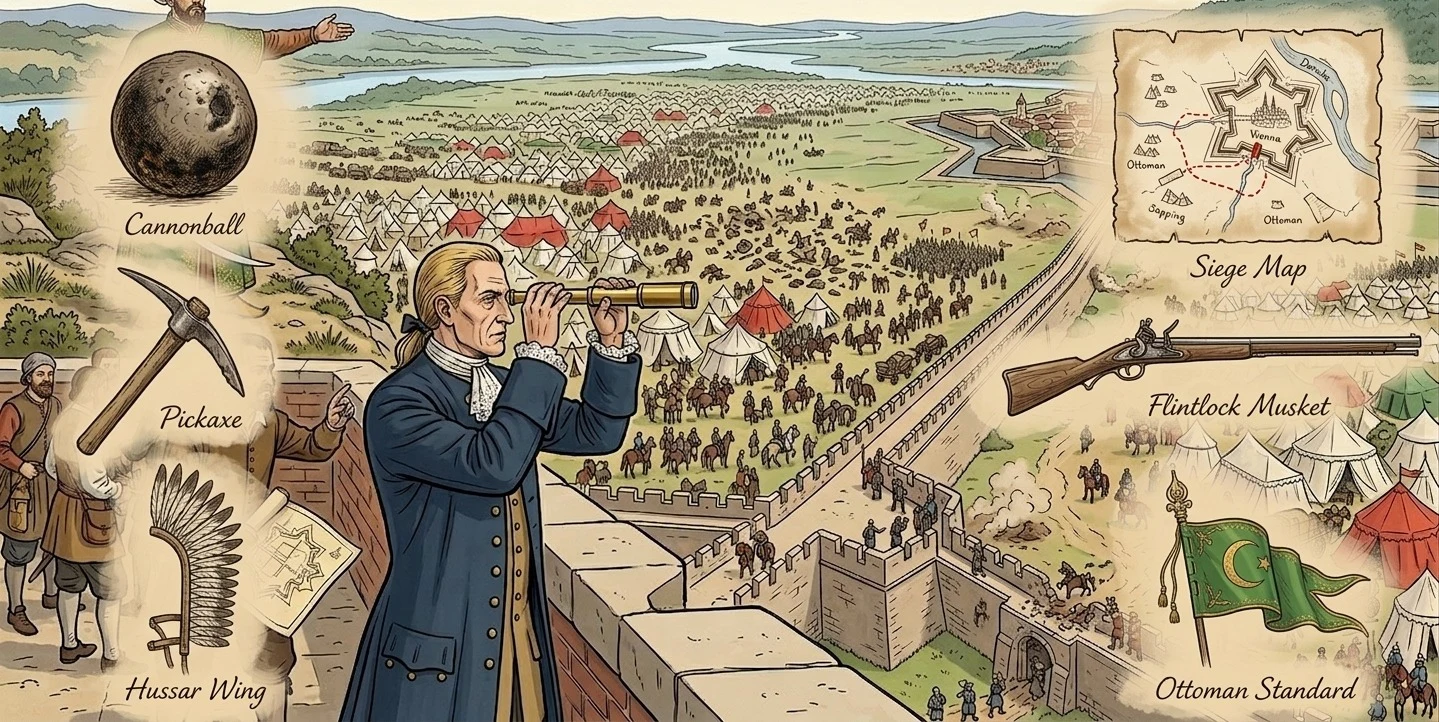
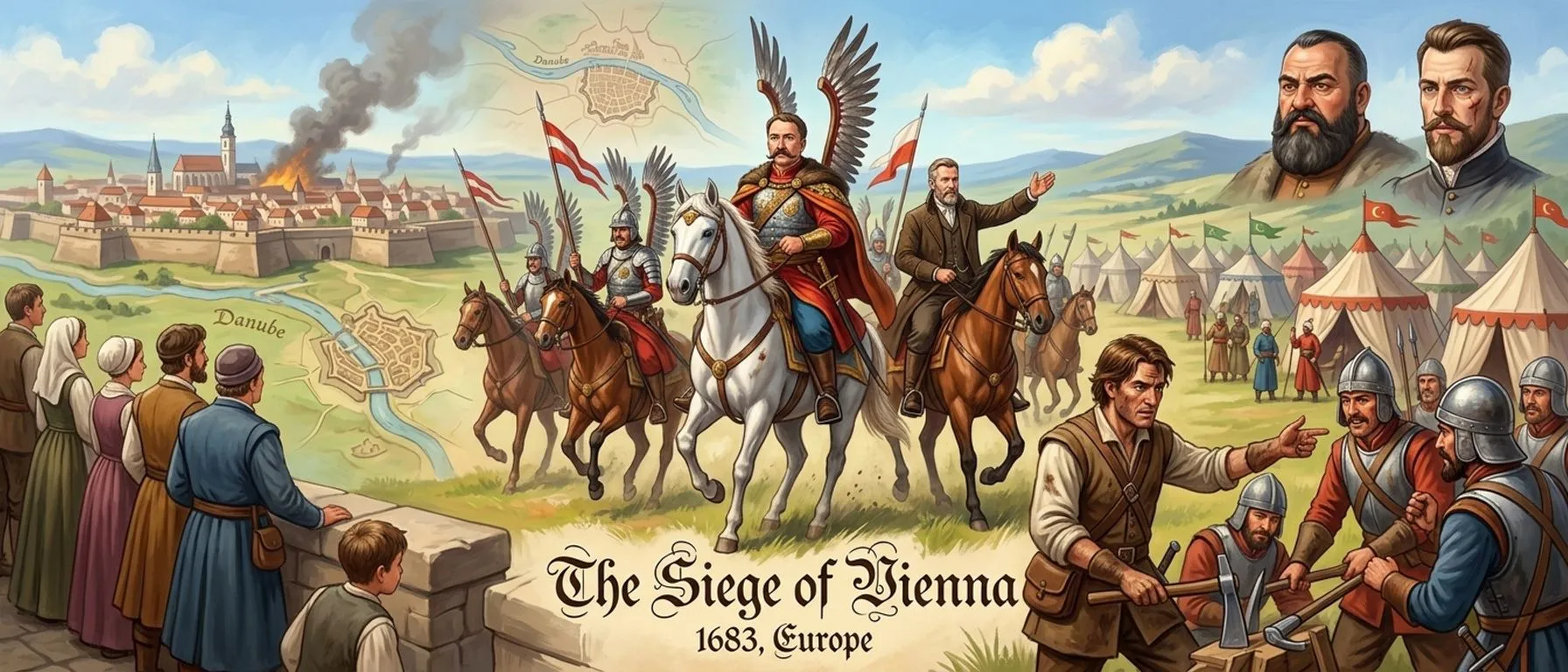
The year is 1683, and Vienna stands as the formidable bulwark of Christendom, a thriving city of 100,000 souls on the Danube, strategically positioned as the gateway between East and West. Its intricate network of walls and bastions had long protected the Holy Roman Empire, a vital hub for trade routes stretching from the German states to the Ottoman domains. However, whispers of a vast Ottoman army gathering in the south, commanded by the ambitious Kara Mustafa Pasha, had escalated into a thunderous roar, threatening to engulf the city and shatter centuries of European peace.
Page 2

Thousands of tents blanketed the plains outside Vienna, forming a sprawling Ottoman encampment as Kara Mustafa Pasha, thick-set with a full dark beard, surveyed his immense army from a hilltop. "These walls will crumble before the might of Islam," he declared, gesturing emphatically towards the distant city. "Our cannons will shatter their defiance, and Vienna's riches will be ours for the taking, a testament to our unmatched power, not for the Sultan, but for my ambition!" A chorus of shouts and war cries erupted from the clustered ranks of Janissaries and cavalry below, echoing his confidence.
Page 3

Inside Vienna, Count Ernst Rüdiger von Starhemberg, gaunt but resolute, faced his engineers and officers amidst the roar of distant cannon fire. "Our foe strikes not only from above but from beneath the earth," he stated, pointing to a recent collapse near the Karntner Gate. "Imperial Engineer, tell us, how do we adapt to this unseen threat?" The Imperial Engineer, his face streaked with dirt, knelt, sketching diagrams on a dusty map. "These tunnels are their unseen weapon, sir, but with our own counter-mines and the science of explosives, we can uncover their plans and even turn their strength against them, buying us precious time."
Page 4

Days blurred into weeks of relentless siege, as Ottoman sappers burrowed closer, their explosions shaking the very foundations of Vienna's walls, creating treacherous breaches. "Reinforce the Löbel bastion! They're pushing through!" Starhemberg bellowed, rushing through a hail of musket fire, his sword drawn as defenders desperately fought hand-to-hand against elite Janissaries swarming through smoke and debris. The air filled with cries, the clash of steel, and the thunderous impact of collapsing masonry, as the city's fate hung by a thread.
Page 5

Far to the north, King Jan III Sobieski, a powerful man in his 50s with a distinctive long mustache and piercing blue eyes, stood before Duke Charles V of Lorraine, a lean man in his late 40s with a neatly trimmed dark beard and a prominent scar near his left eye. "Vienna cannot fall, Charles, or all of Europe is next," Sobieski declared, slamming his gauntleted fist onto a campaign table. "As Edmund Burke once said, 'The only thing necessary for the triumph of evil is for good men to do nothing.' We must ride now, for God and Christendom!" Duke Charles, nodding firmly, began to unfurl maps, outlining the desperate path to relief.
Page 6
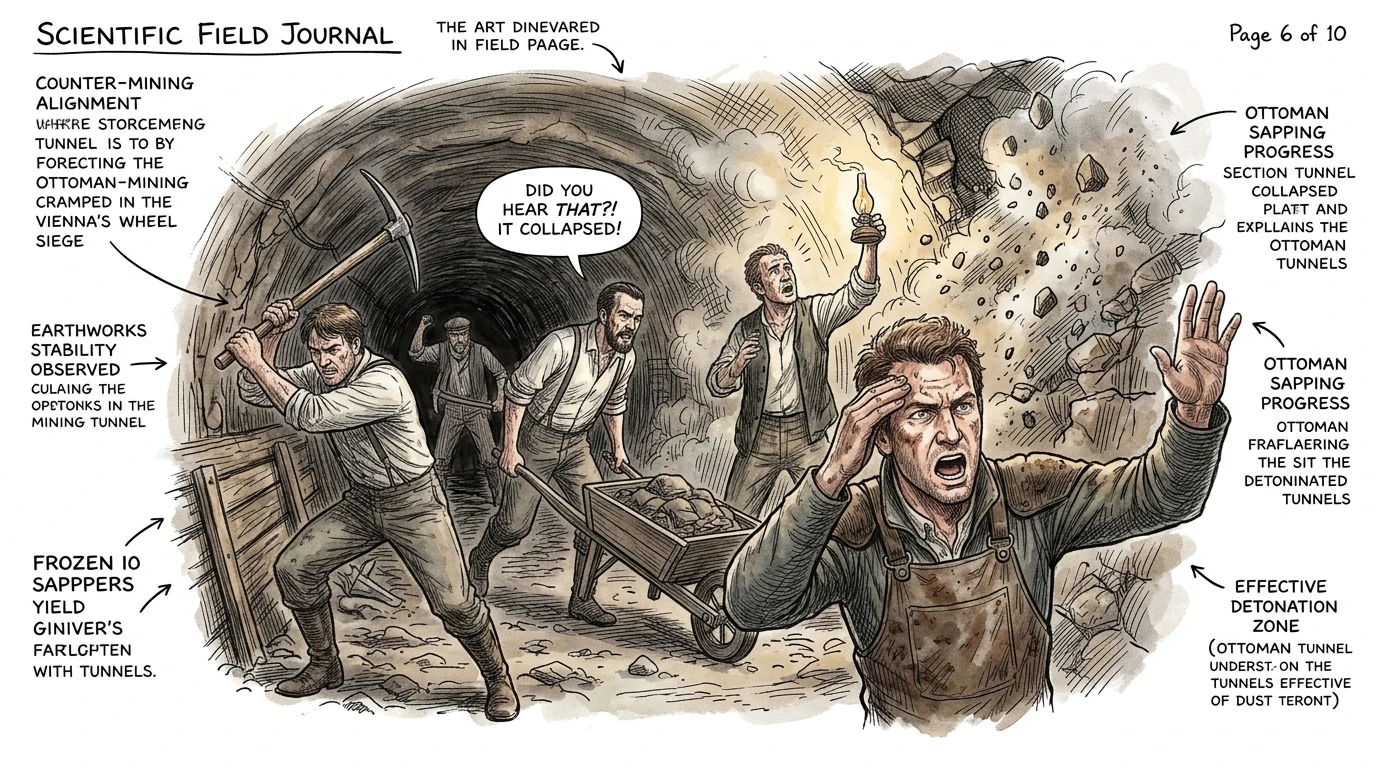
Back within Vienna's crumbling walls, the Imperial Engineer and his team toiled feverishly, racing against time beneath the incessant bombardment. "More powder! This shaft must reach their main tunnel before they detonate!" he yelled, wiping sweat and dust from his brow. His men, grim-faced, dug with picks and shovels, their lamps casting dancing shadows. Suddenly, a muffled roar from below signaled a successful counter-mine, and a section of the Ottoman tunnel collapsed, buying Vienna a few precious hours and preventing a catastrophic breach.
Page 7

On September 11th, the relief army, a formidable host of 65,000 Polish, Imperial, and German soldiers, ascended the Kahlenberg hills overlooking Vienna. "Behold, brothers! The enemy is within our grasp!" Sobieski's voice boomed across the ranks, inspiring a roar of anticipation as his elite Winged Hussars, distinctive with their tall, feathered wings, formed up for the charge. Duke Charles V of Lorraine rode alongside, his eyes fixed on the Ottoman encampment, coordinating the massive force for their decisive descent onto the besieged city.
Page 8

With a thunderous cry, the Winged Hussars launched their historic charge down the slopes of the Kahlenberg, a tidal wave of horse and steel crashing into the unprepared Ottoman flank. "For God and the Commonwealth!" Sobieski roared, leading the charge directly into Kara Mustafa's camp. The Ottoman lines fractured and crumbled under the immense impact, their centuries of siege works and entrenchments suddenly turning into traps as the relief army exploited every weakness, including the delays caused by Vienna's persistent counter-mining efforts, which had critically slowed the Ottoman advance and prevented an early breach.
Page 9

Kara Mustafa Pasha, stunned by the ferocity of the charge, abandoned his command post and fled the field, leaving behind a devastated camp and vast treasures as his army disintegrated in panic. "They flee! Victory is ours!" a triumphant Starhemberg shouted from the breaches, watching the Ottoman remnants stream away. The weary but jubilant defenders of Vienna poured out of the gates, meeting their saviors with cries of relief and celebration, the siege definitively broken. Count Starhemberg, gaunt but victorious, embraced Duke Charles V of Lorraine, their shared ordeal finally over.
Page 10

The Siege of Vienna, lasting 60 days, concluded on September 12th, 1683, with a decisive Christian victory, forever altering the balance of power in Europe and marking the beginning of the end for Ottoman expansion into the continent. Vienna, scarred but resolute, would rebuild its formidable walls and flourish anew, its pivotal role as a guardian of Western Europe cemented in history. The city's resilience, its adaptation to an unprecedented threat, ensured its legacy as a beacon of culture and defense for centuries to come, its path to continued influence now firmly secured.
About this story
- Historical figures: Count Ernst Rüdiger von Starhemberg, Kara Mustafa Pasha, King Jan III Sobieski
- Location: Europe
- Period: Early Modern
- Audience: kids (ages 6–12)
Questions and answers
Questions and answers about The Siege of Vienna (1683, Europe)
Read Wonder History on your phone
Wonder History is available on Android. Get Wonder History on Google Play.
More Wonder History stories
- The Signing of the Declaration of Independence (1776, United Kingdom)
- The Signing of the Magna Carta (1215, United Kingdom)
- The Singing Revolution (1988, USA)
- The Sinking of the Lusitania (1907, United Kingdom)
- The Sinking of the Spanish Armada (1588, United Kingdom)
- The Spanish Armada — United Kingdom & Spain (1588, United Kingdom & Spain)