Gooseberries — Anton Chekhov
Gooseberries — Anton Chekhov — an illustrated literature story. 10 illustrated pages, free to read on Wonder Novels.
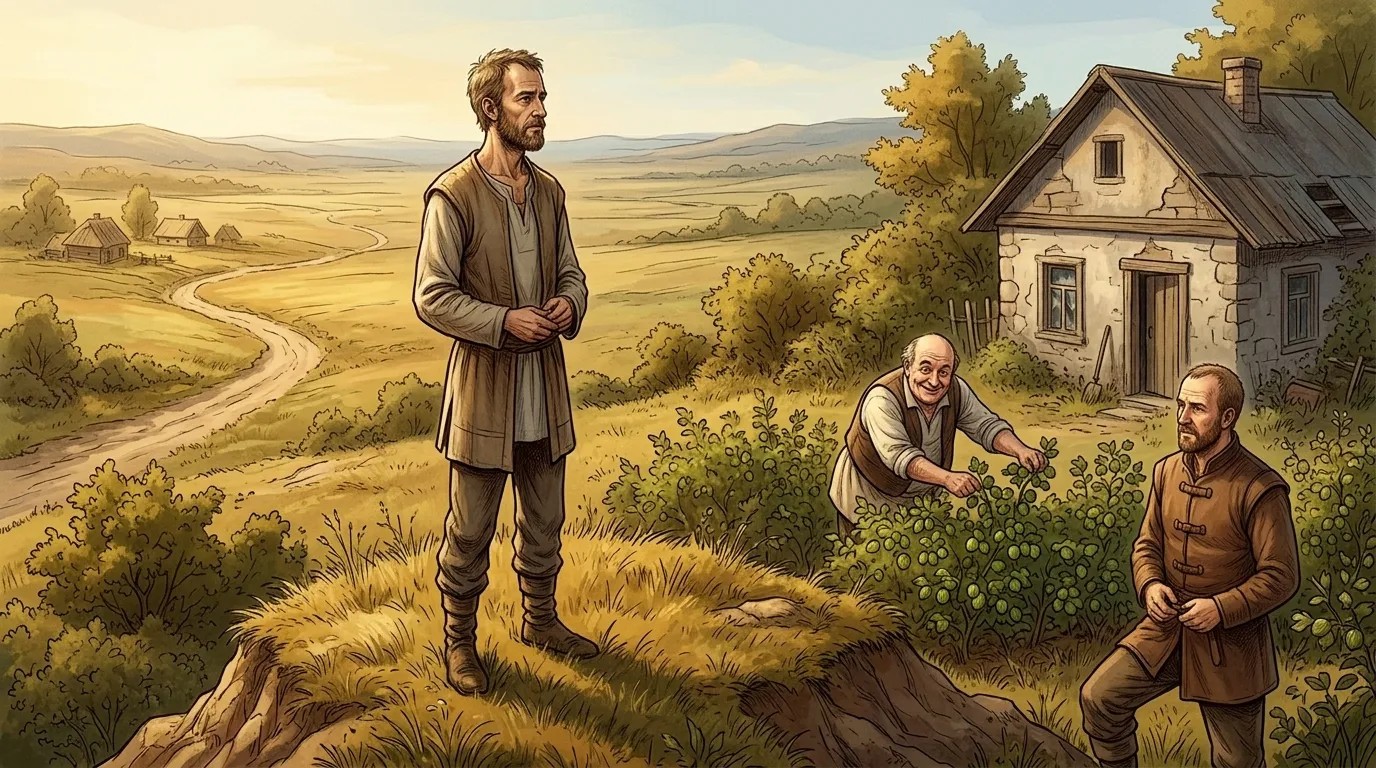
Page 1
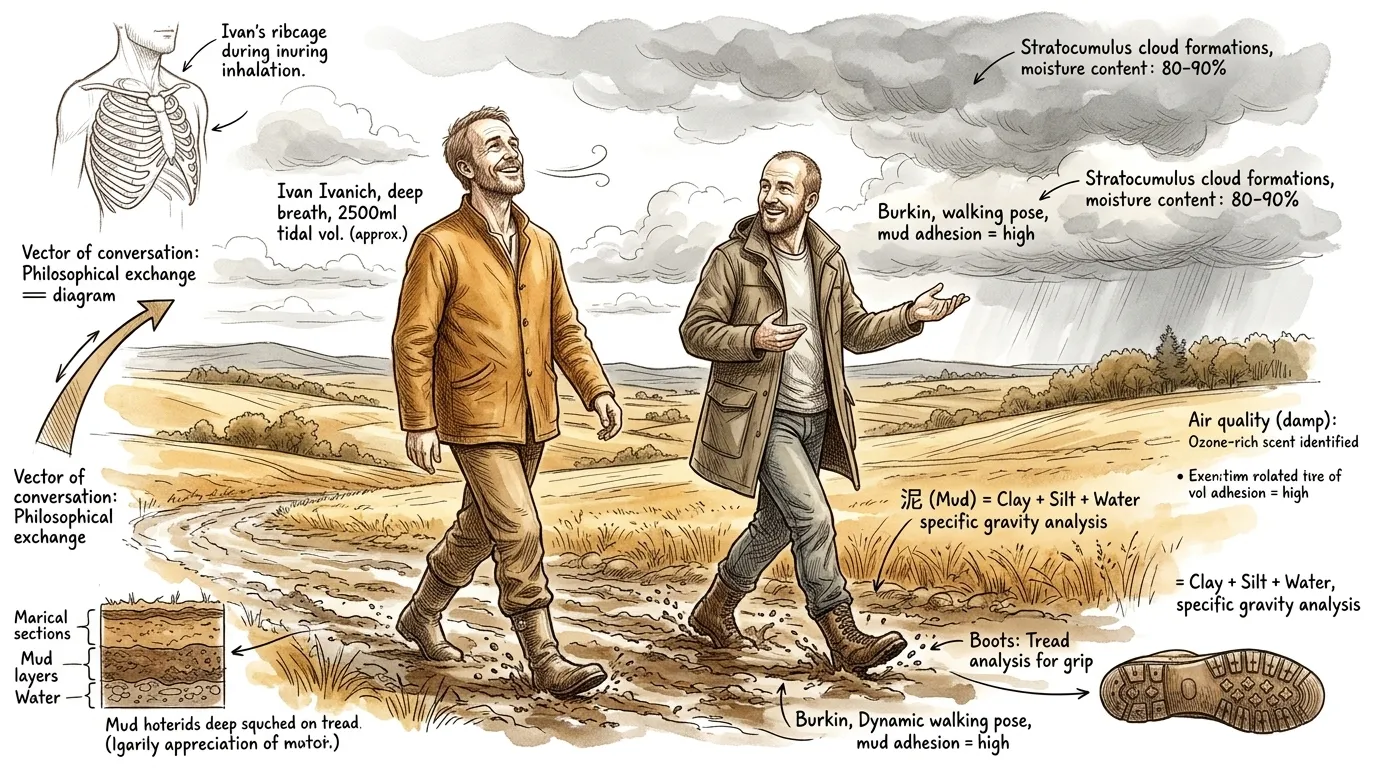
The sky, grey and laden, threatened rain, but Ivan Ivanich and Burkin pressed on, their boots squelching through the mud-churned path. "How splendid it is to wander aimlessly in fine weather," Ivan observed, drawing a deep breath of the damp air. Burkin, a more practical soul, merely nodded, eyeing the darkening clouds with a frown.
️ Literary Fact: This opening establishes the camaraderie between Ivan and Burkin, and the atmospheric setting common in Russian literature. The 'aimless wandering' hints at Ivan's contemplative nature.
Page 2
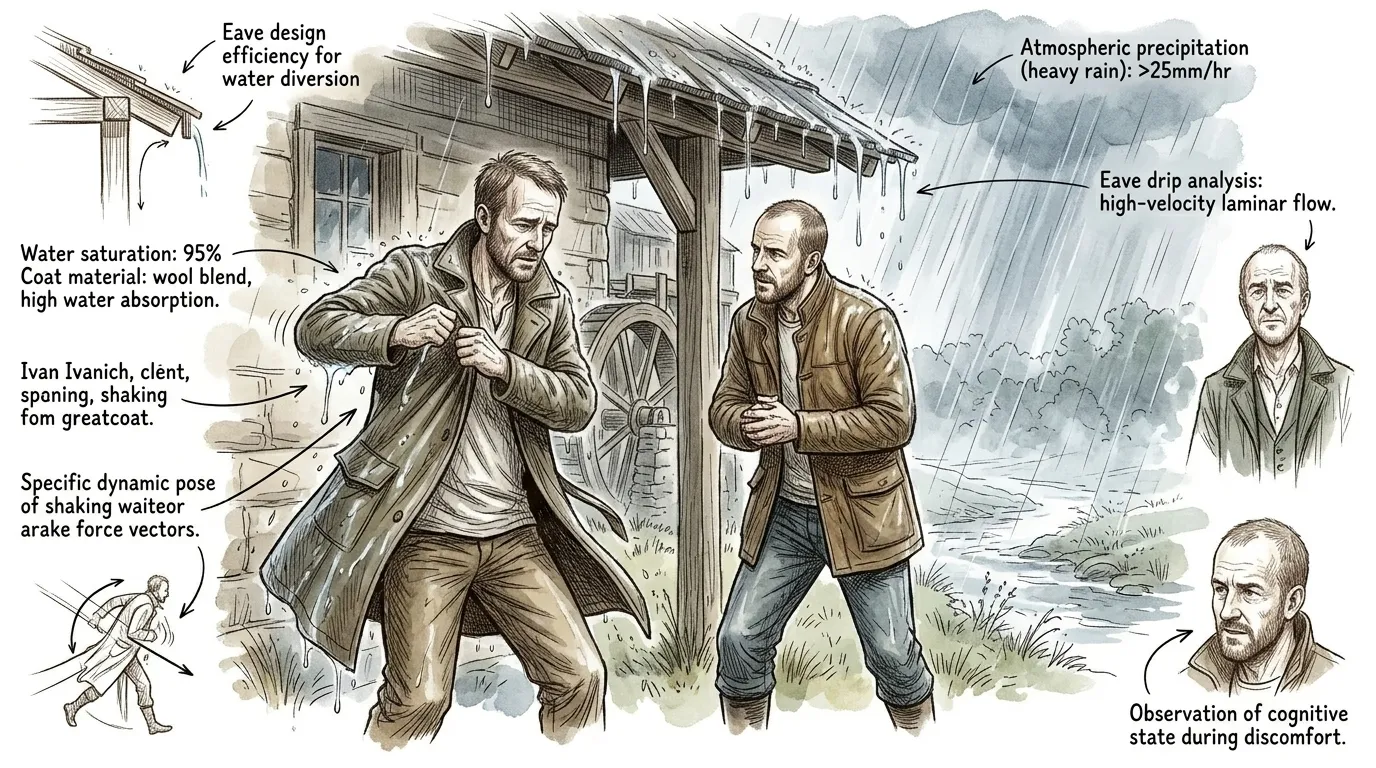
A sudden downpour sent them scrambling for shelter, finding refuge under the dripping eaves of an old mill. "There is a human tendency, Burkin, to fixate," Ivan began, shaking water from his greatcoat. "My brother, Nikolai Ivanich, spent his entire life pursuing one fixed idea, like a dog chasing its own tail. He desired nothing more than a small estate with gooseberry bushes." Ivan paused, a somber look clouding his face, "As the Roman philosopher Seneca once wrote, 'It is not because things are difficult that we do not dare; it is because we do not dare that they are difficult.' Nikolai dared, but for all the wrong reasons."
️ Literary Fact: Here, the 'gooseberry bushes' are introduced as the central motif (Chekhov's Gun). The quote by Seneca adds a philosophical layer, highlighting the theme of human ambition and the choices people make.
Page 3
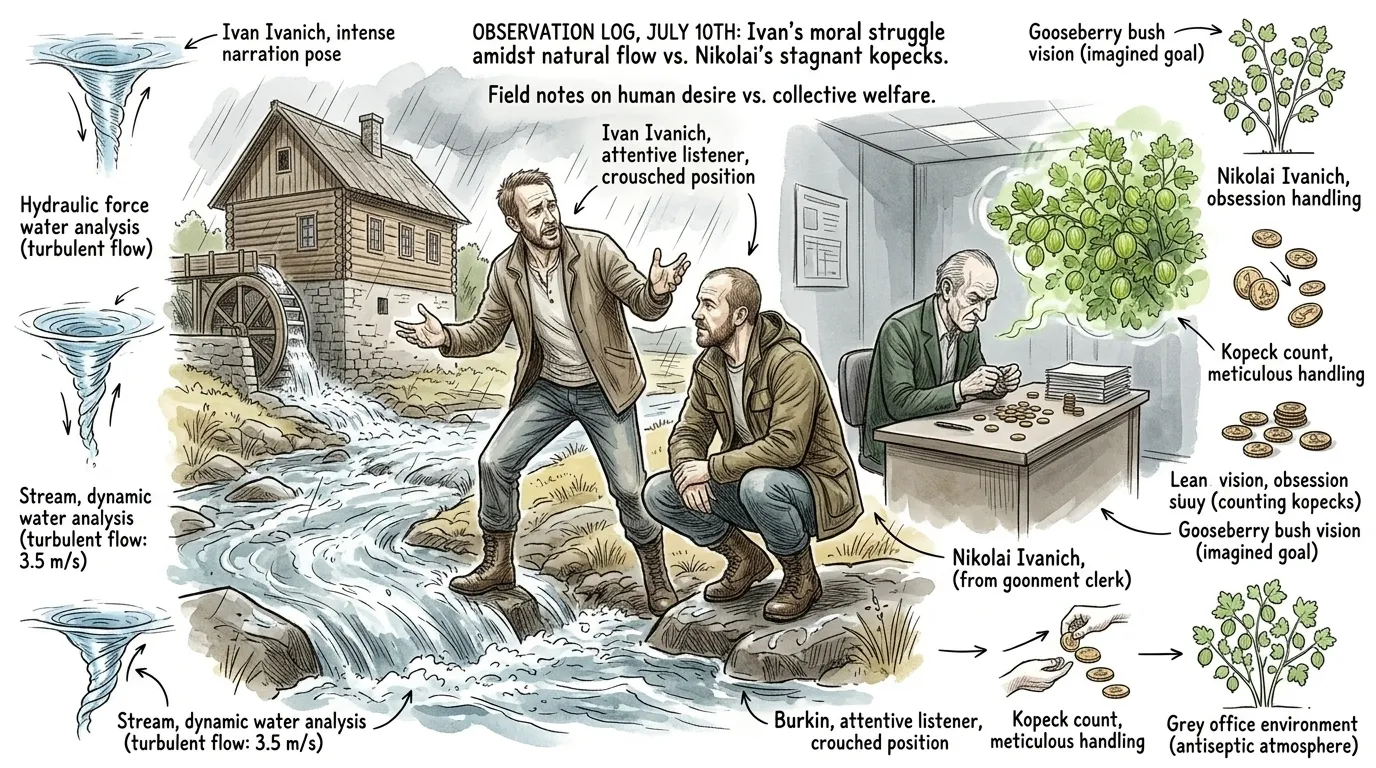
"For twenty years, he toiled as a mere government clerk, a life devoid of joy, existing solely to save every kopeck for his fantasy estate," Ivan continued, gesturing with his hand. "He saw only the gooseberries, not the endless grey walls of his office. His ambition consumed him, shaping every thought, every sacrifice." Burkin listened, his gaze fixed on the rushing stream by the mill.
️ Literary Fact: This page visualizes Nikolai's early life, depicting the stark contrast between his humble, monotonous reality and his grand, consuming dream. The high angle emphasizes his insignificance within the rigid bureaucracy.
Page 4
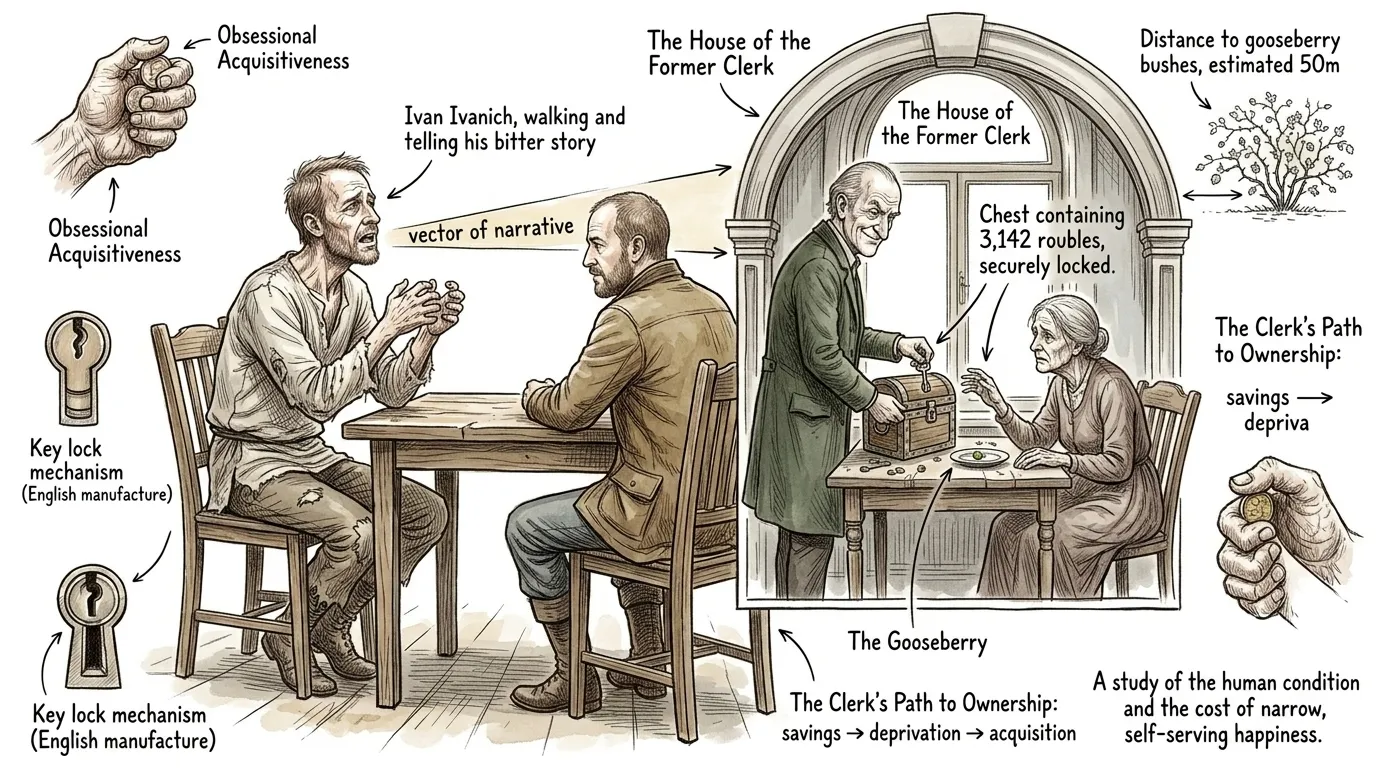
"To speed his goal, he married an old, plain widow, not for love, but for her wealth," Ivan recounted, his voice tinged with bitterness. "He kept her on starvation rations, locking away her money, making her life a misery. He knew what he was doing, yet he justified it all for his sacred gooseberry bushes." Burkin shifted uncomfortably, avoiding Ivan's intense gaze.
️ Literary Fact: This scene exposes the moral cost of Nikolai's ambition. His marriage, driven by greed, illustrates the dehumanizing effect of a singular, material obsession, reflecting the story's critique of selfish pursuits.
Page 5
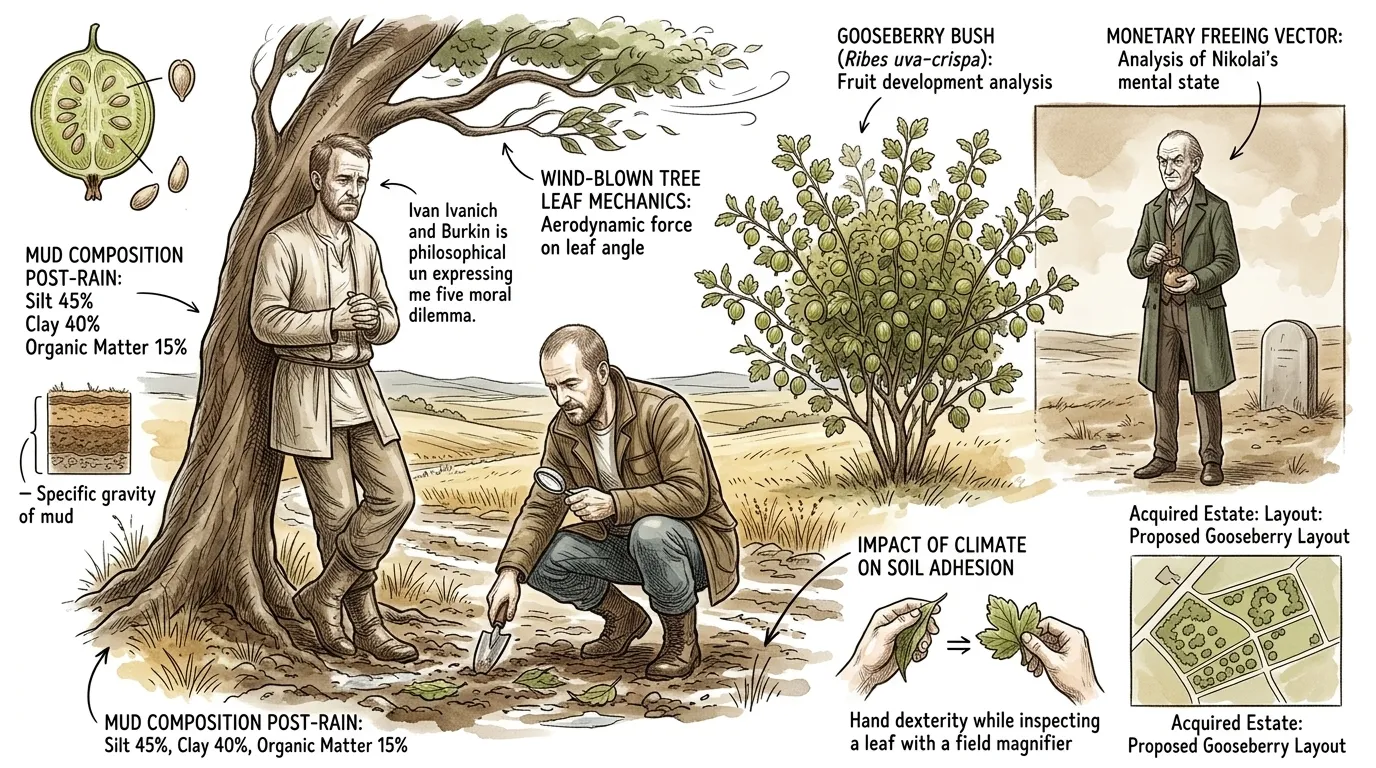
"She soon fell ill and passed away, her spirit crushed by his relentless parsimony," Ivan said, a grim set to his jaw. "Her death was merely a stepping stone for Nikolai, freeing him to pursue his ultimate happiness with the funds he now possessed." The rain had ceased, and a cold wind rustled the leaves around them, echoing the bleakness of Ivan's tale.
️ Literary Fact: The widow's death signifies the culmination of Nikolai's cold ambition. The description underscores the moral decay inherent in his single-minded pursuit, where human life becomes a means to an end.
Page 6
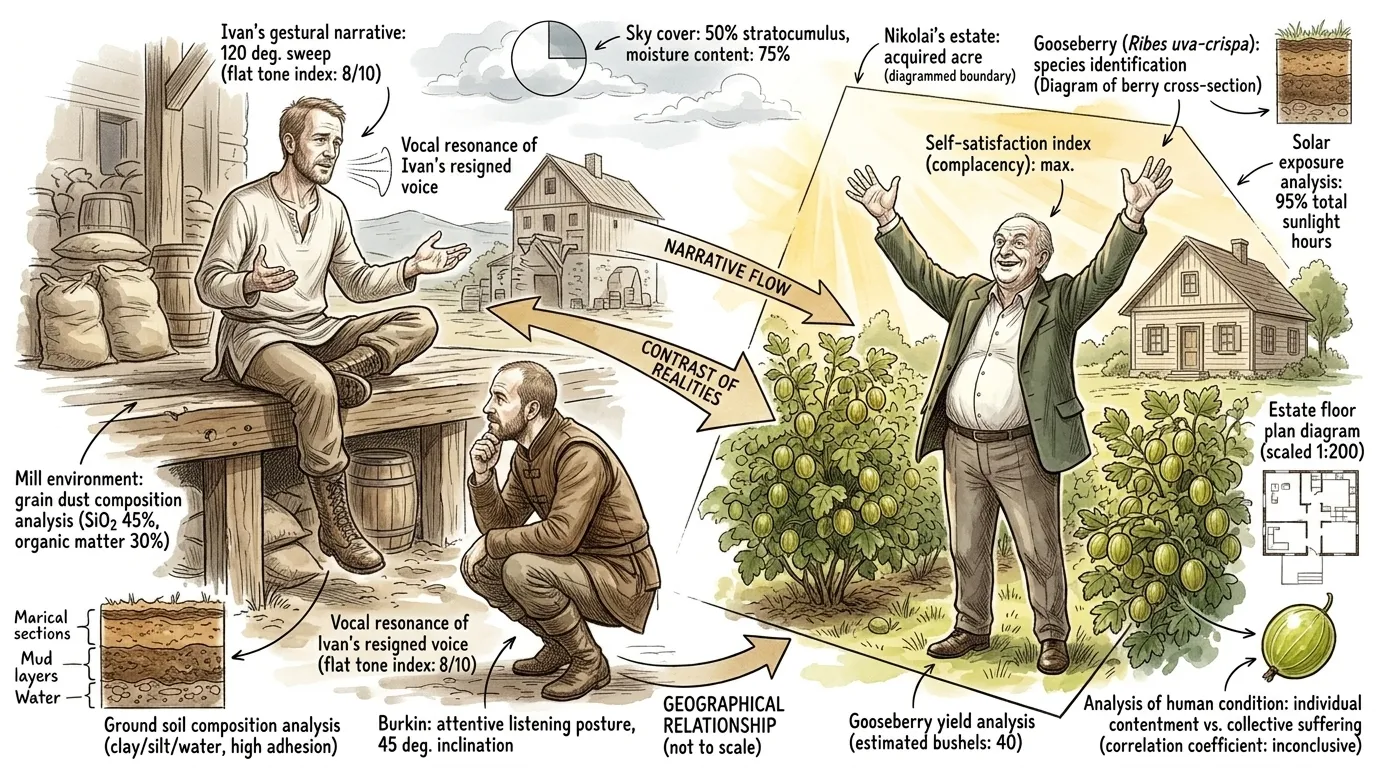
"And so, he finally bought his estate, a small, rather ordinary place with the gooseberry bushes he had longed for," Ivan recounted, his voice now flat. "He saw himself as a landowner, a man of substance, despite the means he used to acquire it. His joy was absolute, uncomplicated by any sense of guilt or regret." Ivan gestured towards the open sky, as if pointing to Nikolai's new realm.
️ Literary Fact: This page depicts Nikolai's 'success,' the acquisition of his estate. The visual contrast between his proud demeanor and the 'ordinary' nature of the property hints at the superficiality of his achievement.
Page 7
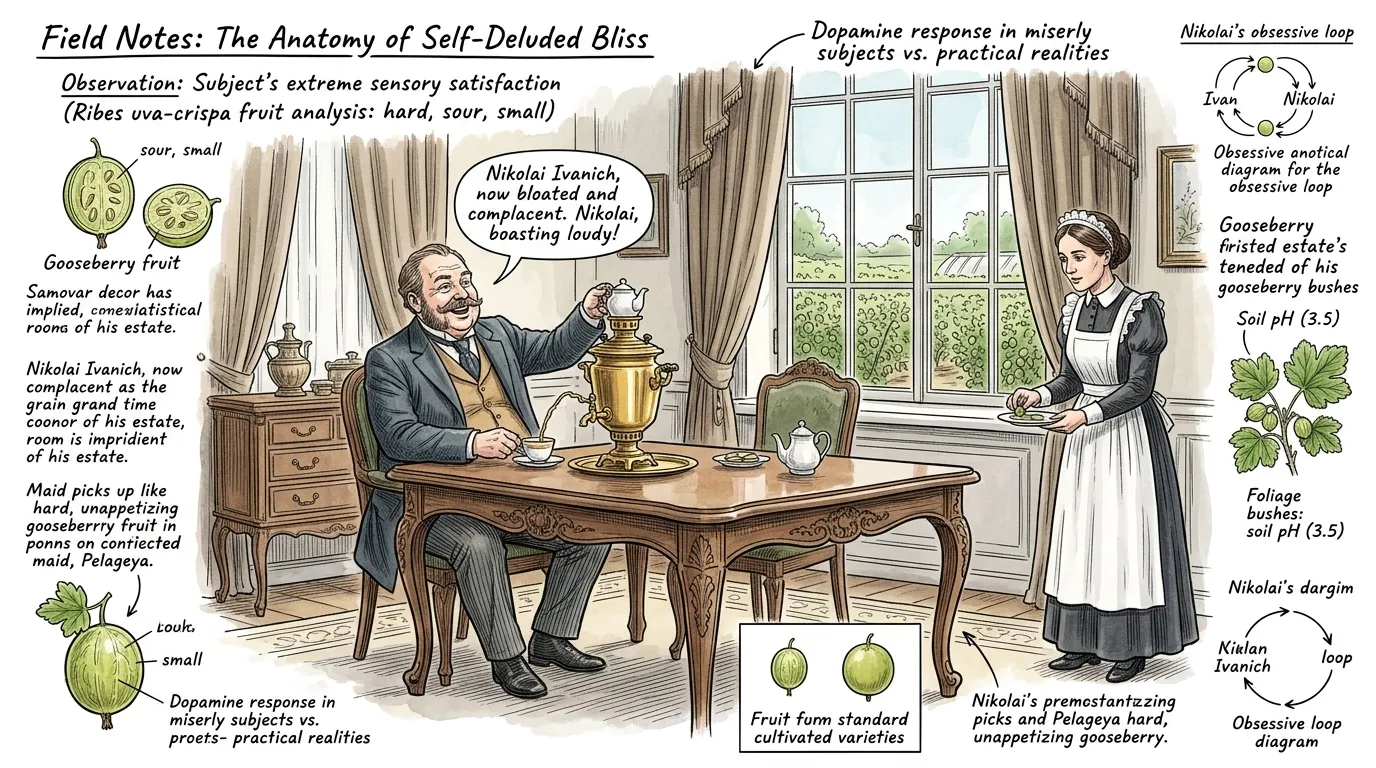
Ivan described his visit to his brother's estate. "There he was, bloated and complacent, pouring tea and boasting of his new life. And then, Pelageya, his maid, brought in a plate of gooseberries, a sour, hard dish that made my teeth ache just to look at." Nikolai, with a beaming smile, popped one into his mouth. "He ate them and declared them delicious! 'Taste them, brother!' he urged, his eyes shining with pure delight."
️ Literary Fact: This is the climax of Nikolai's personal narrative, the moment he savors his life's ambition. The gooseberries, now 'tasted,' represent the fulfillment of his dream, revealing its true, sour nature (the payoff of Chekhov's Gun).
Page 8
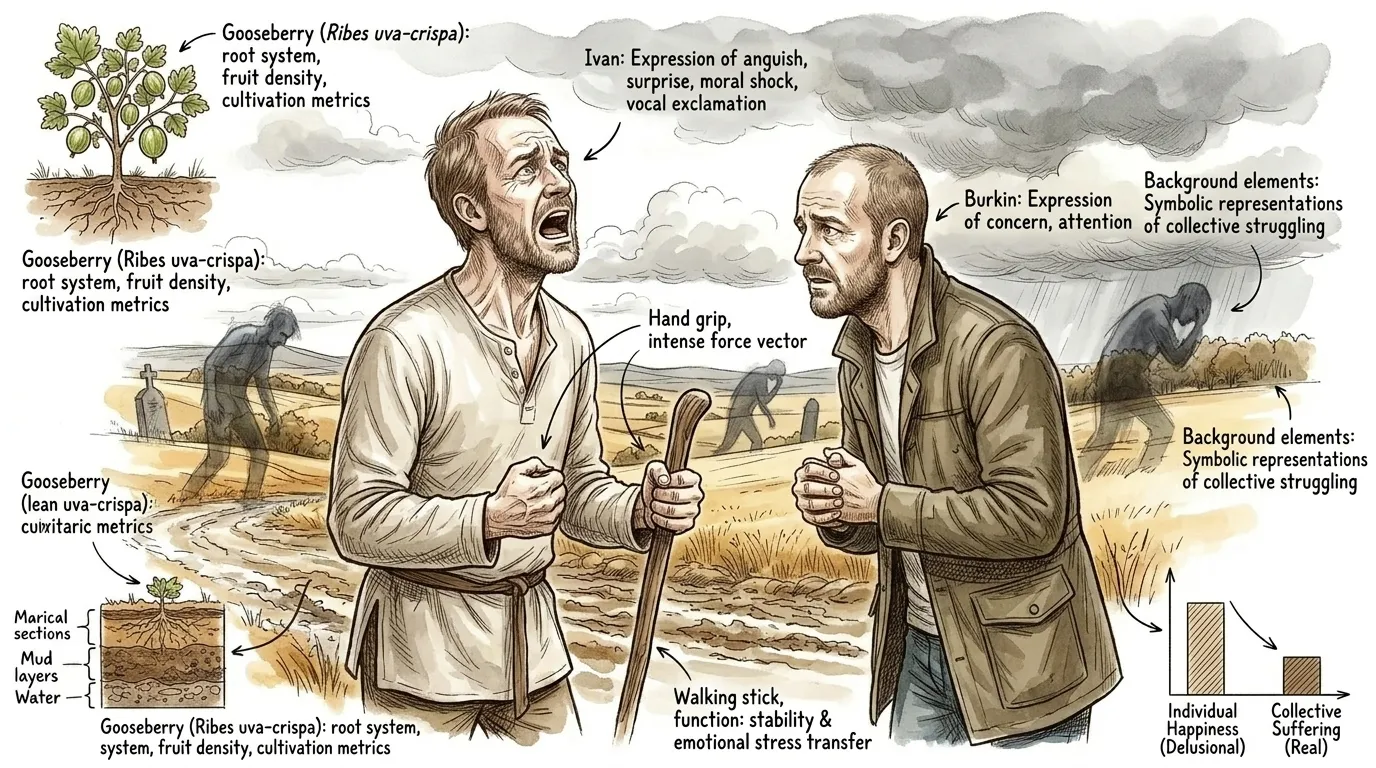
"He was so happy, so utterly convinced of his own bliss," Ivan exclaimed, his voice rising in anguish. "But his happiness was a delusion, born of selfishness and built upon the graves of others. This is the horror, Burkin, to see a man so content in his small, artificial world while the world outside groans with suffering." Ivan gripped his walking stick tightly, his knuckles white.
️ Literary Fact: Ivan's passionate outburst here reveals the story's core theme: the moral danger of individual happiness when it ignores collective suffering. His despair is a direct response to Nikolai's self-satisfaction.
Page 9
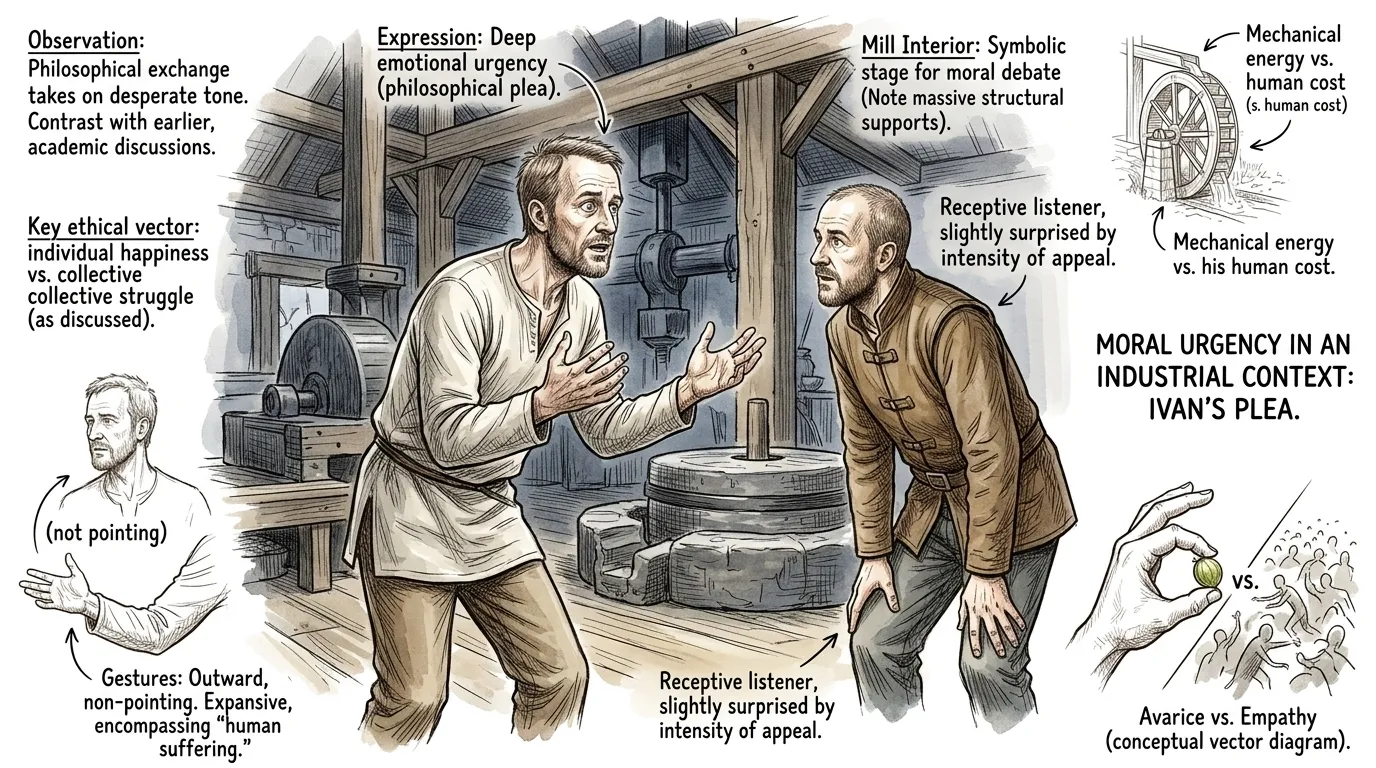
"Don't grow complacent, Burkin! While we sit here, sipping tea, so many are starving, ill, suffering in silence. True happiness is impossible when injustice exists," Ivan pleaded, leaning forward with desperate urgency. "We must not ignore the pleas of those in need, but do good!" He looked at Burkin, his eyes wide and earnest, demanding understanding.
️ Literary Fact: This page is Ivan's moral imperative, a direct appeal to action and empathy. It underscores the story's humanitarian message, moving beyond a critique of Nikolai to a call for social responsibility.
Page 10
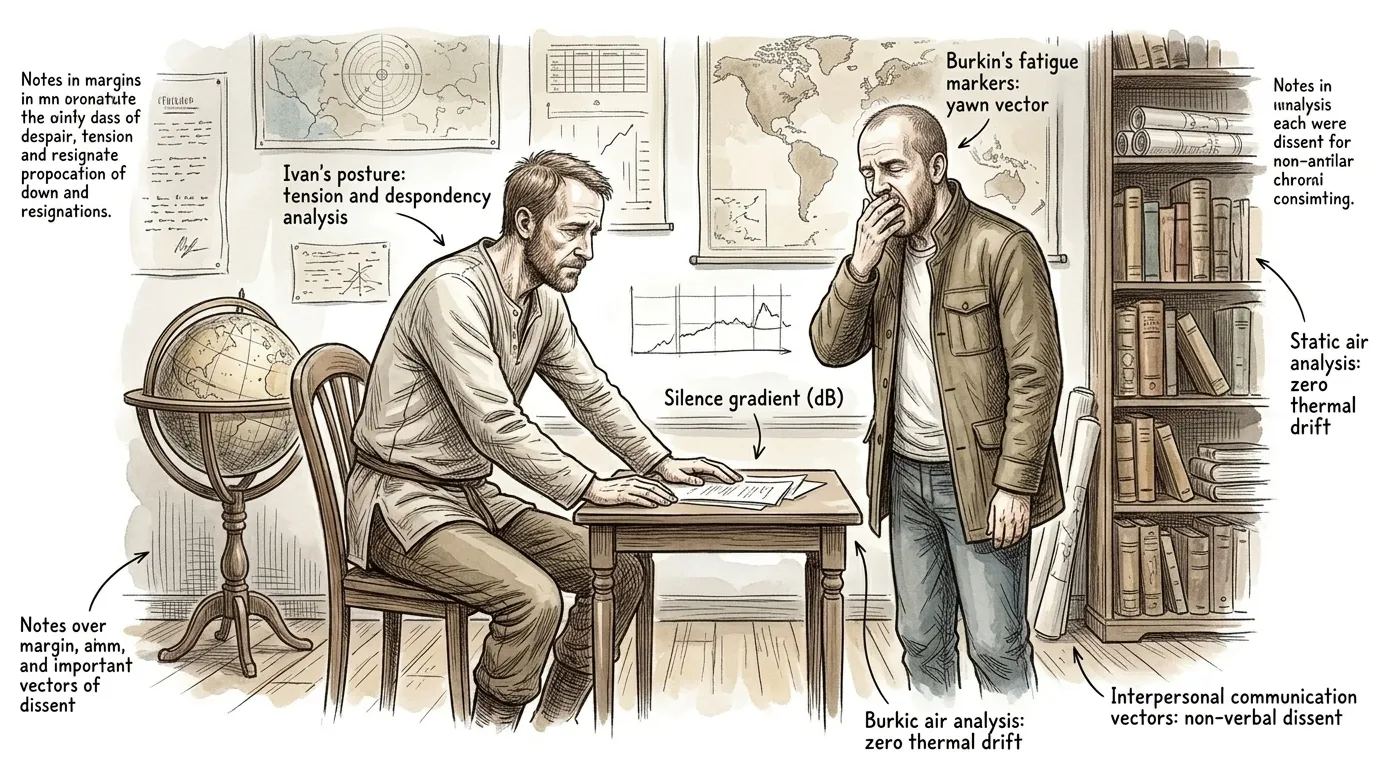
Ivan finished his story, but Burkin seemed to miss the profound message. "That's a good story, Ivan Ivanich," he mumbled, stifling a yawn, already thinking of sleep. The silence that followed was heavy with Ivan's unspoken despair, a stark realization that even the most passionate plea for truth might fall on deaf ears.
️ Literary Fact: The final page captures the story's lingering impact, or lack thereof, on Burkin. Ivan's despair reflects the difficulty of awakening moral consciousness in a world prone to complacency, leaving a lasting impression of profound, unresolved ethical questions.
About this story
- Audience: general readers
Questions and answers
Read Wonder Novels on your phone
Wonder Novels is available on Android. Get Wonder Novels on Google Play.