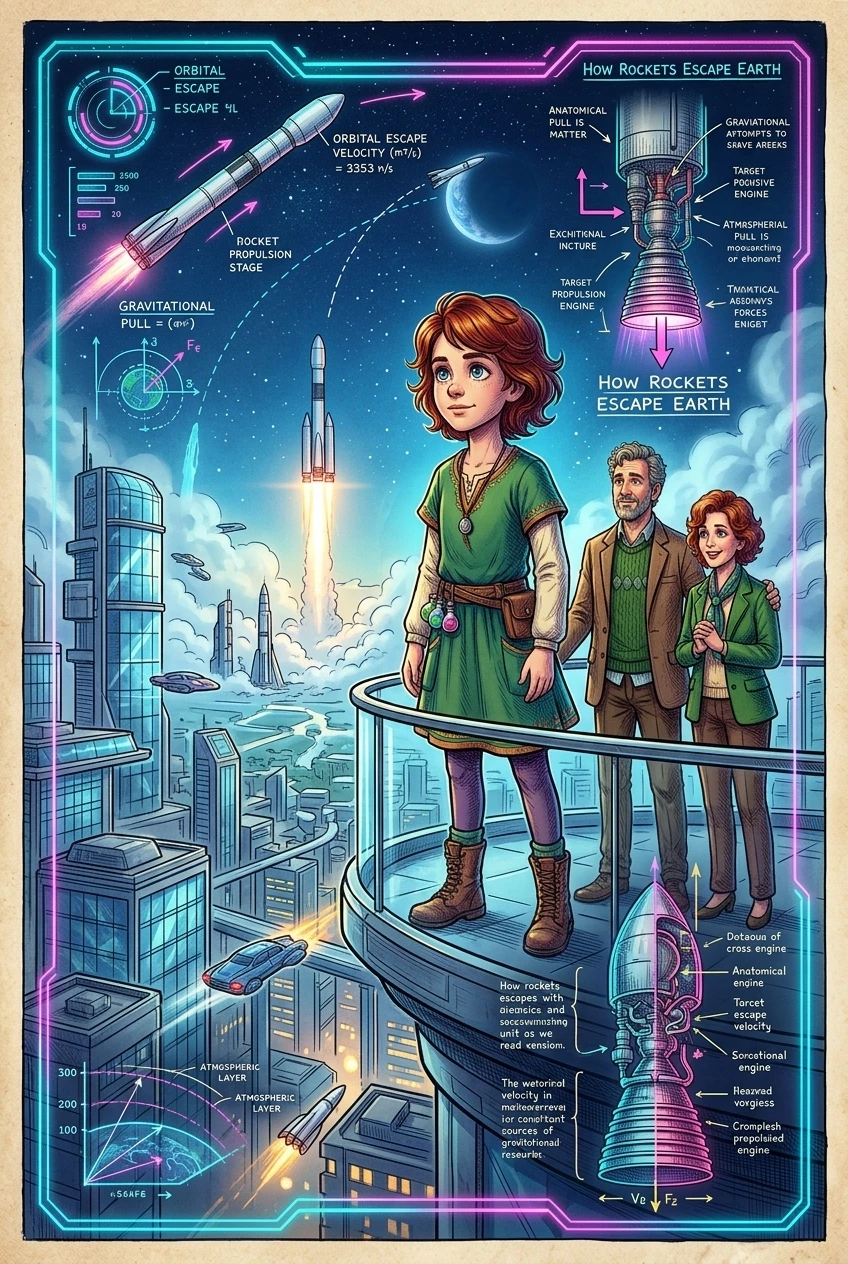
How Rockets Escape Earth
How Rockets Escape Earth — an illustrated science story, set in England. 10 illustrated pages, free to read on Wonder Science.
Page 1
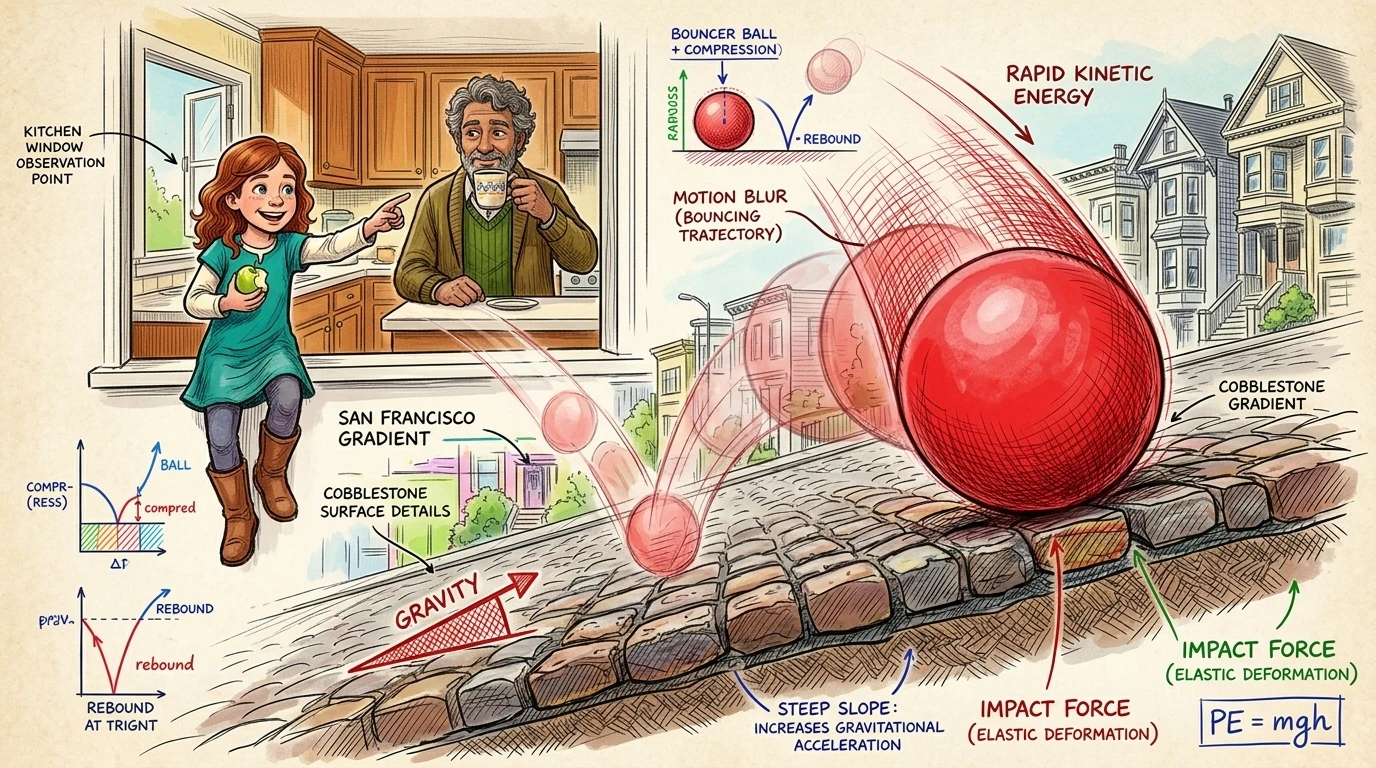
From their kitchen window in Noe Valley, Arlo and her father watched a red ball bounce down the steep San Francisco street. "Whoa, look how fast it's going!" Arlo exclaimed, pointing with a half-eaten apple. Her father nodded, sipping his coffee. "Gravity really pulls things down these hills, doesn't it?" A moment later, Arlo looked up from the street to the pale blue sky. "If gravity is so good at pulling things down," she asked, "how does a rocket ever get up into space?"
Page 2
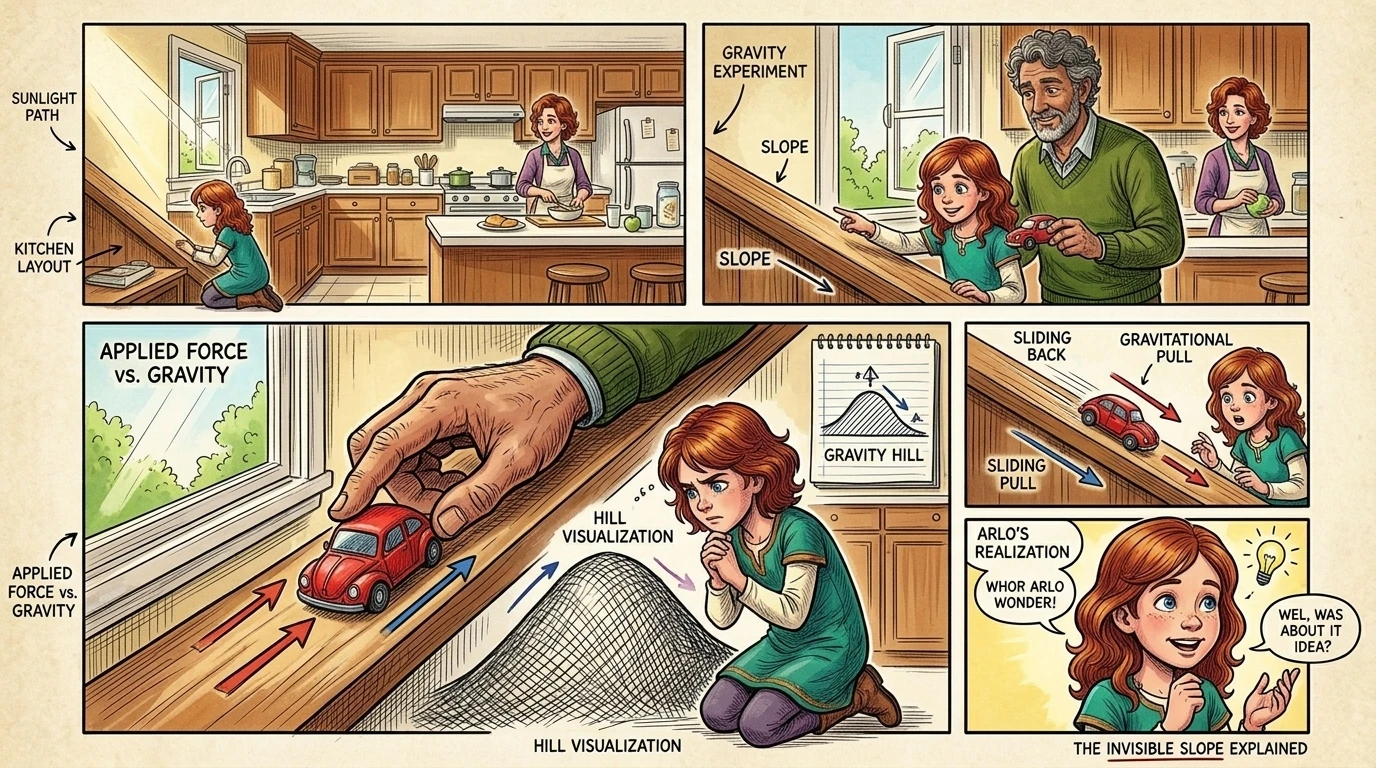
"That's the big question!" her father said, kneeling beside her. "You have to go incredibly fast, something called 'escape velocity.' Think of Earth's gravity as a giant, invisible hill; to get into space, a rocket has to be launched with enough speed to coast all the way to the top and over the other side." He picked up a small toy car and rolled it slowly up the slanted windowsill, watching it slide back down. "See? Too slow, and you always fall back."
Page 3
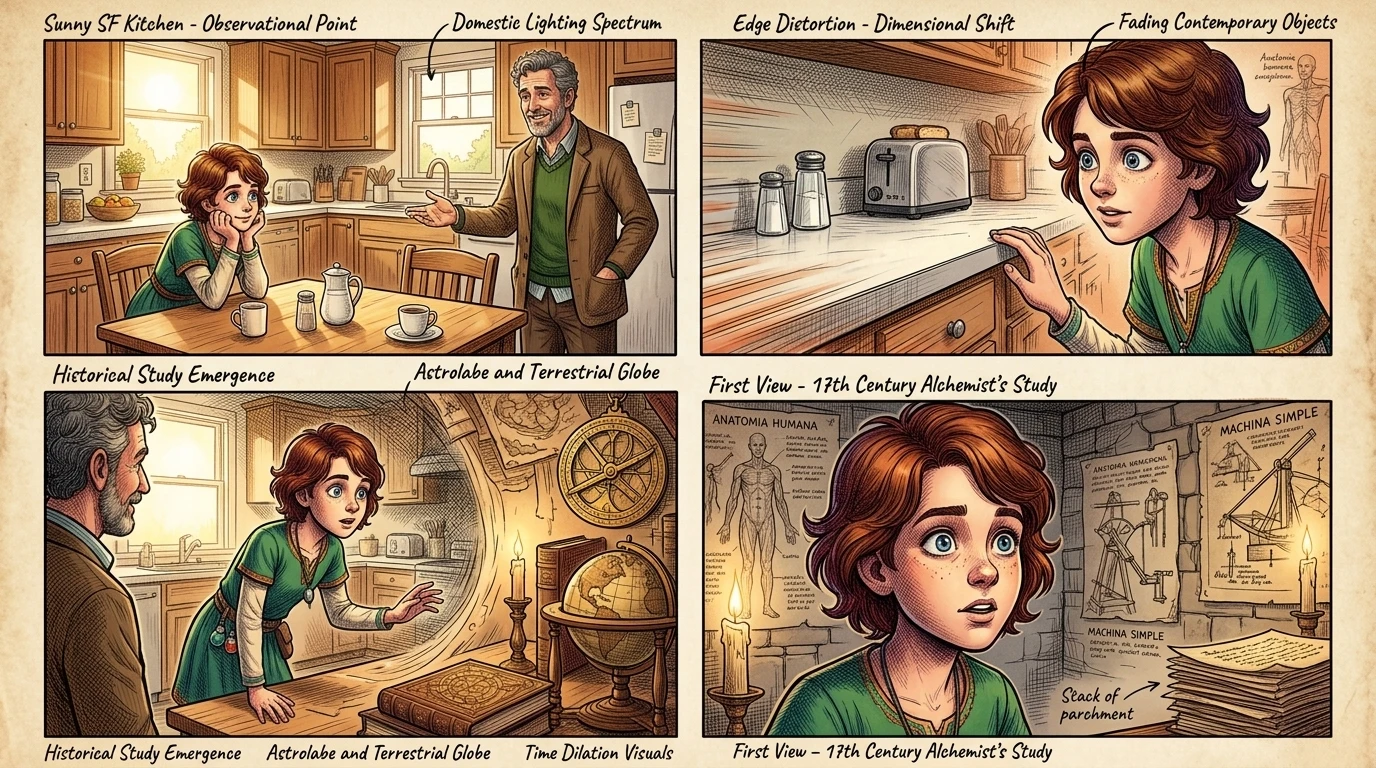
"So who was the first person to figure out how big that gravity hill is?" Arlo wondered aloud, her chin resting in her hands. Her father smiled. "To answer that, we have to travel back in time over 300 years, to England, long before anyone had even dreamed of building a real spaceship." The sunny San Francisco kitchen seemed to fade, replaced by the image of a quiet, stone-walled study filled with books and strange instruments.
Page 4
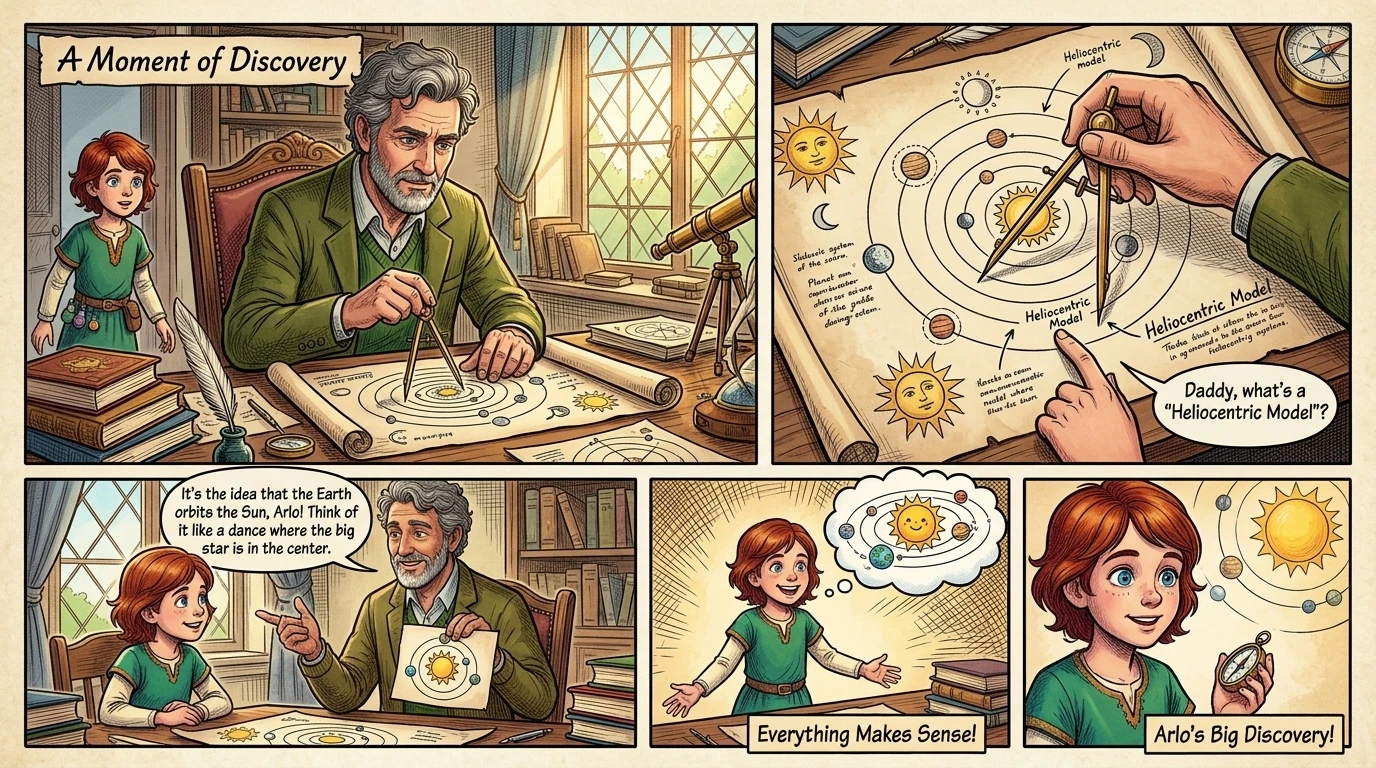
"This is Sir Isaac Newton," her father's voice narrated, as the man at the desk looked up from his work. "In the late 1600s, he wasn't just a scientist; he was an obsessive puzzle-solver who came up with the laws of motion and universal gravitation. He was fascinated by why the moon orbited the Earth instead of just flying away or crashing down." Newton picked up a compass, thoughtfully tapping it against a drawing of the solar system.
Page 5
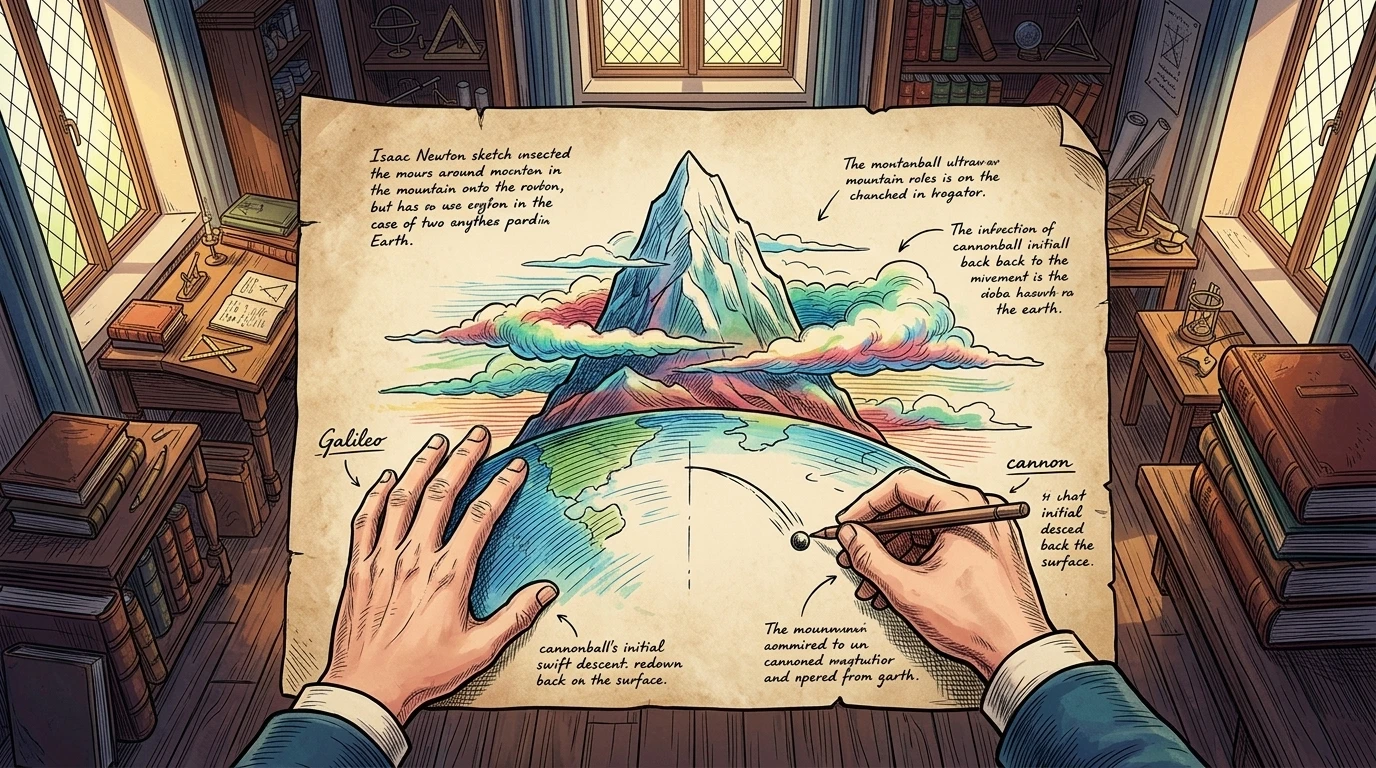
Newton wasn't thinking about rockets, but about cannons. He sketched a picture of a giant mountain rising above the clouds. "He realized that if he could stand on the shoulders of giants like Galileo, he could see further," Arlo whispered, remembering the famous quote. Newton imagined firing a cannonball from the peak. "A little bit of gunpowder, and the ball falls to Earth," he muttered to himself, drawing a short, curved line.
Page 6
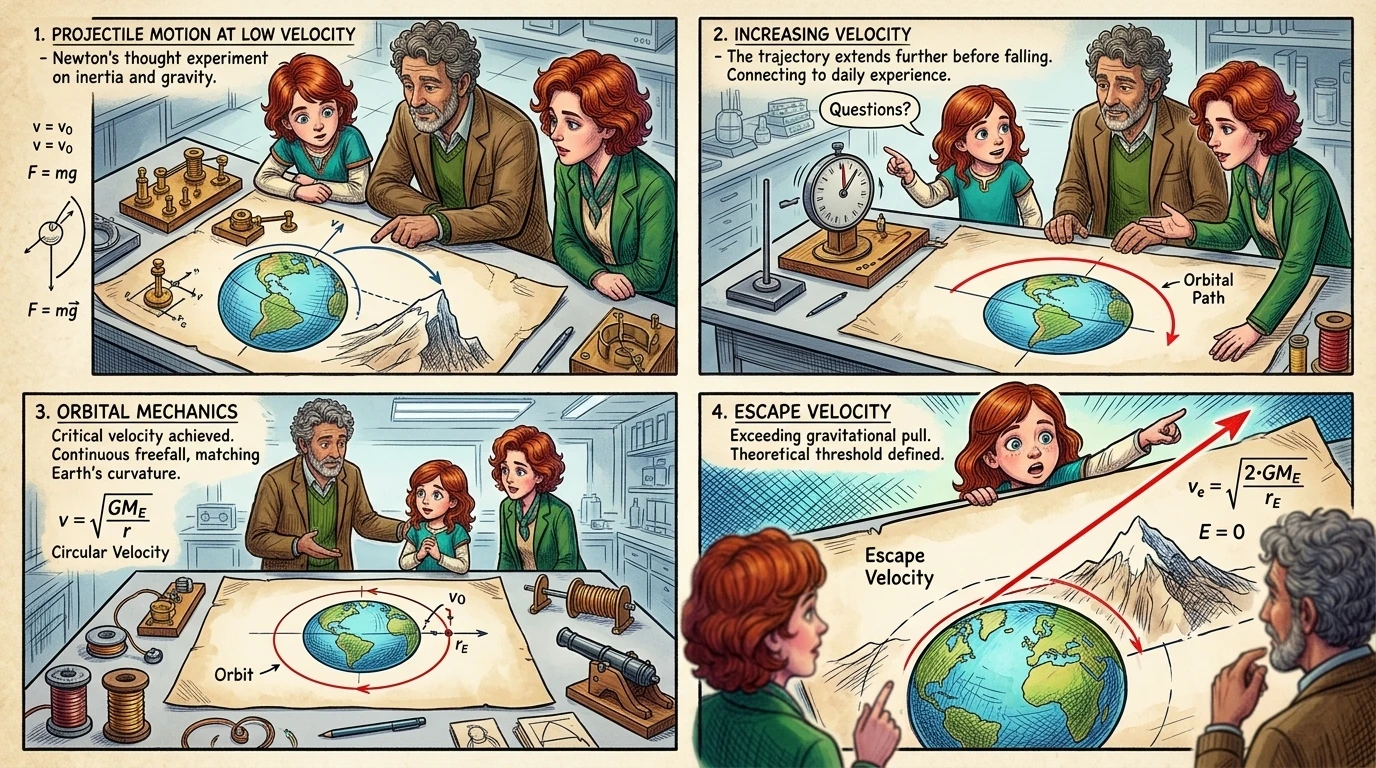
"But with more gunpowder," Newton sketched again, "the ball travels further before it lands." He drew a second, longer arc that wrapped a quarter of the way around his drawing of the Earth. "With just the right speed, the cannonball would fall, but it would travel so far horizontally that it would constantly miss the Earth, entering orbit! And with even more speed..." He drew a final line, one that shot away from the planet entirely, never to return.
Page 7
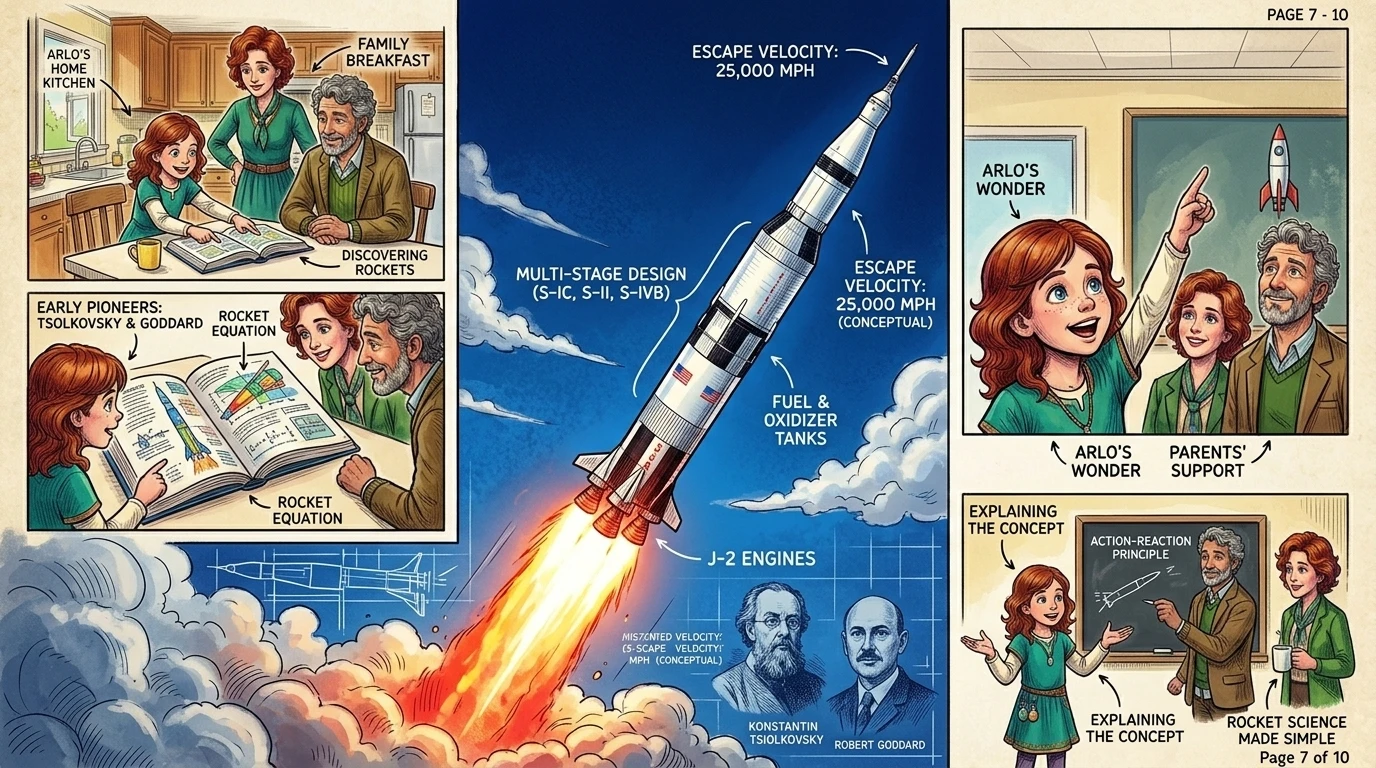
That final, escaping line was the secret! "Newton's idea showed that escape velocity for Earth is about 25,000 miles per hour," Arlo's father explained. "Scientists like Konstantin Tsiolkovsky in Russia and Robert Goddard in America used his math to design the first real rockets." The scene shifted to show the colossal Saturn V rocket, which used that exact principle to send humans to the Moon.
Page 8
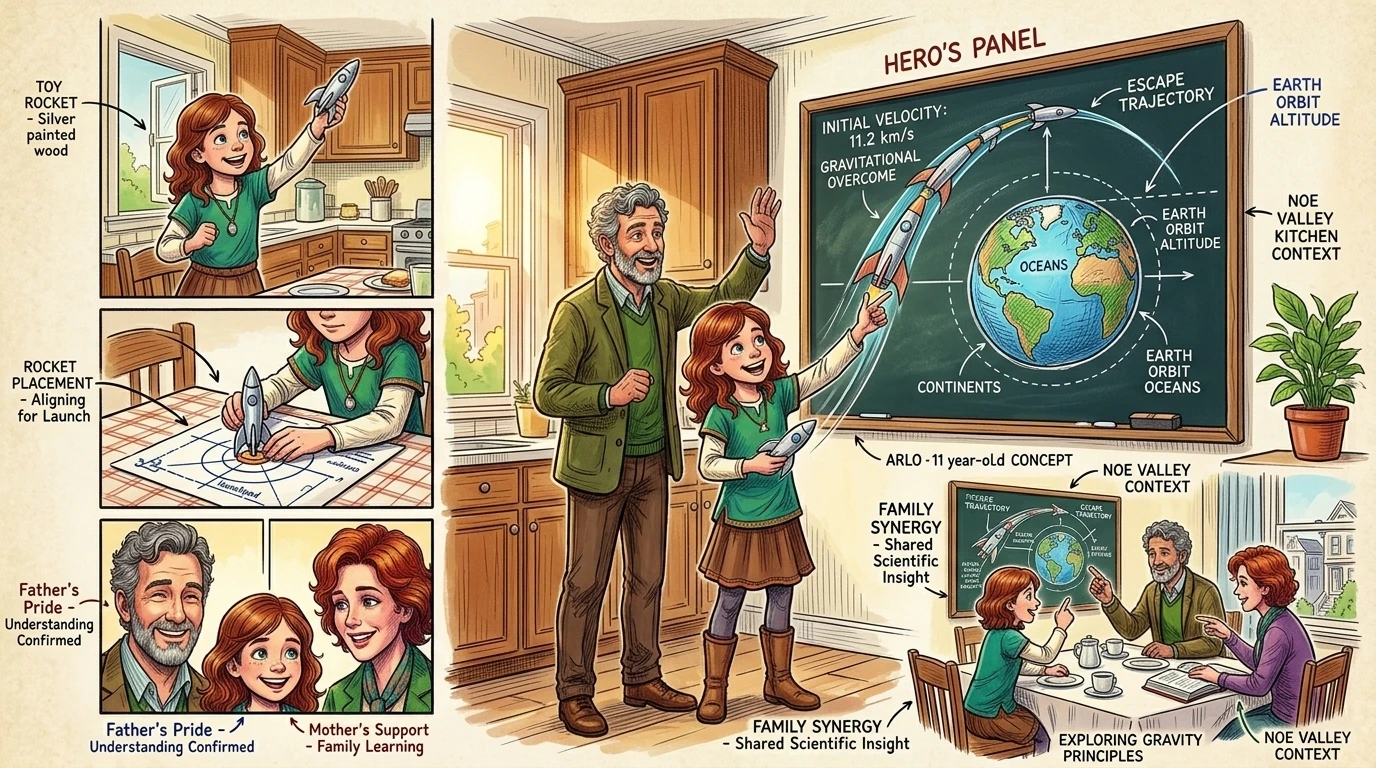
Back in the Noe Valley kitchen, the afternoon sun streamed in. Arlo jumped to her feet, her eyes shining with excitement. "So the giant rocket is just a super-powered cannonball!" she said, grabbing her small toy rocket. "It has to go fast enough to get all the way over Earth's giant gravity hill and not fall back down!" Her father smiled and high-fived her. "Exactly! You've got it."
Page 9
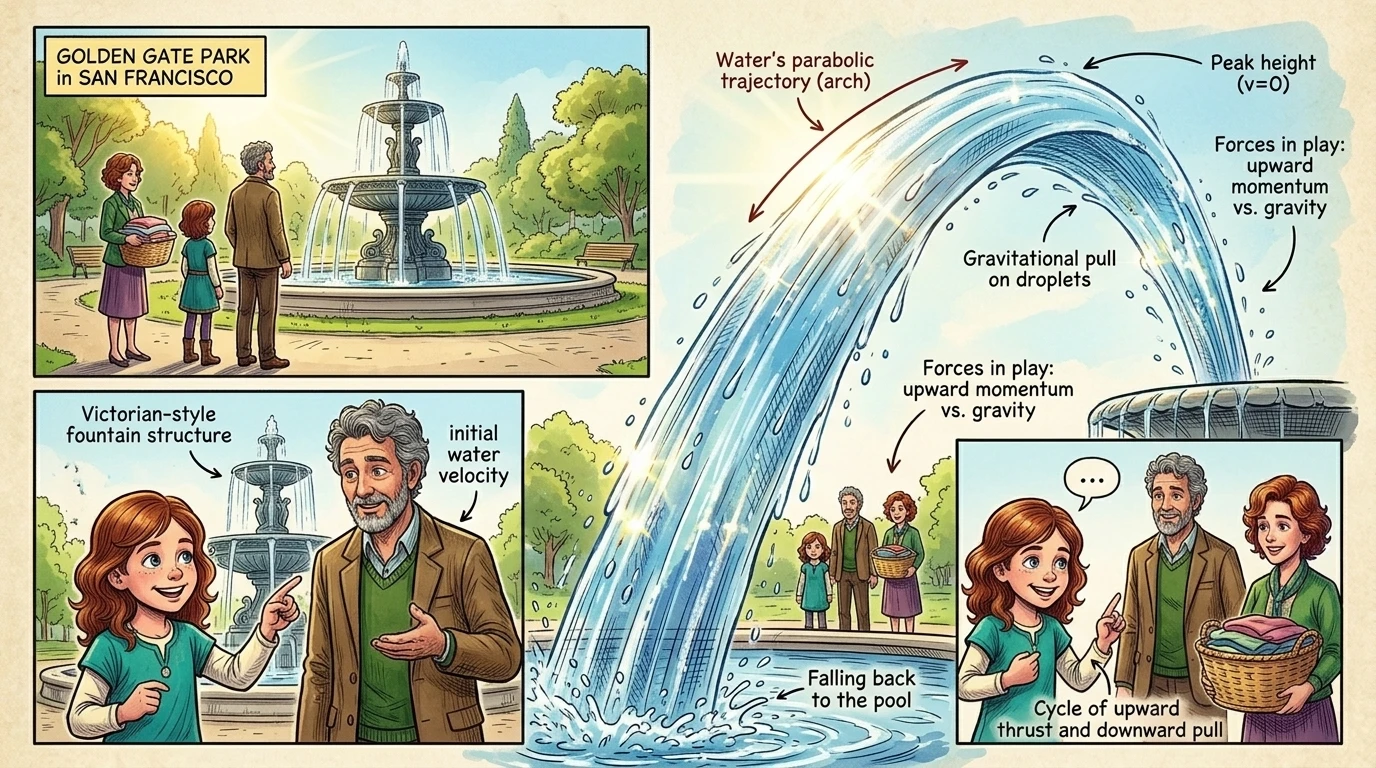
Arlo's mother came in, holding a basket of laundry. "What's all the excitement about?" she asked. "We figured out escape velocity!" Arlo announced. Her father added, "It's like how a professional baseball player can't throw a ball into orbit, no matter how hard they try." Arlo's mother laughed. "So even the water shooting up from the fountain in Golden Gate Park is fighting its own little battle with the gravity hill, but it always loses."
Page 10

Arlo took out her discovery notebook and carefully wrote: 'Escape Velocity the forever speed!' She looked at the poster of the solar system on her wall, a new appreciation in her eyes. "Dad," she said slowly, turning to him, "light travels faster than anything. Is there any gravity hill so steep that even light can't escape it?" Her father's eyes lit up, sensing the next big question.
About this story
- Location: England
- Audience: kids (ages 6–12)
Questions and answers
Read Wonder Science on your phone
Wonder Science is available on Android. Get Wonder Science on Google Play.