Michael Collins
Michael Collins — a science story. Topics: Pioneers of Space Exploration, Global, Unknown Era, Scientific Revolution to space age. 10 illustrated pages, narrated, free to read on Wonder Science.
Page 1
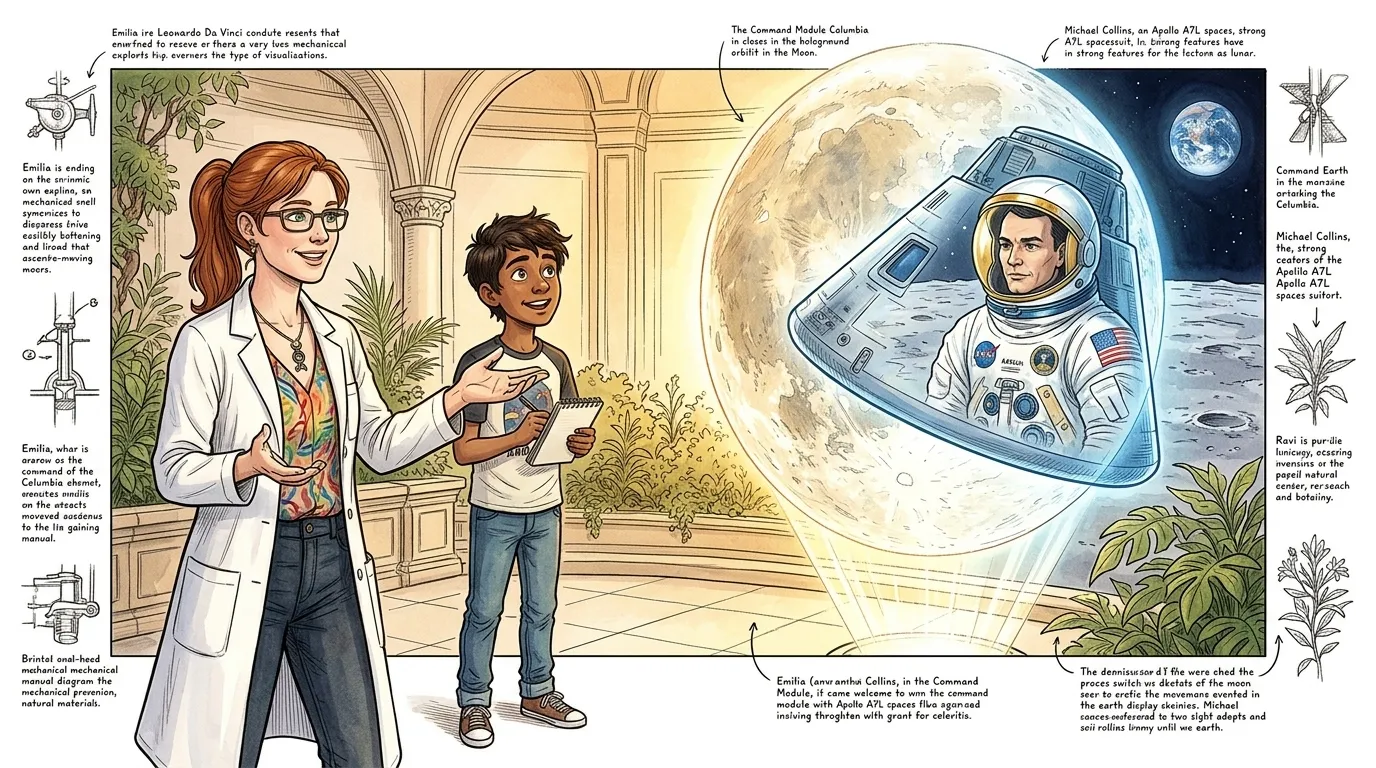
Above the lunar surface, a silent vigil unfolded. As Neil Armstrong and Buzz Aldrin descended towards history in the Lunar Module Eagle, Michael Collins orbited alone in the Command Module Columbia.
""Imagine the solitude," Emilia remarks, gesturing at a holographic projection of the Moon. "He was the only human being anywhere, completely cut off from Earth for part of each orbit, with the fate of the mission resting solely on his shoulders." Ravi, eyes wide, adds, "And if they didn't make it back up, he had to return alone.""
Page 2
The Apollo 11 mission represented the pinnacle of human and engineering endeavor. It wasn't just about reaching the Moon, but about the incredibly complex ballet required to return safely.
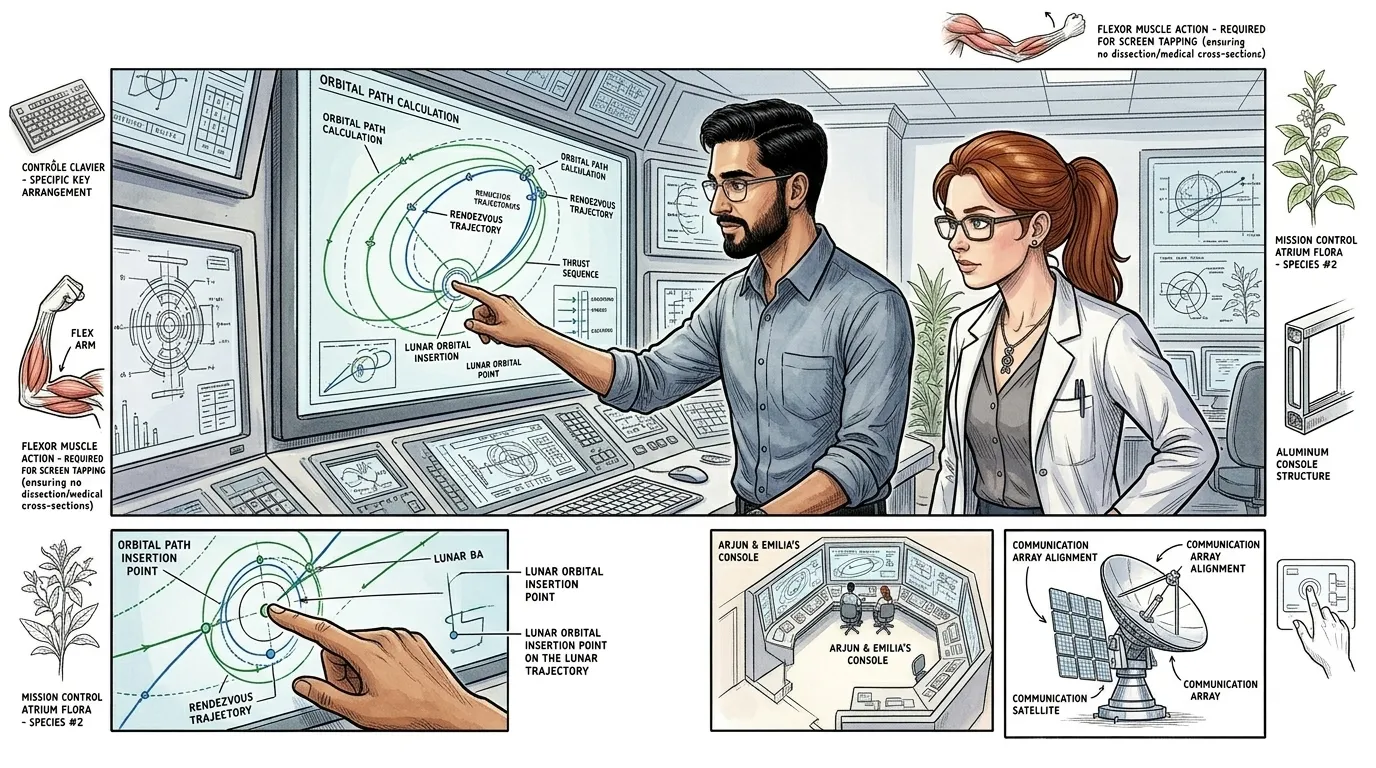
""What made Collins' role so critical wasn't just flying," Arjun states, tapping a point on the console. "It was the rendezvous. Think about it: two spacecraft, orbiting a distant world, trying to find each other in vast emptiness. There's no margin for error." Emilia nods. "It demands an almost impossible level of precision in celestial navigation. A miss would mean being stranded.""
Page 3
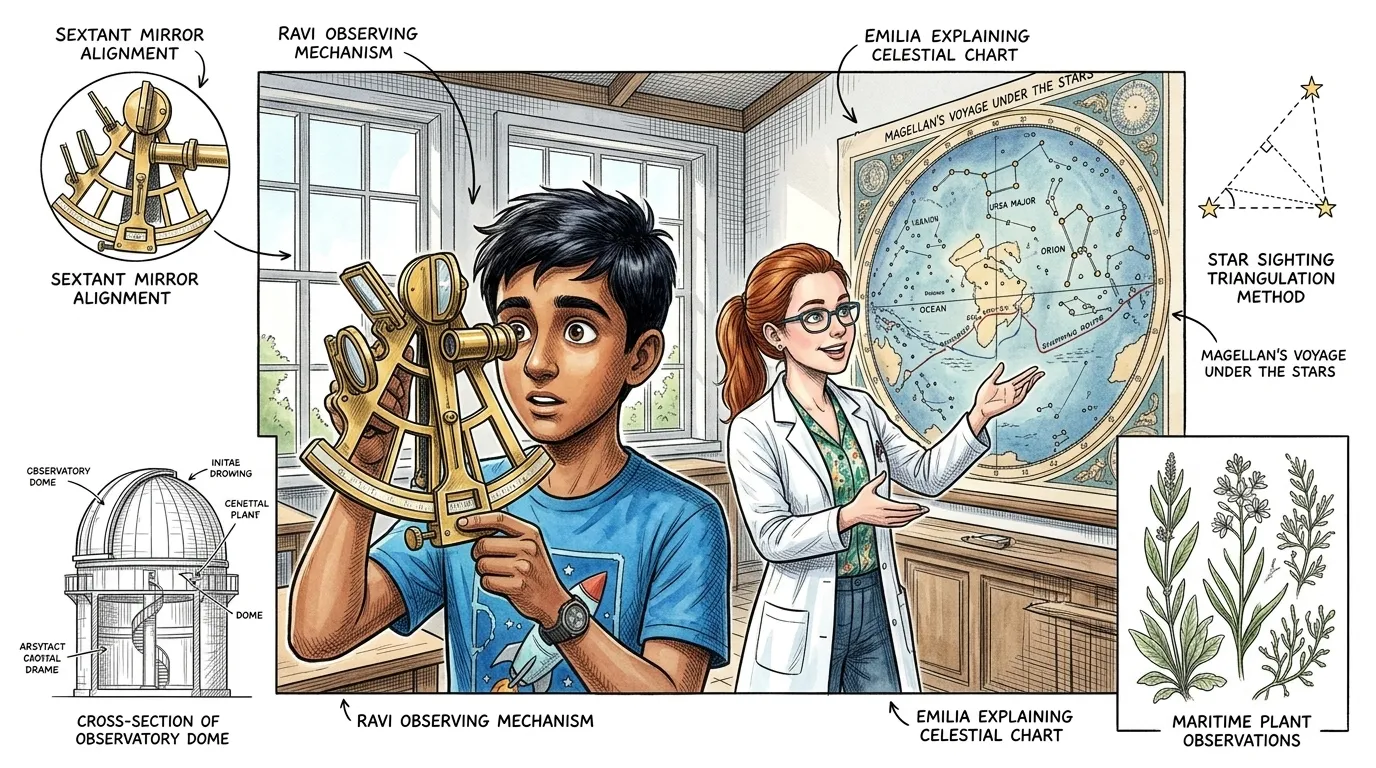
Before GPS and advanced guidance systems, navigating on Earth, and later in space, relied on observing celestial bodies. For Apollo, this ancient art was perfected to an unprecedented degree.
""Speaking of precision," Ravi says, holding up the brass sextant. "Emilia, you once told me that ancient sailors used tools like this to find their way across oceans, using the stars. How is that even possible in space?" Emilia smiles. "Ah, Ravi, you're touching on a timeless principle. Just as the stars guided Ferdinand Magellan across the Pacific in 1521, a highly refined version of celestial navigation was absolutely fundamental for Apollo's success. It was the only fail-safe to get the Command Module to intercept the Lunar Module for the journey home.""
Page 4
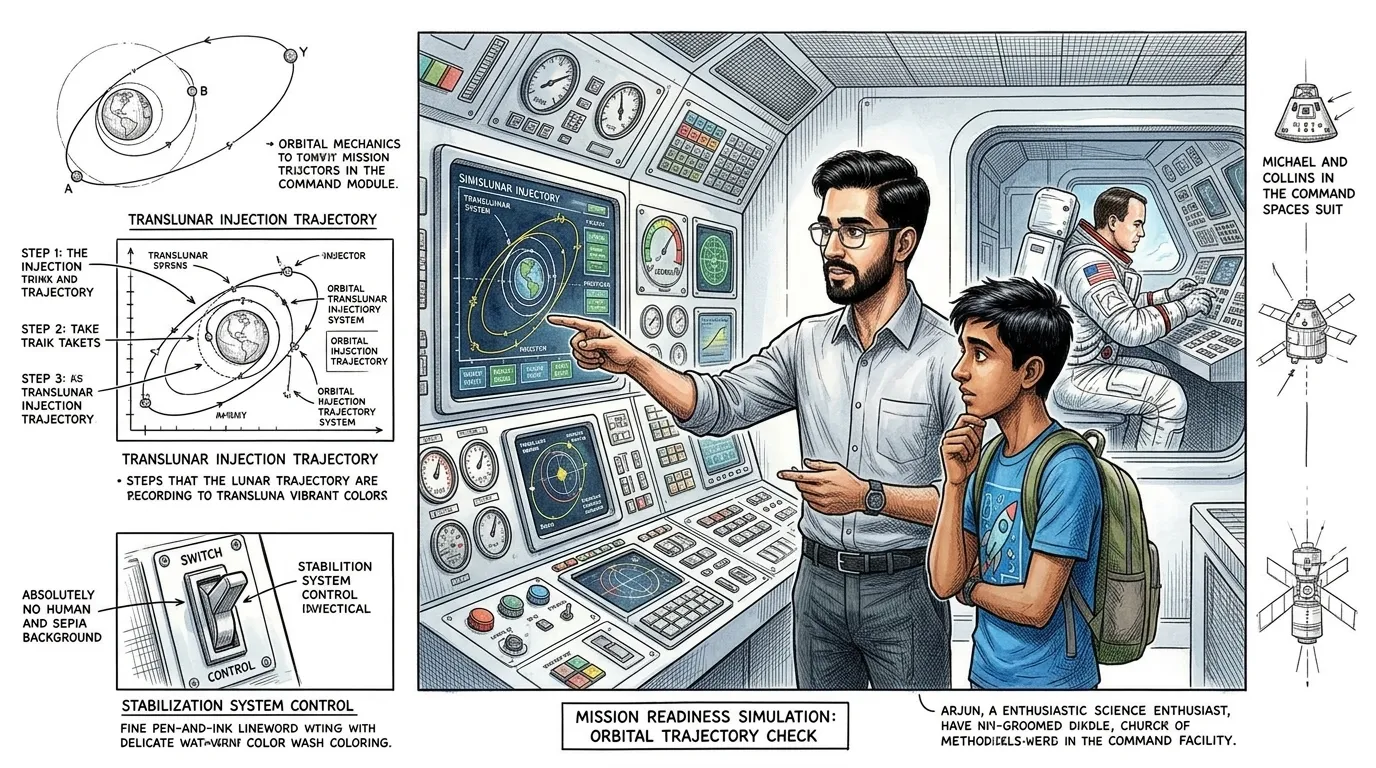
Michael Collins' path to Apollo 11 was built on a foundation of rigorous training and an unparalleled understanding of orbital mechanics. He meticulously prepared for every contingency.
""Collins wasn't just a passenger; he was the mission's single point of failure for the return journey," Arjun states, pointing at a simulated control panel. "He practiced rendezvous procedures hundreds of times in simulators. He had to be ready for any malfunction on the Lunar Module, prepared to calculate and execute the rescue maneuver purely on instruments and celestial fixes if necessary." Ravi nods. "So, he was like the ultimate backup plan, but also the main pilot for the return.""
Page 5
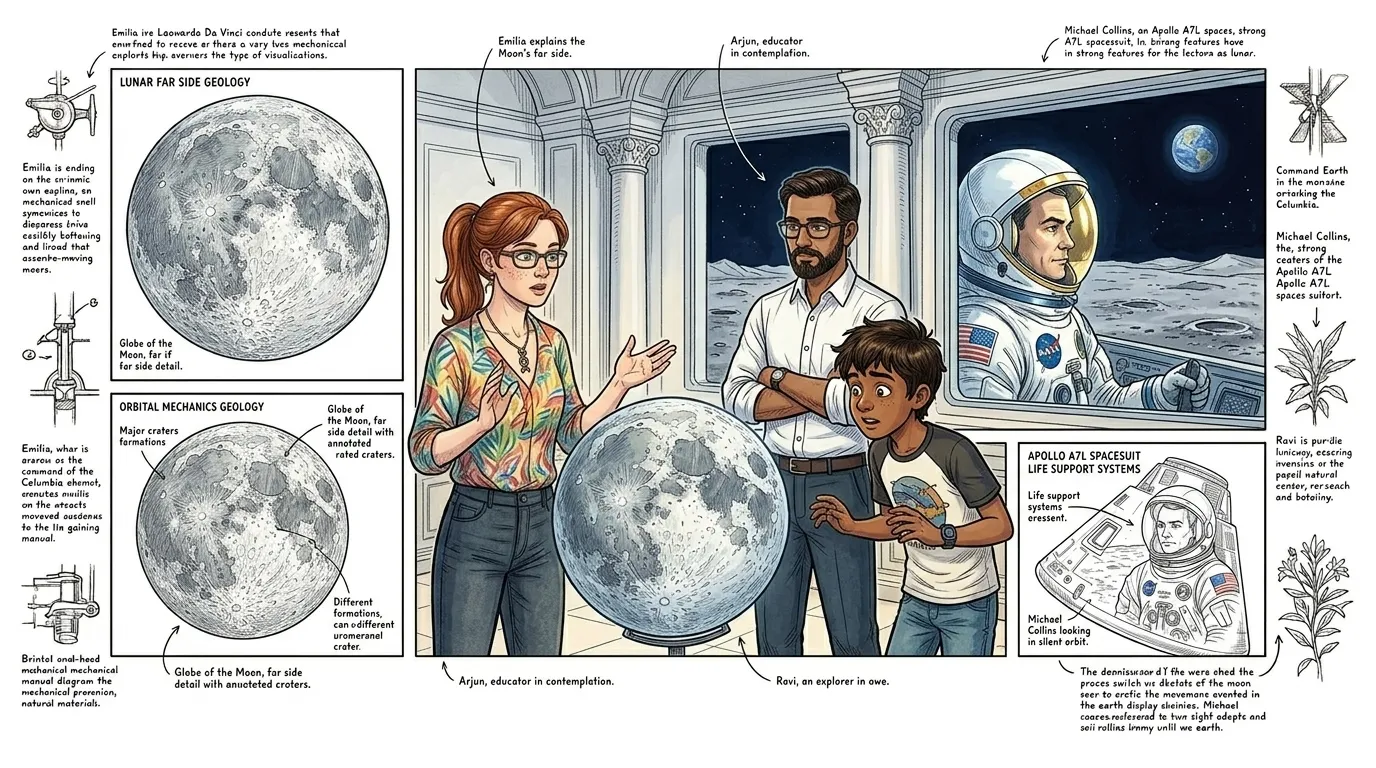
For nearly 28 hours, Michael Collins was utterly alone, orbiting the far side of the Moon. During these periods, he lost all contact with Earth, becoming truly isolated in the cosmos.
""Can you imagine that silence?" Emilia whispers, her voice hushed. "Completely cut off. For 48 minutes of every two-hour orbit, no communication with anyone, just the spacecraft and the Moon." Arjun adds, "It's often called the loneliest journey in human history. Yet, he described feeling not loneliness, but awareness, a profound understanding of humanity's fragile place." Ravi shivers slightly. "That's a unique perspective, seeing everything from such a distance.""
Page 6
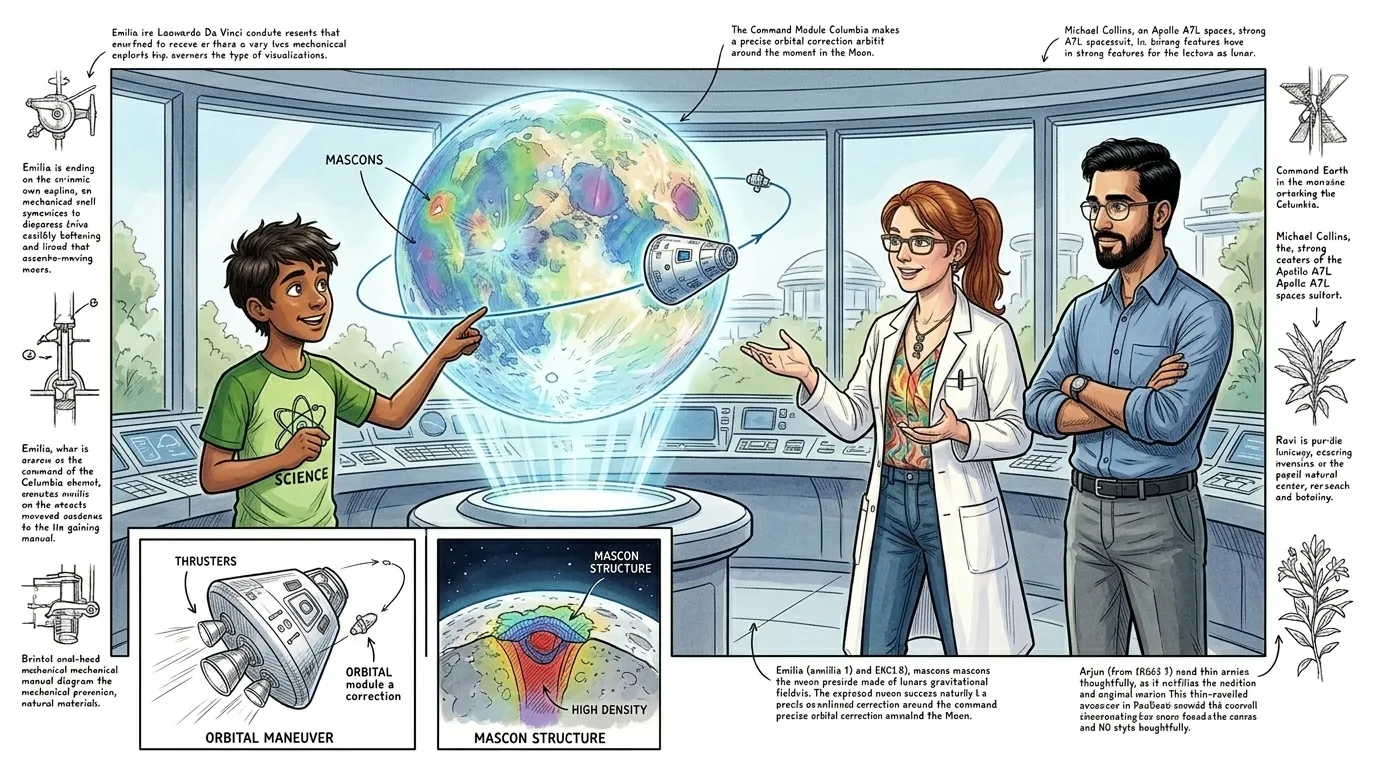
Collins' mastery extended to the complex physics governing objects in space. Lunar orbit, unlike Earth's, presents unique challenges due to the Moon's uneven gravitational field and the interplay of Earth's pull.
""It's not just a simple circle, is it?" Ravi asks, pointing at a dynamic simulation. "The Moon's gravity changes constantly, right?" Emilia explains, "Exactly. The Moon isn't a perfect sphere, and its mass distribution is uneven, creating 'mascons'—mass concentrations—that tug on orbiting spacecraft. Collins had to account for these subtle gravitational anomalies, constantly making tiny corrections to maintain his precise orbit, all while waiting for Eagle to return." Arjun adds, "Any deviation, however small, could jeopardize the critical rendezvous window.""
Page 7
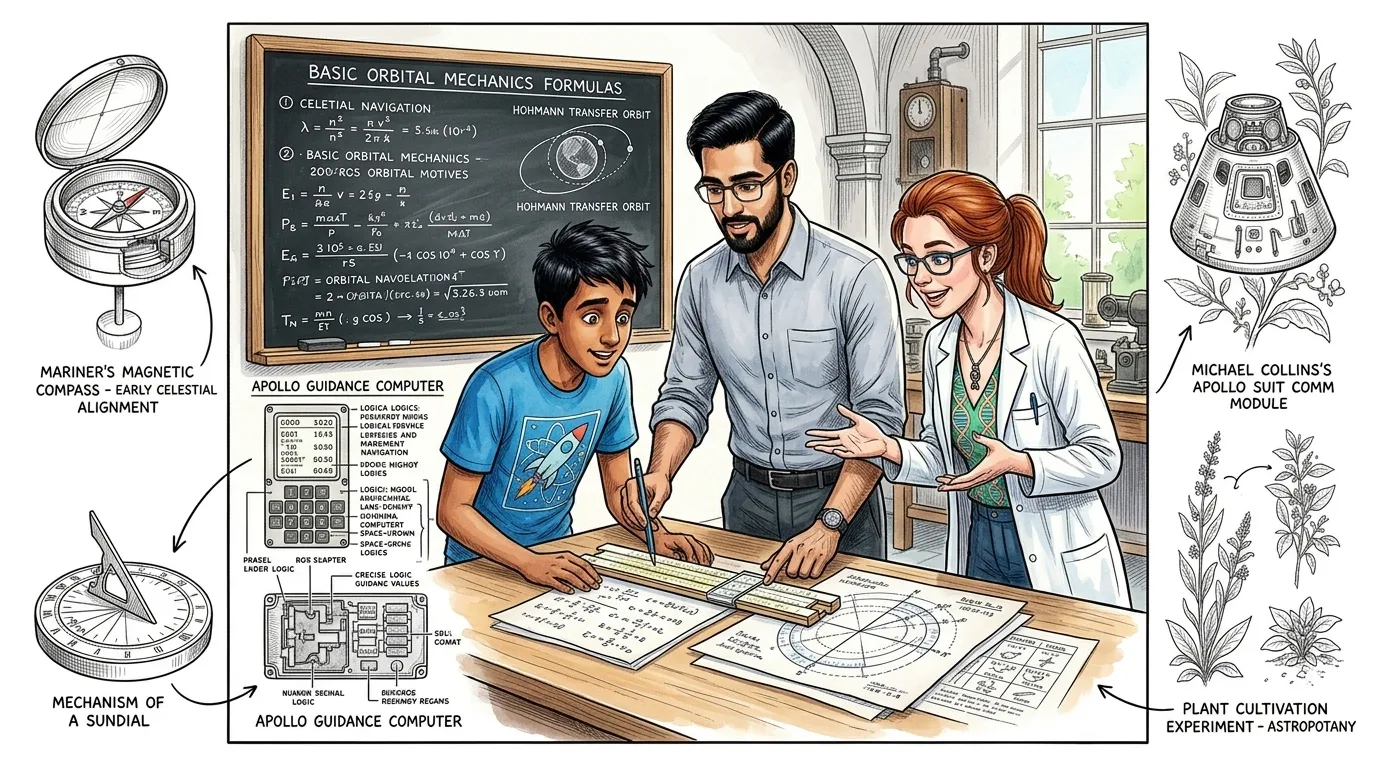
Though aided by onboard computers, the ultimate responsibility for navigation and rendezvous calculations rested with Collins. His brain was the ultimate backup system.
""So, even with computers, he still had to be the master calculator?" Ravi asks, looking thoughtful. Arjun replies, "Absolutely. The onboard computer, the Apollo Guidance Computer, was groundbreaking, but Collins understood its every function and limitation. He performed manual calculations using a slide rule and paper charts, constantly cross-referencing to ensure he could take over if automation failed." Emilia adds, "He once said, 'I felt that if I had to come home by myself, I could do it.' That confidence came from meticulous preparation and his mastery of those fundamental principles of celestial mechanics.""
Page 8
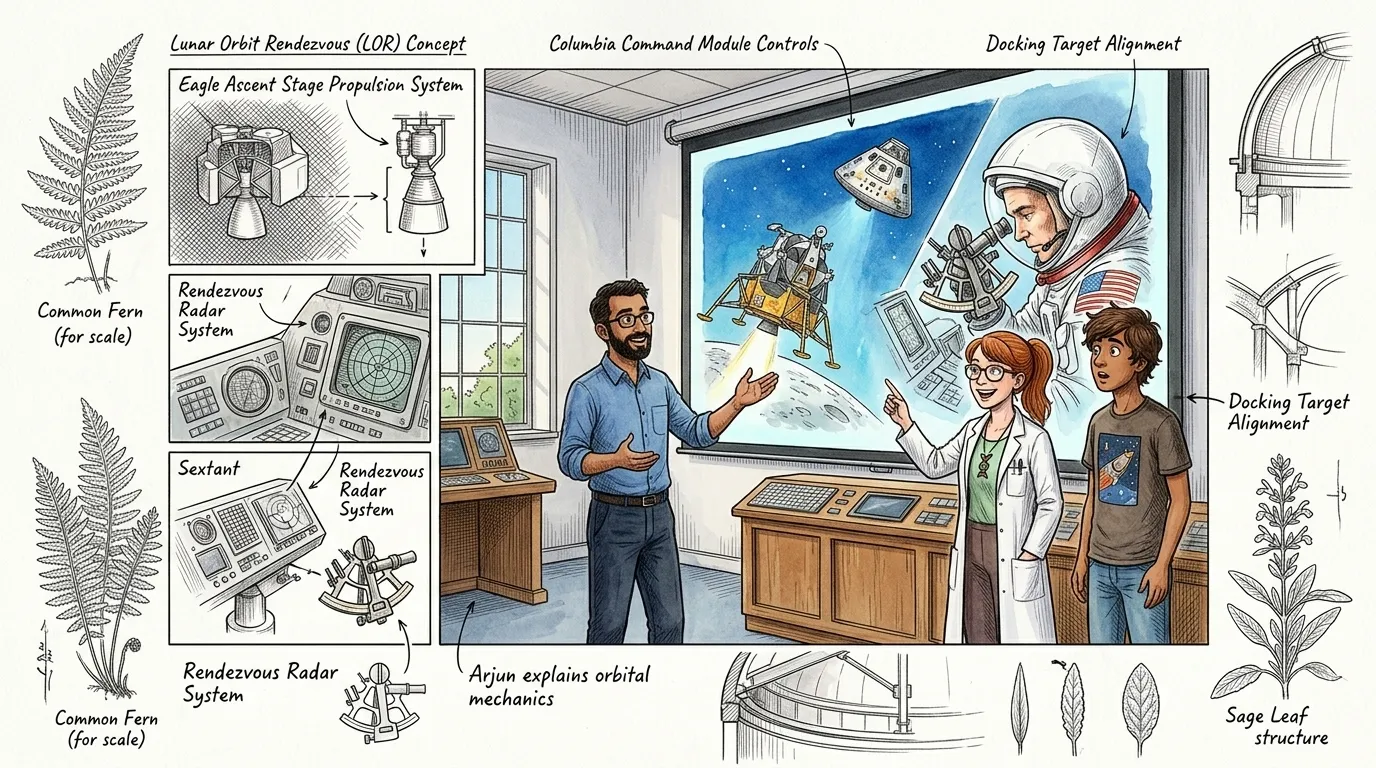
After two days on the lunar surface, the Lunar Module Eagle ascended, rejoining Columbia in orbit. This was Michael Collins' moment, the culmination of his solitary vigil and precise preparation.
""This is it—the moment everything had built towards!" Arjun exclaims, his voice filled with excitement. "Collins had to flawlessly execute the rendezvous. Remember that sextant Ravi was holding?" Emilia points. "Yes, that precise understanding of celestial coordinates, honed through countless simulations and backed by his deep knowledge of orbital mechanics, allowed him to perfectly position Columbia. His calculations ensured the tiny window for docking wasn't missed." Ravi adds, "It's mind-blowing how much depended on that one person getting it exactly right.""
Page 9
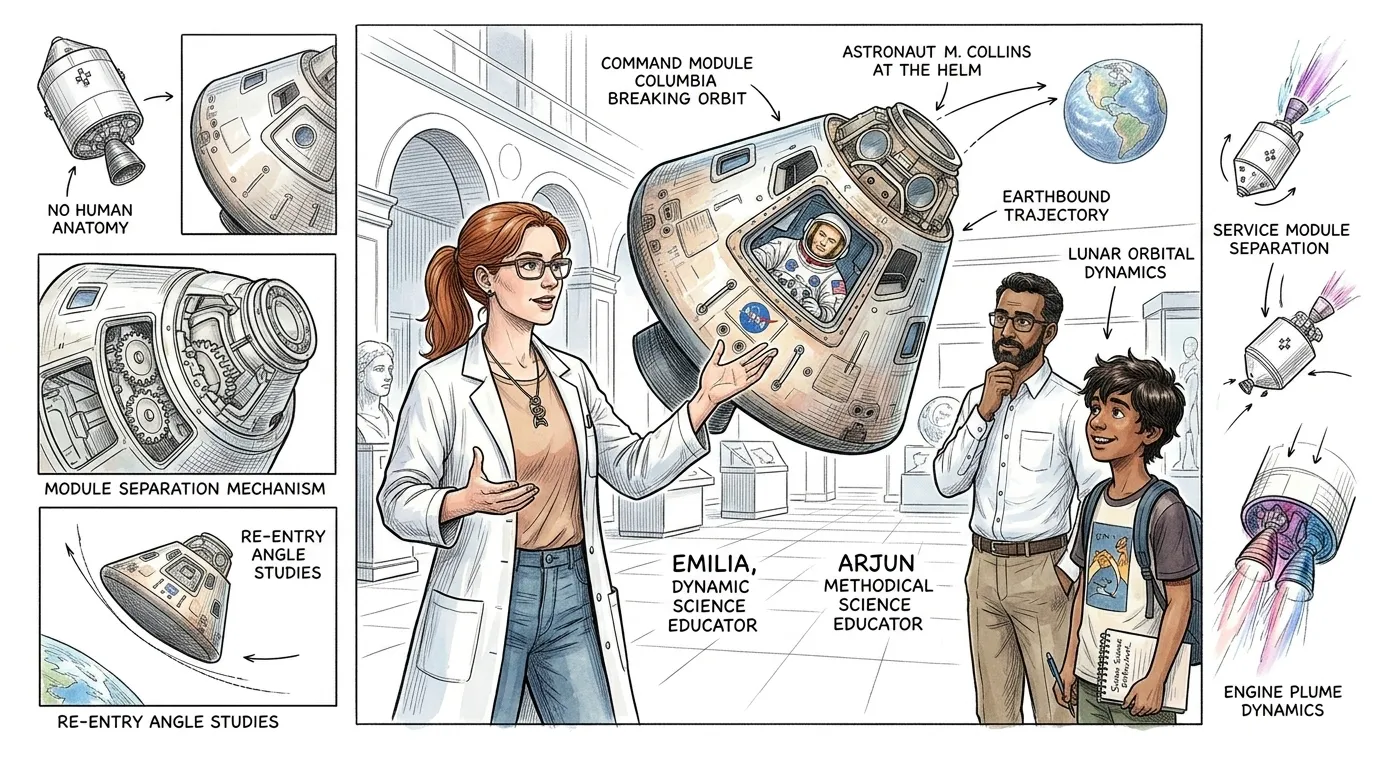
With Armstrong and Aldrin safely aboard, Columbia ignited its engines, breaking free of lunar orbit. Michael Collins, having performed his role with flawless precision, steered them towards Earth.
""The success of Apollo 11 wasn't just the landing; it was the safe return, and Collins was absolutely pivotal to that," Emilia states with conviction. Arjun adds, "His mastery of those 'ancient' navigation skills, paired with modern engineering, brought them home. It's a powerful lesson in foundational knowledge intersecting with cutting-edge technology." Ravi reflects, "So, without him, the Moon landing might have been a one-way trip? That's an incredible responsibility.""
Page 10
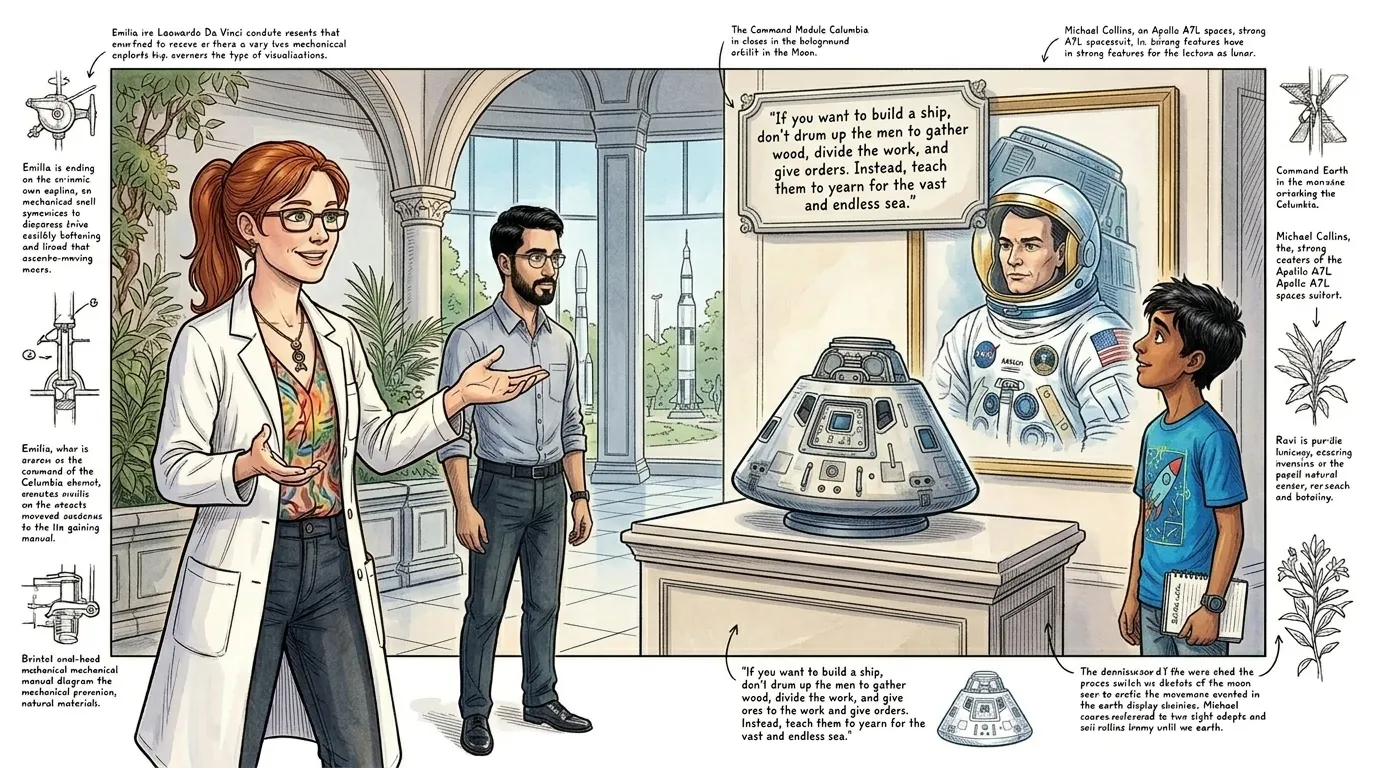
Michael Collins' contribution to Apollo 11, though often overshadowed, remains a testament to the essential role of precision, preparation, and perspective in humanity's greatest endeavors. His career extended far beyond spaceflight.
""Collins once quoted Saint-Exupéry, saying, 'If you want to build a ship, don't drum up the men to gather wood, divide the work, and give orders. Instead, teach them to yearn for the vast and endless sea.' He really understood that motivation is key," Emilia shares. Arjun muses, "His post-NASA career, leading the National Air and Space Museum, shows he continued to inspire that yearning for exploration and understanding." Ravi concludes, "He wasn't just a pilot; he was a silent anchor, enabling a giant leap, and then ensuring future generations could still dream big.""
About this story
- Location: Global
- Audience: general readers
- Format: 10 illustrated pages, narrated, free to read on Wonder Science
Questions and answers
Read Wonder Science on your phone
Wonder Science is available on Android. Get Wonder Science on Google Play.