Hans in Luck
A lump of gold, five trades, and a man who comes home with nothing and calls himself the luckiest man alive
Page 1
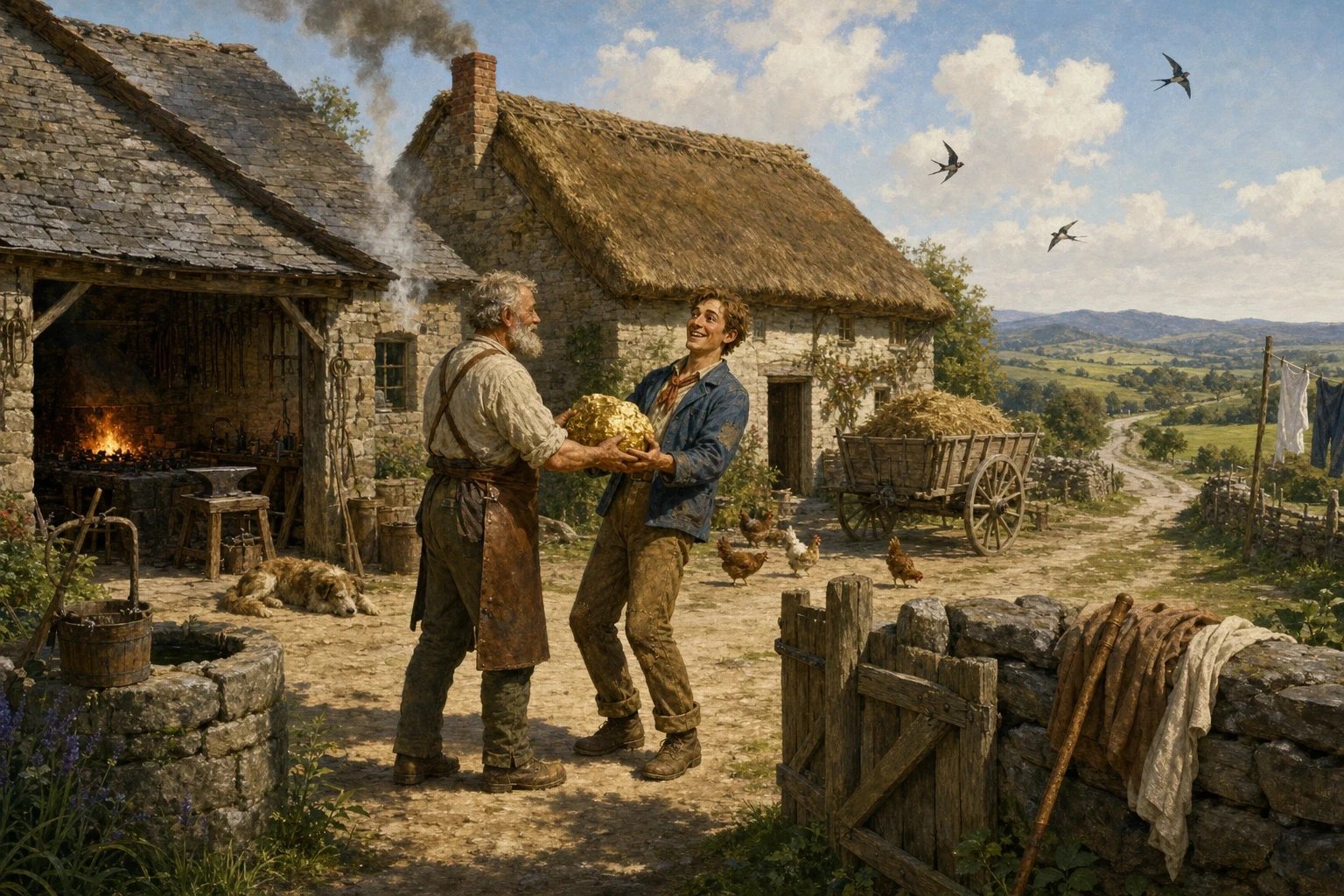
Hans had served his master for seven long years, through plowing seasons and harvests, through hard winters and short summers, and now at last his time was up. 'Hans,' said the master, standing in the yard by the forge, 'you have worked for me well and faithfully, and such service deserves a fine reward.' And he brought out a lump of gold as big as Hans's own head and set it in his arms. Hans wrapped it in a cloth, slung it over his shoulder, and set off down the dusty road toward his mother's village, his heart light and his step quick. The gold was heavier than anything he had ever carried, but he did not mind one bit, for every step took him nearer home, and he was certain that no man in the whole wide world was luckier than he was that bright morning.
Page 2
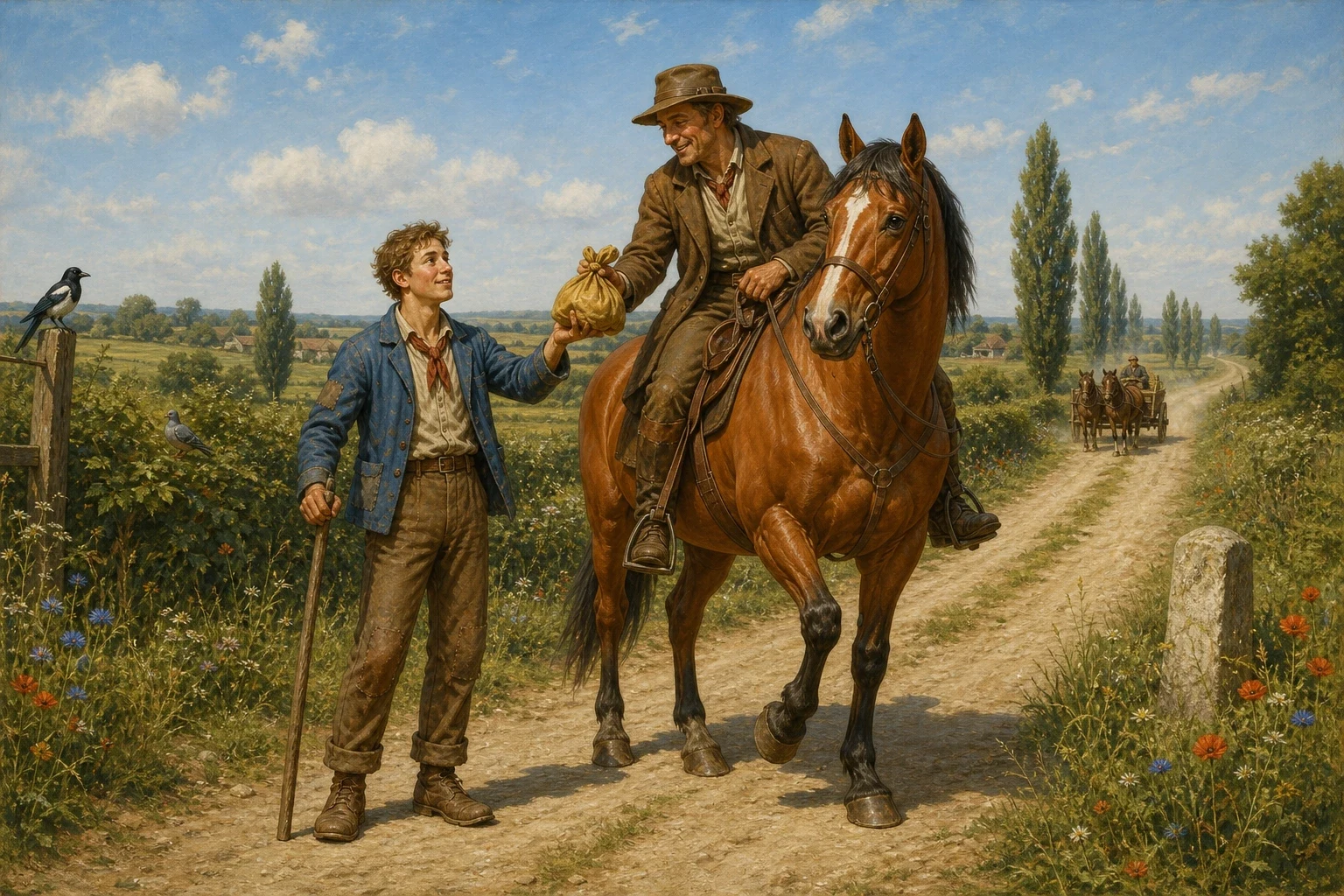
Hans trudged on down the long road, and the lump of gold grew heavier with every mile, pressing on his shoulder until it ached. 'If only I had a horse,' he thought, 'I could ride instead of walk, and never feel tired at all.' Just then a horseman came trotting merrily along, sitting tall and easy in the saddle. 'Ah, if only I could ride as you do,' Hans called out. 'Then why do you walk?' laughed the horseman, reining in. 'Swap with me — my horse for your gold — and you shall ride the rest of the way.' Hans could hardly believe his luck. He handed over the heavy gold without a second thought, and the horseman helped him up into the saddle. 'Now,' thought Hans, settling himself proudly, 'this is riding as a gentleman ought,' and off he trotted down the road, lighter than he had felt in hours.
Page 3
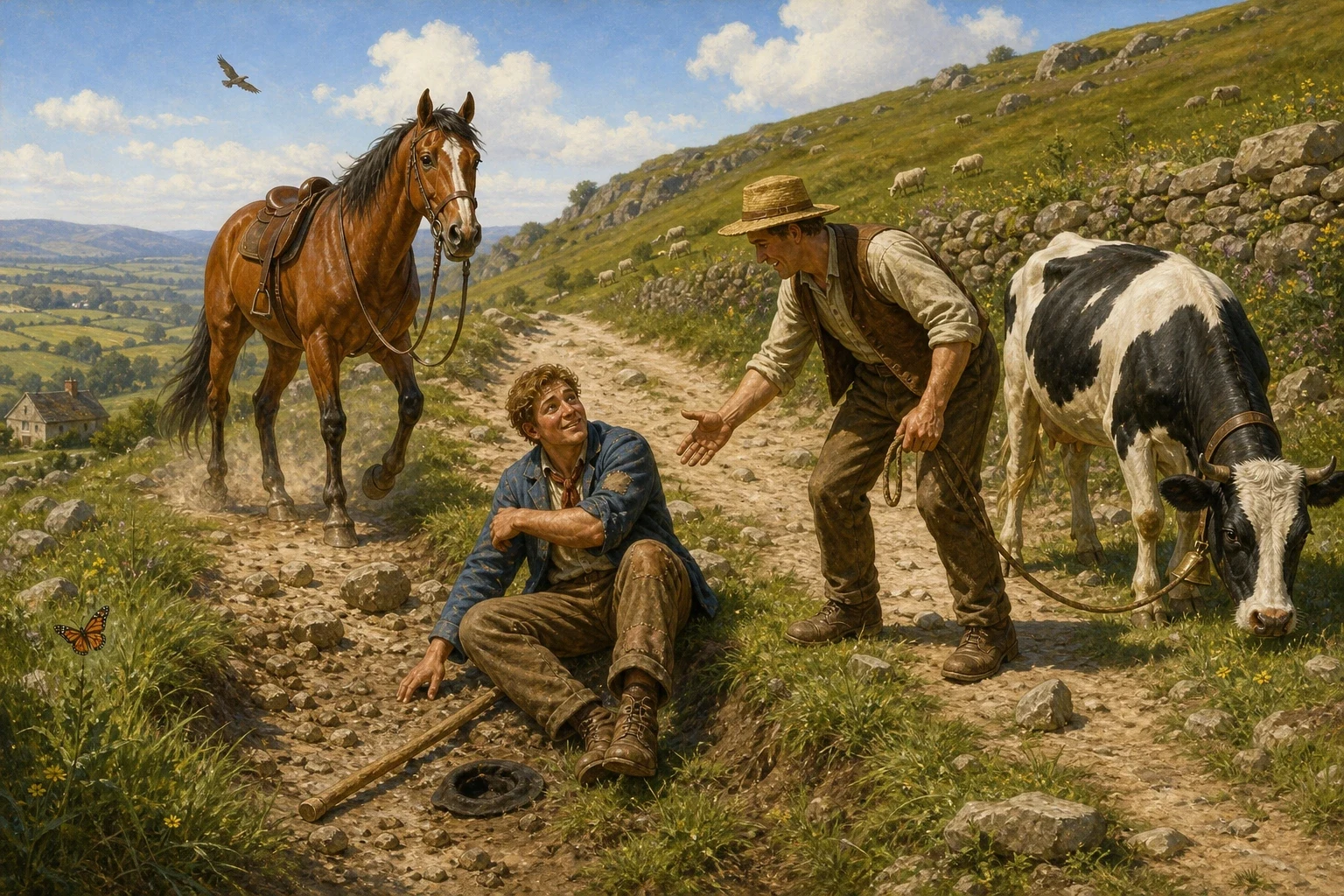
Hans rode on, pleased as could be, until he grew bold and dug in his heels to make the horse go faster. The horse broke into a gallop at once, tossing its head and racing far too fast down the hillside road, and before Hans could do anything about it, he was thrown clean off into the ditch at the side of the road. A farmer leading a cow by a rope happened to be walking that way, and he helped Hans to his feet. 'That is a wild, dangerous animal you have there,' said the farmer, nodding at the horse. 'Now my cow, she will never throw you — and besides, she gives good milk every day, and butter and cheese besides.' 'You are right,' said Hans, rubbing his elbow. 'A cow is a far steadier thing to own than a horse.' So they traded then and there, and Hans walked on leading the cow instead, well pleased with his new and gentler companion.
Page 4
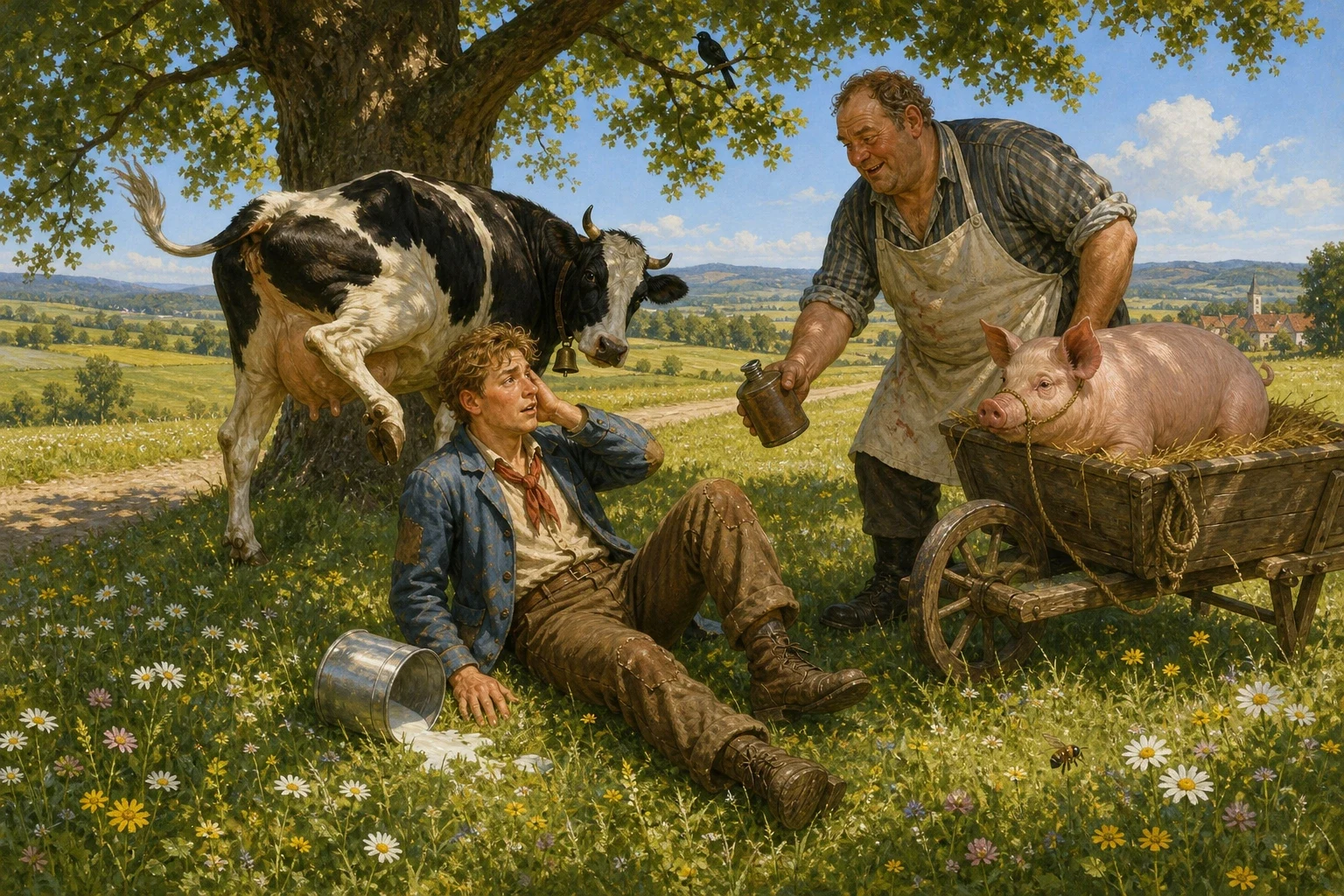
By midday the sun was hot and Hans grew thirsty, so he led the cow under a shady tree and knelt down to milk her for a cool drink. But the cow would not stand still, and when Hans pulled too hard she kicked out with her hind leg and caught him square on the head. Down he went into the grass, and for a while he lay there seeing stars, too dazed to move. When he came to his senses, a butcher happened by, wheeling a young pig along in a barrow, and gave Hans a sip from his flask to steady him. 'This cow is no good for milking,' Hans admitted, rubbing his head. 'She is old and tough,' said the butcher, 'fit only for the knacker. But this fine young pig here would make excellent eating, and I will gladly take your cow for him.' Hans, glad to be rid of such a troublesome beast, agreed at once, and walked on leading the pig instead.
Page 5
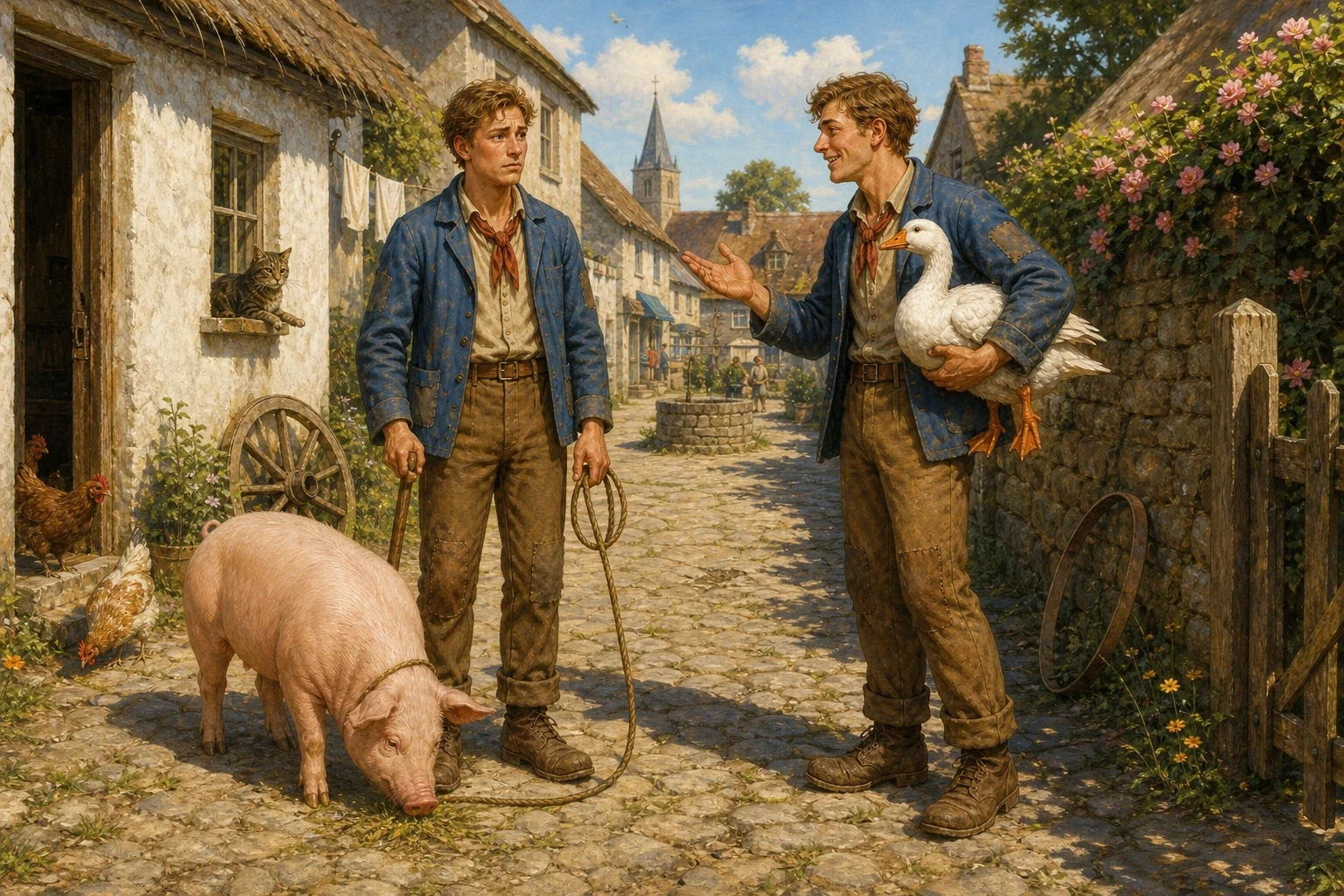
Hans walked on, well pleased with his bargain, leading the pig by a bit of rope. Before long he came to a narrow village lane, where he met a young fellow carrying a fat white goose tucked under one arm. They greeted each other, and the young man asked where Hans had gotten such a fine pig. When Hans told him, the young fellow's face grew serious. 'I hate to tell you this,' he said, 'but just such a pig was stolen from the mayor's sty this very morning, and men have gone out looking for the thief. If they catch you with it, you may find yourself in real trouble, whether you took it or not.' Hans went pale at the thought and begged the young man to help him. 'Well,' said the young fellow, 'I have this goose, which is worth less than your pig, but it will keep you out of danger. Give me the pig, and the goose is yours.' Hans agreed gladly, glad to trade away his worry along with the pig.
Page 6
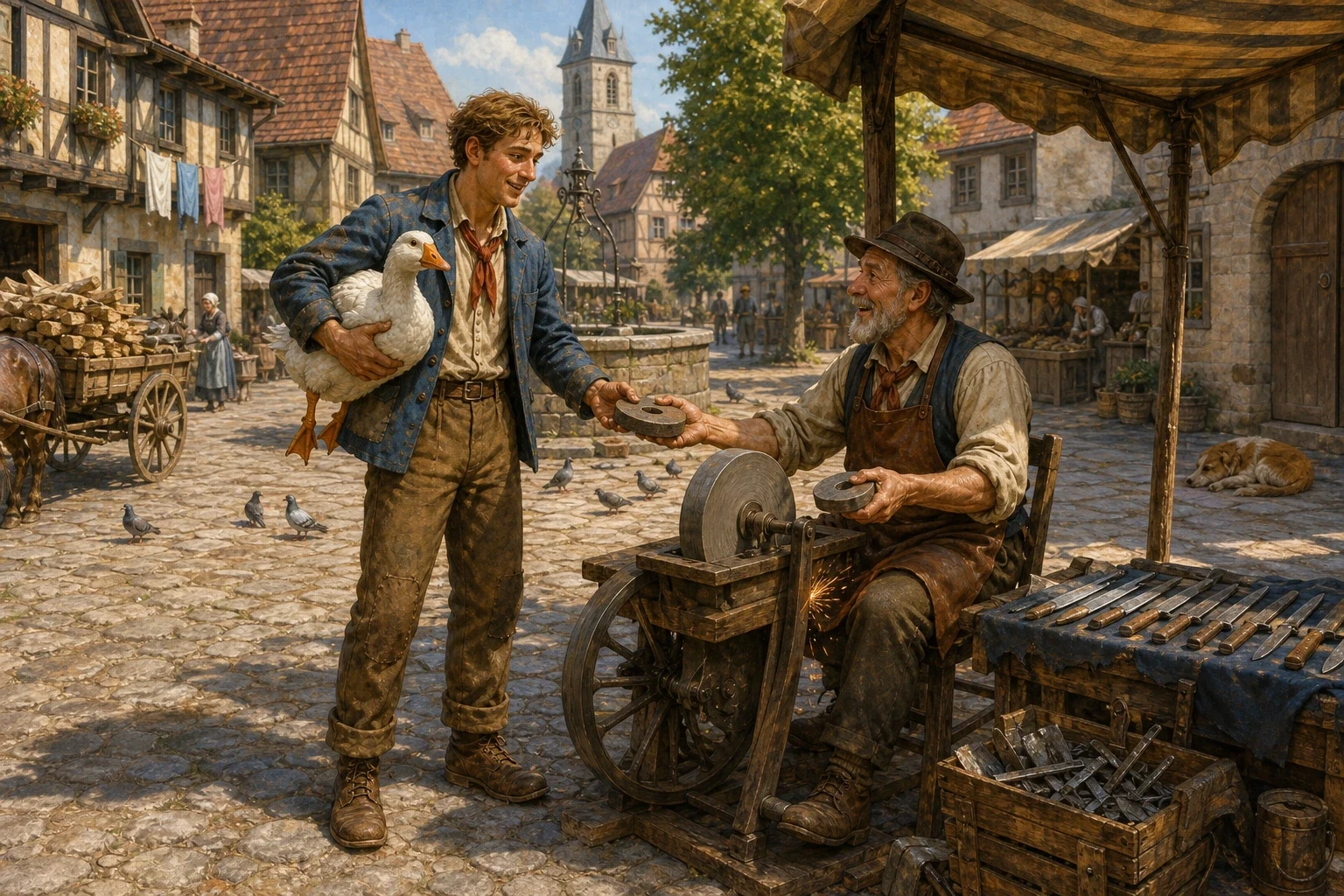
Carrying the goose under his arm, Hans came into the village square, where an old scissor-grinder sat at his wheel, singing merrily as he worked and sharpening knives for anyone who brought them. 'Grinding is a fine trade,' the old man said, pausing to admire Hans's goose. 'A man never need be without money, for there is always something to sharpen. Just listen to how that wheel sings!' Hans thought the grinder looked uncommonly cheerful and prosperous for his trade, and said so. 'Ah,' said the grinder, 'it is a lucky trade indeed — and I will tell you what, since you have been so kind as to admire my work, I will give you this grindstone, and this plain stone besides, in exchange for your goose. Carry these about, and you will never want for money either.' Hans, always eager for good fortune, handed over the goose without hesitation and took up the two heavy stones instead, certain he had found the best bargain yet.
Page 7
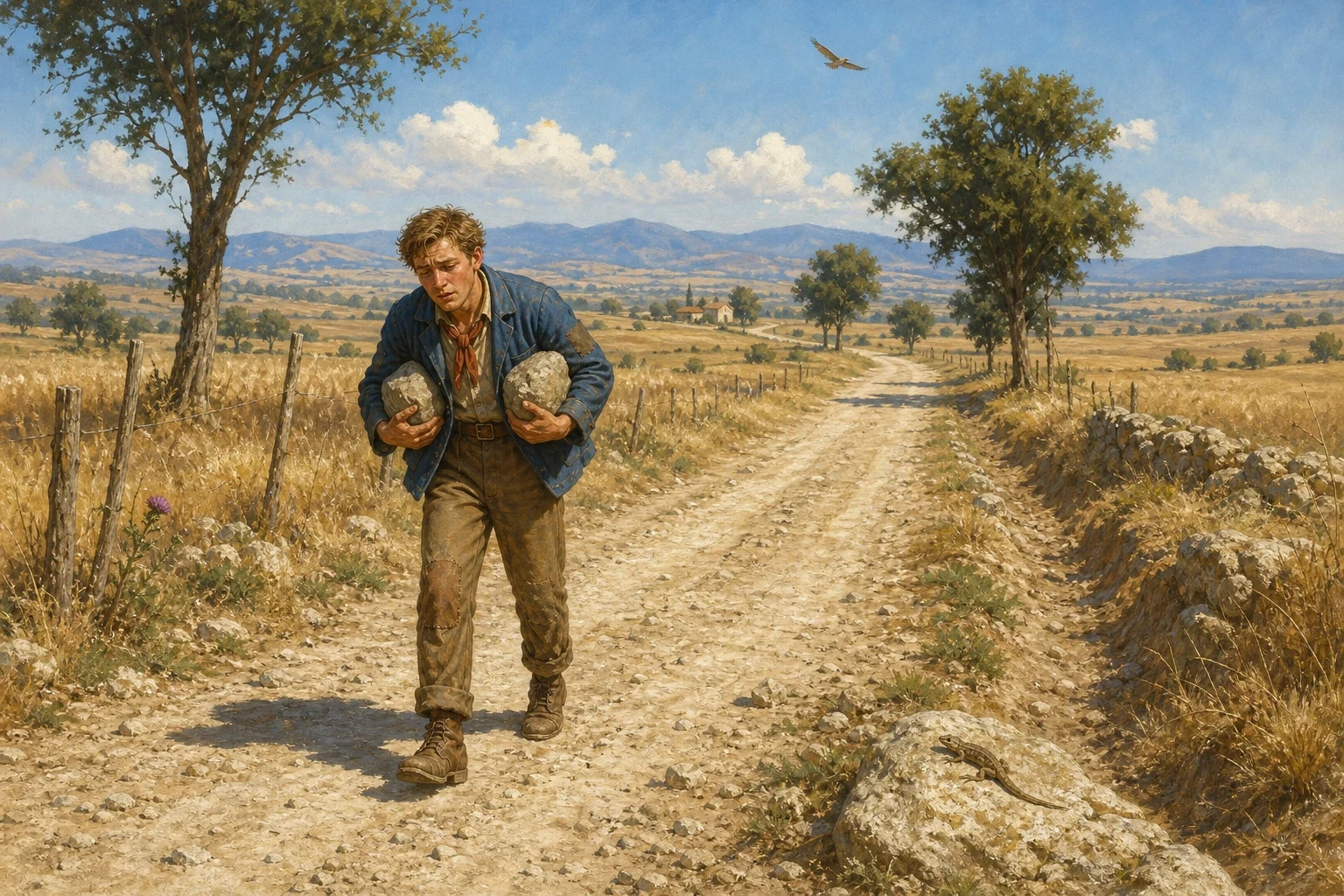
Hans walked on, out of the village and onto the open road again, carrying the heavy stones one in each pocket of his jacket. At first he did not mind the weight, for he was thinking of all the money he would make from grinding. But the day was warm, and the road was long, and he had eaten nothing since morning. Before long his legs grew tired and his shoulders ached, and the stones, which had seemed so light at first, now felt as heavy as the lump of gold he had started out with that morning. He trudged on slower and slower, stopping now and then to shift the stones from one pocket to another, and wishing more than anything for a cool drink of water. The sun climbed high overhead, and still the road stretched on ahead of him, empty and dusty, with no village in sight.
Page 8
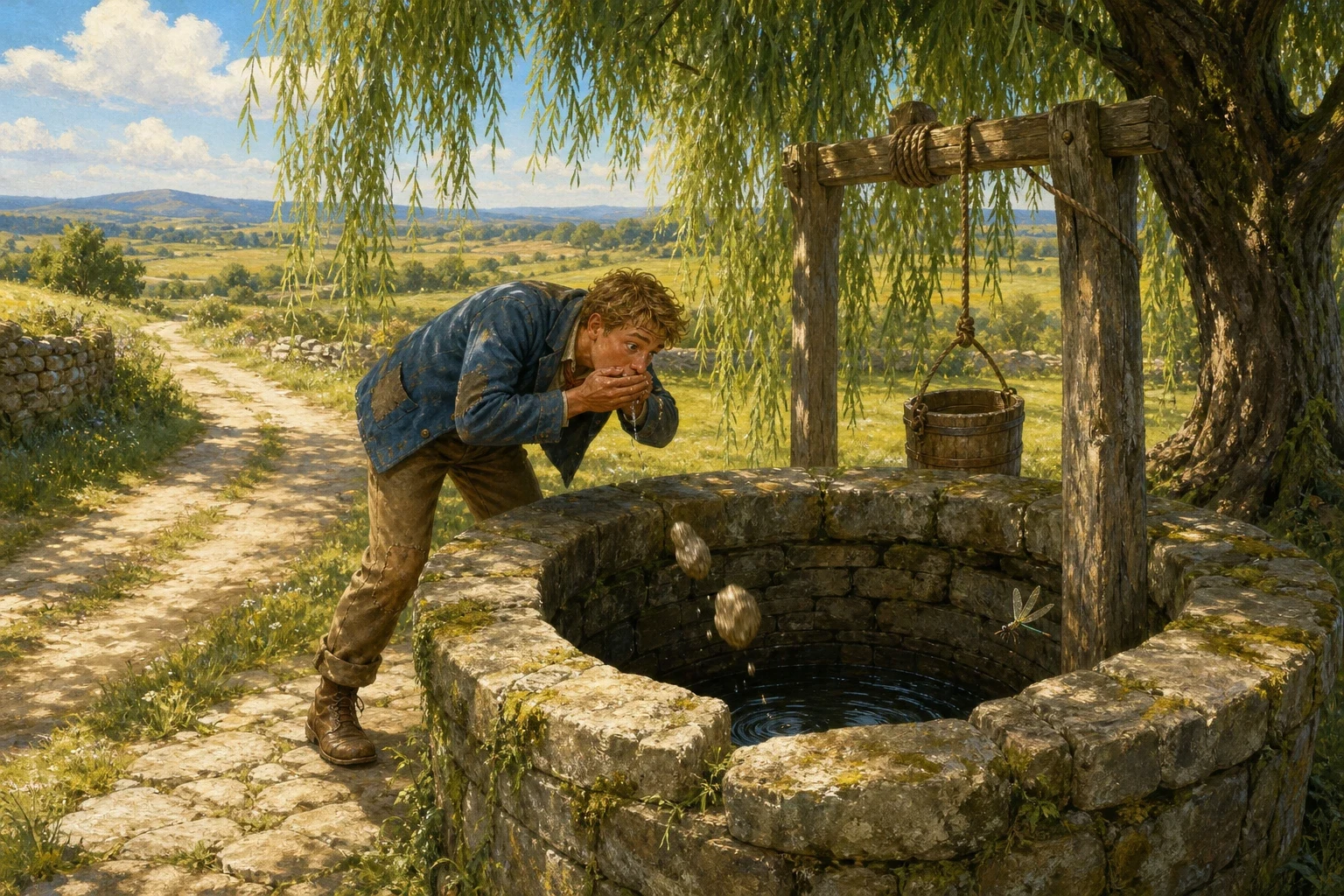
At last Hans came to a well beside the road, with a low stone rim and a bucket on a rope hanging inside it. Overjoyed, he set his two heavy stones carefully on the edge of the well and knelt down to lean over and drink, cupping the cool water in his hands. In his haste and his thirst, he leaned a little too far, and nudged the stones as he did so. Before he could catch them, both stones toppled off the rim and fell with a splash down into the water below, sinking at once out of sight. Hans jumped up and looked down after them, and for a moment he could hardly believe what he saw. Then, instead of being sorry, he found himself filled with joy, for there was no one in the world to see him and no one to blame, and the heavy stones that had worn him out all afternoon were gone forever.
Page 9
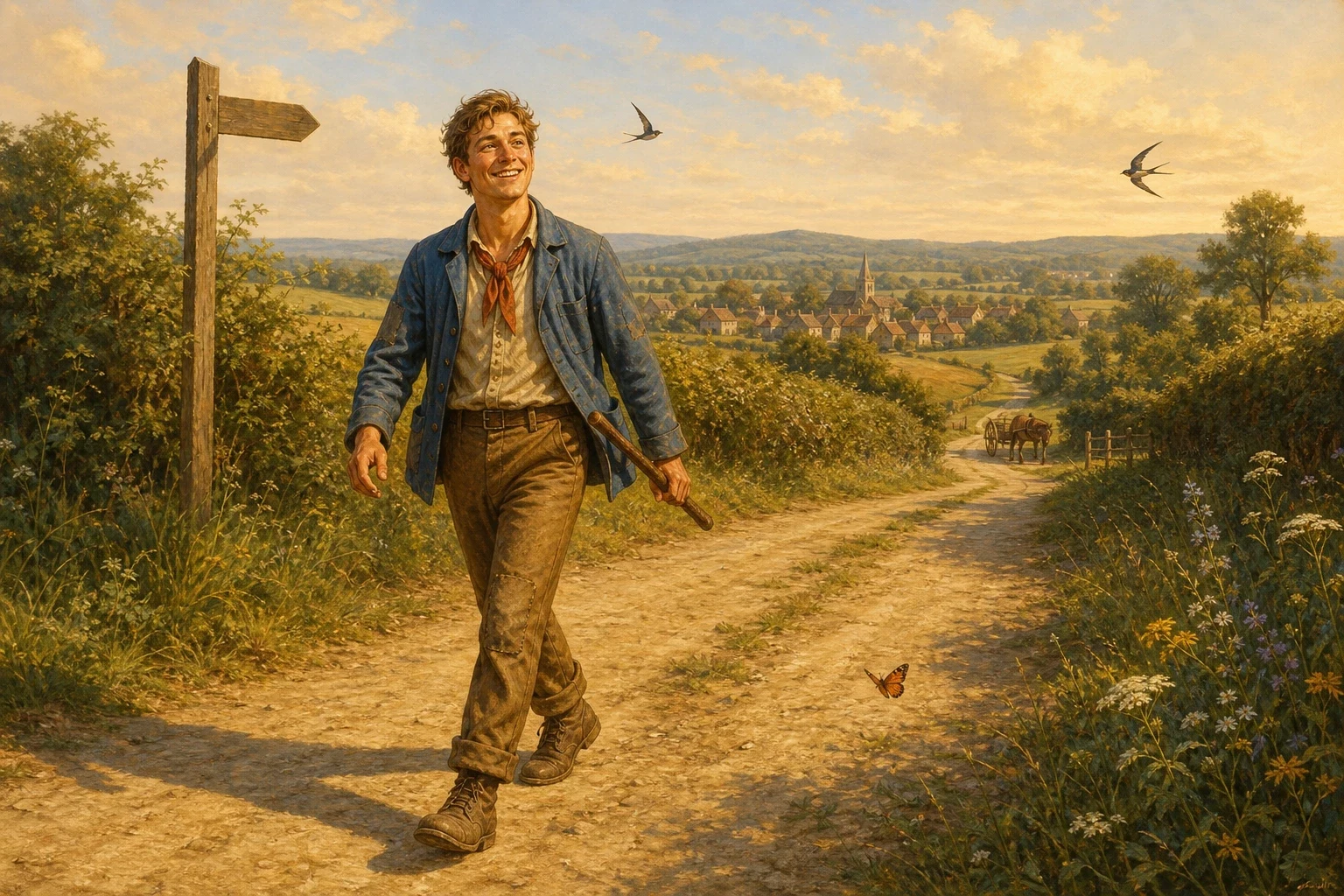
Hans straightened up, dusted off his hands, and felt lighter than he had felt all day — lighter, indeed, than he had felt in seven long years. No gold, no horse, no cow, no pig, no goose, not even a pair of plain stones weighed him down any longer. 'There is no man under the sun as fortunate as I am,' he said aloud to the empty road, and he meant every word of it. With nothing left to carry and nothing left to lose, he set off again toward his mother's village with a new spring in his step, swinging his arms freely and whistling as he went. The road that had seemed so long and so hot only an hour before now seemed to pass quickly beneath his feet, and the hills ahead, with his mother's village nestled among them, looked nearer and friendlier than they ever had before.
Page 10
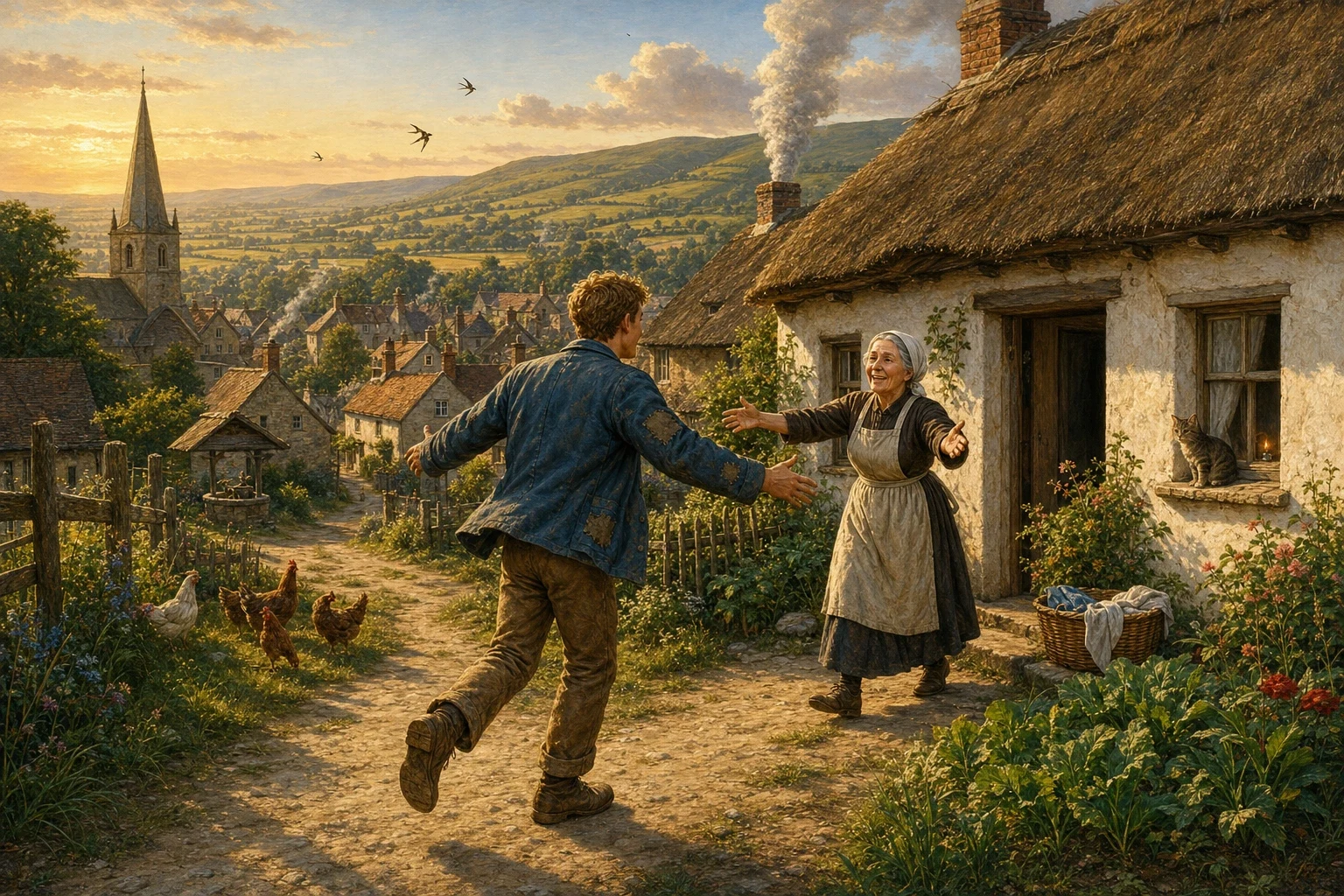
At last Hans came within sight of his mother's village, and there was the little cottage at its edge, just as he remembered it, with smoke curling from the chimney. His mother was standing at the door when she saw him coming, and she hurried out to meet him, her arms open. 'Hans! You're home! But where is all you went to earn — where is your gold?' 'Gold!' said Hans, laughing, and he told her the whole story — how the gold had become a horse, the horse a cow, the cow a pig, the pig a goose, the goose two grindstones, and the grindstones nothing at all, lost forever down a well. 'I have nothing left to carry,' he said, 'and that is the finest thing of all, for now I am free and easy and the luckiest man alive.' And his mother, seeing how glad and light-hearted he truly was, could only shake her head and smile, and took him in to supper.
About this story
- Audience: kids (ages 6–12)
Read Wonder Tales on your phone
Wonder Tales is available on Android. Get Wonder Tales on Google Play.