Issun-boshi, the One-Inch Boy
A rice bowl for a boat, a needle for a sword, and a long way to the capital

Page 1
A long time ago in Japan, in a valley of green rice terraces under a mountain, there lived an old man and an old woman who had been married all their lives and had no children. They had asked for one for forty years. Every month they walked up the hill to the little shrine with its vermilion gate, and clapped their hands, and asked again; and on one particular morning, kneeling on the stone with the whole valley spread out below them, the old woman said out loud the thing she had never said before — that she did not care how big he was, and that she would take a child the size of her own thumb and be glad of him for the rest of her life. They walked home down the terraces. And before the year was out they had exactly what she had asked for.
Page 2

He was born perfect in every way, and he was one inch high. They called him Issun-boshi, which means One-Inch Boy, and they brought him up in that farmhouse as carefully as anybody has ever been brought up: he slept in a wooden box with a folded cloth in it, he ate off a leaf, he bathed in a teacup, and he climbed everything in the house including his father. And he grew — he grew wise and he grew quick and he grew extremely good-tempered — but he did not grow tall. At fifteen he was exactly as tall as he had been at one, and he had begun to notice that the neighbours talked about it, and that his mother heard them. So one evening he stood up on the edge of the rice bowl at supper and announced that he was going to the capital, to make something of himself, and that he would like to borrow a sewing needle, a soup bowl and a chopstick.
Page 3

They did not try to stop him, which took both of them a great deal of effort. His mother sewed him a travelling kimono and his father walked him down to the river and set the lacquer soup bowl on the water and held it steady while he got in. Then they let go. And Issun-boshi went up the river in a soup bowl with a chopstick for an oar, past reeds that stood over him like a forest, past dragonflies as big as herons, past the shadows of bridges and the legs of waterbirds, paddling against the current for days — and he found that he was enjoying himself more than he had ever enjoyed anything, because for the first time in his whole life nobody was looking down at him and saying how small he was. There was just the river, and the bowl, and the next bend.
Page 4

And at the end of the river was the capital. Issun-boshi pulled his bowl up under a willow root, hid it carefully, and walked into the city — and the city nearly finished him. It was the biggest thing he had ever imagined, miles of it, with avenues as wide as his whole valley, and ox-carts, and temples with roofs like mountains, and thousands upon thousands of feet. He walked all day in the gutter at the edge of the road, because that was the only place where nothing would tread on him, and by evening he had come to the gate of the grandest house in the street, with a tiled roof and a wall round it and a man on the door. Issun-boshi stood on the step and shouted up at him for a quarter of an hour. Eventually somebody heard a voice and looked down and found a person one inch high standing on the step, asking very politely for work.
Page 5

They took him in — partly because the master of the house was amused, and partly because his daughter took one look at the one-inch person standing on the step and said that he should come in at once, as it was going to rain. And Issun-boshi turned out to be the most useful servant that household had ever had. He could get into a lock. He could find a lost earring. He could sit on the edge of the ink-stone and keep the young lady's place in a book, or run along a shelf to fetch a thing nobody else could reach, or carry a message across a crowded room without anybody seeing him go. He rode about on her sleeve. Within a year nobody in that house could remember how they had managed before him, and the young lady, who was quick and funny and had been lonely in all that grandeur, had made him her own attendant and her best friend.
Page 6

In the spring the young lady went on a pilgrimage up the mountain to the great temple above the city, with two of her women walking behind her, and Issun-boshi riding on her sleeve as he always did. It was a long climb, up a road of old stone steps through a cedar forest with moss on every rock and the valley opening wider below them at every turn, and it was a perfectly ordinary and lovely morning until they came round a bend near the top. Afterwards everybody agreed that it was the quietness that was wrong. The birds had stopped. The two women stopped as well. And Issun-boshi, standing up on the young lady's sleeve with one hand on the hilt of his needle, said, quietly, that she should keep walking and not look at the trees on the left.
Page 7
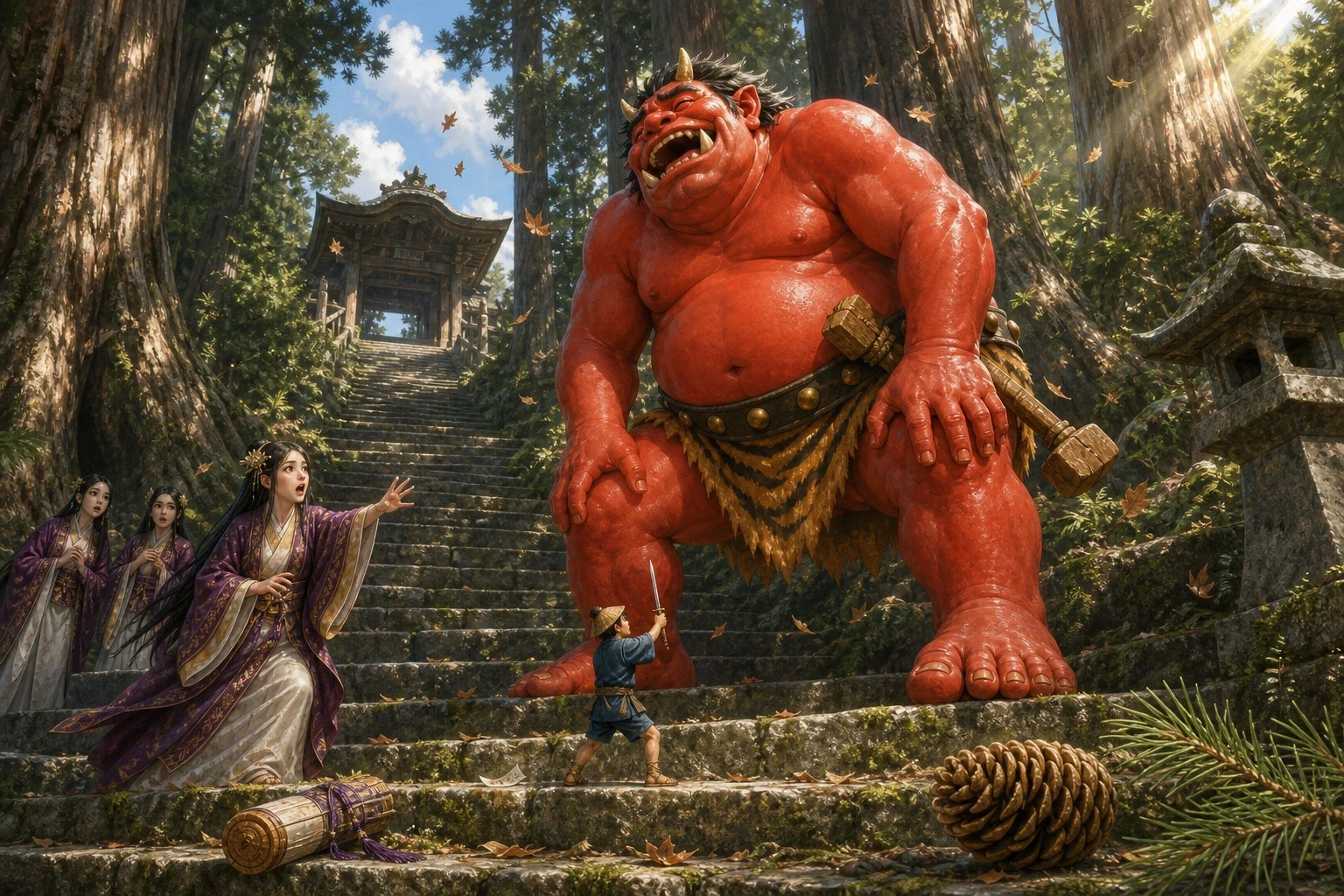
The ogre came out onto the steps in front of them: three times the height of a man, bright red, with two short horns and a belly like a barrel and a small wooden mallet swinging at his belt. He had come down off the mountain for exactly this, and he said so, and he reached out one enormous hand toward the young lady. And Issun-boshi jumped off her sleeve, landed on the step between them, drew his needle, and told the ogre to go back up his mountain. The ogre stopped. Then he bent down, and put his hands on his knees, and looked at the thing on the step for a long moment, and began to laugh so hard that the leaves came down off the cedars. He said that he had been threatened by many people in his life but never by a grain of rice. And he picked Issun-boshi up between a finger and thumb, still laughing, and dropped him into his mouth and swallowed him.
Page 8
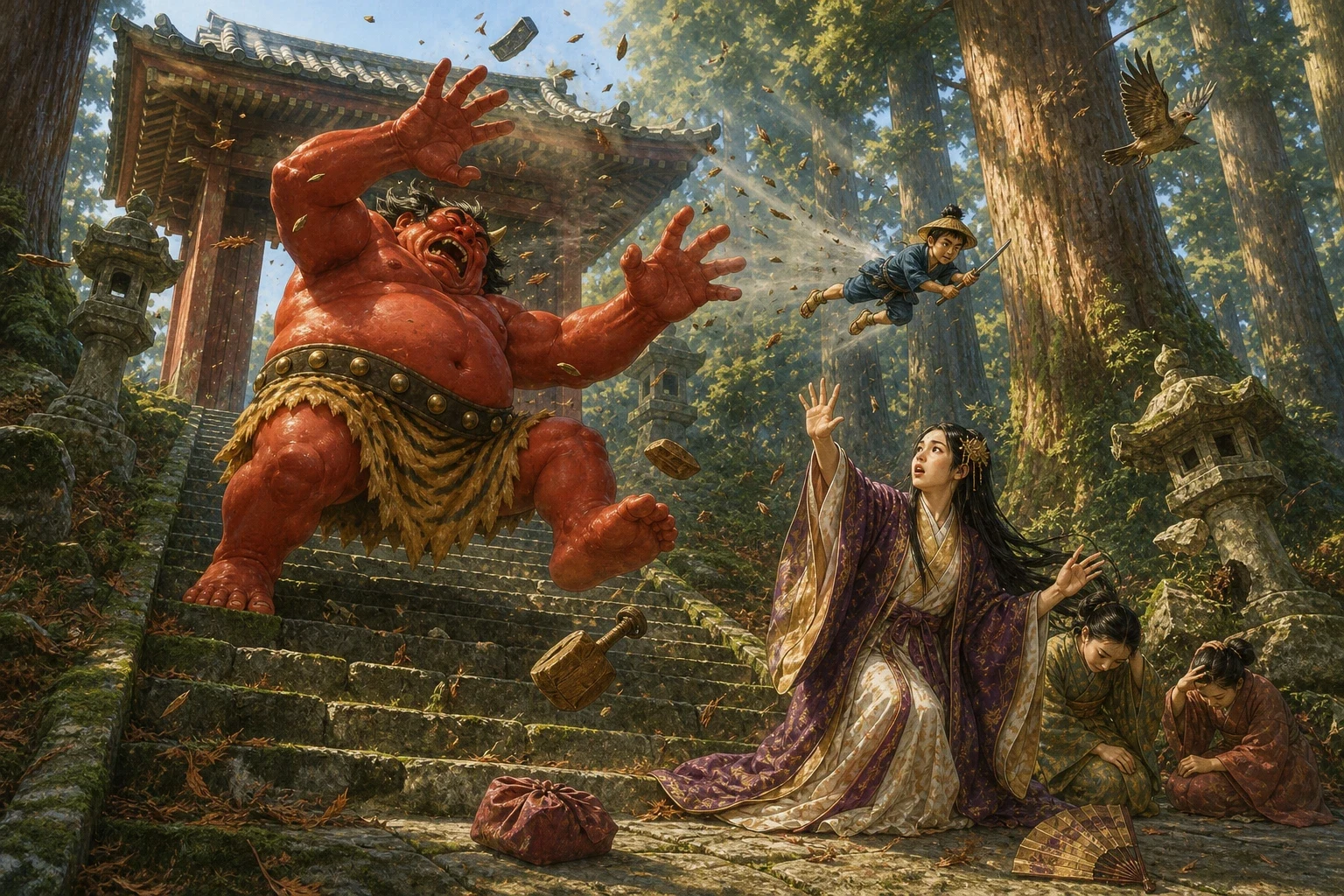
That was a mistake, and the ogre discovered it almost at once. Issun-boshi still had his needle, and he used it — not as a sword, but the way anybody would use a needle if they found themselves somewhere they had no intention of staying. He pricked. He pricked steadily and thoroughly and in a great many places, and the ogre went from laughing to coughing to roaring to hopping about on the temple steps with his eyes watering and his hands over his mouth. And then he sneezed. He sneezed so hard that the cedars shook and a roof tile came off the gate, and Issun-boshi shot out of him like a seed out of a melon, turned over twice in the air, and landed on his feet on the step with his needle still in his hand. The ogre did not stop to discuss it. He went up that mountain in about four strides and he never came down it again — and in his hurry he left his little wooden mallet lying on the steps behind him.
Page 9
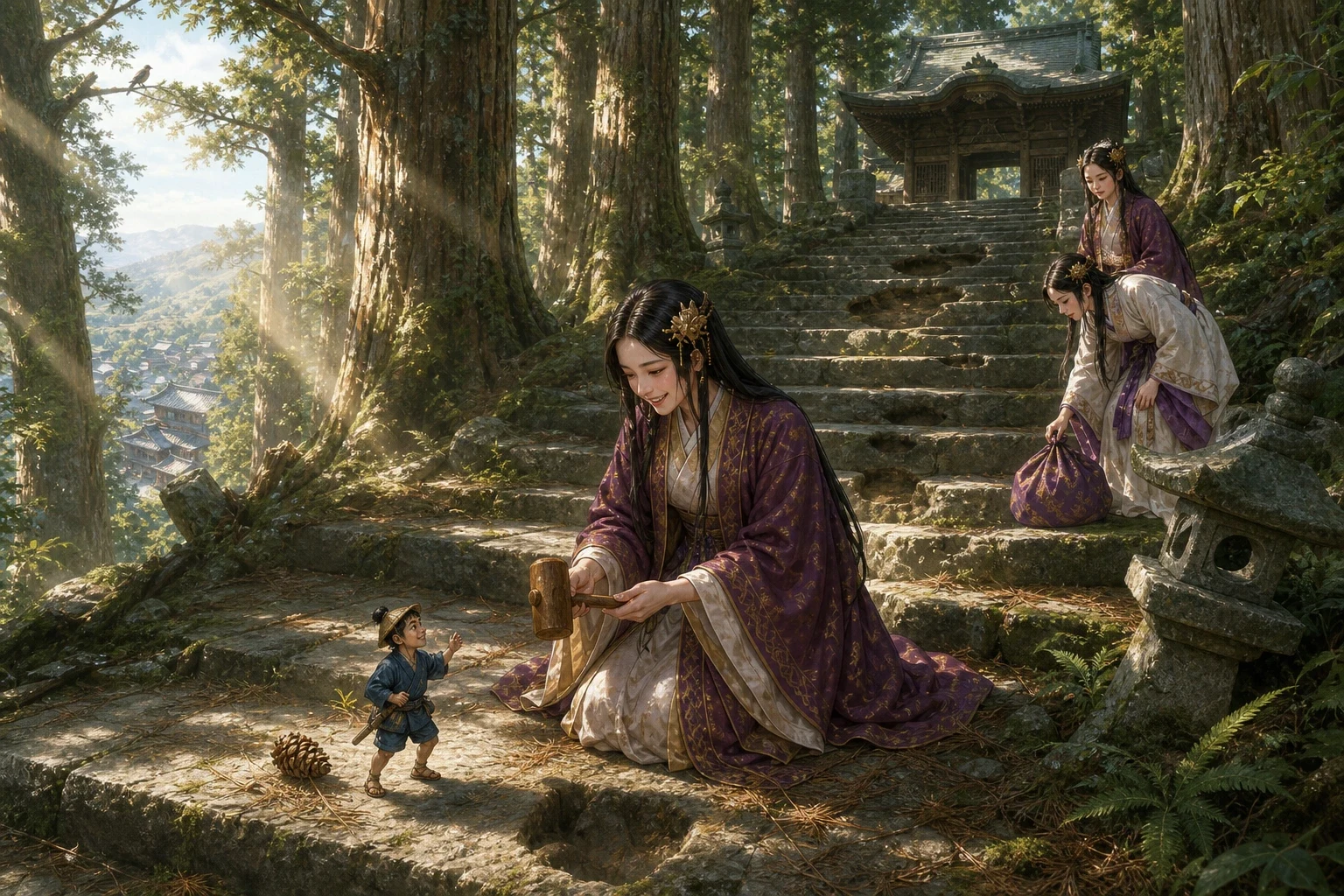
The birds started up again. The young lady came up the steps and knelt down and asked him, in a voice that was not quite steady, whether he was hurt, and Issun-boshi said that he was perfectly well and extremely dusty. And then they both looked at the thing the ogre had dropped. It was a small wooden mallet, plain and worn and not much to look at — and everybody in Japan knows what an ogre's mallet is. It is the Mallet of Good Fortune, and it gives whoever swings it whatever they wish for. The young lady picked it up and turned it over in her hands and said that it was his, since he was the one who had earned it, and asked him what he would wish for. And Issun-boshi looked down at the step he was standing on, and up at her, and said the thing he had never once said out loud in his life.
Page 10
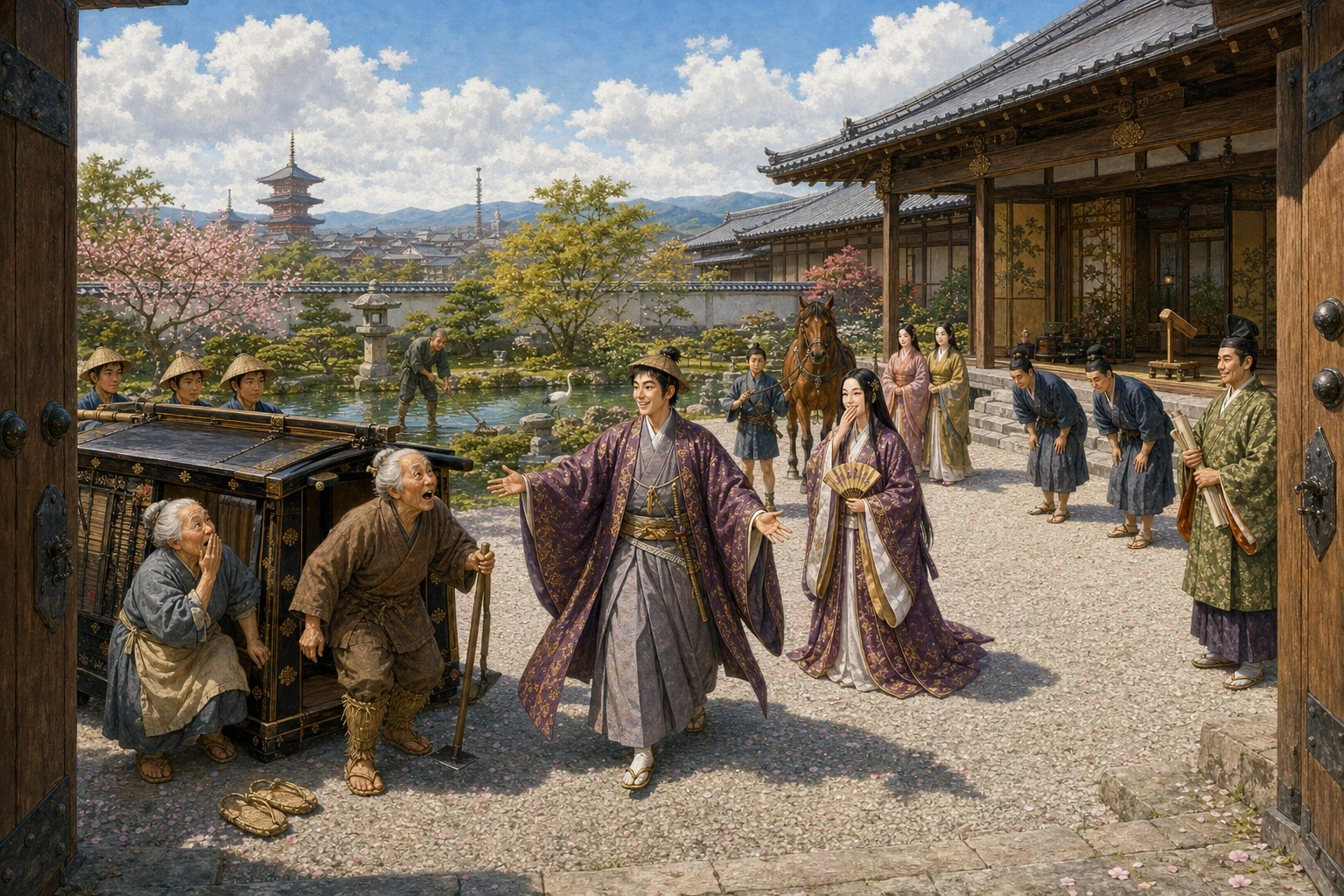
She swung the mallet, and said what he had asked for, and swung it again — and Issun-boshi grew. He grew up off the step and out of his tiny kimono and went on growing until he stood on the mountain stair a head taller than she was, a well-made young man of sixteen in a court kimono, with a sewing needle at his side that was now far too small to be any use to anybody and which he kept for the rest of his life. They went down to the city together, and there was a great deal of explaining to do at the gate. He was made a lord by the Emperor himself, who wanted to hear the whole story twice, and he married the young lady, who had been quite certain about it since the step. And the first thing he did with his new house was send a palanquin and four bearers up the river valley to a small farm under a mountain, to fetch an old man and an old woman who had prayed for a child forty years and had got exactly what they asked for.
About this story
- Audience: kids (ages 6–12)
Read Wonder Tales on your phone
Wonder Tales is available on Android. Get Wonder Tales on Google Play.