Little Ida's Flowers
A night when the flowers on her windowsill got up from their vase and danced across the nursery floor
Page 1
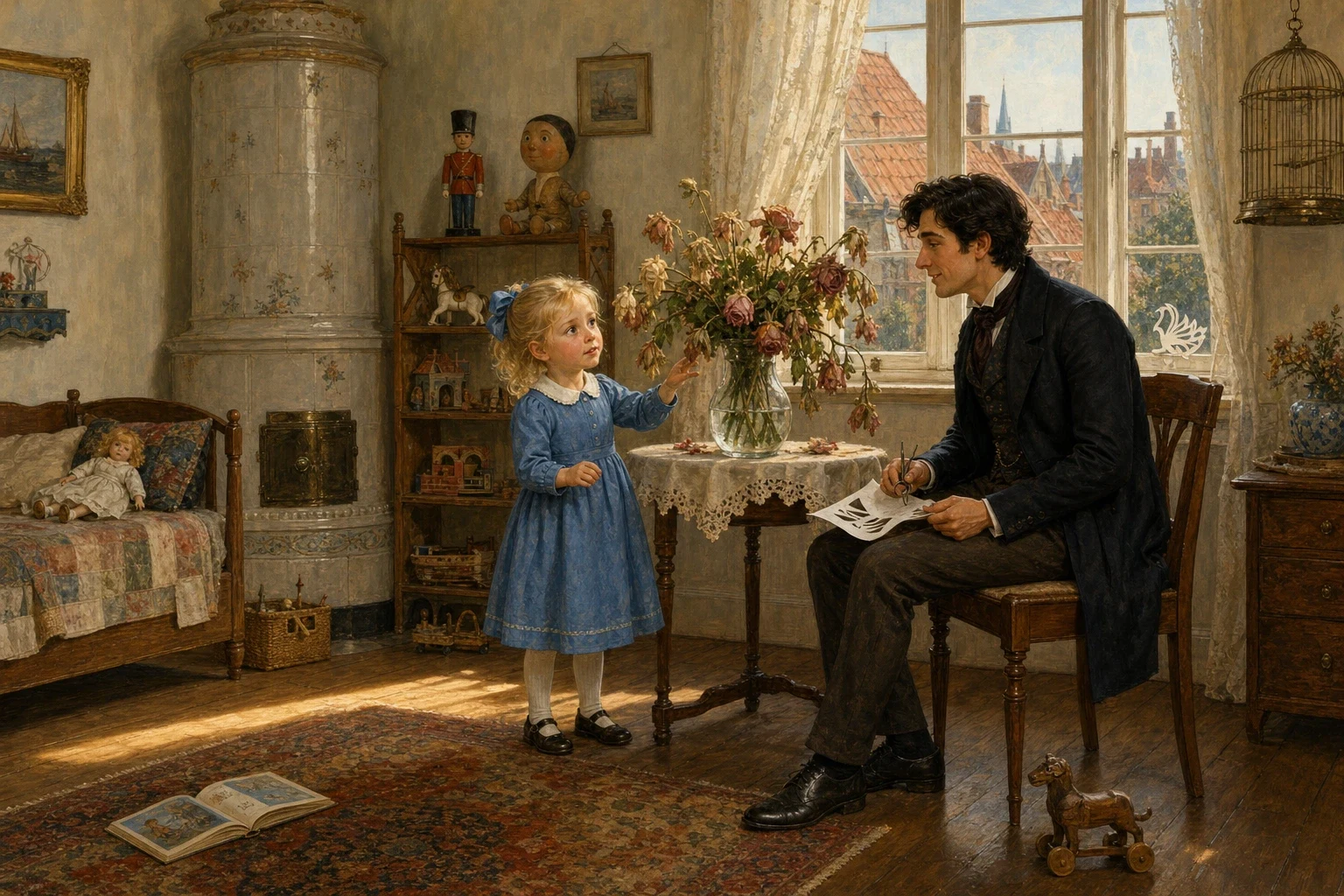
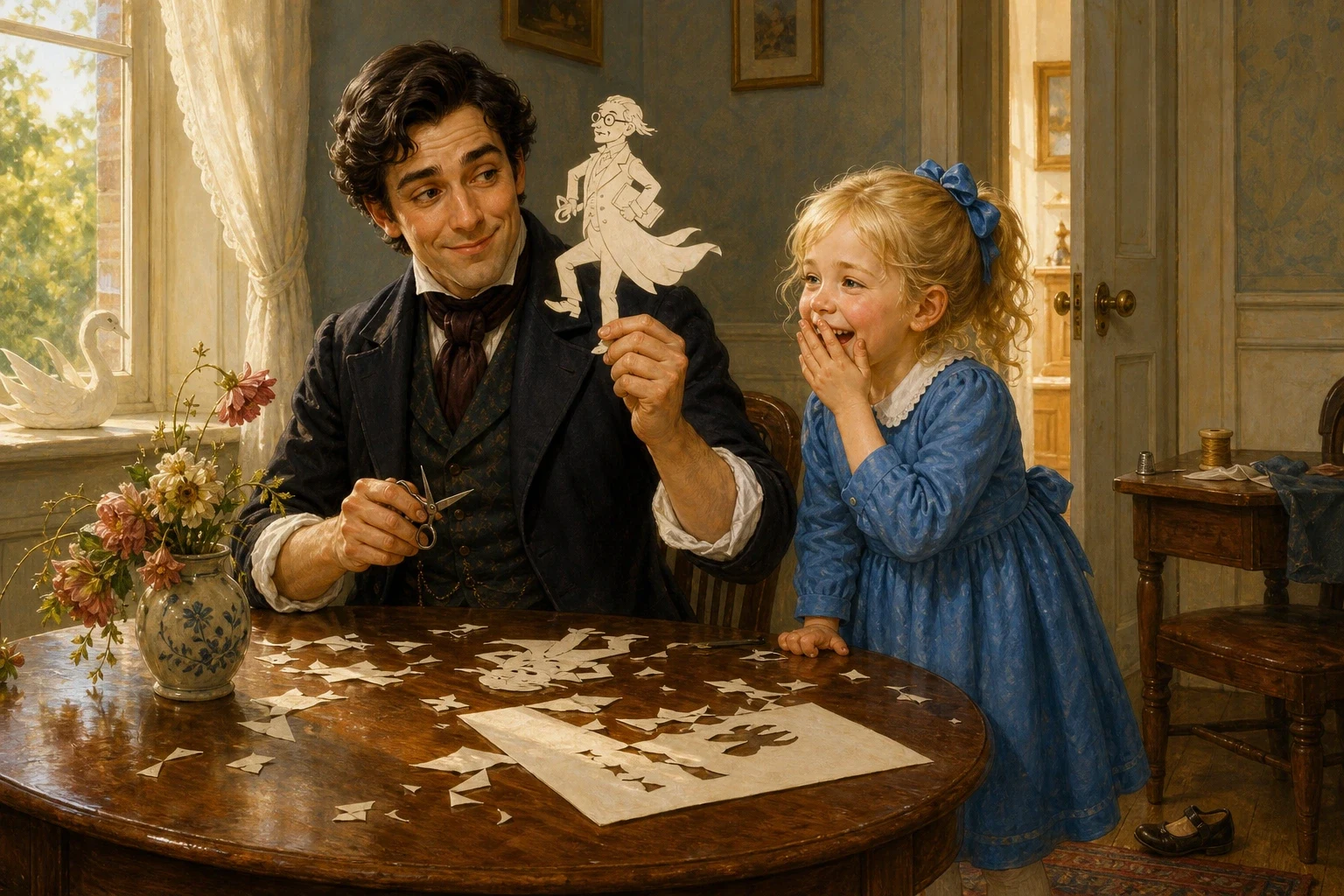
In a tall old house in Copenhagen there lived a little girl named Ida, and on the table by her nursery window stood a vase of beautiful flowers that she had carried home from a ball the evening before. But when Ida came to look at them this afternoon, every single flower hung its head down over the side of the glass, as limp and tired as could be. 'My poor flowers are quite worn out,' said Ida, and she went to find the student, a young man who often came to visit and who was famous in the house for the clever pictures he could cut from paper — ships, dancing figures, castles with windows you could see through. He was sitting by the window when Ida ran in and asked him why her lovely flowers had grown so droopy and sad, when only last night they had looked so fresh and bright.
Page 2
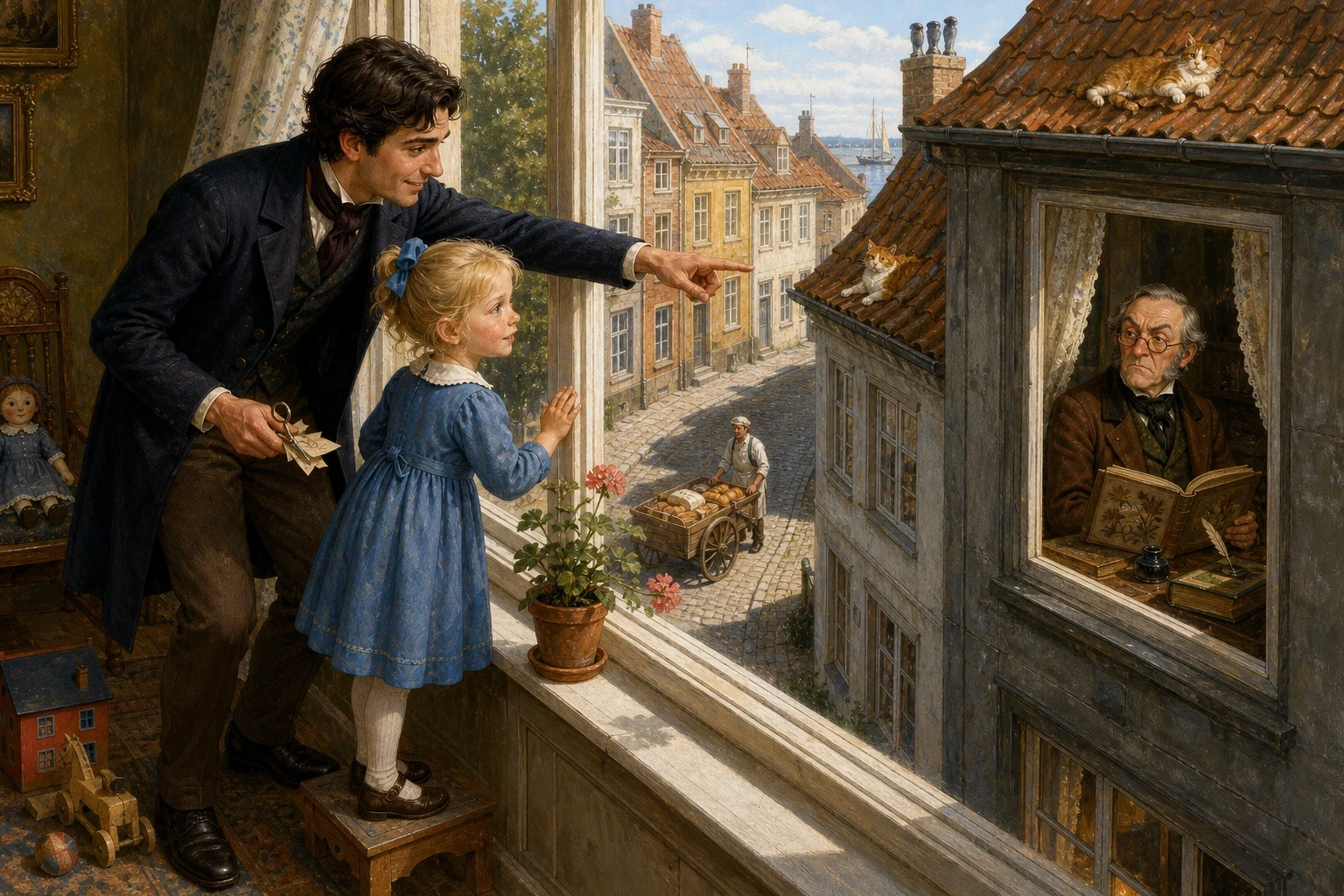
The student came and stood beside Ida at the window. 'Look over there,' he said, pointing across the narrow street to a tall gloomy house where an old gentleman could be seen frowning over his papers. 'That is the Councillor, and he has the dullest big books full of flowers — pressed as flat as paper, poor things, between the pages, so that they can never go dancing again as long as they live.' Ida shivered at the thought of it. 'How dreadful, to be squeezed flat in a book!' 'Dreadful indeed,' said the student, 'which is exactly why your flowers danced so hard last night at the ball in the King's great castle garden — to make the very most of being alive and able to dance at all, before anyone presses them flat.' Across the street, the Councillor glanced up, caught sight of them laughing at his window, and scowled.
Page 3
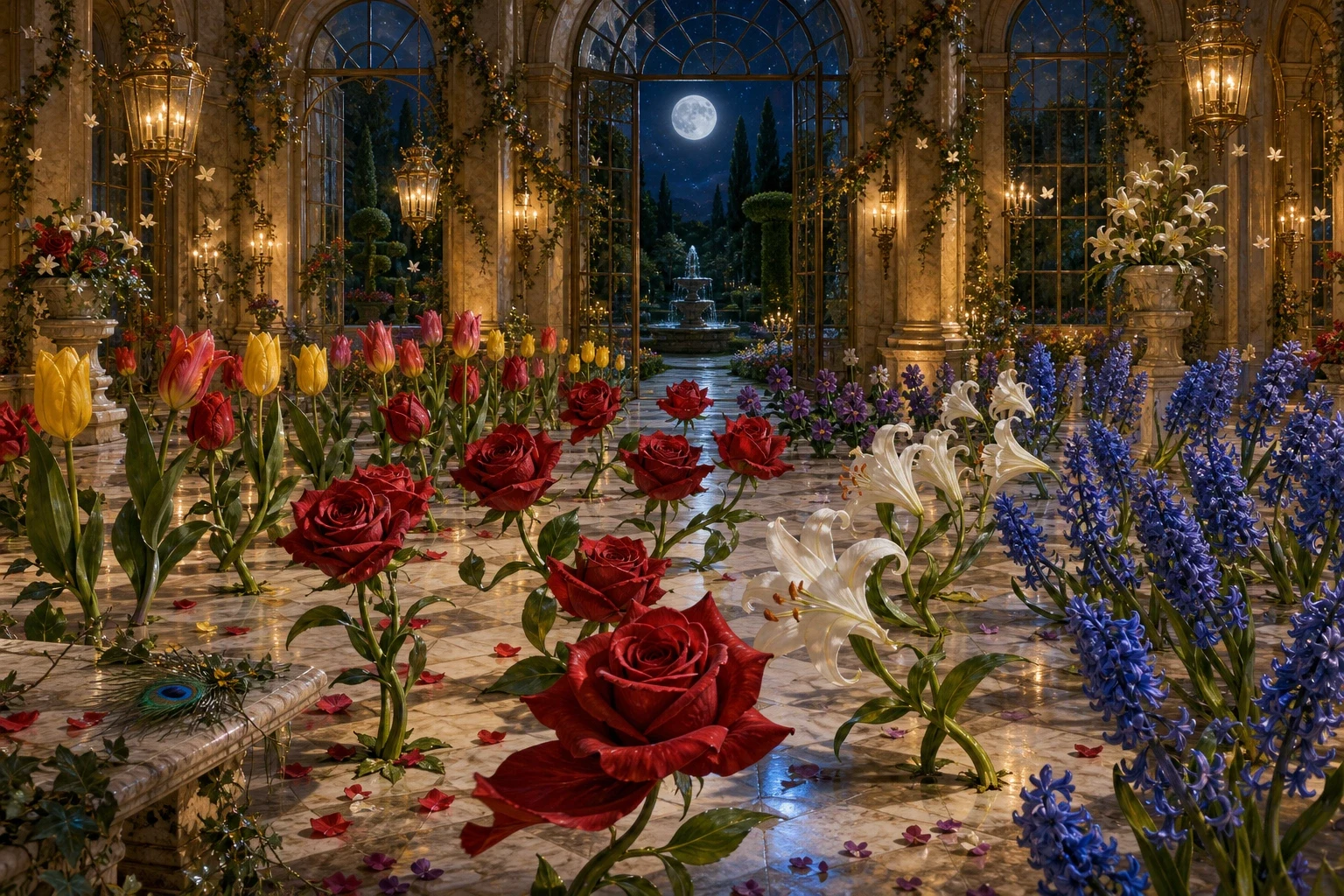
As the student told it, every flower in the world loves nothing better than to dance, and the grandest ball of all is held each night in the King's own castle garden. There the roses dress themselves in their deepest red and lead the opening dance, the tulips stand up straight in rows like soldiers in their best uniforms, and the tall white lilies glide about so smoothly that they hardly seem to touch the floor at all. The hyacinths ring their little bells in time with the music, and the violets, who are far too shy to dance in the middle of the room, creep along the edges and bob quietly to each other in the shadows of the big garden doors. When the first grey light of morning creeps over the wall, every flower hurries back to its own bed and stands quite still, as if it had never moved at all.
Page 4

'And it isn't only in the King's own garden,' the student went on. 'In the great Botanical Garden, where there are more flowers growing than anyone could ever count, the whole garden dances together every single night, from the tallest tree down to the smallest daisy at the edge of the gravel path. The old lindens bow their heavy branches in time with the music, the sunflowers turn in slow stately circles because they are too grand to hurry, and whole beds of pansies and marigolds hop about together in great colourful rings, laughing without making any sound at all.' Ida tried to picture it — the whole garden, usually so still and quiet in the moonlight, suddenly full of dancing. 'I wish I could see it just once,' she said, and the student smiled and told her that perhaps, one night, she would.
Page 5
'Can my dolls dance too, if the flowers want them to?' Ida asked. 'Of course,' said the student. 'The flowers can set anything dancing, if they take a fancy to it — even a broomstick, even a picture in its frame.' To show her, he took up his scissors and a fresh sheet of paper and began snipping away, and in a few moments he held up a droll little paper man with a long coat, round spectacles, and a big book tucked under one arm — unmistakably the cross old Councillor, cut out dancing on one leg with his coat-tails flying. Ida laughed so hard she had to hold the table. But just then her mother came in, saw the little paper figure, and shook her head. 'That is not kind,' she said gently. 'The Councillor is an old man, and he is your godfather, besides.' The student put the scissors down, a little ashamed.
Page 6
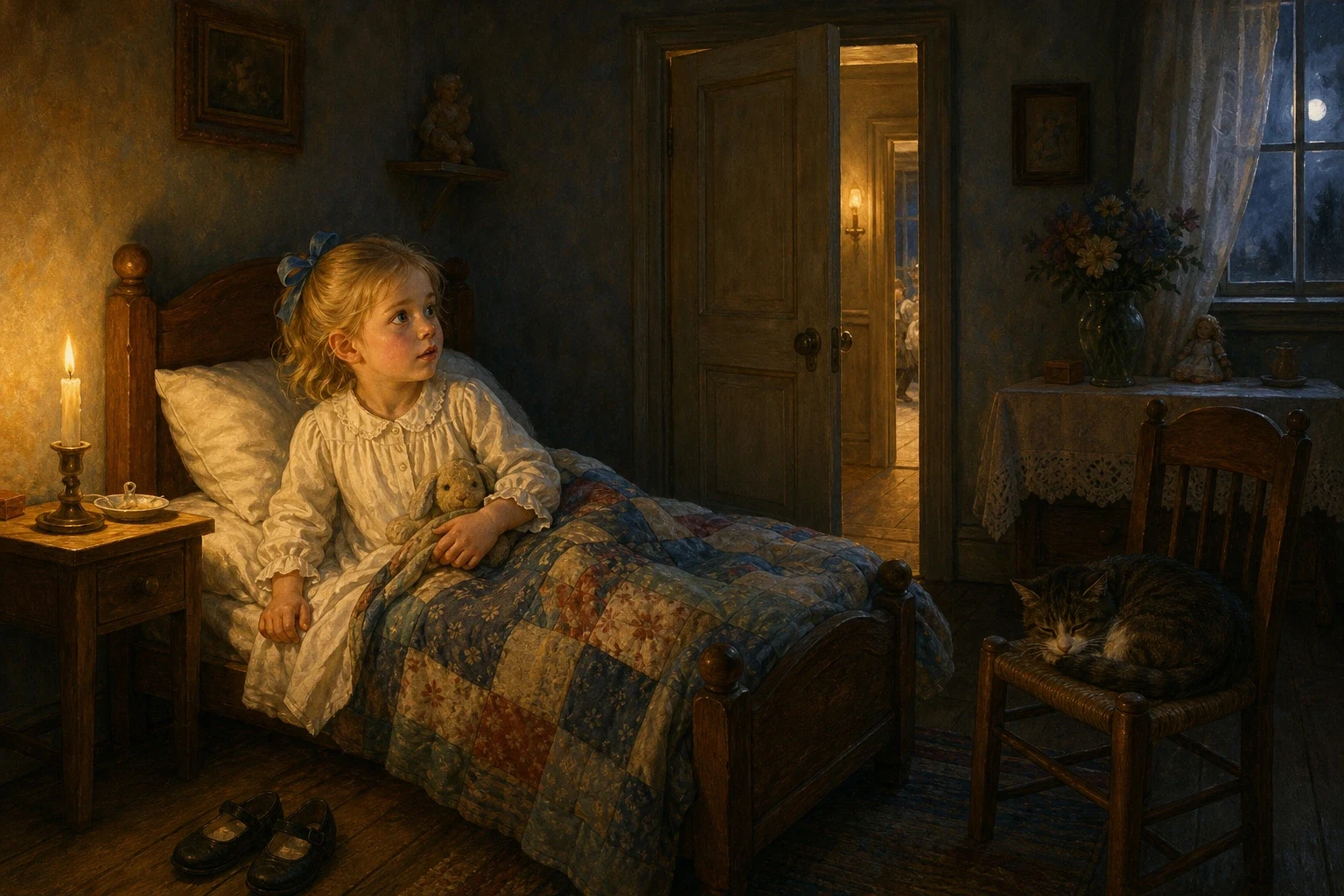
That night, after she had been tucked into bed, Ida lay quite still with her eyes open, thinking about everything the student had told her — the ball in the King's garden, the whole Botanical Garden dancing together, the Councillor's flowers pressed flat and sad in his books. She wondered whether her own flowers, tired as they were, might still have one more dance left in them. The house grew quiet around her, the candle burned low, and at last her eyes grew heavy and she fell asleep. But later — she never knew quite how much later — she woke with a start, certain she had heard music coming from somewhere close by, soft and strange, as if it were drifting straight out of the nursery itself.
Page 7
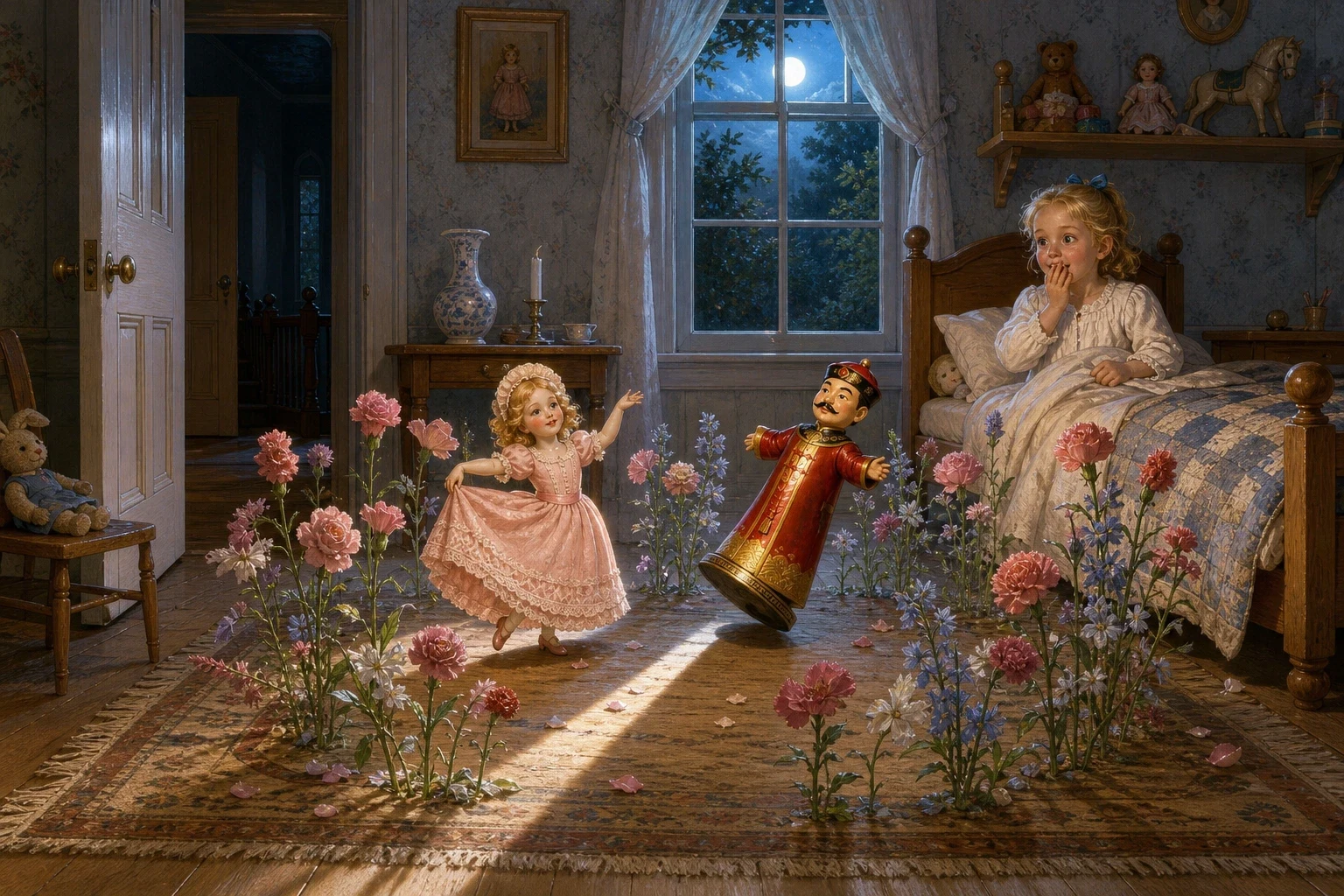
Ida sat straight up and crept to the edge of her bed, and there, in the middle of the moonlit nursery floor, she saw the most wonderful thing. All the flowers had climbed down out of their vase and were dancing in a bright, swaying ring, and her dolls had come down from the shelf to dance with them. Sophie, her favorite doll, turned and curtsied as prettily as any lady at a real ball, her pink skirt swinging wide. But the little Chinese mandarin figure, who was carved all in one stiff piece from his chin to his feet, could not bend his knees at all — he could only rock and hop about on his round base, nodding his big head so hard that Ida had to put her hand over her mouth so her laughter would not stop the music. Round and round they all went, flowers and dolls together, while Ida watched from her bed, hardly daring to breathe.
Page 8
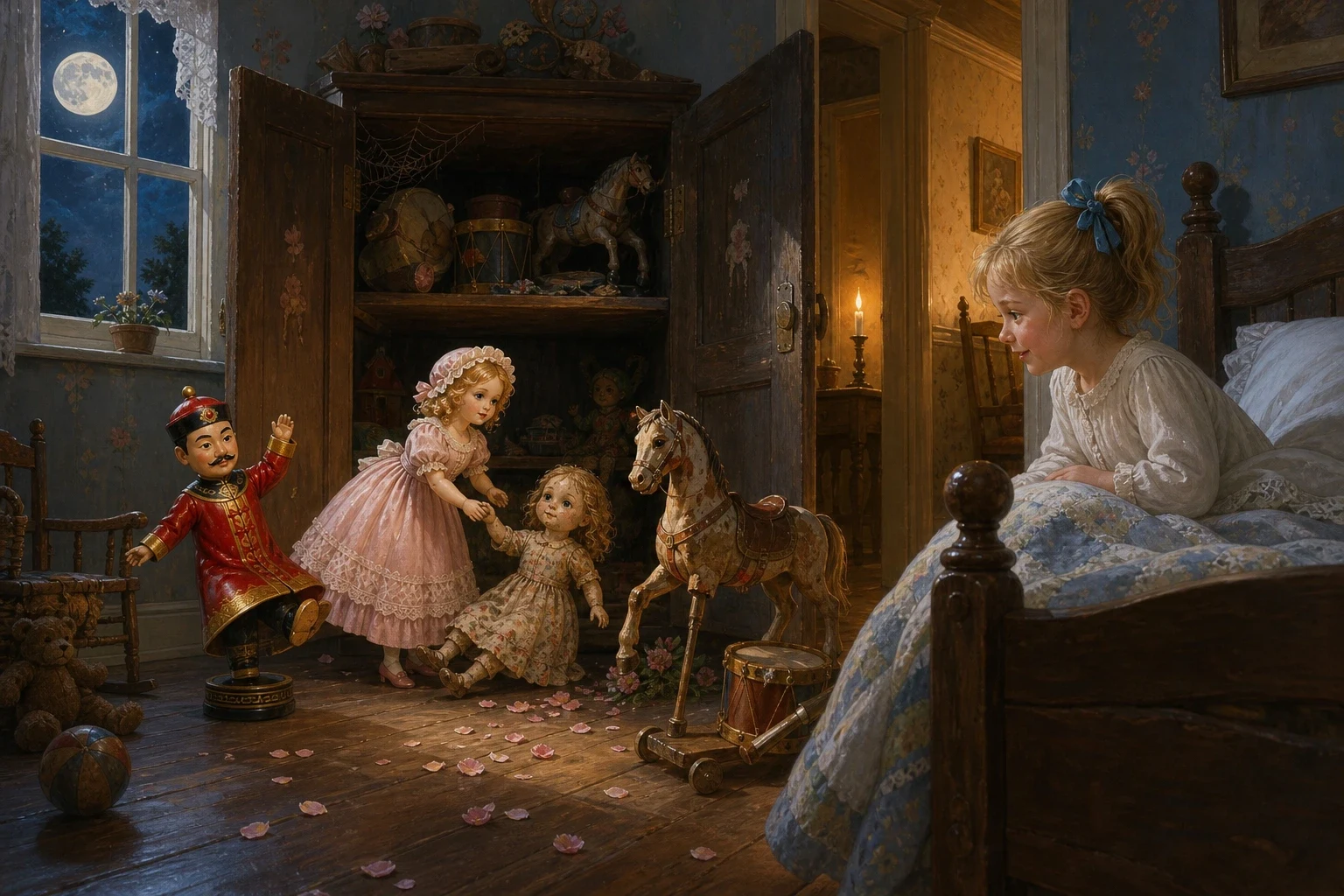
The dance moved on across the room until it reached the old cupboard in the corner, where the broken and forgotten toys were kept — a doll with a cracked cheek, a horse missing a leg, a drum with no stick. Nobody ever played with them anymore, and they stood in the dark cupboard year after year, never asked to join in anything. But the flowers would not leave anyone out. They swept right up to the cupboard door, and Sophie and the little mandarin took the old broken toys gently by whatever hands or legs they still had, and drew them out into the moonlight to dance too. For just that one night, the cracked doll curtsied as nicely as anybody, and the three-legged horse hopped round in its own happy, lopsided way, while Ida watched from her bed, her heart feeling almost too full for her chest.
Page 9
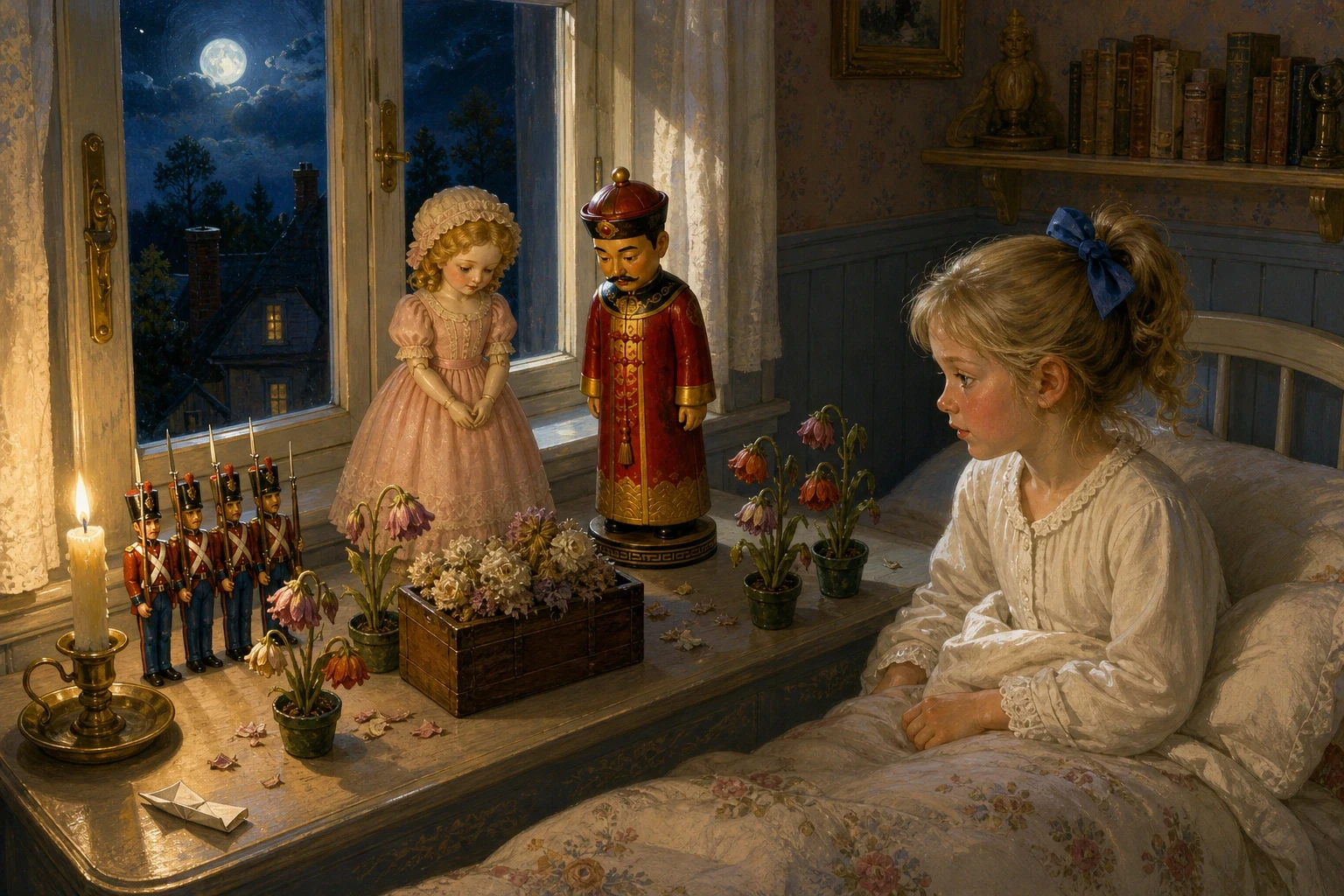
At last the dancing slowed, and the flowers gathered quietly around the box on the windowsill where Ida's very first, most faded blooms had been laid — the ones so withered now that they could never dance again, not even for one more night. 'We are going to die,' one of the old flowers said softly, 'and tomorrow we must be buried in the garden, the same as the little canary was buried last summer, so that we may become beautiful flowers again.' The other flowers, and the dolls too, agreed that this was only right, and that it should be done properly, with care, the way the king's own funeral had been done, with soldiers standing solemnly at either side. Ida watched it all from her bed, no longer laughing now, but feeling instead that she understood something true and gentle about the flowers she loved, before sleep closed over her completely.
Page 10
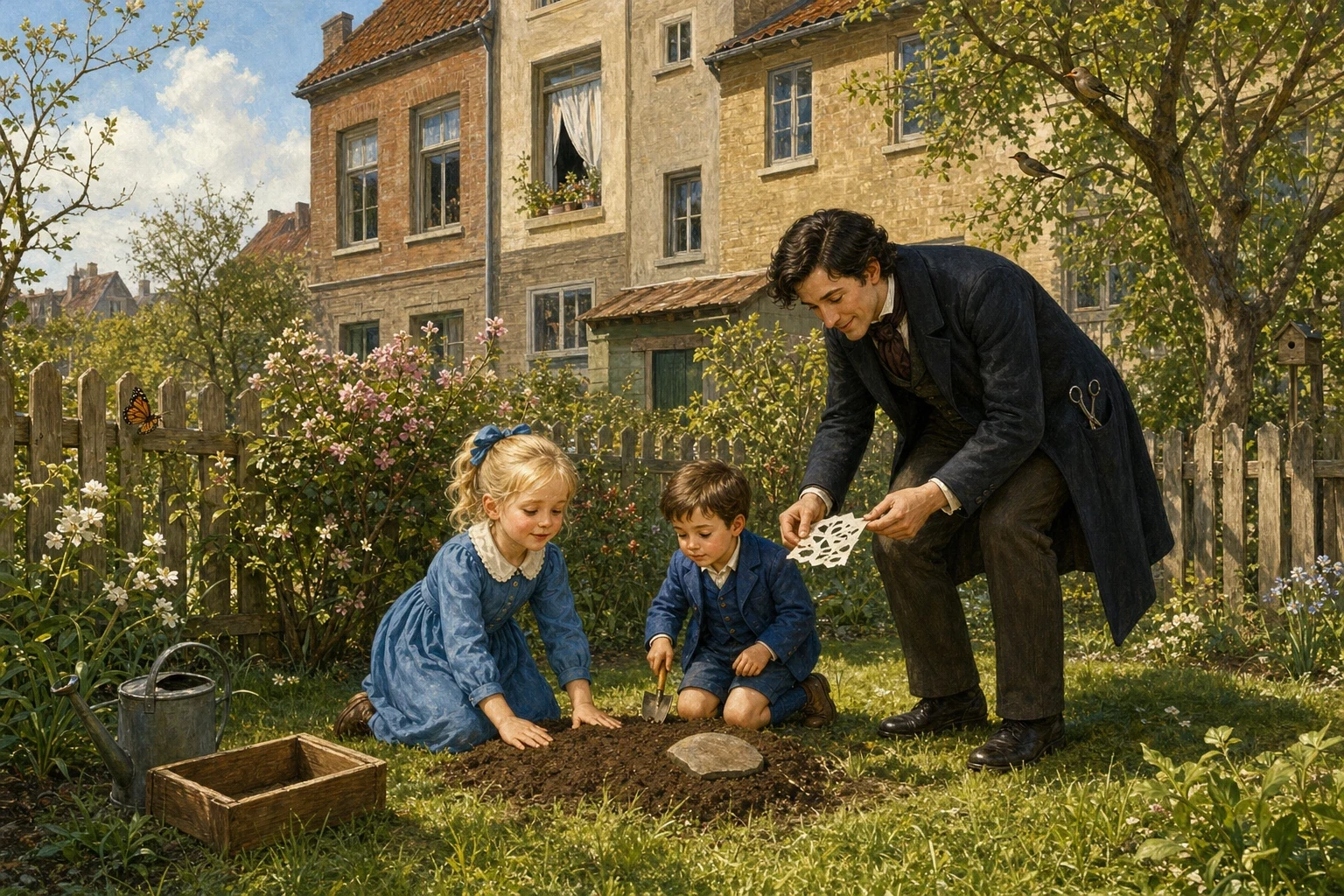
In the morning, Ida went straight to the box on the windowsill and found the flowers just as faded as they had been the night before — it had all truly happened, dream or no dream. She called her little brother Jonas, and together they carried the box out into the garden, to the spot beneath the bushes where, the summer before, they had buried their canary bird in a little grave of its own. They dug a small hollow in the soft earth and laid the flowers gently inside, covering them over with care, just as they had done for the bird. The student came out to find them, and, since he could not bring musicians for such a small funeral, he cut a pretty paper picture instead and laid it over the little mound to decorate it. Ida patted the earth smooth and sat back on her heels. 'Never mind,' she told herself. 'They will have an even grander ball another day, when they come up again as beautiful new flowers.'
About this story
- Audience: kids (ages 6–12)
Read Wonder Tales on your phone
Wonder Tales is available on Android. Get Wonder Tales on Google Play.