The Riddle
A poisoned drink meant for a prince, the riddle it made, and the proud princess who could not guess it

Page 1
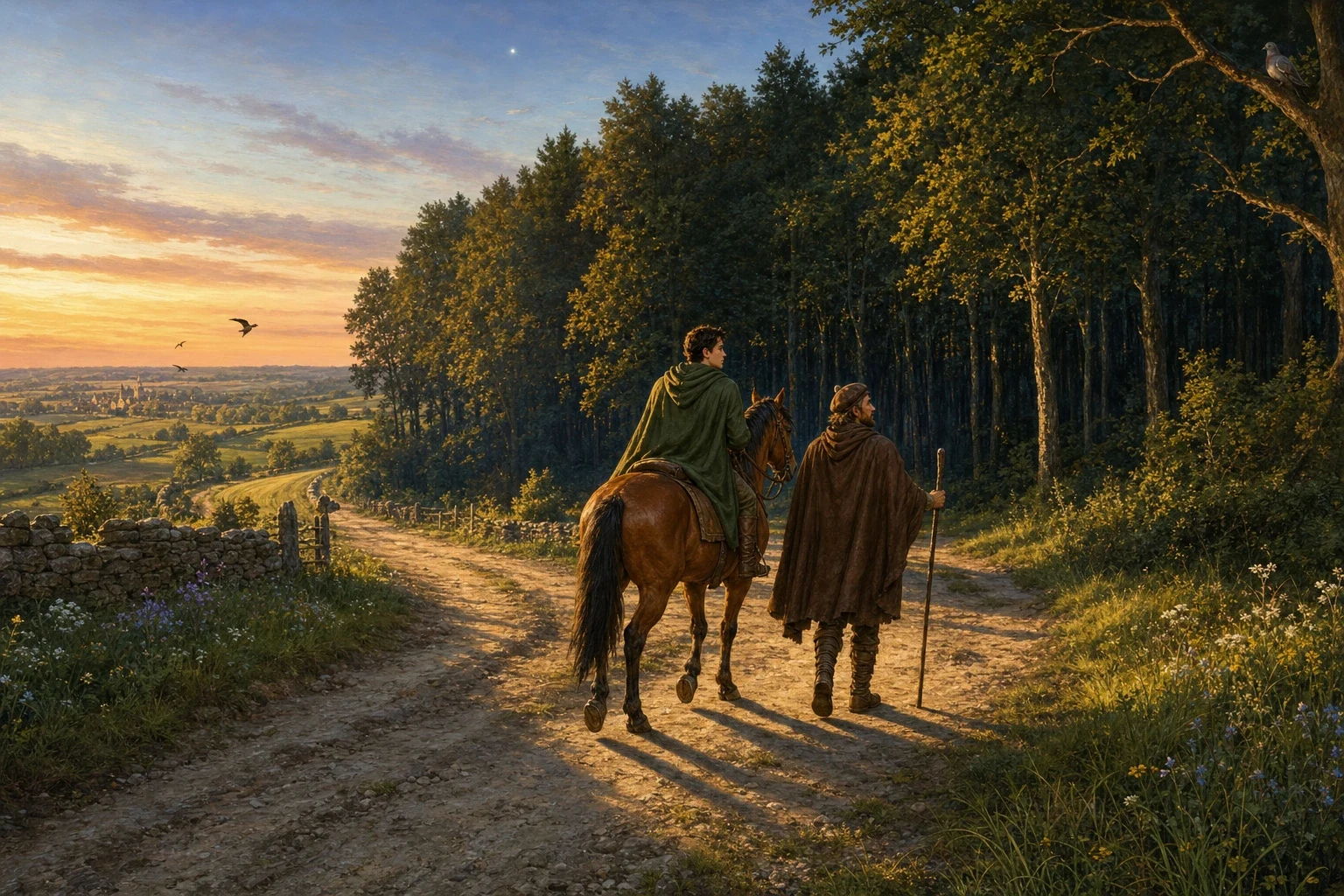
Once, a king's son wished to see the world beyond his father's house, and he took with him only one companion: a servant he trusted above all others. They set out together on a single horse, the prince riding and the servant walking at its side, and for many days the road carried them through open country, past farms and fields and little villages. Toward evening on one particular day, the road brought them to the edge of a great forest, dark and thick as far as they could see in either direction. No house, no light, no roof showed anywhere along the way they had come, and the sun was already low behind the trees. The prince looked at the darkening woods ahead of them and did not turn back. 'We will find somewhere to shelter before the night is out,' he said, and they rode on, straight into the forest, as the last of the daylight failed behind them.
Page 2
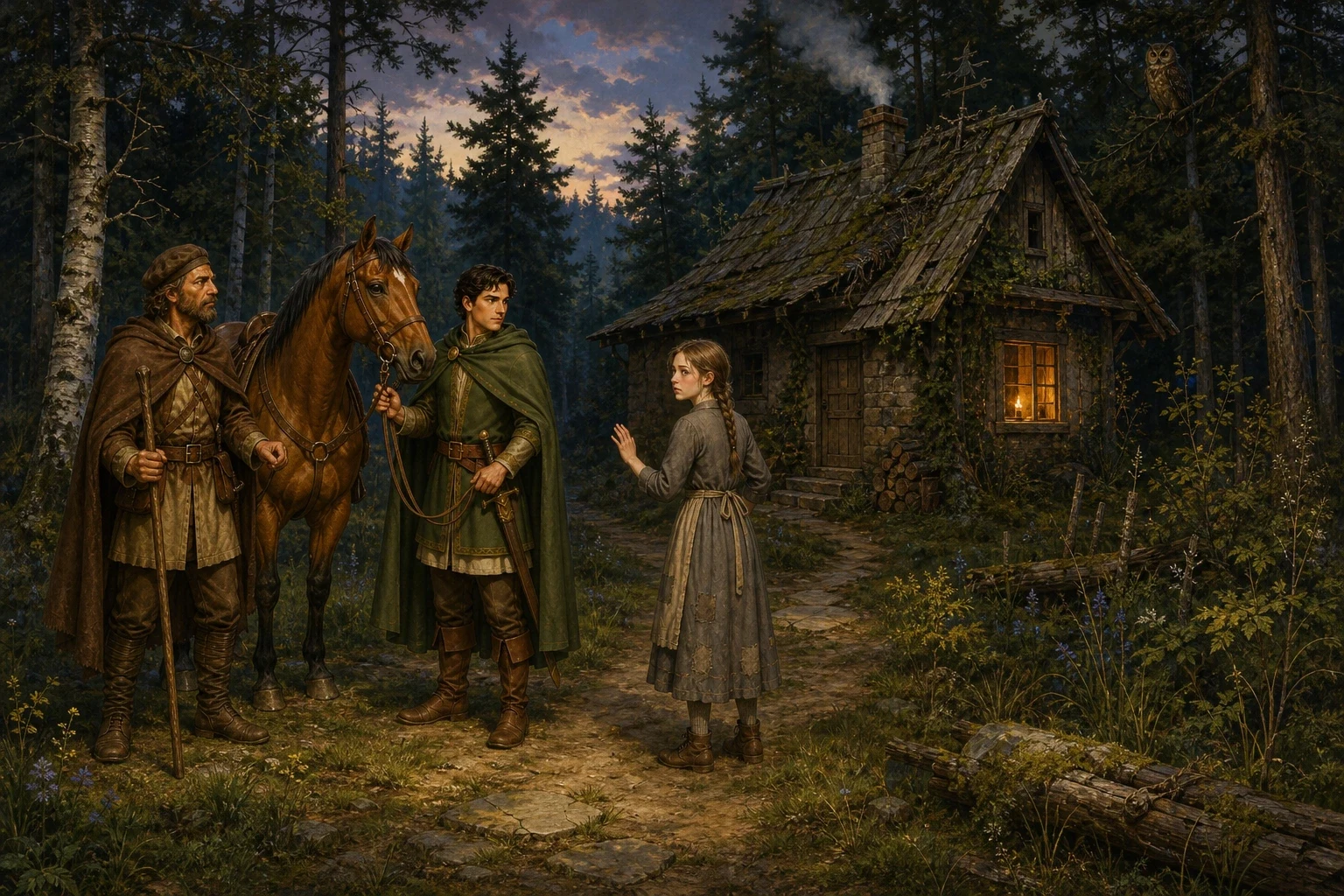
Deep in the forest, with no moon yet up and the trees pressing close on every side, the prince and his servant came upon a clearing, and in it a small house with a single candle burning in the window. As they came nearer they saw a girl walking toward the house ahead of them, thin and pale in a patched grey dress. 'Dear child,' the prince called to her, 'can my servant and I find shelter here for the night?' The girl stopped and looked back at them with a frightened face. 'You may,' she said quietly, 'but I would not advise it. My stepmother lives here, and she knows evil arts, and she is no friend to strangers.' The prince looked at the black forest all around them, and at the one small light in the window, and understood that he had no other shelter to choose. 'We will go in all the same,' he said, 'for night is already upon us.' And the girl, sighing, led them to the door.
Page 3
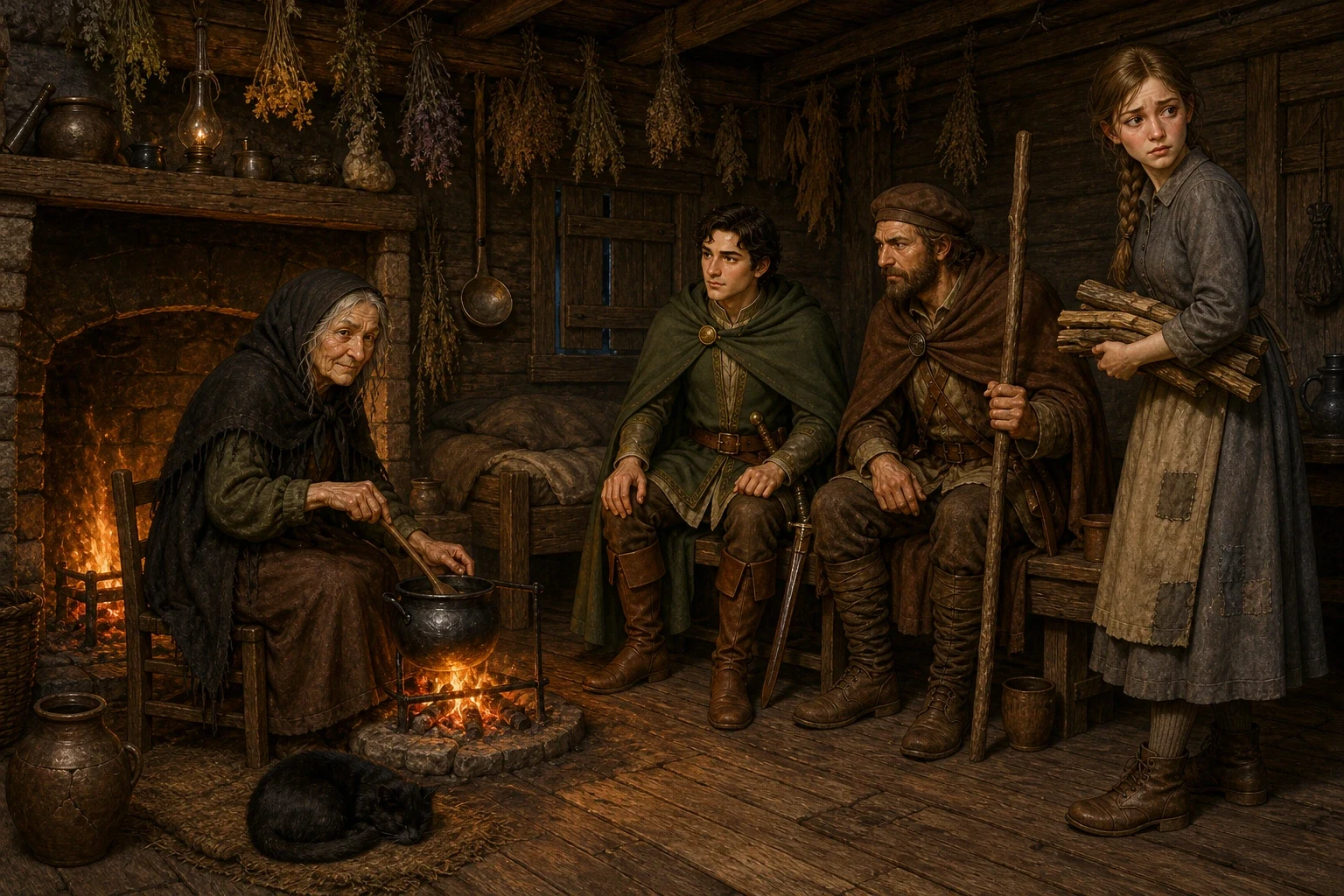
Inside, an old woman sat close by the fire in a low chair, stirring something in a small black pot that smelled strange and bitter. 'Good evening,' she said, in a voice that tried to sound kind and did not quite manage it. 'Sit yourselves down and rest.' She blew up the coals until they glowed red, and all the while her eyes, rimmed with red themselves, moved from the prince to the servant and back again. The girl moved quietly about the room, and once, when the old woman's back was turned, she bent close to the travelers. 'Eat nothing of hers,' she whispered, 'and drink nothing she offers you, whatever she says.' The prince and the servant thanked her with only a look, and that night they ate none of the old woman's strange supper, and touched none of her drink, however often it was pressed on them, and they slept lightly, by turns, until the grey morning light came in through the small window.
Page 4
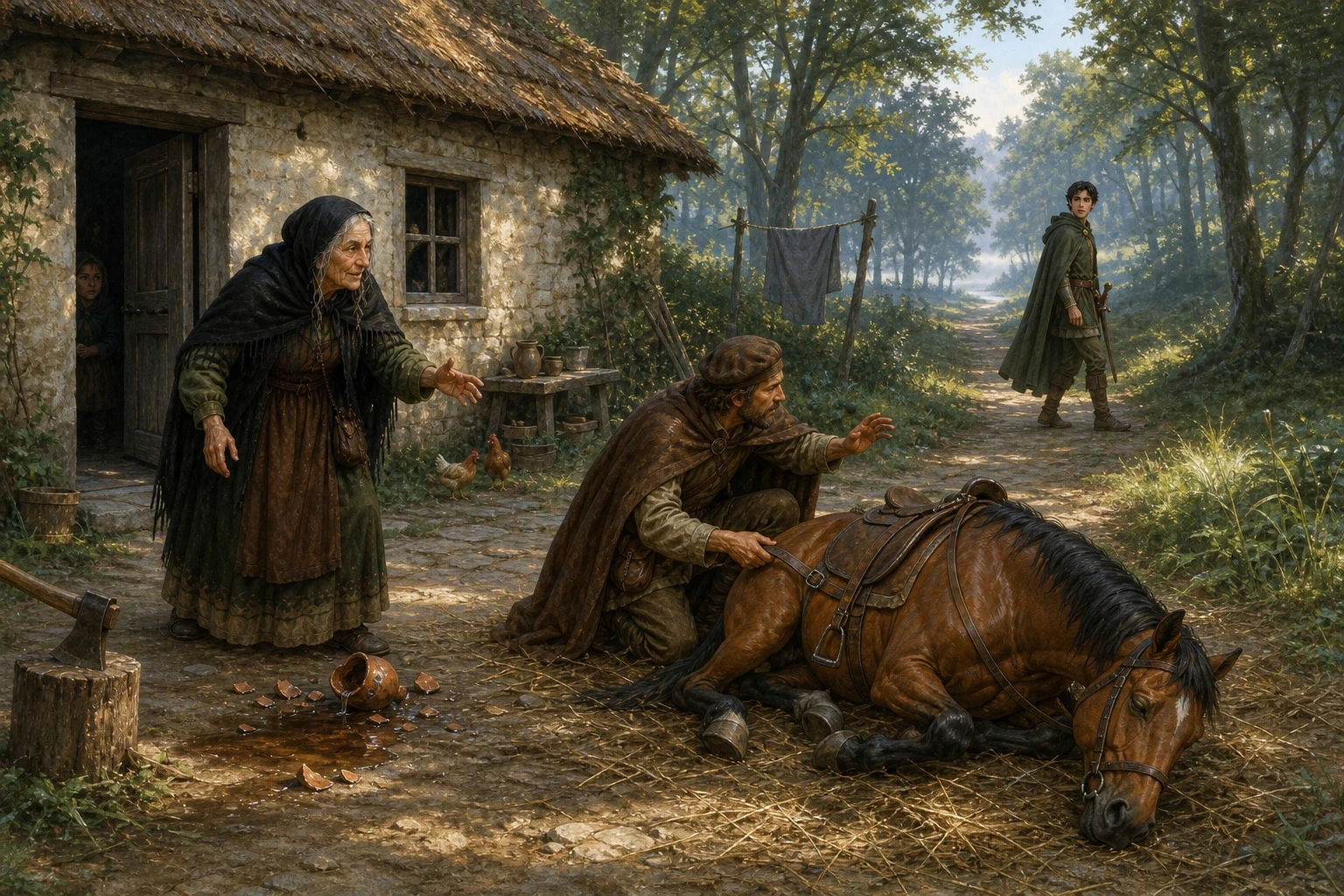
In the morning they rose to leave, glad to be going. The prince walked on a little way down the forest path to stretch his legs after the night indoors, while the servant stayed behind a moment longer to tighten the horse's saddle strap. The old woman came out after them with a cup in her hands. 'Wait,' she called. 'Take this for the road, a parting drink for your master.' She held the cup out to the servant, since the prince was already a little way off. But as she passed it to him, the cup slipped and broke on the stones, and whatever was in it — a dark, strange liquid, far stronger than any ordinary drink — splashed across the horse's flank and over its nose before either of them could stop it. The horse stood still for only a moment. Then its legs gave way beneath it, and it sank down into the yard and did not rise again.
Page 5
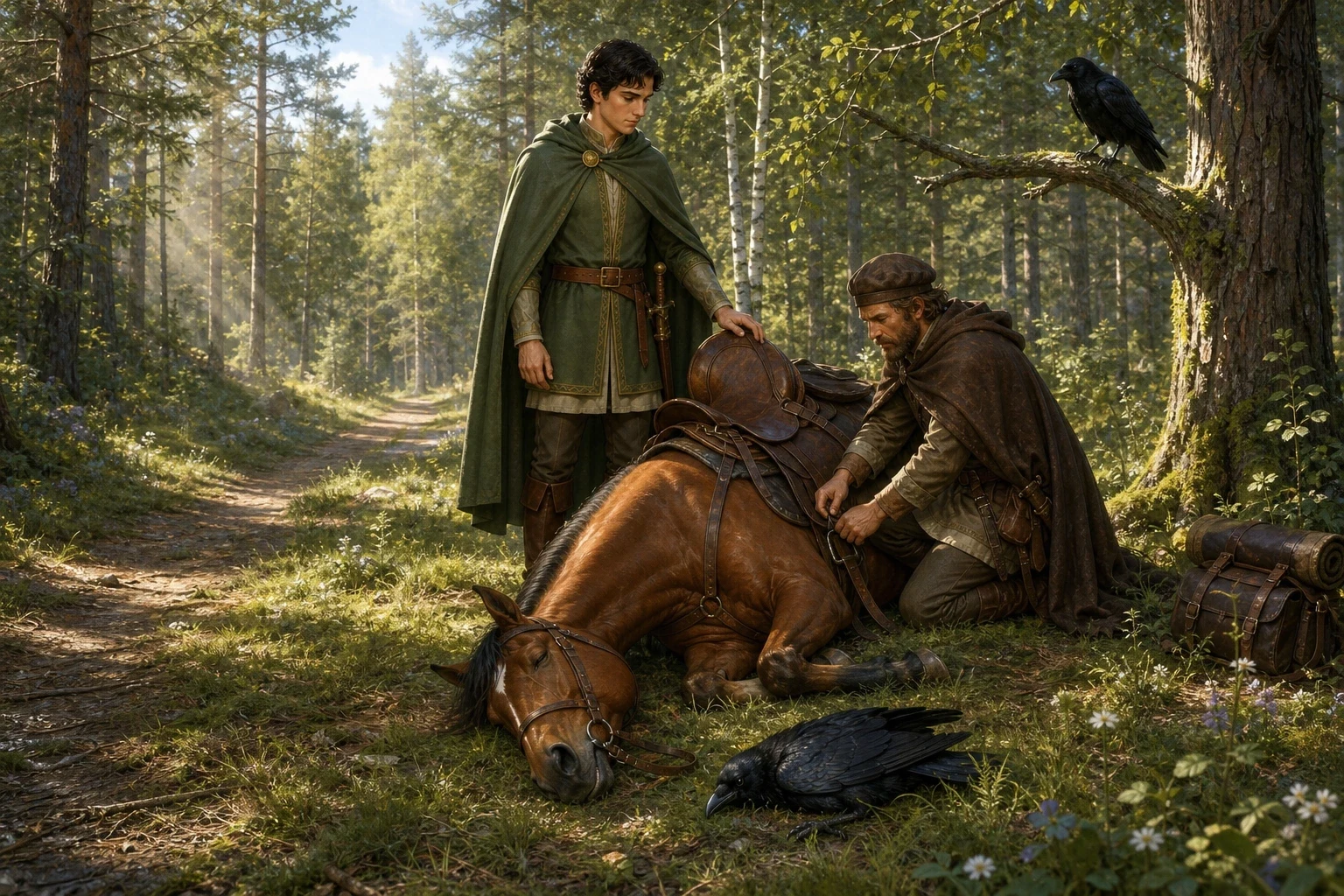
The servant ran to tell the prince what had happened, and together they hurried back along the path. There was nothing to be done; the horse lay quite still in the morning light, beyond waking. Sadly, the servant knelt to loosen the saddle and carry it onward himself, since they had lost their only mount. As he worked, he noticed a raven had come down onto the grass close by the horse, and that the raven too lay still, its black feathers catching the light, having come to peck where it should not have. The servant looked at it a long moment. 'There may be some use in this, even now,' he said, and picked the bird up carefully to carry with them, thinking it might make a good supper later in the day, never once guessing what had truly happened to it. The prince said nothing, only shouldered part of their baggage, and the two of them walked on together into the forest.
Page 6
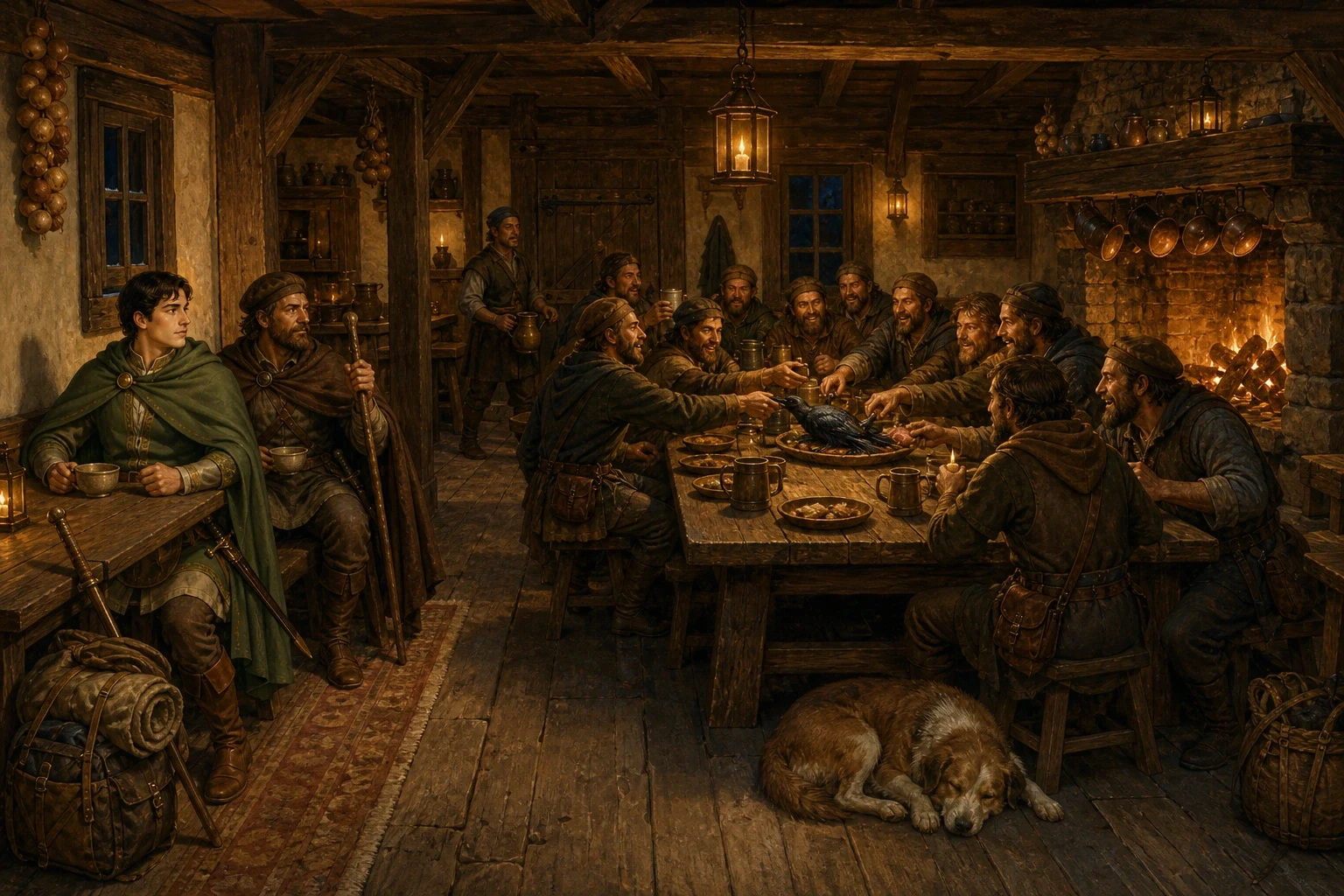
By nightfall the forest had still not ended, and the two travelers were glad to find an inn standing alone among the trees, its windows lit and a good smell of cooking coming from inside. They did not know it, but the inn was home to twelve robbers who used it as their hiding place, and meant that very night to rob the strangers who had come to lodge there. The servant asked the innkeeper to roast the raven he had carried all day, thinking it would make a welcome extra dish for supper, and the innkeeper did so gladly. The prince and the servant, tired from the long day's walk, ate a plain supper of their own and settled into a corner to rest, never knowing what sat cooking in the kitchen. Later that night, before the robbers could begin their wicked plan, the twelve of them sat down together at the long table and shared out the roasted raven among themselves, pleased to have found a little extra for their meal. One by one, before the meal was even finished, they grew quiet and still, and sank down into a deep sleep at the table that none of them would wake from again.
Page 7
In the morning the innkeeper found all twelve of his strange, hard-looking guests fallen asleep at the table and could not wake a single one of them, though he tried for a long while. He never did learn why, only that they were gone from his trouble at last, and in a locked room above the inn he found a great hoard of stolen gold and silver that the twelve had gathered over many years. He offered to share it with the prince, who had unknowingly been the cause of his good fortune, but the prince wanted none of it. 'Keep it, and see that it finds its way back to whoever it was taken from, if you can,' he said. Then he and the servant thanked the innkeeper for his hospitality, took up their packs, and walked on through the last of the forest. By midday the trees began to thin, the light grew brighter ahead of them, and at last the road carried them out from under the branches and into open country, with a far-off town visible on the horizon.
Page 8
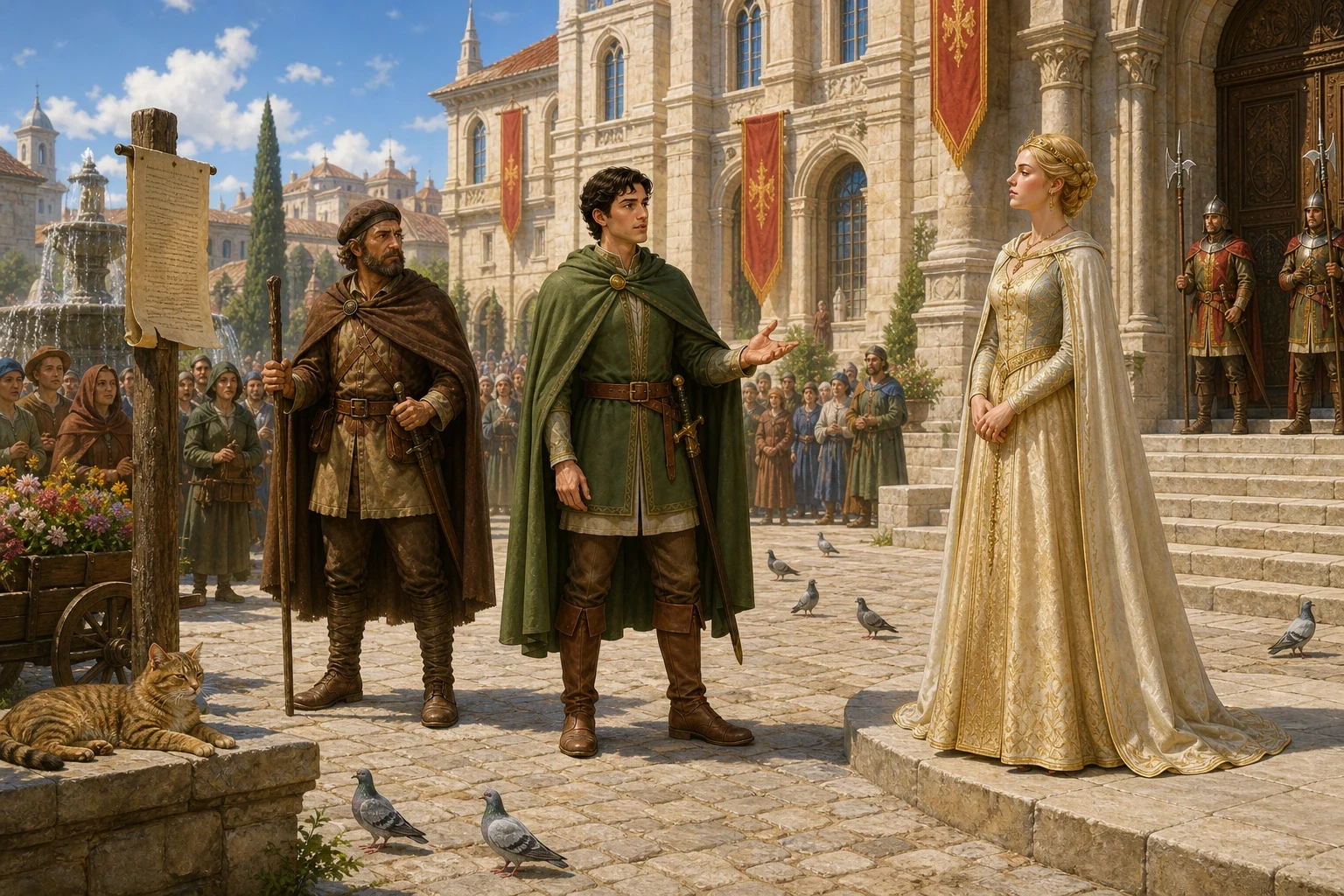
The town the prince and his servant had seen from the forest's edge turned out to have a palace at its heart, and a proclamation posted at every corner of it. A princess lived there, proud and clever, and she had declared that any man who could set her a riddle she could not guess would have her for his wife — but if she guessed it, he would pay for his failure with his life. Many suitors had already tried and lost. The prince, having just lived through a very strange adventure of his own, thought he knew a riddle no one else could possibly have heard before. He walked into the square before the palace, where the princess herself stood to hear each new challenger, and bowed to her. 'Here is my riddle,' he said. 'One slew none, and yet slew twelve. Guess it, if you can.' The princess studied him for a long moment, turning the words over in her mind, and found she had no answer ready at all.
Page 9
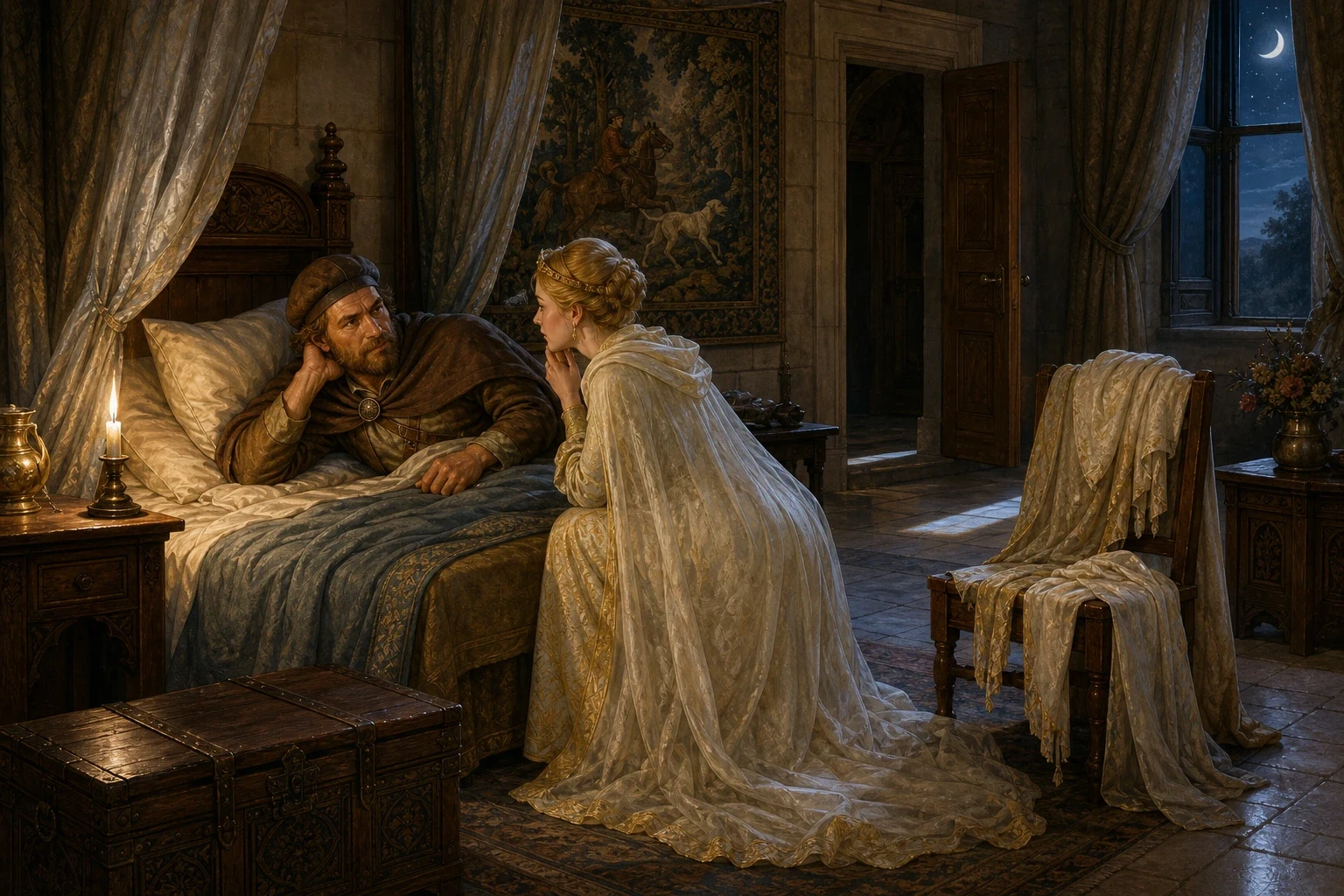
The princess had three days to find the answer, and she tried everything her books of riddles could teach her, but none of them held anything like it. So, on the first night, she sent her maid in secret to creep into the chamber where the prince was said to sleep, hoping to hear him talk in his sleep and give the answer away without meaning to. But it was the servant, not the prince, lying in that bed, wide awake and watching, and he startled the maid so badly she fled at once, leaving her cloak behind in his hand. The second night she sent a second maid, and the same thing happened. On the third night the princess came herself, wrapped head to foot in a cloak as pale and thin as mist, and sat down close beside the bed, certain the servant was fast asleep. 'One slew none,' she murmured softly, 'and yet slew twelve — what can that mean?' And the servant, who had been listening all along, answered her as though talking in a dream: 'A raven, that ate of a poisoned horse, and died of it. And twelve robbers, who ate of the raven, and died of it too.'
Page 10
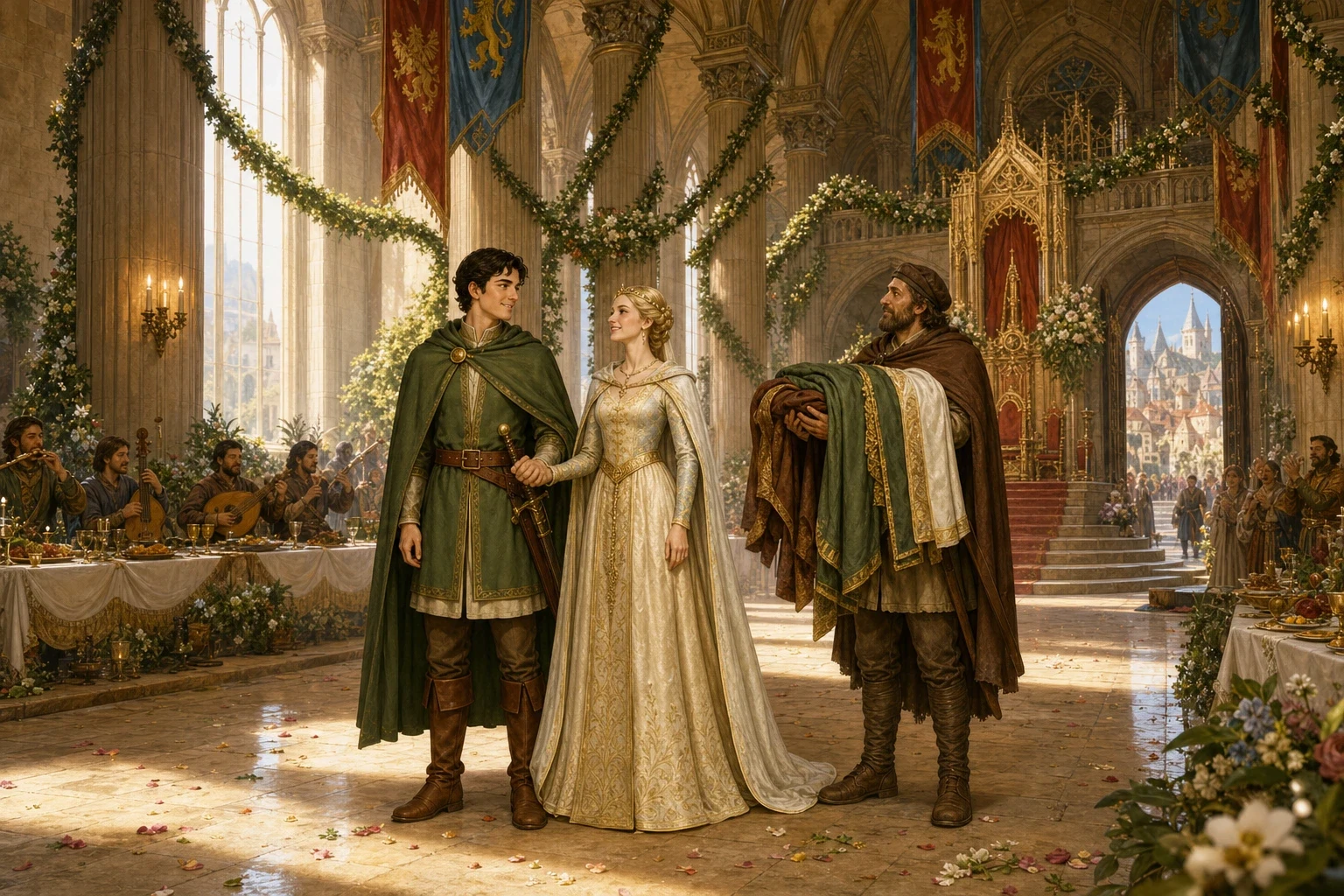
The next morning the princess told the judges she had guessed the riddle, certain she had won. But the prince asked to be heard first, and told them plainly that she could only have found the answer by coming to spy on him in the night, not by guessing it fairly at all. 'Bring us proof of this,' the judges said, and the servant stepped forward and laid out the three cloaks he had kept — the two plain ones from the frightened maids, and the long pale one, richest of all, that the princess herself had left behind in her hurry to escape. When the judges saw whose cloak it was, they ruled at once that she had not won by wit, and so, by the rules she herself had set, she must become the prince's bride instead. The wedding was held that same week in the great hall, with the three cloaks — mended, and the finest of them turned to gold and silver thread for the day — carried in before them all.
About this story
- Audience: kids (ages 6–12)
Read Wonder Tales on your phone
Wonder Tales is available on Android. Get Wonder Tales on Google Play.