Farnese Hercules by Glykon (Naples, Italy — 3rd Century AD)
Farnese Hercules by Glykon (Naples, Italy — 3rd Century AD) — an illustrated arts story, set in Italy. 10 illustrated pages, free to read on Wonder Arts.
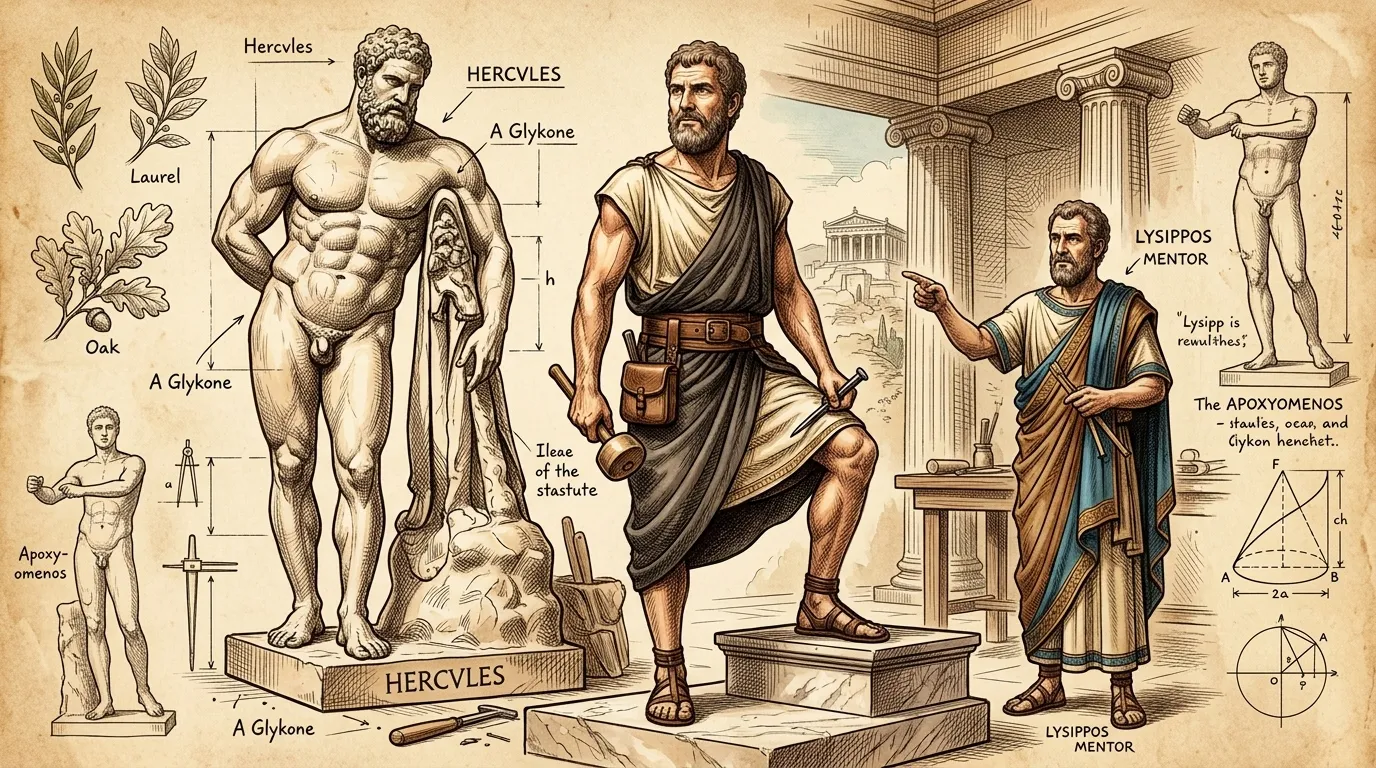
Page 1
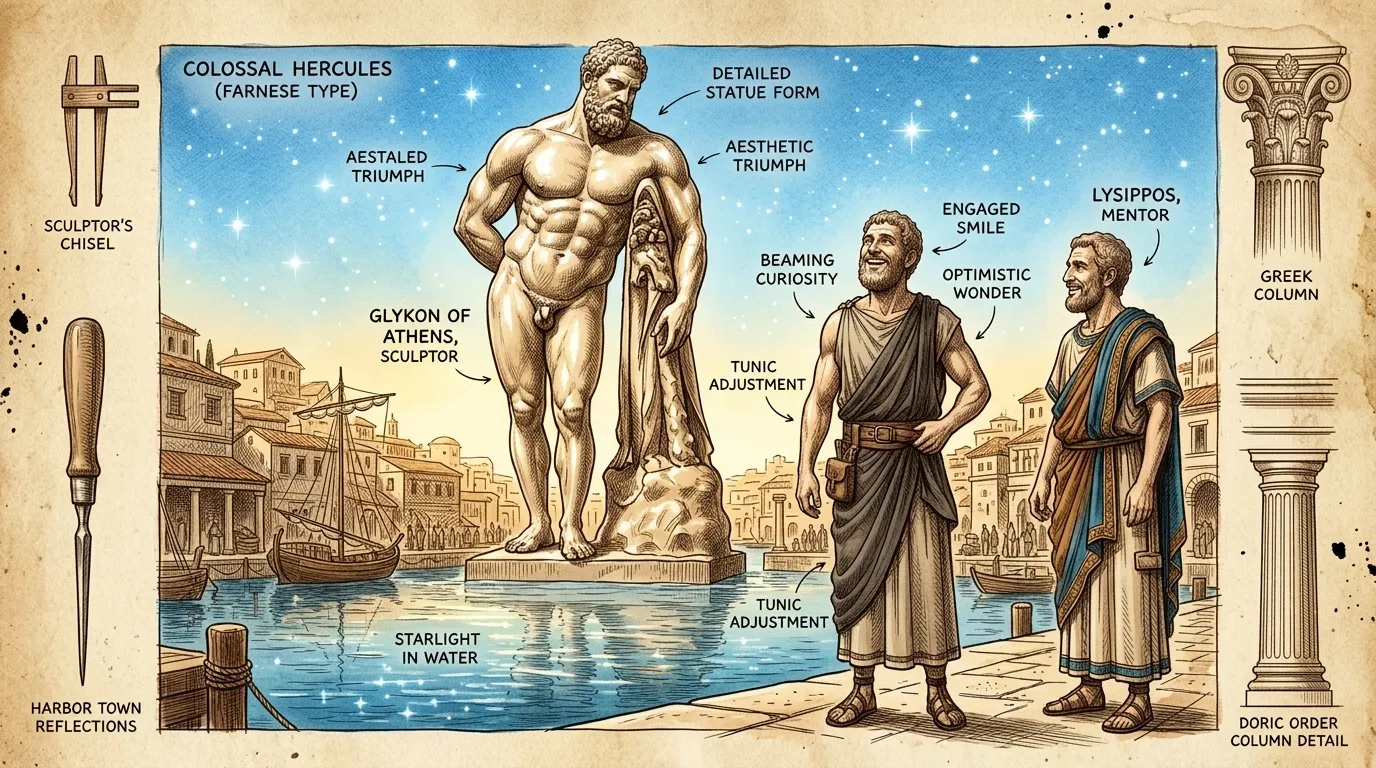
In the radiant harbor town, where starlight mirrored in the water rivals the sun, stood Glykon of Athens. Before him, the Farnese Hercules, a colossal marble testament to strength and repose, glistened. Completed in the 3rd century AD, this statue, now residing in the National Archaeological Museum of Naples, stands at a staggering 12 feet 7 inches. Legend says its exaggerated musculature was meant to evoke not just power but the godlike serenity Hercules achieved after his labors.
"Glykon adjusted his tunic, a flicker of pride in his eyes. He murmured to himself, 'As Aristotle said, 'The ultimate value of life depends upon awareness and the power of contemplation rather than upon mere survival.' Let this Hercules be a reminder of that ultimate value.'"
Art Fact: The Farnese Hercules, a Roman copy of a Greek original, portrays the hero in a moment of weary triumph, leaning on his club.
Page 2

Glykon often recounted his journey to Alexandria, seeking inspiration. There, amidst the Great Library's scrolls, he discovered the works of Lysippos, Alexander the Great's sculptor. Lysippos's emphasis on naturalism and the play of light and shadow deeply affected the young Glykon. He realized then that true strength was not just about size but balance, a lesson he would later apply to his Hercules.
"An Alexandrian scholar gestured towards a weathered papyrus. 'Lysippos taught us,' he said, 'to depict men as they appear to the eye, not as geometry dictates. True art captures life!' Glykon nodded, carefully copying a sketch from the scroll. 'Balance is the key,' he muttered, 'even for Hercules.'"
Art Fact: Lysippos was known for his canon of proportions, emphasizing a slender physique.
Page 3
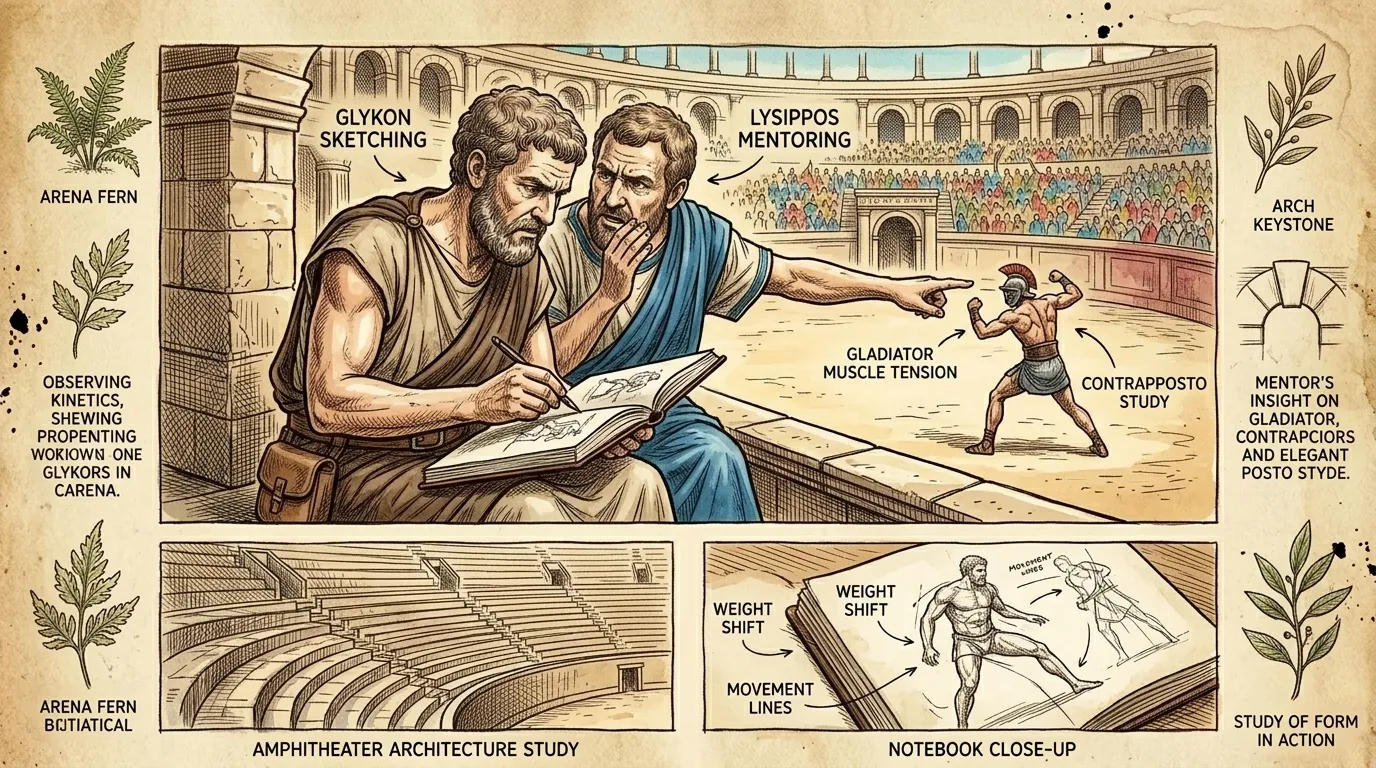
In Naples, Glykon frequently attended the gladiatorial contests. He was not drawn to the violence but to the anatomy of the combatants – the straining muscles, the dynamic poses. One particular gladiator, a Thracian with incredible strength, inadvertently provided Glykon with the precise contrapposto, the weight shift and slight twist of the body, that he sought for his Hercules.
"A seasoned Neapolitan sculptor leaned towards Glykon, his brow furrowed. 'Observe,' he whispered, 'the way the gladiator bears his weight. Notice the tension in his shoulders, the slight curve of his spine. This is not mere brawn; it's controlled power!' Glykon sketched furiously in his notebook."
Art Fact: Gladiatorial games were a popular form of entertainment in Roman society.
Page 4

Securing the finest Carrara marble was crucial. Glykon sailed to the quarries himself, spending weeks examining countless blocks. He sought a piece free of flaws, its grain perfectly aligned to withstand the immense pressure his Hercules would exert. He found it – a block that seemed to hum with latent energy.
"An old Carrara quarryman, his face etched with the dust of ages, pointed to a specific block. 'This one, Glykon,' he rasped, his voice like grinding stone, 'it sings with strength. Feel the grain. It will bear the weight of gods!' Glykon ran his hand over the smooth surface, a spark of certainty igniting in his eyes."
Art Fact: Carrara marble was highly prized by sculptors for its purity and workability.
Page 5
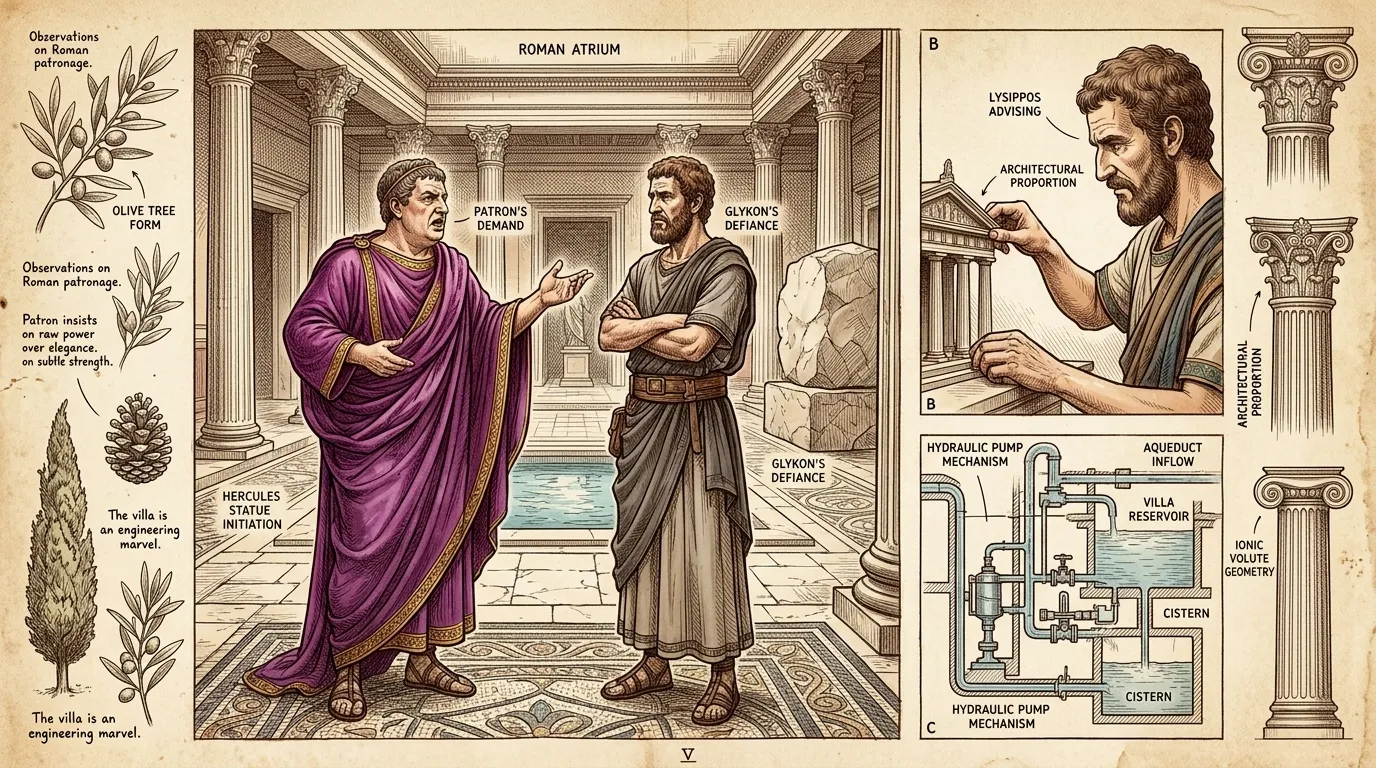
The commission came from a wealthy Roman patron, a man of immense power and vanity. He envisioned a Hercules of unbridled strength, a symbol of his own perceived might. Glykon, however, sought to convey something more profound – the hero's hard-won peace, his transcendence of earthly struggles. The tension between artist and patron simmered.
"The Roman patron, draped in opulent purple robes and radiating arrogance, declared, 'Glykon, I want a Hercules that screams power! Show me his muscles, his fury!' Glykon, his brow furrowed, replied with subtle defiance, 'Strength, my lord, is not merely in brute force, but in the serenity that follows great trials.'"
Art Fact: Patronage played a crucial role in the creation of art in ancient Rome.
Page 6
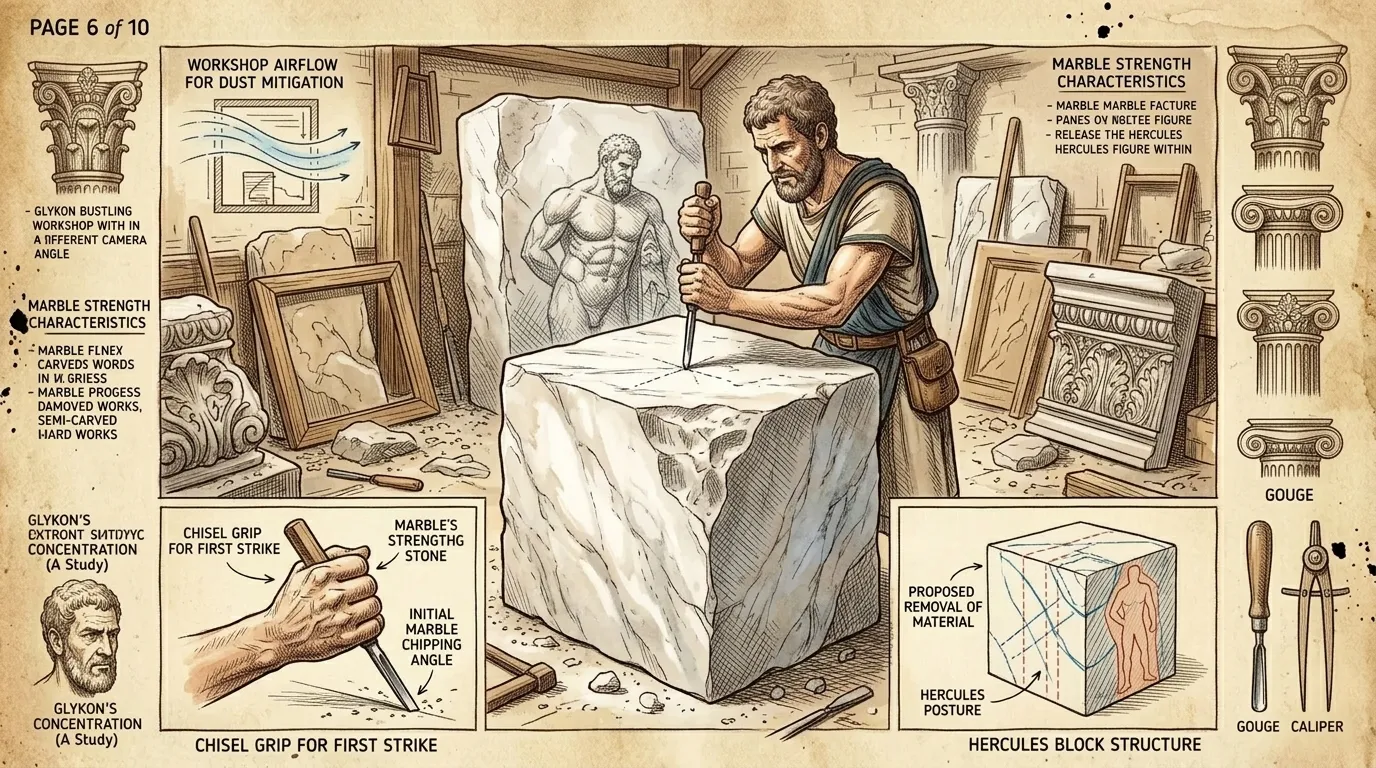
The first strike of the chisel was a moment of profound consequence. Glykon hesitated, contemplating the marble, feeling the weight of Lysippos's teachings, the gladiator's pose, the patron's expectations. Then, with a deep breath, he struck, releasing the Hercules from its stony prison.
"Before striking, Glykon took a moment to prepare himself. 'Da Vinci once said that painting is poetry that is seen rather than felt, and poetry is painting that is felt rather than seen. Let this sculpture be felt!'"
Art Fact: Sculpting is a subtractive process, removing material to reveal the form within.
Page 7
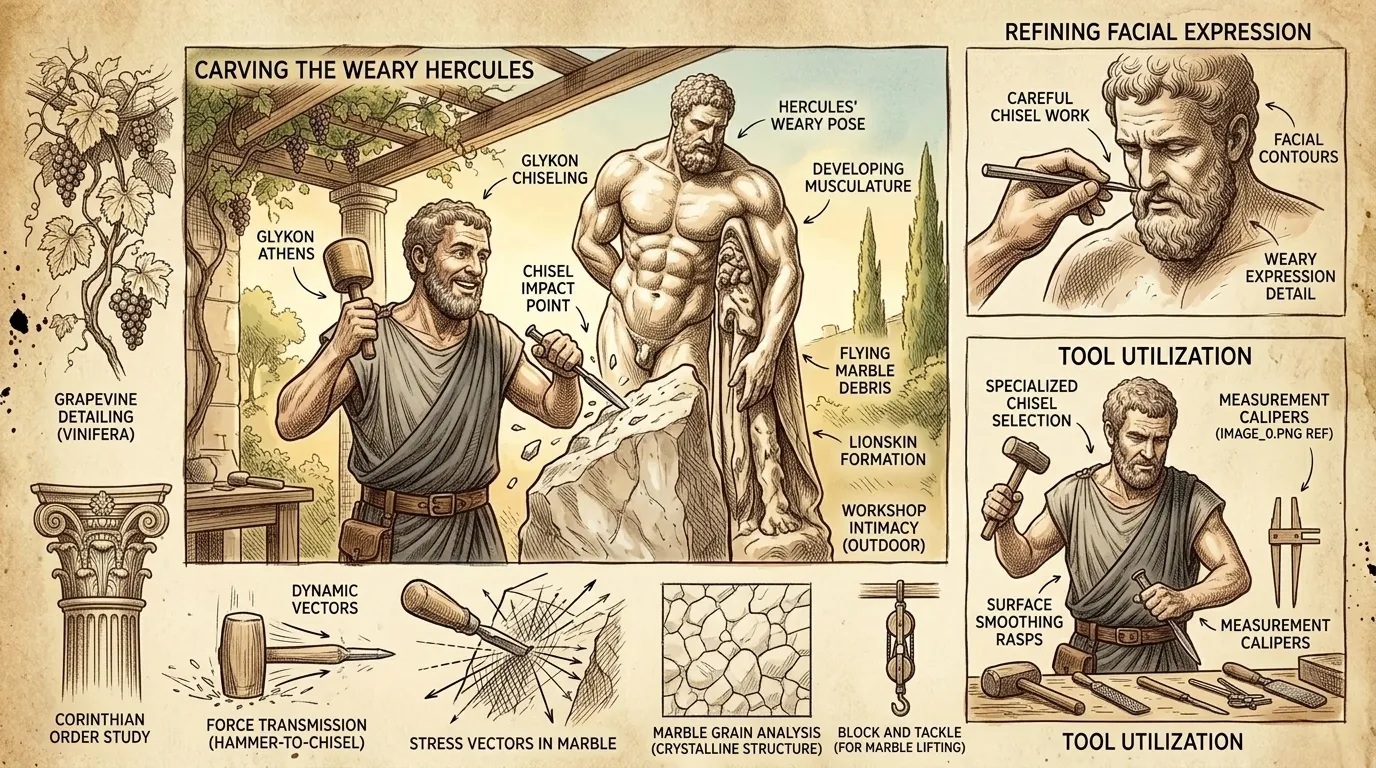
Days turned into weeks, weeks into months. Glykon labored tirelessly, chipping away at the marble, refining the form, imbuing it with emotion. He sought to capture not just Hercules's strength but the weariness that followed his legendary labors, the profound understanding that came from facing impossible challenges. The statue began to take shape, a testament to both physical and emotional endurance.
"Working diligently Glykon expressed, 'Ah, now, he is starting to truly come to life with this pose.'"
Art Fact: The twelve labors of Hercules are a popular subject in classical art.
Page 8
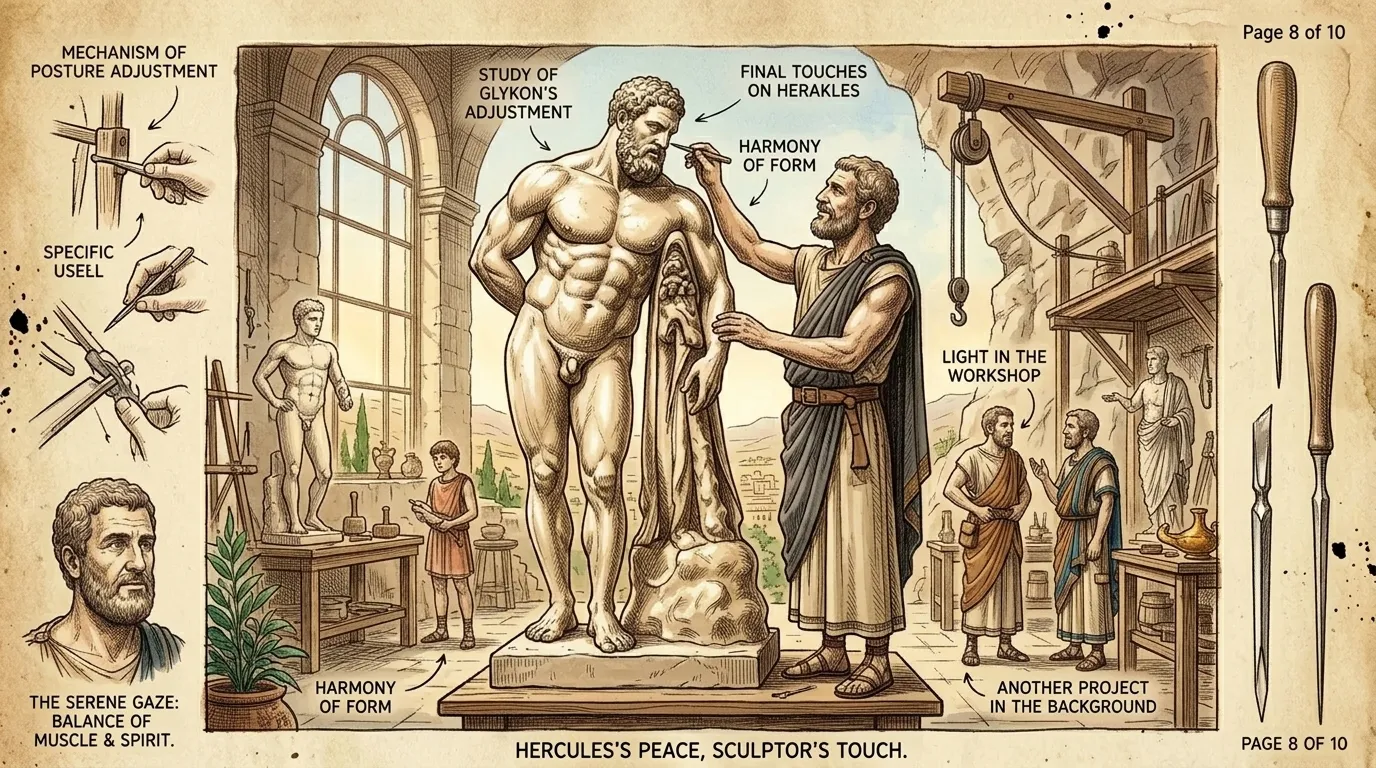
The final touch was the most challenging – conveying Hercules's hard-won serenity. Glykon studied the statue for hours, seeking the perfect balance of tension and relaxation. He subtly adjusted the hero's gaze, his posture, imbuing him with a sense of peace that transcended his physical power.
"As the final touches were added, Glykon paused. 'Now, he is at peace, as he should be.'"
Art Fact: The Hercules statue became a symbol of strength and resilience
Page 9

The Farnese Hercules was unveiled to great acclaim. Its size, its anatomy, its emotional depth captivated audiences. It became a symbol of not just Roman power but of the human potential for both physical and spiritual triumph. Centuries later, it continues to inspire, a reminder that true strength lies in the ability to find peace amidst struggle.
"Attendees expressed, 'This is a true marvel to behold! It will surely inspire many and prove the meaning of hard work.'"
Art Fact: The Hercules serves as a symbol of the power of strength and overcoming adversity.
Page 10
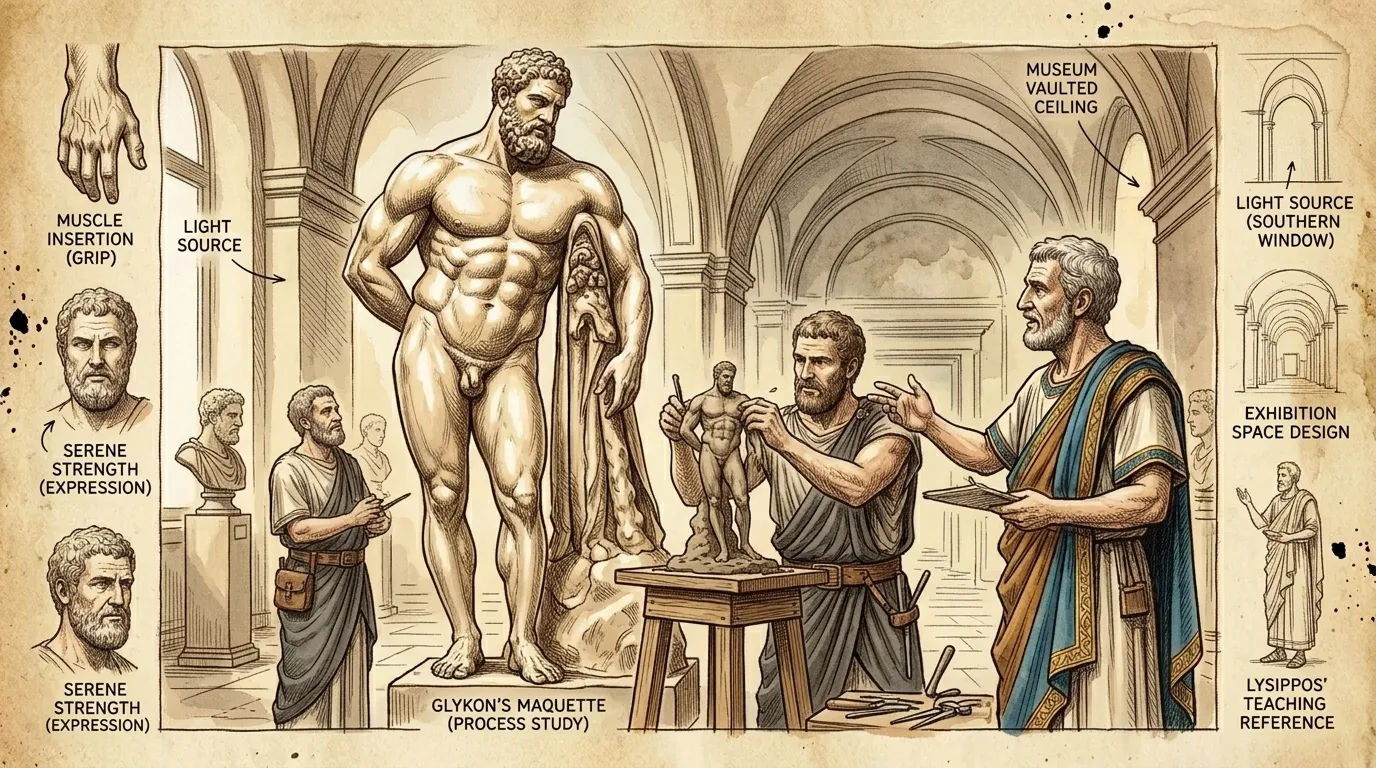
Today, the Farnese Hercules stands in the National Archaeological Museum of Naples, a timeless testament to Glykon's vision. Generations of artists have studied it, drawn to its power, its beauty, its profound humanity. Glykon's Hercules endures, reminding us that even the mightiest heroes seek, and sometimes find, inner peace. Why does Glykon's work survive forever? Because it captures the essence of human struggle and triumph, resonating across centuries and cultures.
"The eternal echo of Glykon's masterpiece: an art critic once declared, 'The body is merely the vehicle for the soul. It is a beautiful vehicle, but it is the soul that is the essence.' That is the lasting impression we get when viewing this glorious statue of Hercules."
Art Fact: The Farnese Hercules remains one of the most celebrated sculptures of antiquity.
About this story
- Location: Italy
- Audience: general readers
Questions and answers
Questions and answers about Farnese Hercules by Glykon (Naples, Italy — 3rd Century AD)
Read Wonder Arts on your phone
Wonder Arts is available on Android. Get Wonder Arts on Google Play.
More Wonder Arts stories
- Fidelio by Ludwig van Beethoven (Vienna, Austria — 1805)
- First Color Photograph by Thomas Sutton and James Clerk Maxwell (London, UK — 1861)
- First Film Screening by Lumière Brothers (Paris, France — 1895)
- First Folio by William Shakespeare (London, UK — 1623)
- First Impressionist Exhibition by Monet and peers (Paris, France — 1874)
- First Photograph by Nicéphore Niépce (France — 1826)