First Impressionist Exhibition by Monet and peers (Paris, France — 1874)
First Impressionist Exhibition by Monet and peers (Paris, France — 1874) — an illustrated arts story, set in France. 10 illustrated pages, free to read on Wonder Arts.
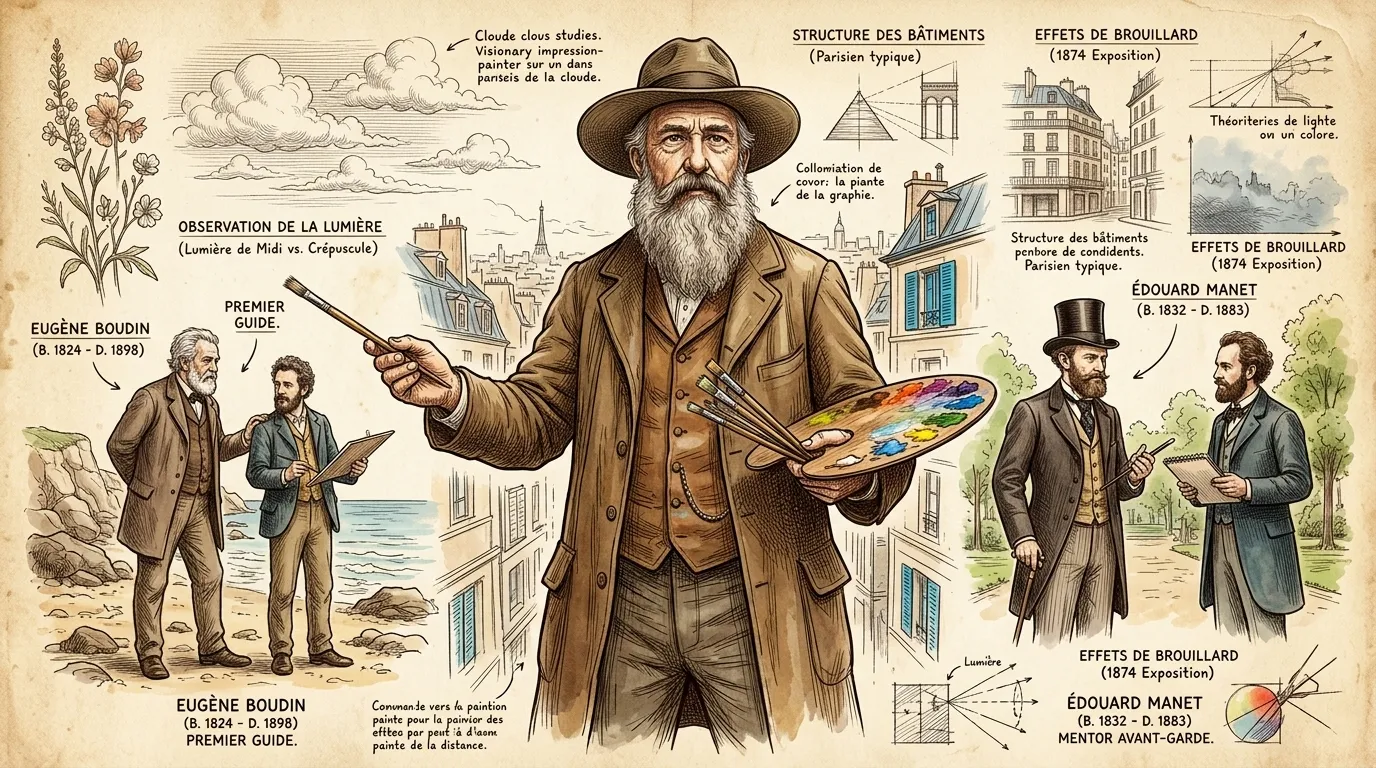
Page 1

Claude Monet, a passionate artist with a vision unlike any other, stands proudly before 'Impression, soleil levant'. Painted in 1872, it would soon give a name to an entire movement. The painting, measuring 48 cm 63 cm, currently resides at the Musée Marmottan Monet in Paris. Few know the controversy it would ignite, sparking debates and forever changing the art world's landscape.
""This isn't just a landscape, it's a feeling," Monet murmurs, his eyes reflecting the fiery sunrise on the canvas. "It's the very soul of Le Havre, captured in a fleeting moment.""
Art Fact: The painting's title, hastily provided by Monet for the exhibition catalogue, inadvertently named the Impressionist movement, much to the initial chagrin of some of the artists.
Page 2

Years before the exhibition, Monet's early works faced rejection at the official Salon, a stark reminder of the conservative art establishment's grip. Eugène Boudin, Monet's mentor, witnessed the young artist's frustration. He knew the Salon favored academic painting and offered Monet a piece of wisdom that would serve him well: embracing artistic freedom.
""Claude, don't let their narrow minds deter you," Boudin advises, placing a hand on Monet's shoulder. "'The only real voyage of discovery consists not in seeking new landscapes, but in having new eyes,' as Marcel Proust will one day say. Paint what you see, what you feel, not what they expect.""
Art Fact: The Salon's rigid adherence to academic standards often stifled innovation, leading many artists to seek alternative venues for exhibiting their work.
Page 3

Édouard Manet, a leading figure among the avant-garde artists, gathered regularly at the Café Guerbois. Monet, Renoir, Degas, and others joined him, forming a circle of rebellious spirits. They debated art, challenged conventions, and fueled each other's artistic fire. It was there, amidst the clatter and conversation, that the seeds of the Impressionist exhibition were sown.
""We need to show them what true art can be!" Renoir exclaims, gesturing emphatically with a glass of wine. "'The artist is a receptacle for emotions that come from all over the place: from the sky, from the earth, from a scrap of paper, from a passing shape, from a spider's web,' as Picasso will say, we must let them flow!""
Art Fact: The Café Guerbois served as a vital intellectual hub, fostering the exchange of ideas that would shape the Impressionist movement.
Page 4

Monet's move to Argenteuil provided him with a haven of inspiration. His garden became a living canvas, filled with vibrant flowers and shimmering light. It was here that he honed his plein air technique, capturing the fleeting effects of sunlight on water and foliage. The garden became a recurring motif in his work, a testament to nature's endless beauty.
""Look at the way the light dances on the water lilies!" Monet exclaims to his wife, Camille, as he sets up his easel by the pond. "'Everything is beautiful, all that matters is to be able to interpret,' as Camille Pissarro would agree. It's not just about seeing, it's about feeling.""
Art Fact: Monet's garden at Argenteuil provided him with a continuous source of inspiration, shaping his unique artistic vision.
Page 5

Frustrated by the Salon's continued rejection, Monet and his peers decided to take matters into their own hands. They formed an independent collective, determined to exhibit their work outside the confines of the official art world. The group secured a space in the former studio of the photographer Nadar, a bold statement of artistic independence.
""We will show them that art doesn't need the Salon's approval!" Degas declares, pacing the room with energy. "'The world is full of obvious things which nobody by any chance ever observes,' as Sherlock Holmes would say, so let's make people observe our world!""
Art Fact: The decision to hold an independent exhibition was a pivotal moment, marking a clear break from the established art system.
Page 6

The studio of Nadar, a renowned photographer and a supporter of the arts, provided the perfect setting for the exhibition. Its spacious interior and ample natural light created an inviting atmosphere for visitors. The location itself was a symbolic victory, a testament to the growing acceptance of new artistic ideas.
""This space is a breath of fresh air," Berthe Morisot remarks, admiring the light streaming through the windows. "'The artist is a hand that plays, touching one key or another, to cause vibrations in the souls,' as Kandinsky believed, and this studio will help us play our music.""
Art Fact: Nadar's willingness to host the exhibition demonstrated his commitment to supporting innovative artists and challenging conventional norms.
Page 7

The exhibition opened to a barrage of criticism. Louis Leroy, a prominent art critic, coined the term 'Impressionism' in a scathing review, mocking Monet's 'Impression, soleil levant.' However, the name stuck, and what was intended as an insult became a badge of honor for the rebellious artists.
""An 'Impression'? Ha!" Leroy scoffs, pointing to Monet's painting. "'I am easily satisfied with the very best,' as Winston Churchill said, and this is far from it! This is mere daubing!""
Art Fact: Ironically, the negative review by Louis Leroy inadvertently gave the Impressionist movement its name, solidifying its place in art history.
Page 8

Despite the initial criticism, some viewers were captivated by the Impressionists' bold new approach. Artists like Gustave Caillebotte, a wealthy painter and collector, championed their work, purchasing paintings and providing financial support. Slowly, the movement gained momentum, attracting a new generation of artists and collectors.
""These artists are capturing the essence of modern life!" Caillebotte exclaims, admiring a painting by Renoir. "'Art washes away from the soul the dust of everyday life,' as Picasso said, and their work is doing just that!""
Art Fact: The support of key figures like Gustave Caillebotte helped the Impressionist movement gain recognition and overcome initial resistance.
Page 9

In the years that followed, Impressionism revolutionized the art world. Monet, Renoir, Degas, and their peers achieved international acclaim. Their innovative techniques and focus on capturing fleeting moments of light and color inspired countless artists. The first Impressionist exhibition, once ridiculed, became a landmark event in art history.
""We showed them that art can be more than just imitation!" Monet declares, reflecting on the movement's success. "'I would like to paint the way a bird sings,' as I've always said, and now, it seems, the world is listening to our song.""
Art Fact: The Impressionist movement paved the way for modern art, transforming the way artists perceived and represented the world.
Page 10

Today, 'Impression, soleil levant' hangs in the Musée Marmottan Monet, drawing visitors from around the globe. Monet's vision, once derided, is now celebrated as a pivotal moment in art history. His focus on light and feeling continues to inspire artists and captivate audiences. Monet's work survives because it invites us to see the world with fresh eyes, to find beauty in the fleeting moments of everyday life.
"A museum visitor whispers to her companion, "It's incredible how he captured the light. 'The aim of art is not to represent the outward appearance of things, but their inward significance,' as Aristotle said, and Monet truly understood that.""
Art Fact: Monet's Impression, soleil levant, continues to be celebrated not just for its artistic innovation but as the symbolic starting point of an entire art movement.
About this story
- Location: France
- Audience: general readers
Questions and answers
Questions and answers about First Impressionist Exhibition by Monet and peers (Paris, France — 1874)
Read Wonder Arts on your phone
Wonder Arts is available on Android. Get Wonder Arts on Google Play.
More Wonder Arts stories
- First Photograph by Nicéphore Niépce (France — 1826)
- First Portrait Photograph by Robert Cornelius (Philadelphia, USA — 1839)
- First Special Effects Film by Alfred Clark (USA — 1895)
- Florence Cathedral (Florence, Italy — 1436)
- Forbidden City (Beijing, China — 1406–1420)
- Gattamelata by Donatello (Padua, Italy — 1453)