Library of Alexandria destruction (Alexandria, Egypt — c. 3rd Century BC)
Library of Alexandria destruction (Alexandria, Egypt — c. 3rd Century BC) — an illustrated arts story, set in United States. 10 illustrated pages, free to read on Wonder Arts.
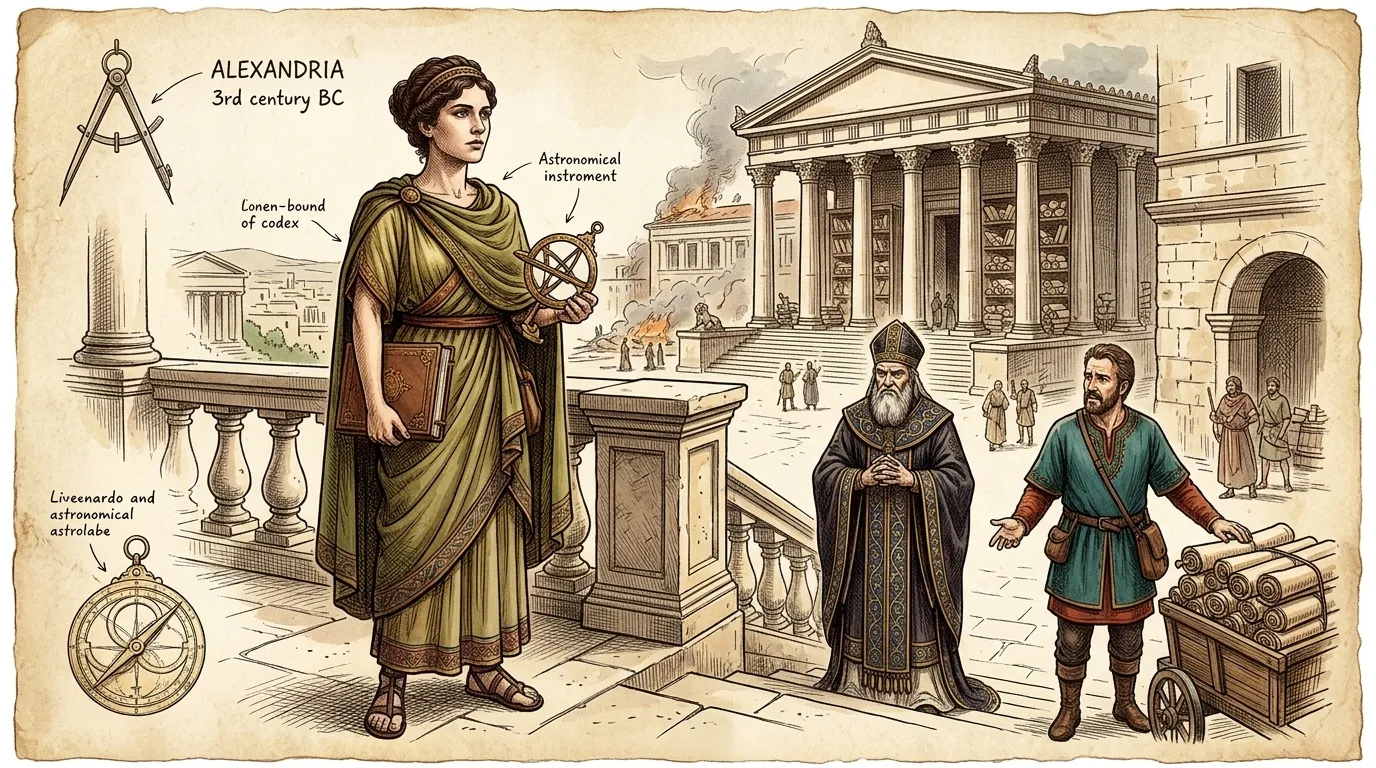
Page 1

Hypatia, the brilliant philosopher and astronomer, stood amidst the towering scrolls of the Library of Alexandria. The year was approximately 415 AD. This vast repository of human knowledge, once the heart of the ancient world, was under siege by religious zealots. Measuring roughly 330 feet long and housing hundreds of thousands of scrolls, the library was more than just a building; it was the embodiment of intellectual pursuit. Its destruction marked a turning point in history, a loss of countless works of literature, science, and philosophy. The value of what was lost is immeasurable.
""The pursuit of knowledge is our sacred duty, even in the face of madness," Hypatia murmured to herself, her voice barely audible above the growing roar of the mob."
Art Fact: The Library of Alexandria was founded in the 3rd century BC by Ptolemy I Soter. It aimed to collect all the world's knowledge, housing texts in Greek, Egyptian, and other languages. Its destruction is considered one of the greatest intellectual tragedies in history.
Page 2

Bishop Cyril of Alexandria, a stern figure with unwavering convictions, preached to a growing crowd outside the library's walls. His words, laced with religious fervor, stirred up resentment against those who embraced pagan learning. The rift between the intellectual elite and the increasingly powerful Christian community widened with each passing day.
""These pagan scrolls are filled with falsehoods and blasphemies!" Cyril thundered, his voice resonating through the city. "We must cleanse Alexandria of this corruption!""
Art Fact: Bishop Cyril's actions were influenced by the growing power of the Christian Church in Alexandria and its intolerance towards other beliefs and intellectual pursuits.
Page 3

Inside the library, Hypatia pondered the philosophical implications of the escalating conflict. She found solace in the words of Plato, whose dialogues emphasized reason and the pursuit of truth. "'Thinking is the talking of the soul with itself,'" she mused, recalling Plato's wisdom. "But what happens when souls refuse to listen?"
""If we allow fear to dictate our actions, we betray the very principles we hold dear," Hypatia declared to her students, her voice filled with determination."
Art Fact: Hypatia was a respected teacher of mathematics, astronomy, and philosophy. She believed in the power of reason and intellectual freedom.
Page 4

Rumors spread like wildfire through the city. Some claimed Hypatia was a sorceress, using her knowledge to undermine the Christian faith. Others accused her of political influence, siding with the Roman prefect against Cyril's growing power. The truth was lost in the maelstrom of religious and political intrigue.
""They say she controls the Roman prefect, using her dark magic to defy the Church," whispered a hooded figure in a darkened alleyway. "Alexandria will fall if we allow this to continue.""
Art Fact: Political tensions between the Roman authorities and the Christian Church in Alexandria contributed to the volatile atmosphere and fueled the conspiracy against Hypatia.
Page 5

A mob, whipped into a frenzy by Cyril's fiery sermons, descended upon the library. They smashed statues, looted scrolls, and set fire to the ancient texts. The flames consumed centuries of knowledge, turning the library into a smoldering ruin. Amidst the chaos, Hypatia was brutally attacked.
""Burn it all! Let the flames cleanse this den of paganism!" shouted a member of the mob, wielding a flaming torch."
Art Fact: The exact details of Hypatia's death and the library's destruction are debated by historians. However, the event remains a symbol of the loss of knowledge and the dangers of religious intolerance.
Page 6

The fire raged for days, reducing the Library of Alexandria to ashes. Countless scrolls, containing invaluable works of literature, science, and philosophy, were lost forever. The intellectual heart of the ancient world had been silenced.
"An eerie silence fell over the city as the last embers of the Library of Alexandria faded, a stark reminder of what had been lost forever."
Art Fact: The destruction of the Library of Alexandria is often cited as a major setback for intellectual progress and a symbol of the dangers of fanaticism.
Page 7

Orestes, the Roman prefect of Alexandria and a friend of Hypatia, mourned the loss of the library and the senseless violence that had claimed her life. He recognized the profound implications of this tragedy for the future of learning and civilization.
""'The death of one is a tragedy; the death of a million is a statistic,'" Orestes muttered, remembering the words of Joseph Stalin. "How can we recover from such a catastrophic loss?""
Art Fact: Orestes' friendship with Hypatia and his support for intellectual pursuits made him a target of Cyril's animosity.
Page 8

Centuries later, the destruction of the Library of Alexandria continues to resonate as a cautionary tale. It serves as a reminder of the fragility of knowledge and the importance of safeguarding intellectual freedom. The loss of the library's vast collection represents a profound cultural void.
"A lone historian, sketching the ruins centuries later, reflects, "Even in its absence, the Library's story demands we protect knowledge from the ravages of ignorance.""
Art Fact: The legacy of the Library of Alexandria continues to inspire efforts to preserve and promote knowledge in the face of adversity.
Page 9

The spirit of the Library of Alexandria, though physically destroyed, lived on in the works of surviving scholars and the enduring pursuit of knowledge across generations. The flame of intellectual curiosity, once ignited in Alexandria, continued to burn brightly in other centers of learning.
"Though these stones have crumbled," an unseen narrator states, "the quest for understanding sparked within these walls travels forward through time." "
Art Fact: The destruction of the Library of Alexandria did not extinguish the human desire for knowledge. Instead, it served as a catalyst for the establishment of new centers of learning and the preservation of existing knowledge.
Page 10

Today, the story of Hypatia and the Library of Alexandria stands as a testament to the enduring power of knowledge and the importance of defending intellectual freedom. Though the library is gone, its legacy continues to inspire scholars, artists, and thinkers around the world. Her silhouette stands over the ruins, a constant, quiet protector. The library's essence is etched in the hearts of those who seek truth, "E pur si muove" – 'And yet it moves,' a sentiment echoing her spirit of unyielding pursuit of truth and progress.
"An unseen admirer whispers, "Hypatia's light endures in the minds of all who value the pursuit of knowledge.""
Art Fact: The story of the Library of Alexandria serves as a reminder that the pursuit of knowledge is a continuous process, and that even in the face of destruction, the spirit of learning can endure.
About this story
- Location: United States
- Audience: general readers
Questions and answers
Read Wonder Arts on your phone
Wonder Arts is available on Android. Get Wonder Arts on Google Play.
More Wonder Arts stories
- Lion Monument by Bertel Thorvaldsen (Lucerne, Switzerland — 1821)
- Lithography by Alois Senefelder (Germany — 1796)
- Louvre Museum opening (Paris, France — 1793)
- Luncheon of the Boating Party by Pierre-Auguste Renoir (Washington D.C., USA — 1881)
- Macchiaioli by Tuscan painters (Florence, Italy — c. 1855)
- Machu Picchu (Cusco, Peru — c. 1450)