Macchiaioli by Tuscan painters (Florence, Italy — c. 1855)
Macchiaioli by Tuscan painters (Florence, Italy — c. 1855) — an illustrated arts story, set in Italy. 10 illustrated pages, free to read on Wonder Arts.
Page 1

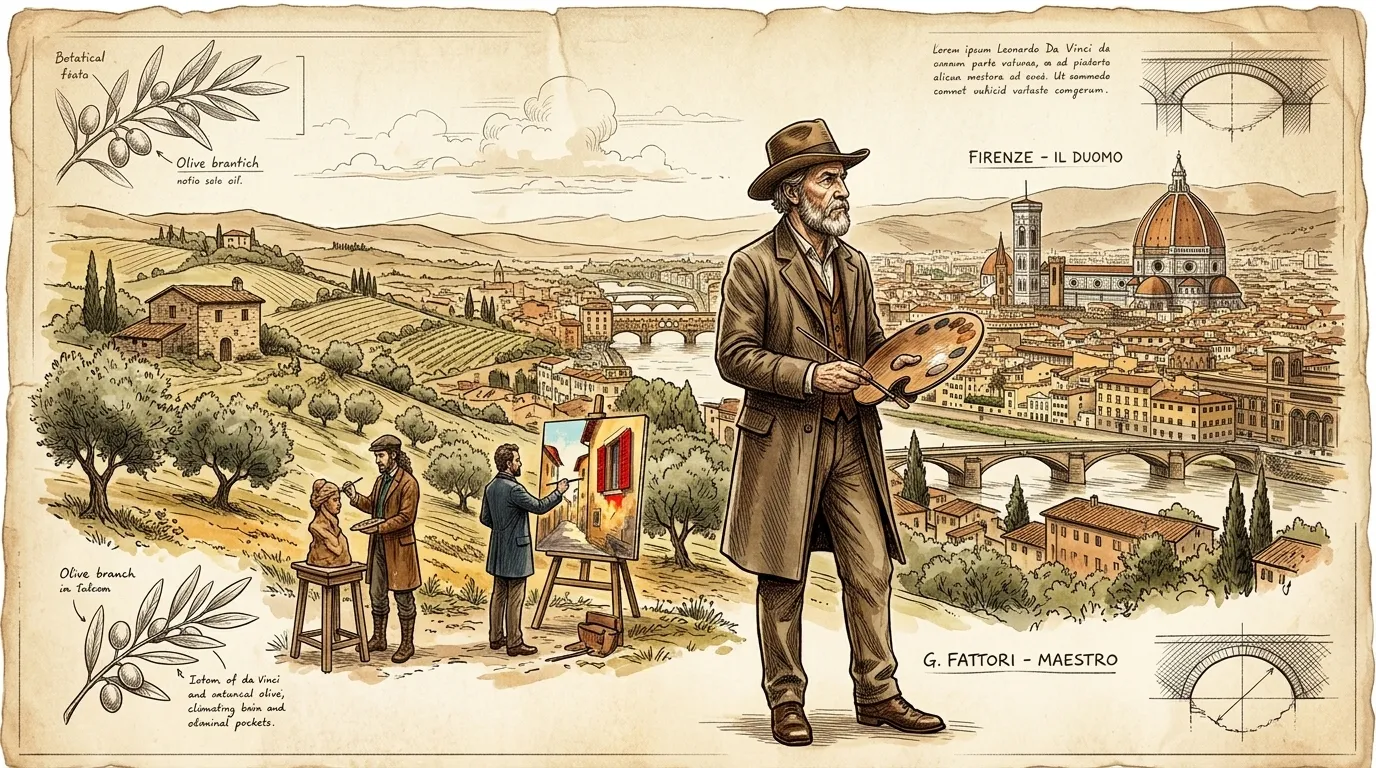
Giovanni Fattori stands before his masterpiece, 'The Battle of Magenta,' completed around 1862. The air crackles with the unseen energy of creation. He captures the moment, the scene, with all of its realities.
"Fattori murmurs to himself, barely audible, 'Not an imitation of nature, but an interpretation.'"
Art Fact: Completed circa 1862, 'The Battle of Magenta' measures approximately 3 x 5 meters. It is a testament to Fattori's commitment to capturing the true spirit of the Risorgimento. Today, it resides in the Gallery of Modern Art in the Palazzo Pitti, Florence.
Page 2

A young Telemaco Signorini wanders through the bustling clockwork streets of Florence, the air filled with the rhythmic ticking of gears and the melodies of unseen automatons. He notices the light filtering through the intricate architecture, transforming the ordinary into the extraordinary. The city pulses with both art and machines.
"Signorini exclaims, 'Look at how the light falls on those gears, Francesco! It transforms the metal into something...alive!' Francesco replies, 'Indeed, Telemaco. Florence itself is a masterpiece in motion.'"
Art Fact: The clockwork city is powered by music and laughter, a vibrant world where art and mechanics intertwine, fostering creativity and innovation.
Page 3

In the smoky haze of the Café Michelangelo, the Macchiaioli gather, their boisterous debates echoing through the room. Arguments erupt and subside as quickly as brushstrokes on canvas. Here, they challenge convention and forge a new path for Italian art.
"Adriano Cecioni shouts, 'We must break free from the academies! Paint the 'macchia' – the patch of color – as it truly appears!' Cristiano Banti retorts, 'But without form, Adriano, what substance remains?'"
Art Fact: The Café Michelangelo was the epicenter of the Macchiaioli movement, a place where artists debated, challenged, and inspired one another.
Page 4

Giovanni Fattori studies the works of the Old Masters in the Uffizi Gallery, Florence. He seeks to understand their techniques, their use of light and shadow. He absorbs the lessons of the past, preparing to forge his own artistic vision.
"Fattori remarks, 'Michelangelo said, 'I saw the angel in the marble and carved until I set him free.' We must find the truth within the scene before us.'"
Art Fact: Fattori's deep study of the Old Masters laid the foundation for his innovative approach to capturing light and form.
Page 5
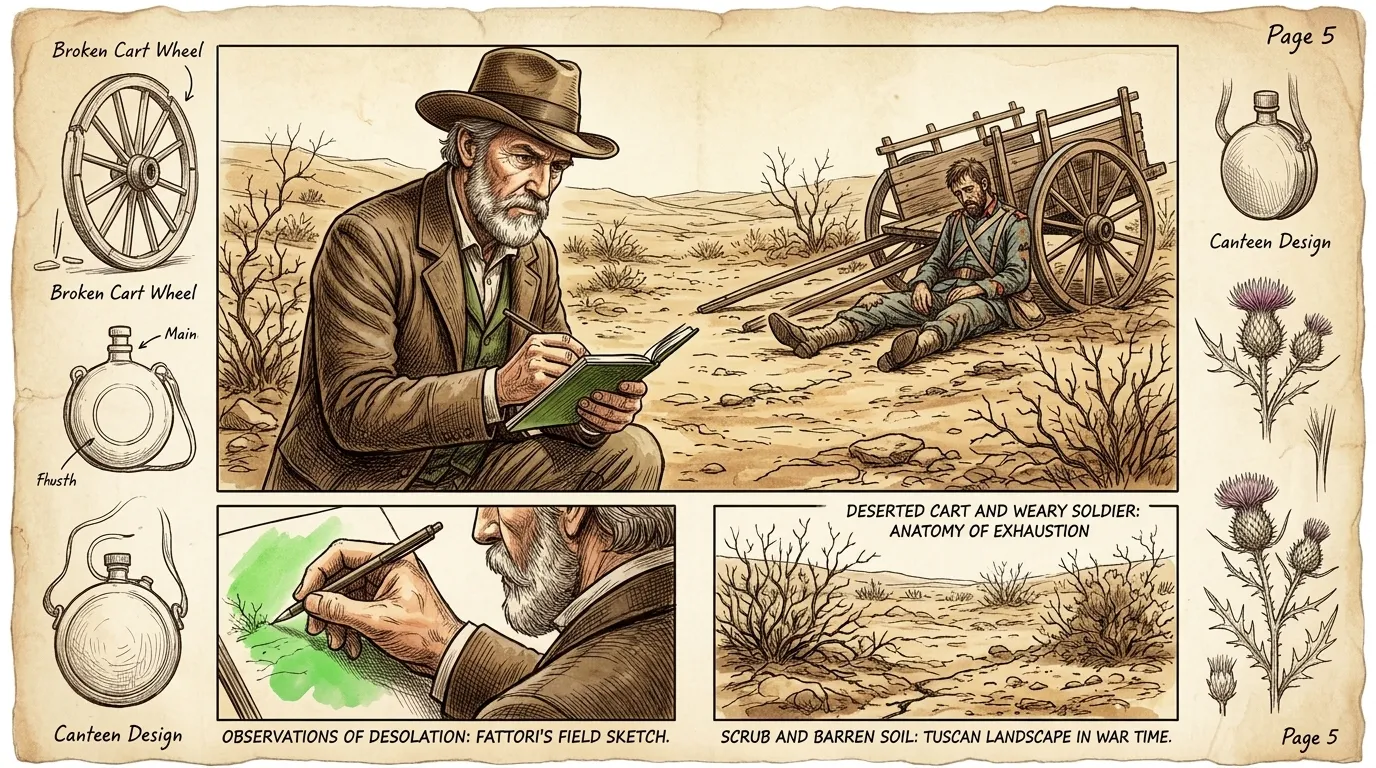
The experience of war profoundly shapes Giovanni Fattori's art. He witnesses the harsh realities of battle, the weariness of soldiers, the desolation of the landscape. These scenes will later populate his canvases, imbued with raw emotion and stark realism.
"Fattori, sketching in a field, mutters, 'The true battle is not glory, but survival.' A weary soldier nearby sighs, 'Just another day, Giovanni.'"
Art Fact: Fattori's experiences in the military directly influenced his shift towards realism and his focus on the lives of ordinary soldiers.
Page 6

Diego Martelli, a wealthy art critic and patron, recognizes the talent of the Macchiaioli. He provides them with support and encouragement, fostering their artistic growth. His villa becomes a haven for these revolutionary painters.
"Martelli proclaims, 'These young painters – they are the future of Italian art! They capture the essence of our time.' Fattori responds, 'We strive only to represent the truth as we see it, Diego.'"
Art Fact: Diego Martelli's patronage was crucial to the Macchiaioli, providing them with the resources and freedom to pursue their artistic vision.
Page 7

The Macchiaioli develop their distinctive 'macchia' technique – patches of color applied directly to the canvas, capturing the essence of light and form. This innovative approach revolutionizes Italian painting, paving the way for modern art.
"Signorini explains, 'It's all about the contrast, the relationships between the 'macchie'. We seek to create an impression of reality, not a perfect imitation.'"
Art Fact: The 'macchia' technique, characterized by bold patches of color, was the hallmark of the Macchiaioli movement.
Page 8

Despite their innovative approach, the Macchiaioli face criticism and rejection from the established art world. Undeterred, they persevere, confident in their artistic vision. Their resilience fuels their creativity, pushing them to even greater heights.
"Fattori sighs, 'It is as Nietzsche said, 'That which does not kill us makes us stronger.' We will continue to paint our truth, regardless of their opinions.'"
Art Fact: The Macchiaioli's resilience in the face of criticism solidified their commitment to their artistic vision.
Page 9

The Macchiaioli's influence extends far beyond their time. Their innovative techniques and commitment to realism inspire generations of artists. They are recognized as pioneers of modern Italian art.
"A young artist declares, 'The Macchiaioli showed us that art should reflect life, not merely imitate it. They dared to break the rules.'"
Art Fact: The Macchiaioli's legacy as pioneers of modern Italian art continues to inspire and influence artists today.
Page 10

Giovanni Fattori's spirit watches over Florence, his legacy etched into the heart of the city. His paintings continue to captivate and inspire, reminding us of the power of art to capture the truth of human experience.
"None."
Art Fact: Fattori and the Macchiaioli survive eternally because they showed Italy -- and the world -- that the true artist reflects reality, never just copies it.
About this story
- Location: Italy
- Audience: general readers
Questions and answers
Questions and answers about Macchiaioli by Tuscan painters (Florence, Italy — c. 1855)
Read Wonder Arts on your phone
Wonder Arts is available on Android. Get Wonder Arts on Google Play.