Mannerism by Pontormo (Florence, Italy — c. 1520)
Mannerism by Pontormo (Florence, Italy — c. 1520) — an illustrated arts story, set in Italy. 10 illustrated pages, free to read on Wonder Arts.
Page 1

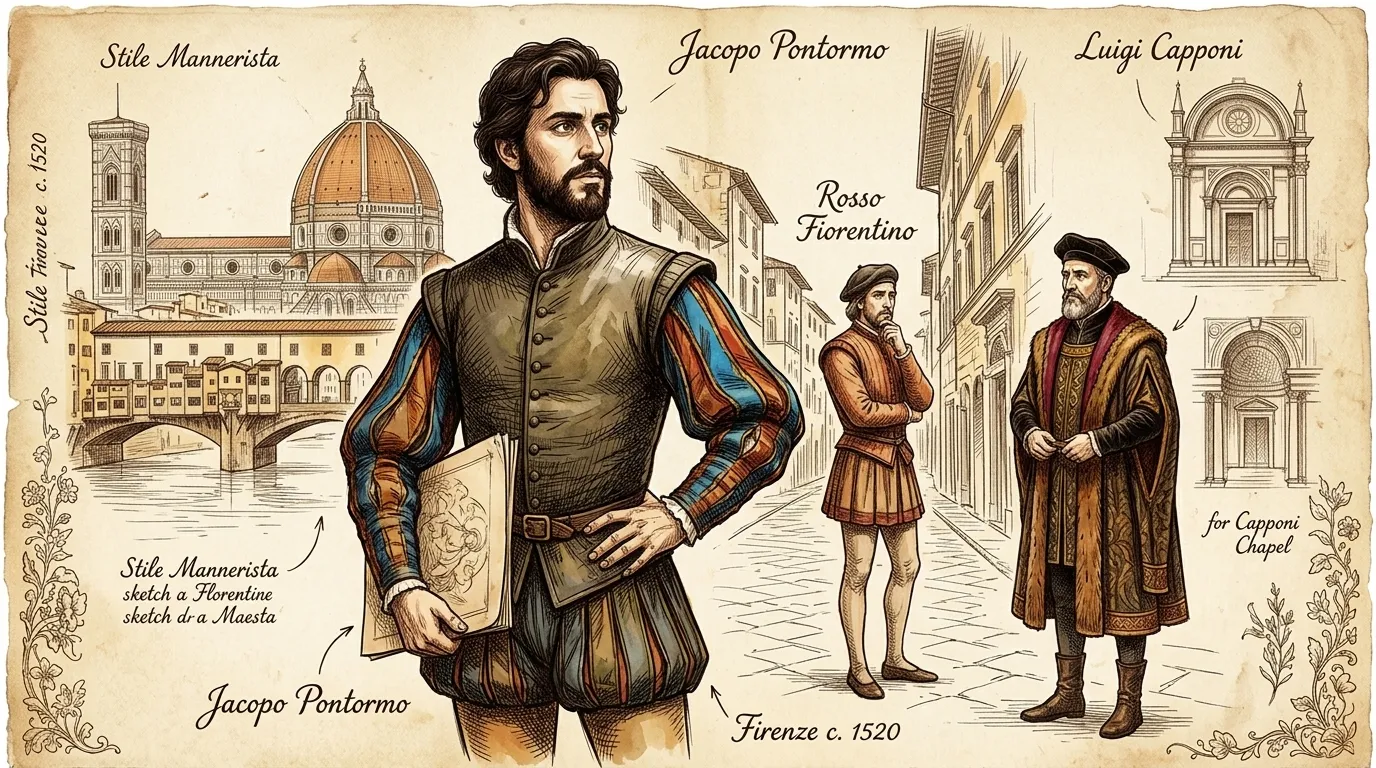
Jacopo Carucci, known as Pontormo, stood before his masterpiece, 'The Deposition from the Cross,' also known as 'The Descent from the Cross.' Completed around 1528, this altarpiece dominates the Capponi Chapel in the church of Santa Felicita, Florence. Unlike traditional depictions of the Deposition, Pontormo's work is unsettling, filled with elongated figures and a swirling composition. Its dimensions are a monumental 313 cm 192 cm.
"Pontormo murmured, almost to himself, 'Have I truly captured the agony? Or have I merely created a beautiful puzzle?'"
Art Fact: The painting's unconventional use of color and distorted figures marked a significant departure from High Renaissance ideals.
Page 2

Early in his career, Pontormo apprenticed with Leonardo da Vinci. However, the artist's true artistic awakening came from witnessing Michelangelo's David in Florence. The sheer power and anatomical precision left him breathless, sparking a lifelong quest to capture human emotion through form. But it was Michelangelo's unfinished frescoes that truly ignited Pontormo's imagination. He later admitted in his journals that his work was trying to capture the feelings it gave him.
"Young Pontormo, sketching furiously, exclaimed to his mentor, 'Michelangelo's figures... they move with such... such tormented grace! I must capture that essence!' His mentor replied, 'Remember what Leonardo da Vinci said: 'Painting embraces all the ten functions of the eye; that is to say, darkness, light, body and colour, substance and form, motion and rest, distance and proximity.' You must understand all to create true art.'"
Art Fact: Michelangelo's influence is evident in Pontormo's anatomical studies and dynamic compositions.
Page 3

The Florentine plague of 1522-1523 devastated the city. Pontormo, like many, sought refuge in the countryside. The experience marked him deeply. The pervasive sense of death and suffering found its way into his art, lending a haunting quality to his later works. The plague changed Pontormo's ideas of the world around him. He knew death was inevitable. He sought to showcase that in his works, like 'The Descent from the Cross'
"Huddling in a makeshift shelter, Pontormo sketched as he spoke to his companion, Marta. 'The plague... it strips away all pretense, doesn't it?' Marta, responds solemnly, 'As Albert Camus wrote centuries later, 'There's no love of life without a little despair.' We must remember that despair to find beauty, Pontormo."
Art Fact: The plague years instilled a sense of melancholy and heightened emotion in Pontormo's artistic vision.
Page 4

Pontormo's artistic trajectory was significantly shaped by his complex relationship with fellow Mannerist painter Rosso Fiorentino. Both artists pushed the boundaries of traditional Renaissance art. However, their rivalry fueled innovation and experimentation. Rosso's boldness challenged Pontormo to refine his own unique style. The pressure made Pontormo a better artist, constantly trying to best his rival.
"During a heated discussion in a Florentine workshop, Rosso challenges Pontormo, 'Your colors are too muted, Pontormo! Where is the fire, the passion?' Pontormo retorts, 'Passion without control is mere chaos, Rosso. We cannot always burn at 100%'"
Art Fact: The rivalry with Rosso Fiorentino spurred Pontormo to refine his unique Mannerist style.
Page 5

The commission for the Capponi Chapel in Santa Felicita was a turning point in Pontormo's career. The wealthy Capponi family entrusted him with creating a masterpiece that would reflect their piety and status. This provided him with the resources and freedom to fully realize his artistic vision. They wanted something that would forever mark the Capponi name in Florence. They got just that with 'The Descent from the Cross.'
"Luigi Capponi, the patron, declares to Pontormo, 'We desire a work that transcends earthly beauty, something that speaks to the soul!' Pontormo, responds thoughtfully, 'I shall strive to create a vision that captures the divine spirit. Like Michelangelo before, I will create something truly special.'"
Art Fact: The Capponi commission provided Pontormo with the opportunity to create his most celebrated work.
Page 6

Pontormo's use of color in 'The Descent from the Cross' is one of its most striking features. He abandoned the harmonious palette of the High Renaissance in favor of jarring, unnatural hues – pinks, yellows, and greens that seem to vibrate with emotional intensity. The clashing colours of the Renaissance were a step away from tradition. It was one of the main reasons people flocked to Pontormo.
"While mixing pigments, Pontormo asks Marta, 'Do these colors shock you, Marta? Do they unsettle the eye?' Marta replies, 'They do, but it is an intriguing vision. As Mark Rothko would later say, 'I'm not an abstractionist... I'm interested only in expressing basic human emotions: tragedy, ecstasy, doom.' Your use of colour does just that, Jacopo.'"
Art Fact: Pontormo's unconventional use of color reflects his rejection of High Renaissance ideals.
Page 7

The figures in 'The Descent from the Cross' are deliberately elongated and distorted, departing from classical proportions. This Mannerist technique heightens the emotional impact of the scene, conveying a sense of unease and spiritual anguish. Instead of the perfection of Raphael, Pontormo chooses the anguished spirit. It shows in every fibre and thread of his painting.
"Pontormo, scrutinizing his painting, says, 'These forms... they must express the inner turmoil, the spiritual torment. It is the truest form of art' Daria responds. As Leonardo da Vinci had said, 'The painter has the Universe in his mind and hands.' The form and emotional must connect, Jacopo.'"
Art Fact: The elongated forms and exaggerated emotions are hallmarks of Pontormo's Mannerist style.
Page 8

One of the most puzzling aspects of 'The Descent from the Cross' is the lack of a clear ground plane. The figures seem to float in a shallow space, contributing to the painting's unsettling and dreamlike quality. It is as if they are untethered from reality, suspended in a realm of pure emotion. There is no safety net for the feelings Pontormo is trying to convey.
"Pacing before his nearly finished altarpiece, Pontormo says to Marta, 'Does it lack grounding, Marta? Is there no stable point for the eye to rest upon?' Marta considers the painting with a thoughtful look. 'Yes, and it seems as if they are floating.'"
Art Fact: The absence of a clear ground plane contributes to the painting's unsettling and dreamlike atmosphere.
Page 9

With the completion of 'The Descent from the Cross,' Pontormo cemented his place as a leading figure of the Mannerist movement. The altarpiece challenged conventional artistic norms and paved the way for future generations of artists to explore new forms of expression. People came from around the globe to simply see it.
"Standing before his masterpiece, Pontormo reflects, 'Perhaps I have created something that truly captures the complexities of human emotion. Perhaps I have finally met my goals.' Daria smiles. The famous Michelangelo once said, 'Every block of stone has a statue inside it and it is the task of the sculptor to discover it.' Now you have found yours."
Art Fact: Pontormo's 'Descent from the Cross' remains a defining work of the Mannerist period.
Page 10

Today, Pontormo's 'Descent from the Cross' continues to captivate and challenge viewers in the Capponi Chapel of Santa Felicita. Its unsettling beauty and emotional intensity ensure its place as a masterpiece of Mannerist art. The world continues to be entranced by the painter from Florence.
"His vision continues, an immortal testament. Jacopo truly did capture the depths of emotion through 'The Descent from the Cross'."
Art Fact: Pontormo's masterpiece lives on, inspiring generations with its emotional power and artistic innovation.
About this story
- Location: Italy
- Audience: general readers
Questions and answers
Questions and answers about Mannerism by Pontormo (Florence, Italy — c. 1520)
Read Wonder Arts on your phone
Wonder Arts is available on Android. Get Wonder Arts on Google Play.