Olympia by Édouard Manet (Paris, France — 1863)
Olympia by Édouard Manet (Paris, France — 1863) — an illustrated arts story, set in France. 10 illustrated pages, free to read on Wonder Arts.
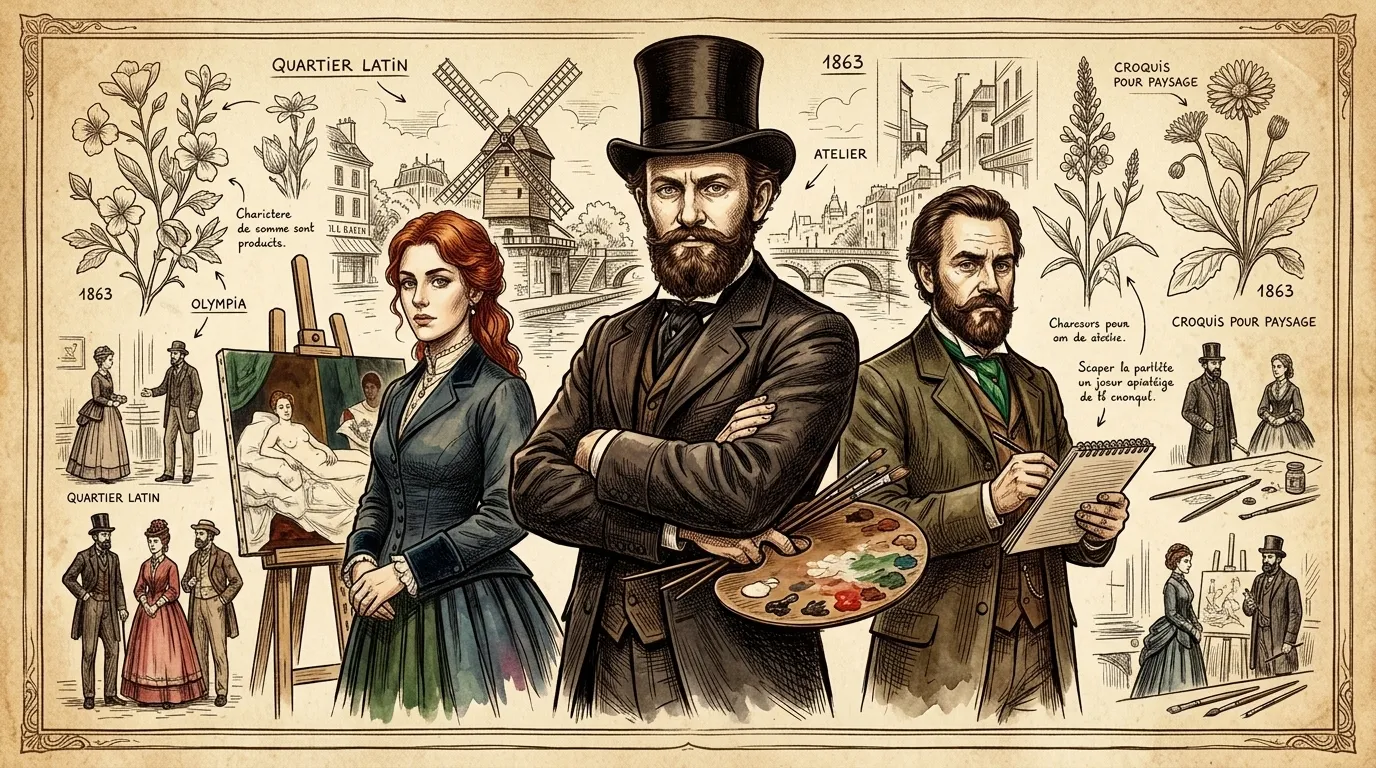
Page 1

Édouard Manet stands before his controversial masterpiece, Olympia. Paris, 1863. The painting, measuring 130.5 cm 191.5 cm (51 3/8 in 75 3/8 in), would spark outrage, but also mark a pivotal shift towards modernism. Few knew the depths of thought and study behind this daring work.
"Manet whispers to himself, 'They may criticize, but they will not ignore it.'"
Art Fact: Olympia's direct gaze and the inclusion of a black cat challenged the idealized nudes of academic painting, leading to accusations of vulgarity.
Page 2

Manet, visiting the Uffizi Gallery in Florence, studies Titian's 'Venus of Urbino'. The echoes of the Renaissance master are undeniable, yet Manet seeks to break free. He whispers his revelation to himself about the Renaissance Master Titian.
"Manet murmurs, 'Titian's beauty, yes, but a beauty of my time, of truth.'"
Art Fact: Manet draws inspiration from classical art, but seeks to portray modern life rather than mythology.
Page 3

Manet finds his muse in Victorine Meurent, a young artist and model. Her direct gaze and unidealized beauty captivate him. He sees in her the embodiment of modern womanhood.
"Manet tells Victorine, 'Your gaze, mademoiselle, it holds a truth that the old masters never dared to capture.' Victorine replies, 'Perhaps they were afraid of what they would see.'"
Art Fact: Victorine Meurent, herself an artist, became Manet's favorite model, appearing in several of his most important works.
Page 4

A stray black cat wanders into Manet's studio. Its sleek form and independent spirit inspire a key element in 'Olympia'. The animal becomes a symbol of the painting's defiant spirit.
"Manet says, 'Look at that creature, so sure of itself, so unapologetic.' Victorine responds, 'It knows its worth, as every woman should.'"
Art Fact: The black cat, a symbol of independence and sexuality, replaced the traditional dog of fidelity in Titian's 'Venus of Urbino'.
Page 5

Manet ponders the identity of the bouquet's sender. Is it a suitor? A patron? The mystery adds another layer of intrigue to Olympia's story.
"Manet asks, 'Who sent these flowers, Victorine? A secret admirer, perhaps?' Victorine replies, 'A question for the canvas to ponder.'"
Art Fact: The bouquet suggests a transaction, hinting at Olympia's role as a courtesan.
Page 6

The Paris Salon rejects 'Olympia'. Manet, undeterred, displays the painting in his own studio. He states, 'I have tried to paint what I saw.'
"Manet tells a fellow artist, 'They say it's vulgar, indecent. But art must reflect its time, its truth!'"
Art Fact: The Salon's rejection fueled the controversy surrounding 'Olympia,' but also solidified Manet's reputation as a modern rebel.
Page 7

Émile Zola, the celebrated writer, fiercely defends 'Olympia' in the press. He sees in Manet's work a crucial step towards realism and honesty in art.
"Zola writes in his article, 'Manet is not trying to shock; he is simply painting what he sees, with the honesty of a true artist.' He says, 'As Voltaire said, 'The secret of being a bore is to tell everything.' Manet understands this; he lets us see the truth.'"
Art Fact: Zola's passionate defense of 'Olympia' helped to shift public opinion and secure Manet's place in art history.
Page 8

Young artists, inspired by Manet's boldness, begin to explore new approaches to painting. 'Olympia' becomes a symbol of artistic freedom and innovation.
"A young Claude Monet tells Renoir, 'Manet has shown us that we can paint our own world, not the world of the academy.' Renoir replies, 'A revolution on canvas!'"
Art Fact: 'Olympia' became a catalyst for the Impressionist movement, inspiring artists to break free from traditional constraints.
Page 9

Even decades later, whispers and controversies persist. Was Olympia a victim, a rebel, or something in between? The power of art is in interpretation.
"An art critic whispers, 'Olympia... a mirror to our own desires, fears, and prejudices.'"
Art Fact: The enduring fascination with 'Olympia' lies in its ambiguity, inviting viewers to project their own interpretations onto the canvas.
Page 10

Today, Olympia resides in the Musée d'Orsay, Paris, a testament to Manet's genius and the enduring power of art to challenge and inspire. Manet's spirit lives on within the gallery, a place of beauty and revolution.
"A modern admirer says, 'To stand before Olympia is to see the birth of modern art.'"
Art Fact: Manet's 'Olympia' remains a cornerstone of modern art, challenging viewers to confront uncomfortable truths and embrace artistic freedom.
About this story
- Location: France
- Audience: general readers
Questions and answers
Questions and answers about Olympia by Édouard Manet (Paris, France — 1863)
Read Wonder Arts on your phone
Wonder Arts is available on Android. Get Wonder Arts on Google Play.
More Wonder Arts stories
- Ophelia by John Everett Millais (London, UK — 1852)
- Palace of Knossos (Crete, Greece — c. 1700 BC)
- Palace of Versailles (Versailles, France — 1661–1715)
- Parthenon (Athens, Greece — 432 BC)
- Pauline Bonaparte as Venus Victrix by Antonio Canova (Rome, Italy — 1805)
- Peacock Throne by Shah Jahan (Delhi, India — 1628)