Parthenon (Athens, Greece — 432 BC)
Parthenon (Athens, Greece — 432 BC) — an illustrated arts story, set in Greece. 10 illustrated pages, free to read on Wonder Arts.
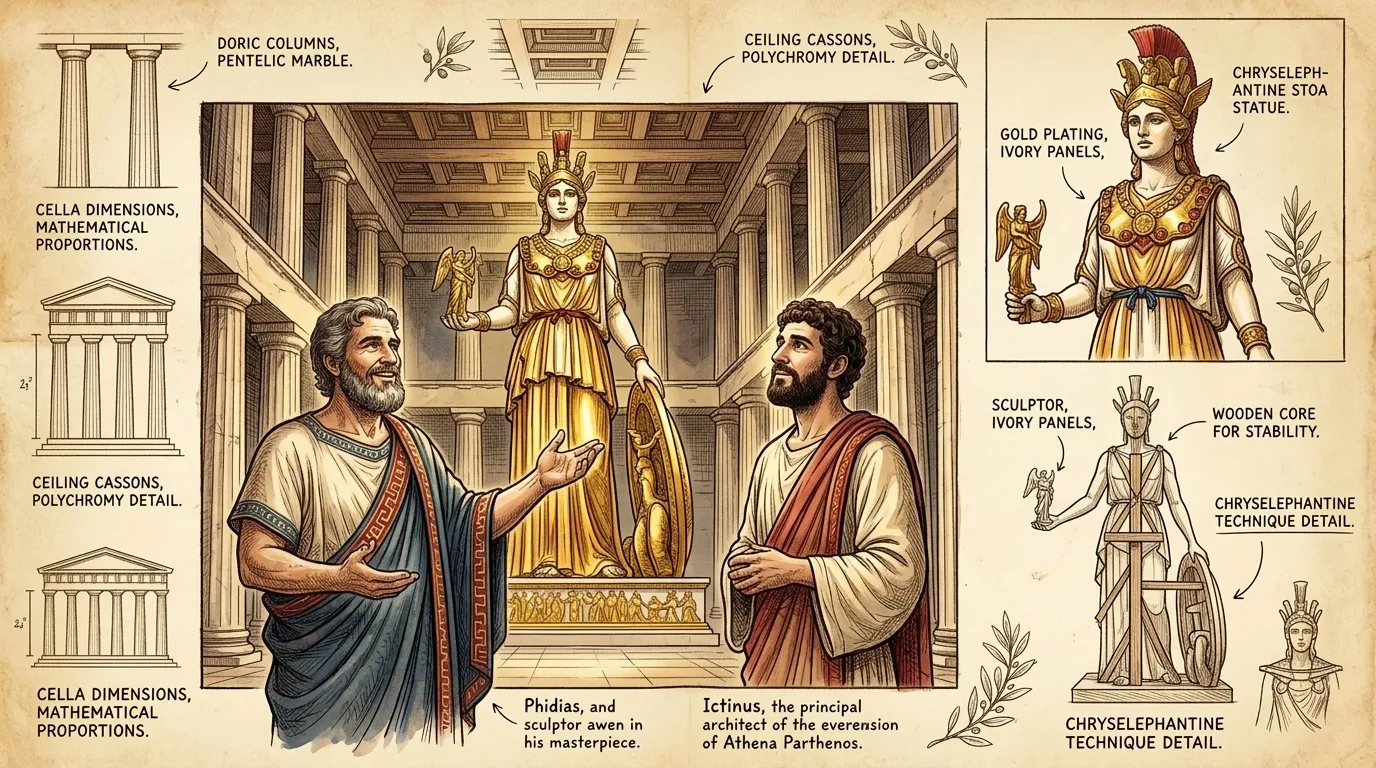
Page 1
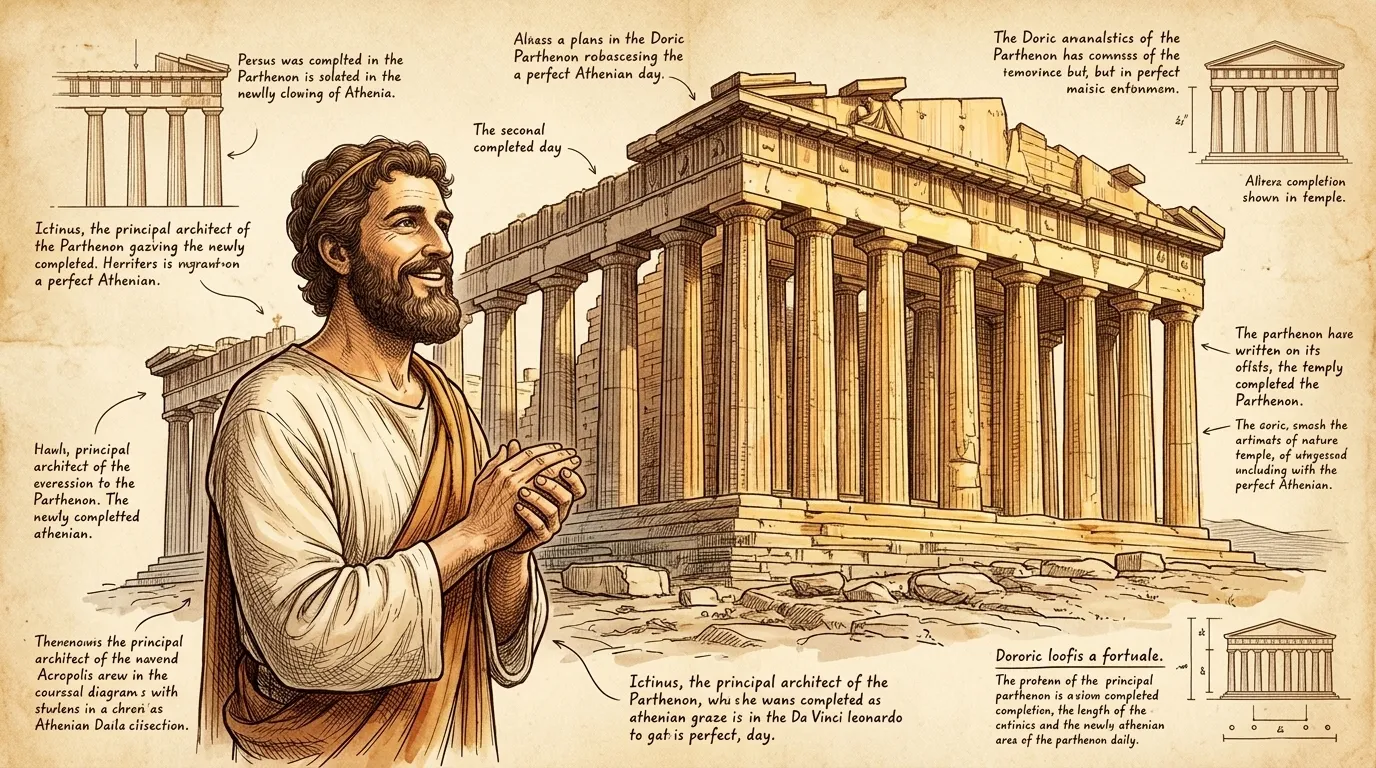
The year is 432 BC. On the Athenian Acropolis, architect Ictinus surveys his completed masterpiece: the Parthenon. This Doric temple, dedicated to the goddess Athena, stands as a testament to Athenian power and artistic prowess. The Parthenon, measuring approximately 69.5 meters long, 30.9 meters wide, and 13.7 meters high, is not just a temple, but a symbol. It will later house a massive gold and ivory statue of Athena Parthenos. Its survival and eventual destruction over the centuries will become a testament to human ambition and resilience. Today, it represents the pinnacle of classical architecture.
"Ictinus murmurs, his gaze sweeping over the structure, 'Let it be a beacon of reason and beauty, a gift to Athena, and to posterity.'"
Art Fact: The Parthenon's construction began in 447 BC, replacing an older temple destroyed by the Persians. It's celebrated for its architectural refinements, including subtle curves designed to counteract optical illusions. Its friezes and sculptures were adorned with vibrant colors, traces of which are still visible today.
Page 2
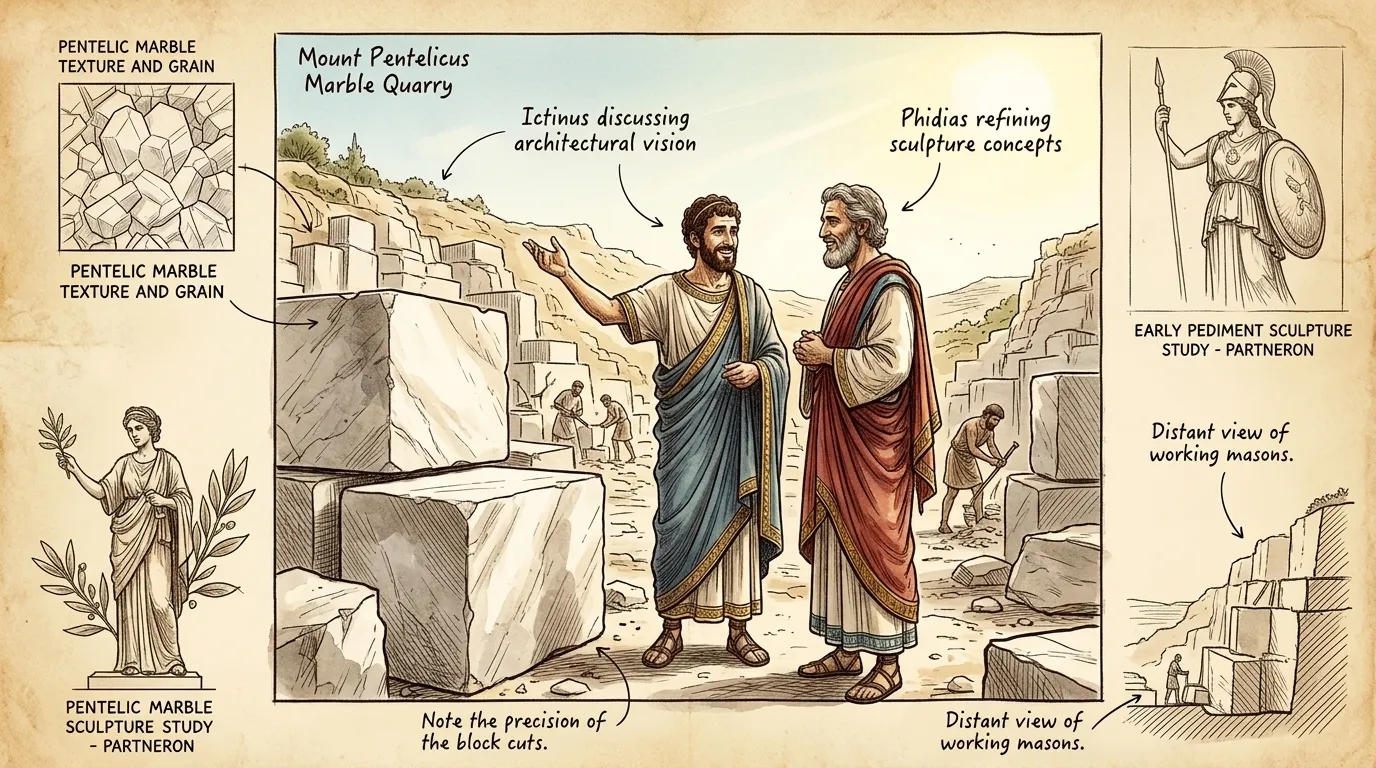
Years earlier, Ictinus and the sculptor Phidias were commissioned by Pericles to undertake this ambitious project. The vision: to create a temple unlike any other, a monument to Athena's glory, and to the Athenian spirit. Marble was sourced from Mount Pentelicus. The air was thick with dust and the sound of chisels.
"Phidias asks, his voice echoing in the quarry, 'Do you envision her strong, Ictinus? A goddess of war, or of wisdom?' Ictinus replies, 'Both, Phidias. Athena is the embodiment of Athenian virtue – strength tempered with intellect.'"
Art Fact: The marble used for the Parthenon was of exceptionally high quality, known for its pure white color and fine grain. Transporting the massive blocks to the Acropolis was a logistical feat, requiring specially designed ramps and teams of oxen.
Page 3
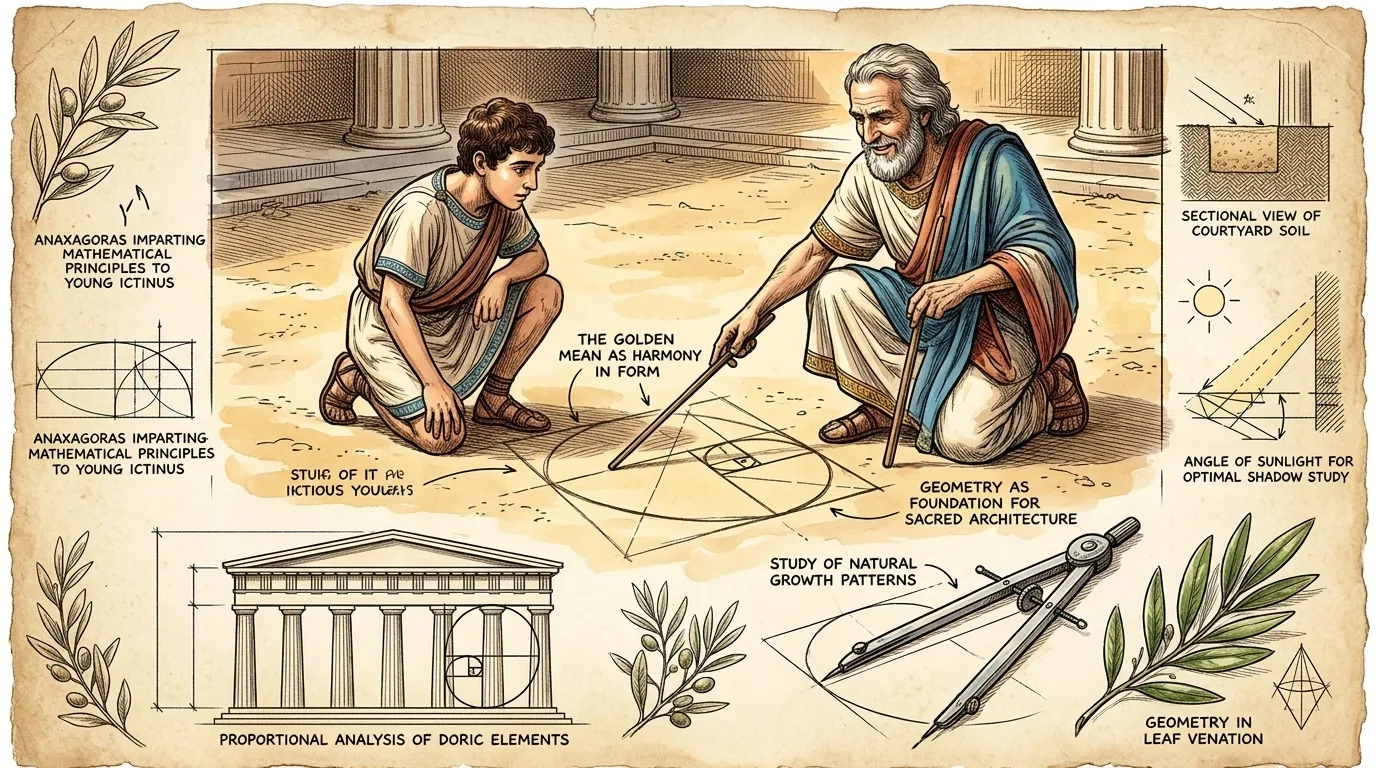
As a young architect, Ictinus studied the principles of geometry under the tutelage of Anaxagoras. These lessons in mathematical precision would later define the Parthenon's design. Anaxagoras showed him harmony could arise from careful ratios and proportions.
"Anaxagoras says, pointing to a geometric diagram drawn in the sand, 'Observe, Ictinus, how perfect form arises from the union of reason and proportion. The golden ratio shall be your guide.' Ictinus replies thoughtfully, 'So, beauty is not merely seen, but understood.'"
Art Fact: The Parthenon incorporates numerous subtle mathematical ratios, including the golden ratio (approximately 1.618), believed to enhance its aesthetic appeal. These refinements demonstrate the Greeks' advanced understanding of geometry and optics.
Page 4
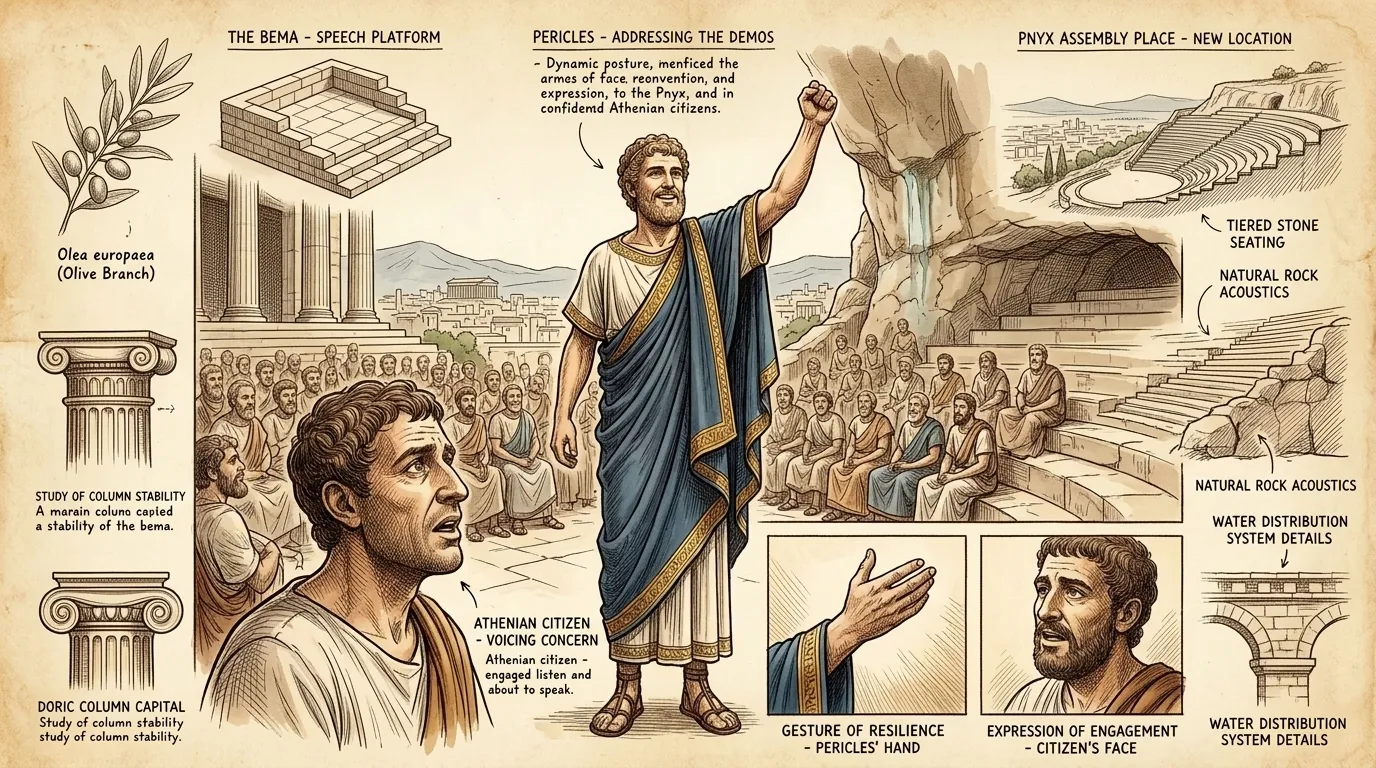
The Peloponnesian War casts a long shadow over Athens. Resources are strained, and the construction of the Parthenon is threatened. Pericles defends the project, insisting that it is not a vanity project, but a symbol of Athenian resilience.
"Pericles stands before the Athenian assembly, his voice ringing with conviction. 'We build not for ourselves alone, but for all generations. Shall we cower in fear, or create a monument that speaks of our strength?' A citizen retorts, 'But at what cost, Pericles? Our treasury dwindles while Sparta gathers its forces!'"
Art Fact: The Peloponnesian War (431-404 BC) pitted Athens against Sparta and its allies, severely impacting Athenian society and resources. Pericles' leadership was crucial in maintaining morale and continuing important projects like the Parthenon.
Page 5

Phidias and his team meticulously carve the Parthenon's friezes, depicting scenes from Athenian mythology and the Panathenaic procession. Each figure is imbued with grace and vitality, capturing the spirit of Athenian society. Ictinus marvels at the precision and artistry.
"Ictinus says, watching Phidias at work, 'The gods themselves could not have sculpted with greater skill, Phidias.' Phidias replies modestly, 'We merely strive to reflect the divine harmony that already exists in the universe.'"
Art Fact: The Parthenon's frieze, over 160 meters in length, is a masterpiece of classical sculpture. It depicts the Panathenaic procession, a religious festival held in honor of Athena every four years. The level of detail and anatomical accuracy is remarkable.
Page 6
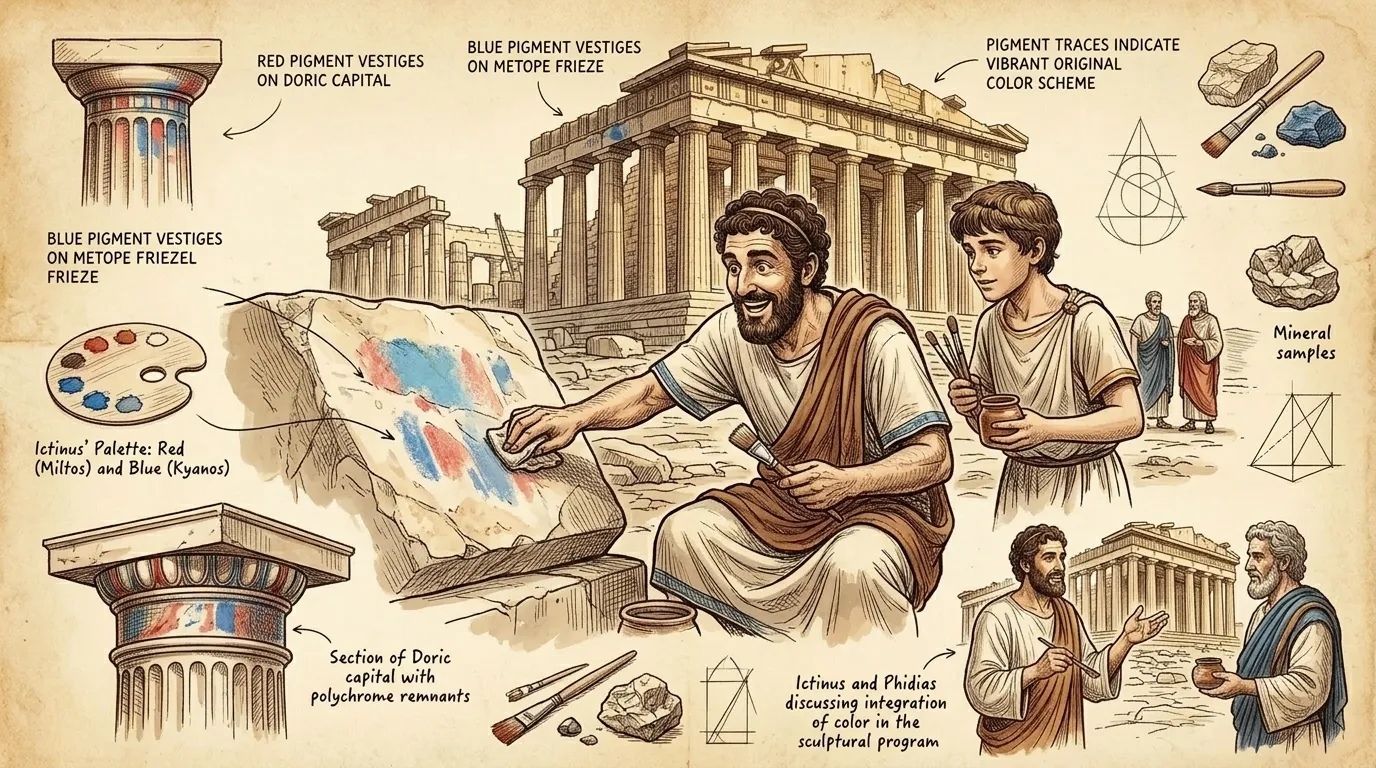
Contrary to modern perception, the Parthenon was not entirely white. Traces of vibrant colors are discovered by Ictinus. The sculptures and architectural elements were painted with vivid hues, adding another layer of beauty and meaning. He sought out the best pigment available, and would mix the paints himself.
"Ictinus says, his eyes widening with discovery, 'The marble... it retains traces of pigment! We must restore the color to its rightful place.' An assistant replies, 'But will the people accept it? They expect pure white marble.'"
Art Fact: Archaeological evidence reveals that the Parthenon's sculptures and architectural details were painted with vibrant colors, including blue, red, and gold. The colors would have added depth and richness to the overall appearance of the temple.
Page 7
Phidias completes the colossal statue of Athena Parthenos, crafted from gold and ivory. Her gaze commands the temple, a symbol of Athenian power and wisdom. Ictinus sees the culmination of his and Phidias' life's work coming to life.
"Phidias says, his voice filled with awe, 'Behold, Athena Parthenos! May she guide and protect Athens for all time.' Ictinus responds, 'Her presence fills the temple with a divine light. We have created a worthy home for our patron goddess.'"
Art Fact: The statue of Athena Parthenos, standing nearly 12 meters tall, was one of the most celebrated sculptures of antiquity. It was made of gold and ivory, and housed in the Parthenon's main chamber. Its presence reinforced Athens' status as a center of religious and cultural power.
Page 8
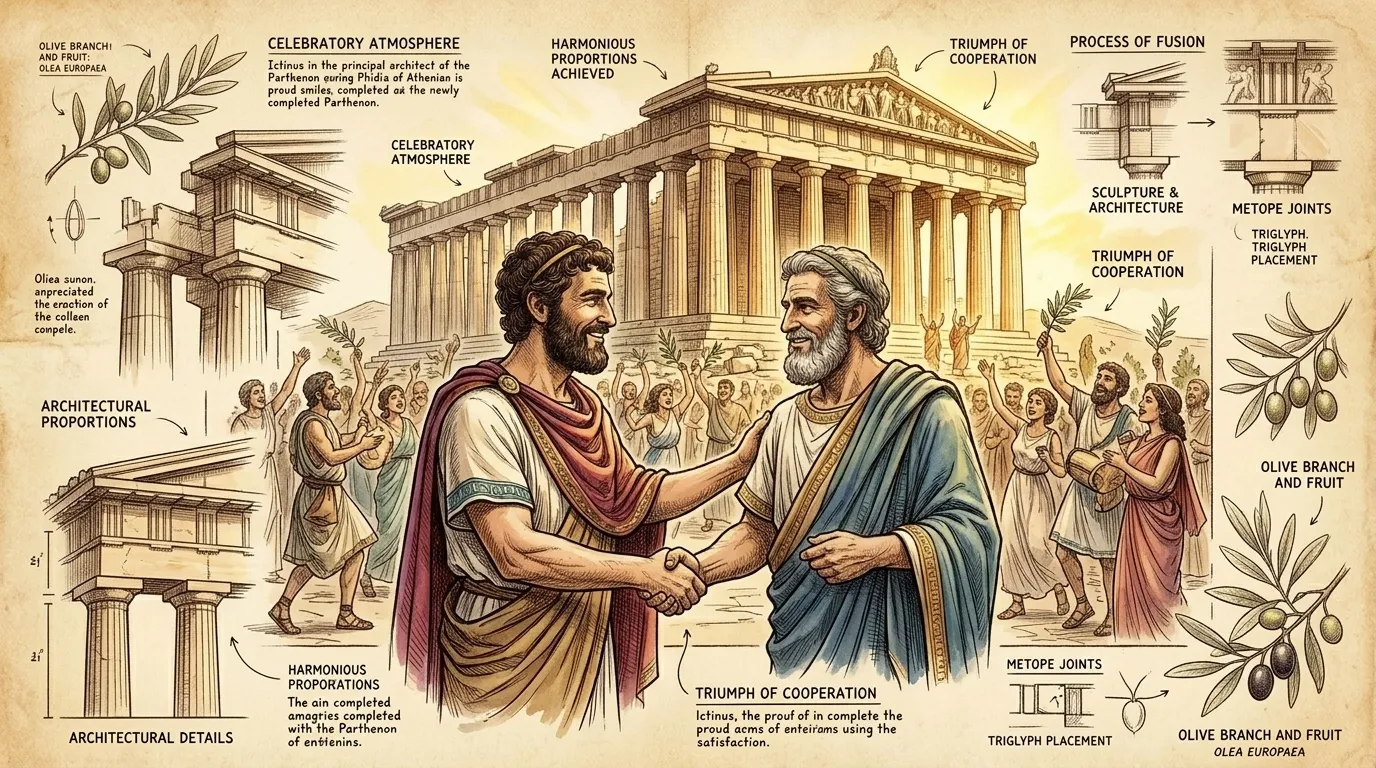
With the placement of the final stone, the Parthenon is declared complete. A great celebration erupts in Athens, honoring Athena and the artisans who brought the temple to life. The Parthenon stands as a testament to human ingenuity and the enduring power of beauty.
"A citizen shouts, his voice filled with joy, 'Long live Athena! Long live Athens! Long live the builders of the Parthenon!' Ictinus and Phidias exchange a knowing smile, their hearts filled with pride."
Art Fact: The completion of the Parthenon marked a high point in Athenian history. The temple became a symbol of Athenian power, wealth, and artistic achievement.
Page 9
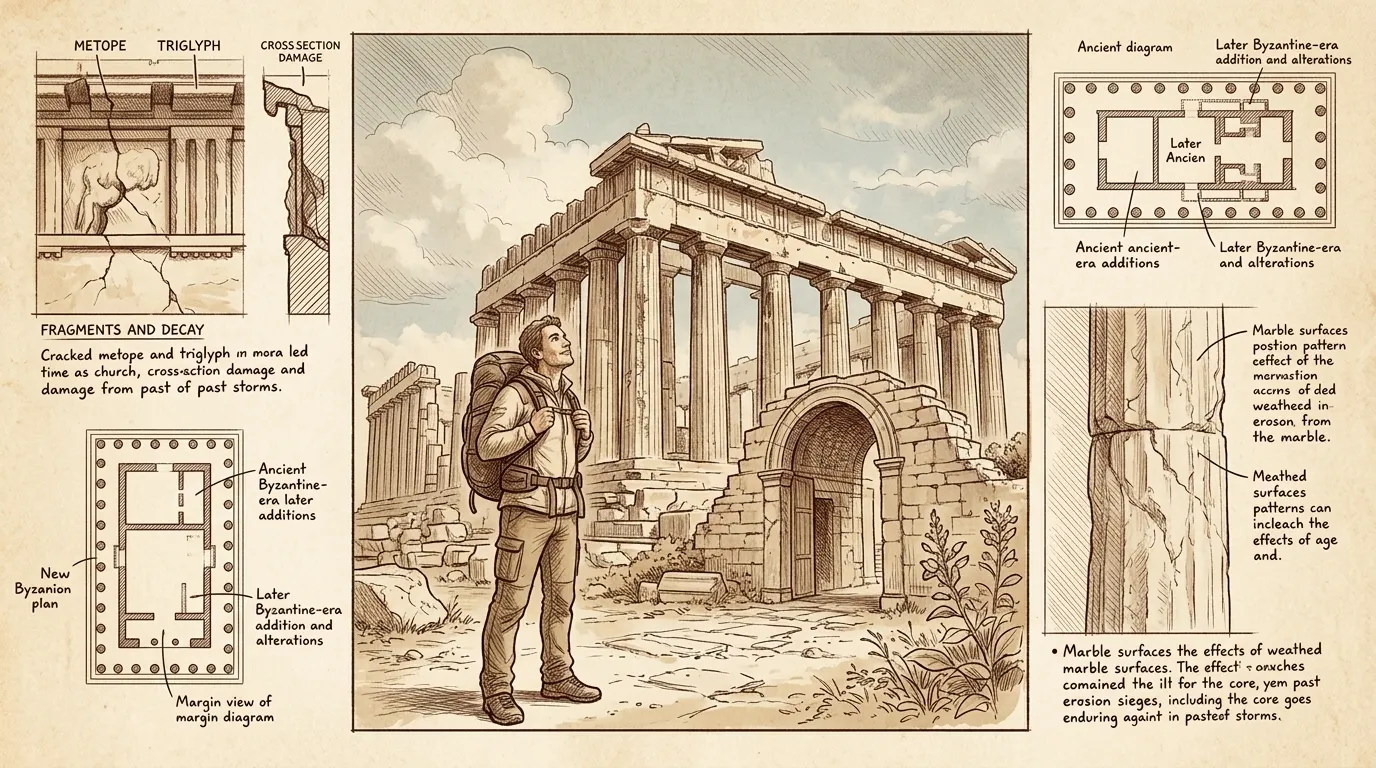
Centuries pass. The Parthenon endures sieges, earthquakes, and transformations. It becomes a church, a mosque, and a storehouse for gunpowder. Yet, its beauty continues to inspire awe, a reminder of the greatness of ancient Greece. But still, time marches on.
"A traveler says, gazing upon the Parthenon's ruins, 'Even in its damaged state, its magnificence shines through. It is a testament to the enduring power of human creativity.'"
Art Fact: Throughout its long history, the Parthenon has been subjected to numerous transformations and destructive events. Despite the damage, it continues to inspire awe and remains a symbol of classical civilization.
Page 10
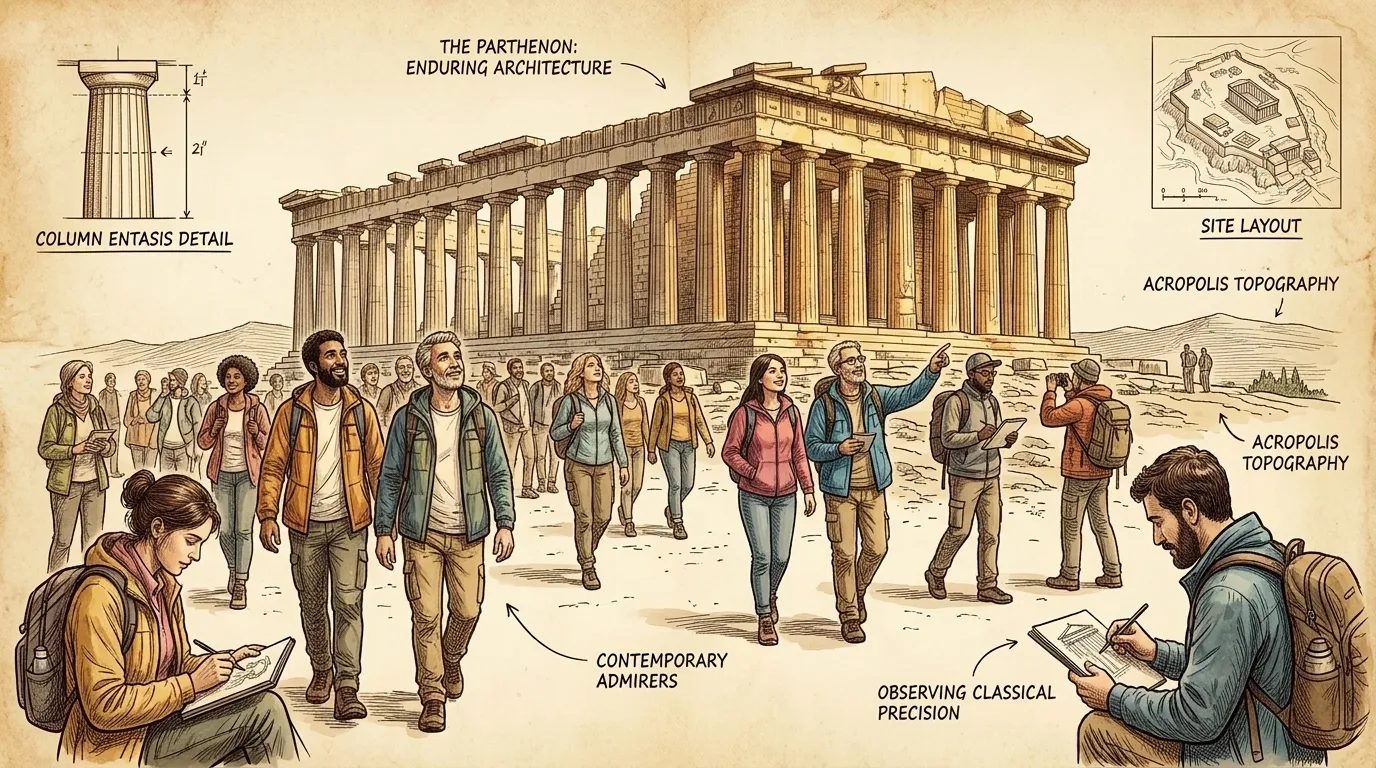
Today, the Parthenon stands as a UNESCO World Heritage site, drawing visitors from around the globe. Ictinus's vision, though weathered by time, endures, reminding us of the power of human ingenuity and the timeless allure of beauty. As Aristotle said, 'The aim of art is to represent not the outward appearance of things, but their inward significance.' It is a beacon of the past, and inspiration for the future.
Art Fact: The Parthenon's enduring legacy lies in its ability to inspire awe and wonder across generations. It represents the pinnacle of classical architecture and serves as a reminder of the enduring power of human creativity.
About this story
- Location: Greece
- Audience: general readers
Questions and answers
Questions and answers about Parthenon (Athens, Greece — 432 BC)
Read Wonder Arts on your phone
Wonder Arts is available on Android and iPhone and iPad. Get Wonder Arts on Google Play · Get Wonder Arts on the App Store.
More Wonder Arts stories
- Pauline Bonaparte as Venus Victrix by Antonio Canova (Rome, Italy — 1805)
- Peacock Throne by Shah Jahan (Delhi, India — 1628)
- Perseus with the Head of Medusa by Benvenuto Cellini (Florence, Italy — 1554)
- Petra (Ma'an, Jordan — c. 5th Century BC)
- Pietà by Michelangelo (Vatican City, Rome — 1499)
- Ploughing in the Nivernais by Rosa Bonheur (France — 1849)