Petra (Ma'an, Jordan — c. 5th Century BC)
Petra (Ma'an, Jordan — c. 5th Century BC) — an illustrated arts story, set in Egypt. 10 illustrated pages, free to read on Wonder Arts.

Page 1

Khaled al-Qaisi, the Nabataean architect, stood before Al-Khazneh, the Treasury, bathed in the rosy hues of the early morning sun. Carved directly into the sandstone cliffs of Petra around the 1st century AD, this monumental tomb served a ruler's resting place and a symbol of Nabataean ingenuity. Its façade, nearly 40 meters high, demonstrated their mastery of Hellenistic architectural styles, fused with local traditions.
""May this monument stand as a testament to our people's skill," Khaled murmured, his voice echoing in the silent canyon. "May it inspire awe for generations to come.""
Art Fact: Al-Khazneh, meaning 'The Treasury,' is believed to have been built as a mausoleum for the Nabataean King Aretas IV in the 1st century AD. Despite its name, it was never used as a treasury, rather it served as a prominent symbol of Nabataean wealth and architectural prowess. Its precise function remains debated among archaeologists.
Page 2

Khaled remembered the day he found the hidden oasis deep in the desert. The coolness of the water, the lush greenery – it was a stark contrast to the harsh, arid landscape that surrounded it. He realised then that Petra, too, could be an oasis – not of water, but of art and civilisation.
""Imagine, friends," Khaled had exclaimed to his fellow architects, "a city carved from stone, a testament to our resilience, like this oasis blooming in the heart of the desert!""
Art Fact: The Nabataeans were masters of water conservation, using intricate systems of dams, canals, and cisterns to collect and store rainwater. This allowed them to thrive in the arid environment of Petra and support a large population.
Page 3

The arrival of merchants from Alexandria sparked a new fascination within Khaled. They brought with them tales of Hellenistic architecture – the grand columns, the intricate friezes. He realised that to truly impress, Petra needed to embrace these foreign styles, blending them with their own.
""Look at these scrolls!" Khaled exclaimed, tracing the lines of a Corinthian capital. "Imagine these designs gracing our monuments, elevating Petra to new heights!""
Art Fact: The Nabataeans were shrewd traders, controlling caravan routes that linked Arabia, Egypt, and the Mediterranean. They amassed considerable wealth, which they used to commission ambitious building projects and import luxury goods.
Page 4
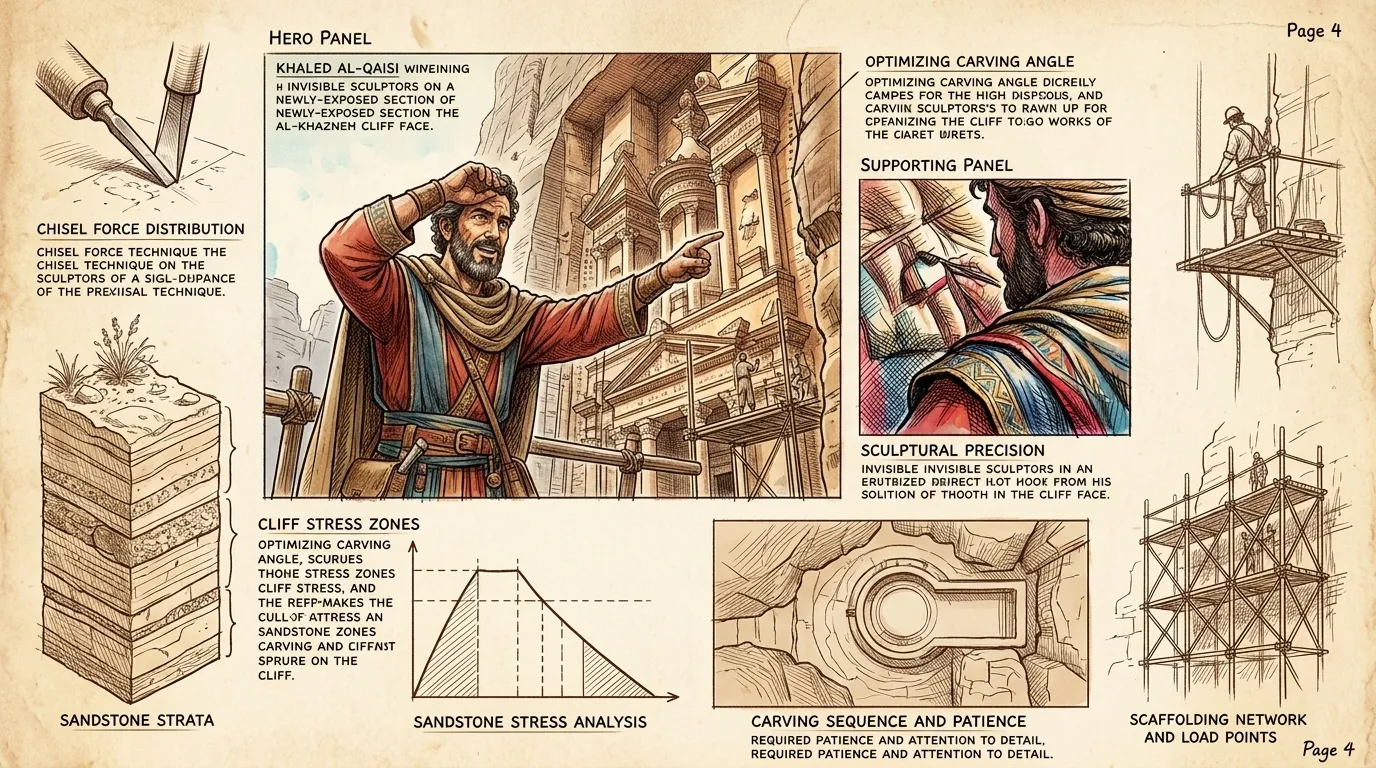
The greatest challenge was the rock itself. The sandstone cliffs were unforgiving. Khaled and his team had to develop new techniques for carving directly into the rock, ensuring both stability and aesthetic appeal. Every stroke of the chisel was a gamble.
""Patience, my friends," Khaled urged, wiping sweat from his brow. "Each layer we remove reveals the beauty hidden within. We must not rush, nor falter.""
Art Fact: The Nabataeans were skilled engineers, using sophisticated techniques to quarry, transport, and carve the sandstone cliffs of Petra. Their mastery of these skills allowed them to create monumental structures that have endured for centuries.
Page 5

Khaled insisted on blending Hellenistic styles with Nabataean artistic traditions. The Treasury's façade featured both Corinthian columns and intricate carvings of Nabataean deities, reflecting a unique cultural fusion.
""Why merely imitate?" Khaled challenged his sculptors. "Let us take what we admire and reshape it to reflect our own spirit, our own gods!""
Art Fact: The Nabataeans were a syncretic culture, adopting and adapting elements from the cultures they encountered, including the Greeks, Romans, and Egyptians. This is reflected in their art and architecture, which blends diverse styles into a unique and distinctive aesthetic.
Page 6

King Aretas IV visited the construction site frequently, offering encouragement and guidance. He saw the Treasury as a symbol of his kingdom's power and prosperity, a legacy that would endure for centuries.
""This monument, Khaled," Aretas declared, his voice filled with pride, "will speak volumes of our reign, our achievements. Ensure it is worthy!""
Art Fact: King Aretas IV (reigned 9 BC – 40 AD) was one of the most successful Nabataean rulers. He expanded his kingdom's territory, promoted trade, and commissioned numerous building projects, including Al-Khazneh.
Page 7
The day the final stone was placed atop the Treasury's façade was a day of celebration. The entire city rejoiced, acknowledging Khaled's accomplishment. It was a testament to Nabataean ingenuity, and would stand as a symbol of their enduring legacy.
""We have done it!" Khaled exclaimed, his voice hoarse with emotion. "Petra will forever be known for its magnificence!""
Art Fact: The completion of Al-Khazneh marked a high point in Nabataean civilization. The monument became a symbol of their wealth, power, and artistic achievement, attracting visitors and traders from across the ancient world.
Page 8
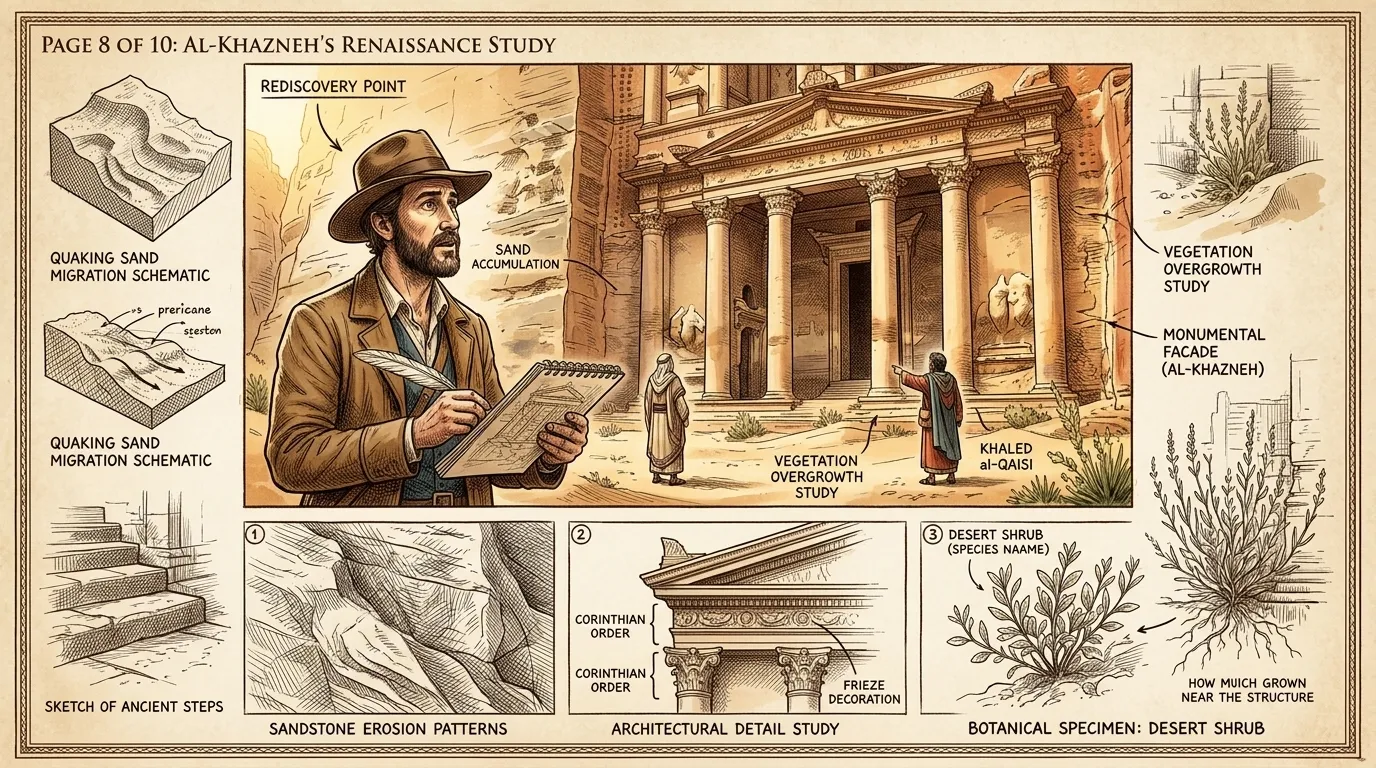
Centuries passed. Earthquakes shook Petra, damaging some of its structures. The city was eventually abandoned, its secrets lost to the sands of time. But in the 19th century, the Swiss explorer Johann Ludwig Burckhardt rediscovered Petra, revealing its hidden wonders to the world. As Mark Twain famously said: 'The glory that was Greece, and the grandeur that was Rome, would pale in comparison to the vastness and magnificence of Petra'.
""Incredible," Burckhardt whispered, his voice filled with awe as he beheld the Treasury for the first time. "A lost city, resurrected from the dust!""
Art Fact: Johann Ludwig Burckhardt (1784-1817) was a Swiss explorer who rediscovered Petra in 1812. His detailed accounts of the city sparked renewed interest in the site, leading to further exploration and excavation.
Page 9

Today, Petra stands as a UNESCO World Heritage Site, attracting millions of visitors each year. It is a testament to the ingenuity and artistry of the Nabataeans, a reminder that even in the harshest environments, beauty can flourish.
""Imagine," a modern archaeologist mused, carefully examining a section of the Treasury's façade, "the skill and dedication required to create such a masterpiece, so long ago.""
Art Fact: Petra was designated a UNESCO World Heritage Site in 1985. It is one of the most important archaeological sites in the Middle East, attracting visitors from around the world. Ongoing conservation efforts are essential to protect Petra's fragile sandstone structures from further damage.
Page 10

Though Khaled al-Qaisi is long gone, his vision endures. The Treasury stands as a testament to his skill, his passion, and his unwavering belief in the power of art to transcend time. His spirit lives on in every carved stone, in every soaring column, in every visitor who gazes upon its beauty with awe. Petra's legacy is one of innovation, artistry, and cultural fusion. It survives because beauty, crafted with dedication, never truly fades.
""His legacy remains..." a modern visitor whispers, gazing at Al-Khazneh in wonder. "A master builder forever enshrined in stone.""
Art Fact: Petra continues to inspire awe and wonder in all who visit. Its enduring legacy is a testament to the power of human creativity and the enduring appeal of beauty. The site reminds us that even in the face of adversity, art can thrive and endure, leaving an indelible mark on the world.
About this story
- Location: Egypt
- Audience: general readers
Questions and answers
Questions and answers about Petra (Ma'an, Jordan — c. 5th Century BC)
Read Wonder Arts on your phone
Wonder Arts is available on Android and iPhone and iPad. Get Wonder Arts on Google Play · Get Wonder Arts on the App Store.
More Wonder Arts stories
- Pietà by Michelangelo (Vatican City, Rome — 1499)
- Ploughing in the Nivernais by Rosa Bonheur (France — 1849)
- Pointillism by Georges Seurat (Paris, France — 1886)
- Polonaises by Frédéric Chopin (Paris, France — 1840s)
- Portrait of Madame X by John Singer Sargent (Paris, France — 1884)
- Post-Impressionism by Cézanne (France — c. 1886)