Pietà by Michelangelo (Vatican City, Rome — 1499)

Pietà by Michelangelo (Vatican City, Rome — 1499) — an illustrated arts story, set in Global. 10 illustrated pages, free to read on Wonder Arts.

Pietà by Michelangelo (Vatican City, Rome — 1499) — book cover — Wonder Arts
Pietà by Michelangelo (Vatican City, Rome — 1499) — book cover

Page 1

Pietà by Michelangelo (Vatican City, Rome — 1499) — page 1 illustration — Wonder Arts

Michelangelo Buonarroti, barely 24, stood before his completed Pietà in 1499. Carved from a single block of Carrara marble, the sculpture depicted the Virgin Mary cradling the body of her son, Jesus. Housed in St. Peter's Basilica, Vatican City, this Renaissance masterpiece stands 174 cm tall. Its estimated value is incalculable, representing not just artistic skill but profound spiritual significance.

"Michelangelo murmured, running a hand over Mary's serene face, 'Art is the noblest of human expressions.'"

Art Fact: The Pietà is the only work Michelangelo ever signed.

Page 2

Pietà by Michelangelo (Vatican City, Rome — 1499) — page 2 illustration — Wonder Arts

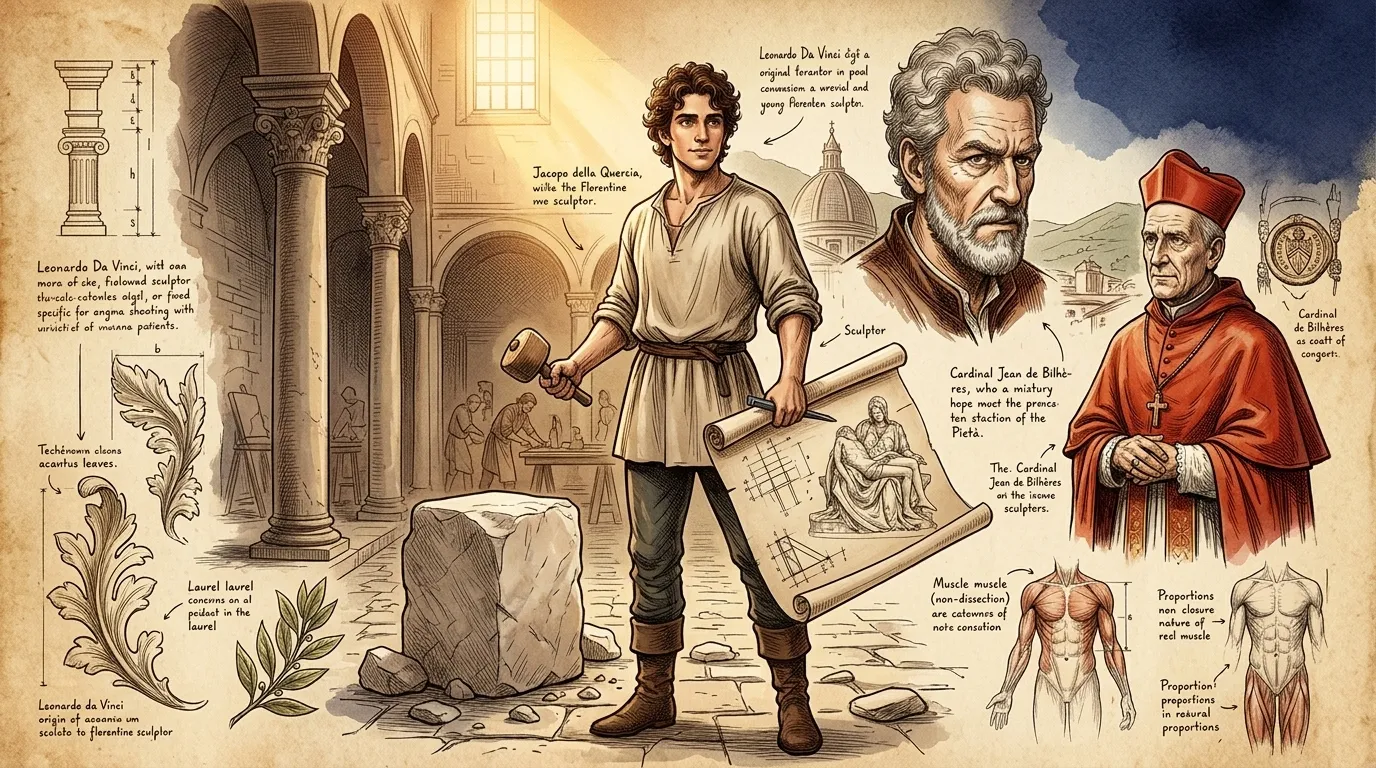
As Michelangelo began his work in Rome, he encountered the disdain of local sculptors. They mocked his Florentine style and youth. Jacopo della Quercia, a master sculptor, challenged his abilities, claiming the marble was too flawed for such a delicate piece.

"Jacopo scoffed, 'This marble is cursed! It contains impurities!' Michelangelo, his jaw tight, responded, 'The flaw is not in the stone, but in the eye of the beholder. As Leonardo da Vinci said, 'Every now and then go away, have a little relaxation, for when you come back to your work your judgment will be surer.' I shall make it sing!'"

Art Fact: The Pietà was commissioned by Cardinal Jean de Bilhères, a French diplomat.

Page 3

Pietà by Michelangelo (Vatican City, Rome — 1499) — page 3 illustration — Wonder Arts

Michelangelo, wandering through the ruins of ancient Rome, encountered a broken statue of a Roman goddess. Its flowing drapery and serene expression struck him deeply. He spent hours sketching the fragments, absorbing the classical ideals of beauty and proportion.

"Michelangelo whispered to himself, tracing the statue's form, 'Such balance, such grace... I must learn from the ancients.' He muttered under his breath, 'Perfection is no small thing, but it is made up of small things.'"

Art Fact: Michelangelo studied anatomy to ensure the accuracy of his sculptures.

Page 4

Pietà by Michelangelo (Vatican City, Rome — 1499) — page 4 illustration — Wonder Arts

Michelangelo travelled to Carrara to personally select the marble for the Pietà. After days of searching, he found a flawless block, gleaming white and pure. The quarrymen were astonished by his discerning eye. He declared this marble held the soul of his vision.

"Michelangelo said, pointing at the chosen block, 'This one! This marble speaks to me. It holds the light within. As Michelangelo would famously say later in life, 'I saw the angel in the marble and carved until I set him free'.'"

Art Fact: Carrara marble is prized for its purity and fine grain.

Page 5

Pietà by Michelangelo (Vatican City, Rome — 1499) — page 5 illustration — Wonder Arts

To capture the Virgin Mary's grief, Michelangelo sought inspiration from sacred plays and religious processions. He observed mothers mourning their lost children, seeking to understand the depths of sorrow. The emotion had to be perfectly balanced with the serene expression of the Virgin.

"Michelangelo told Lorenzo, his assistant, 'Her sorrow must be profound, yet her faith unwavering. It is what the poet Dante Alighieri meant when he wrote, 'From a little spark may burst a flame'.'"

Art Fact: Michelangelo defied the traditional depiction of Mary as an older woman.

Page 6

Pietà by Michelangelo (Vatican City, Rome — 1499) — page 6 illustration — Wonder Arts

Michelangelo obsessed over the hands of both Mary and Jesus. He studied cadavers to understand the precise musculature and bone structure. He wanted the hands to convey both sorrow and resignation, life and death, holding and release.

"Michelangelo muttered, meticulously carving the hand of Jesus, 'These hands must speak of the sacrifice. As Aristotle said, 'The ultimate value of life depends upon awareness and the power of contemplation rather than upon mere survival.'"

Art Fact: The hands are considered one of the most moving aspects of the sculpture.

Page 7

Pietà by Michelangelo (Vatican City, Rome — 1499) — page 7 illustration — Wonder Arts

The biggest challenge was fitting the fully grown Jesus in Mary's lap. To make it aesthetically pleasing, Michelangelo deliberately made Mary bigger, and the focus was on her dress. This caused some debate and discussion with his commissioners.

"Cardinal Jean de Bilhères asked, 'Michelangelo, is it correct to make the Mother larger than the Son?' Michelangelo replied, 'It is to provide peace and solace to the soul of her son, but as Plato said: 'Good actions give strength to ourselves and inspire good actions in others'.'"

Art Fact: The sculpture is one of the most famous artworks from the Renaissance.

Page 8

Pietà by Michelangelo (Vatican City, Rome — 1499) — page 8 illustration — Wonder Arts

After the unveiling, a group of Lombard sculptors incorrectly attributed the Pietà to one of their own. Michelangelo, furious at the slight, secretly returned to the basilica one night. He carved his name across Mary's sash, securing his legacy.

"Michelangelo, etching his name into the marble sash, said, 'They will know my name. It is what the writer Miguel de Cervantes once said, 'He who is not courageous enough to take risks will accomplish nothing in life'.'"

Art Fact: It is the only work Michelangelo ever signed.

Page 9

Pietà by Michelangelo (Vatican City, Rome — 1499) — page 9 illustration — Wonder Arts

The Pietà was an instant sensation. Artists, patrons, and pilgrims flocked to St. Peter's Basilica to witness its beauty. It became a symbol of the Renaissance and Michelangelo's genius. Its fame spread throughout Europe.

"Giorgio Vasari, the famous art historian, said, 'Michelangelo has surpassed all artists of our time. As Cicero so eloquently put, 'The life of the dead is placed in the memory of the living'. His artistry would live forever."

Art Fact: The Pietà is a central figure in the basilica and the Vatican's artwork.

Page 10

Pietà by Michelangelo (Vatican City, Rome — 1499) — page 10 illustration — Wonder Arts

Centuries later, the Pietà continues to inspire awe. Generations of artists have studied its form, drawn to its emotional power. Michelangelo's vision endures. His mastery of marble ensures the Renaissance wonder is timeless. Art lives forever because, as Michelangelo knew, the spirit of creation is immortal.

"An inspired sculptor thinks, while gazing at the Pietà 'Michelangelo knew, 'Every block of stone has a statue inside it and it is the task of the sculptor to discover it.'"

Art Fact: The Pietà remains one of the most visited and revered sculptures in the world.

About this story

  • Location: Global
  • Audience: general readers

More Wonder Arts stories

All Wonder Arts stories · Open the library