Post-Impressionism by Cézanne (France — c. 1886)
Post-Impressionism by Cézanne (France — c. 1886) — an illustrated arts story, set in France. 10 illustrated pages, free to read on Wonder Arts.

Page 1

Paul Cézanne stood before his canvas, 'Still Life with Apples and Oranges,' completed around 1895. The arrangement, a deliberate study in form and color, occupied a space of 74 x 93 cm. The painting, now residing at the Musée d'Orsay in Paris, was more than just fruit; it was a revolution. Cézanne whispered to himself, lost in the moment, 'I want to surprise Paris with an apple.'
Art Fact: Cézanne's 'Still Life with Apples and Oranges' is valued for its groundbreaking approach to form and perspective, paving the way for modern art movements like Cubism.
Page 2

Cézanne, as a young man, strolled through the Aix-en-Provence market, a riot of color and form. The vibrant displays of fruits and vegetables awakened something within him, a desire to capture the essence of these simple objects. He remembered the words of Émile Zola, who would soon become a childhood friend, 'An artist can't fail; it's a success to be one.'
"'Look at those apples, Paul,' Zola exclaimed, nudging Cézanne. 'They're practically begging to be painted!'"
Art Fact: Aix-en-Provence, Cézanne's birthplace, provided constant inspiration with its vibrant landscapes and bustling markets.
Page 3

In Auvers-sur-Oise, Cézanne sought the counsel of Camille Pissarro, the Impressionist master. Pissarro's guidance helped Cézanne refine his technique, encouraging him to embrace color and break from traditional forms. 'Everything in nature adheres to the cone, the cylinder and the curve,' Pissarro explained, as Cézanne nodded, absorbing the wisdom.
"Pissarro, his face etched with experience, pointed to a nearby tree. 'Paul, see the light, how it dances on the leaves? Capture that essence, not just the form.'"
Art Fact: Pissarro's mentorship was crucial in Cézanne's development, helping him bridge Impressionism and his unique Post-Impressionist style.
Page 4
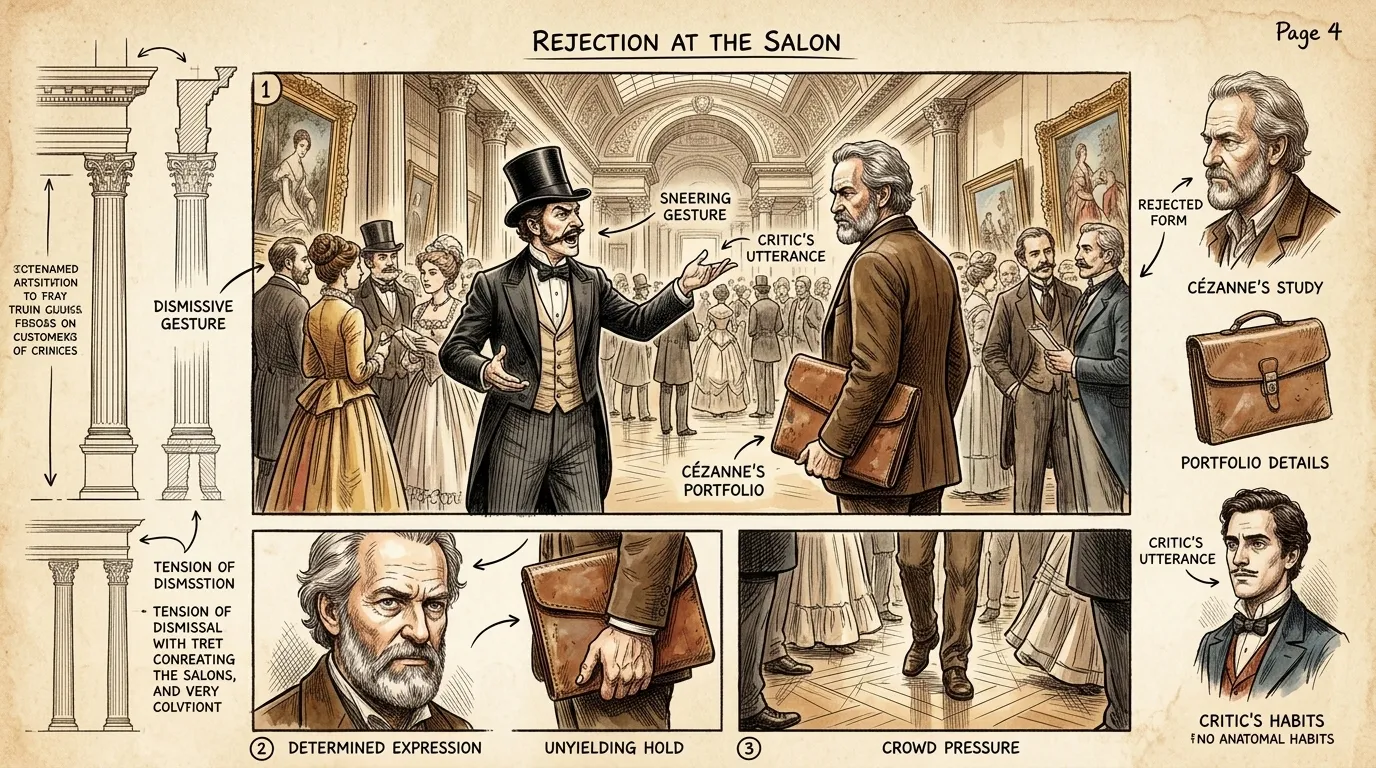
Cézanne's repeated rejections at the Paris Salon, the art world's most prestigious exhibition, fueled his determination. Critics dismissed his work as clumsy and unfinished, but Cézanne refused to compromise his vision. 'I'm coming along slowly,' Cézanne wrote to Zola, 'but nature is very complex, and progress comes in waves.'
"One critic sneered, 'His colors are muddy, his forms distorted! He'll never be accepted here.' Cézanne, overhearing the remark, simply tightened his grip on his portfolio."
Art Fact: Cézanne faced constant rejection from the establishment, but this only strengthened his resolve to forge his own path.
Page 5
The Jas de Bouffan, Cézanne's family estate near Aix, provided a sanctuary where he could immerse himself in nature. The estate's gardens, orchards, and surrounding landscapes became recurring subjects in his paintings. He often repeated, 'Painting from nature is not copying the object; it is realizing one's sensations.'
"Standing before the Mont Sainte-Victoire, Cézanne murmured, 'That mountain...it's a motif that haunts me. I must capture its essence.'"
Art Fact: The Jas de Bouffan provided Cézanne with a constant source of inspiration and a refuge from the pressures of the Parisian art world.
Page 6

Cézanne frequented the Louvre, studying the works of the Old Masters. He was particularly drawn to the paintings of Poussin and the Venetian artists, analyzing their compositions and color palettes. 'One is neither too scrupulous nor too sincere nor too submissive to nature; but one is more or less master of one's model, and, above all, of the means of expression,' said Cezanne about mastering painting skills.
"Before a Poussin landscape, Cézanne observed, 'Look at how he structures the space, the balance of forms. We must learn from these masters, but not imitate them.'"
Art Fact: Cézanne's study of the Old Masters at the Louvre was essential to his development, providing him with a foundation upon which to build his unique style.
Page 7

As Cézanne matured, he began to diverge from Impressionism, seeking a more structured and enduring approach to painting. He wanted to create an art that was both modern and timeless. 'With an apple I will astonish Paris,' Cézanne declared.
"Discussing his latest still life, Cézanne told a fellow artist, 'I want to make of Impressionism something solid and durable, like the art of the museums.'"
Art Fact: Cézanne's break with Impressionism marked a turning point in art history, paving the way for Post-Impressionism and modern art.
Page 8
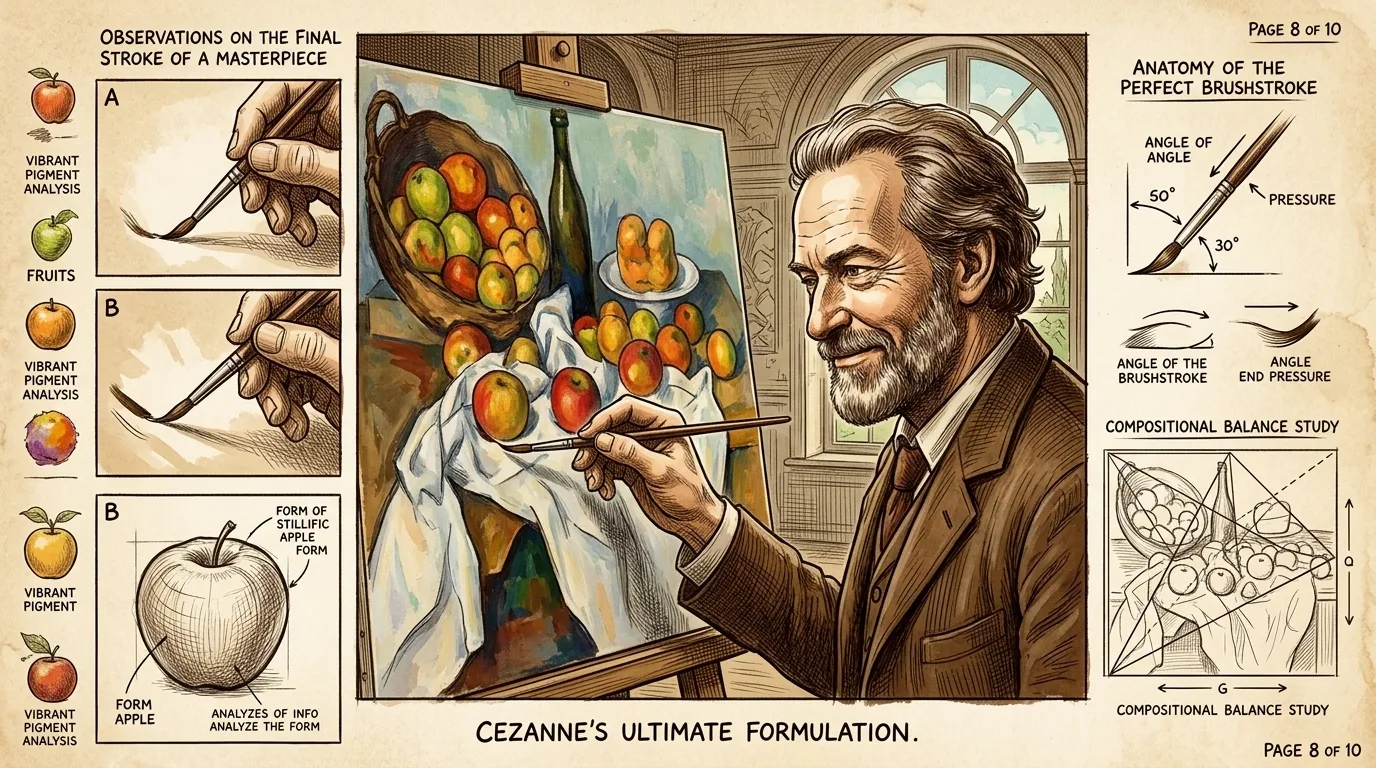
After years of experimentation, Cézanne finally put the finishing touches on 'Still Life with Apples and Oranges'. He knew that this painting represented a culmination of his artistic journey, a testament to his unwavering pursuit of form and color. He muttered the words of Leonardo da Vinci, 'Painting embraces all the ten functions of the eye; that is to say, darkness, light, body and colour, substance and form, motion and rest, fullness and emptiness, divisibility and contiguity.'
"Surveying the finished work, Cézanne nodded slowly. 'It is complete,' he said softly. 'It is what I have always striven for.'"
Art Fact: Cézanne's meticulous and deliberate process resulted in paintings of profound depth and visual complexity.
Page 9
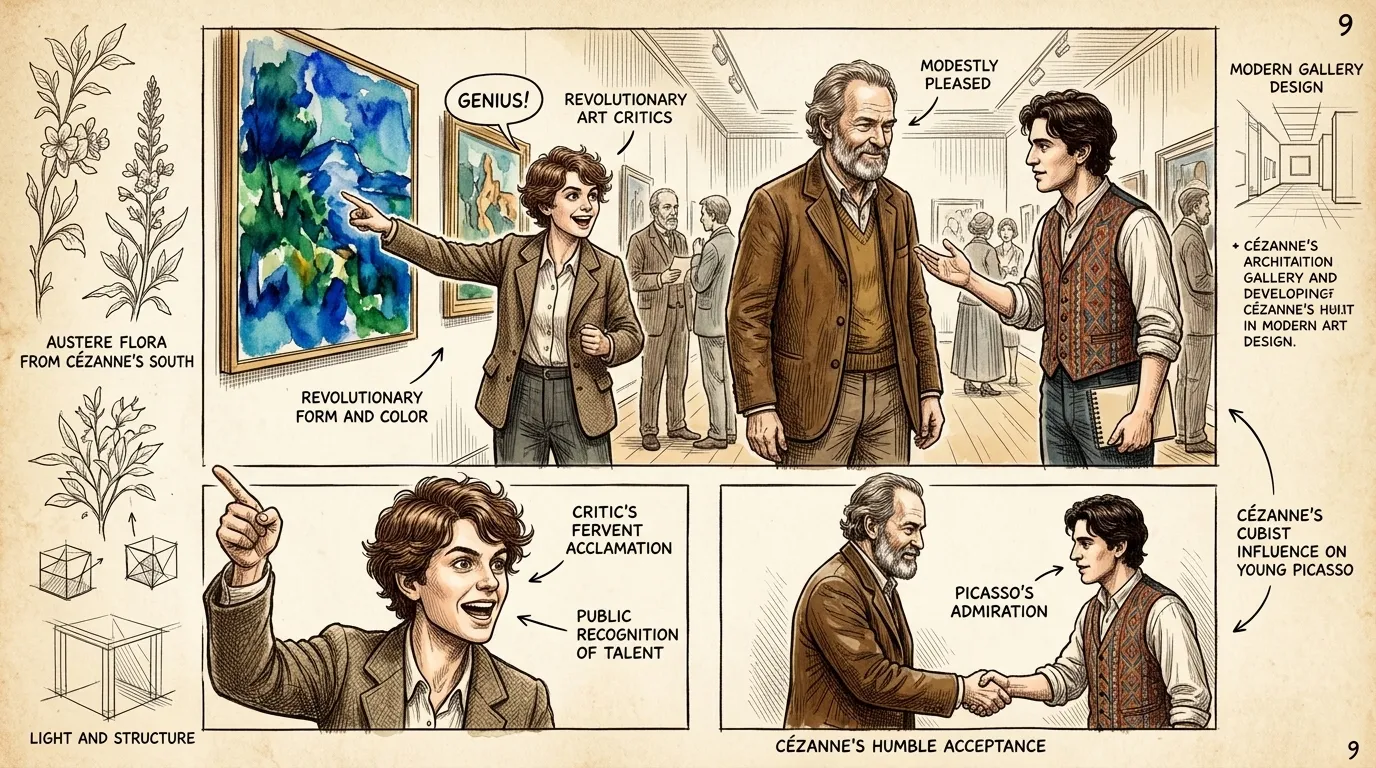
Toward the end of his life, Cézanne finally began to receive the recognition he deserved. Younger artists, like Picasso and Matisse, hailed him as a visionary. 'He was my one and only master!' said Picasso admiringly, who carried a photo of Cezanne in his wallet.
"A young art critic exclaimed, 'Cézanne has shown us a new way of seeing! He has revolutionized painting!'"
Art Fact: Cézanne's late recognition paved the way for future generations of artists, solidifying his place as a pivotal figure in modern art.
Page 10
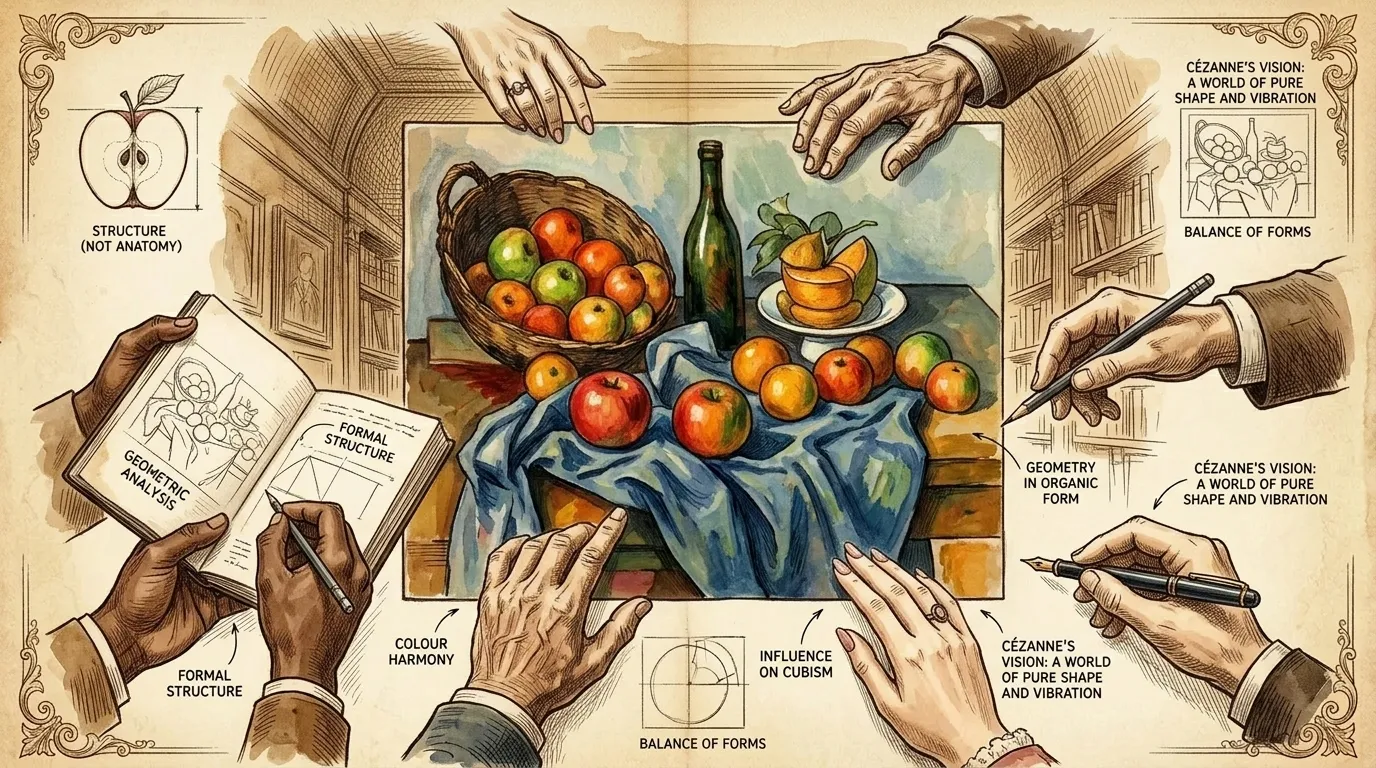
Today, Cézanne's 'Still Life with Apples and Oranges' continues to inspire artists and captivate audiences around the world. His legacy endures because he taught us to see the world anew, to find beauty in the simplest of objects. As Cézanne himself said, 'Art is a harmony parallel with nature.'
Art Fact: Cézanne's influence transcends time and culture, ensuring his work will continue to inspire artists and viewers for generations to come.
About this story
- Location: France
- Audience: kids (ages 6–12)
Questions and answers
Questions and answers about Post-Impressionism by Cézanne (France — c. 1886)
Read Wonder Arts on your phone
Wonder Arts is available on Android and iPhone and iPad. Get Wonder Arts on Google Play · Get Wonder Arts on the App Store.