Proserpine by Dante Gabriel Rossetti (London, UK — 1874)
Proserpine by Dante Gabriel Rossetti (London, UK — 1874) — an illustrated arts story, set in United Kingdom. 10 illustrated pages, free to read on Wonder Arts.
Page 1

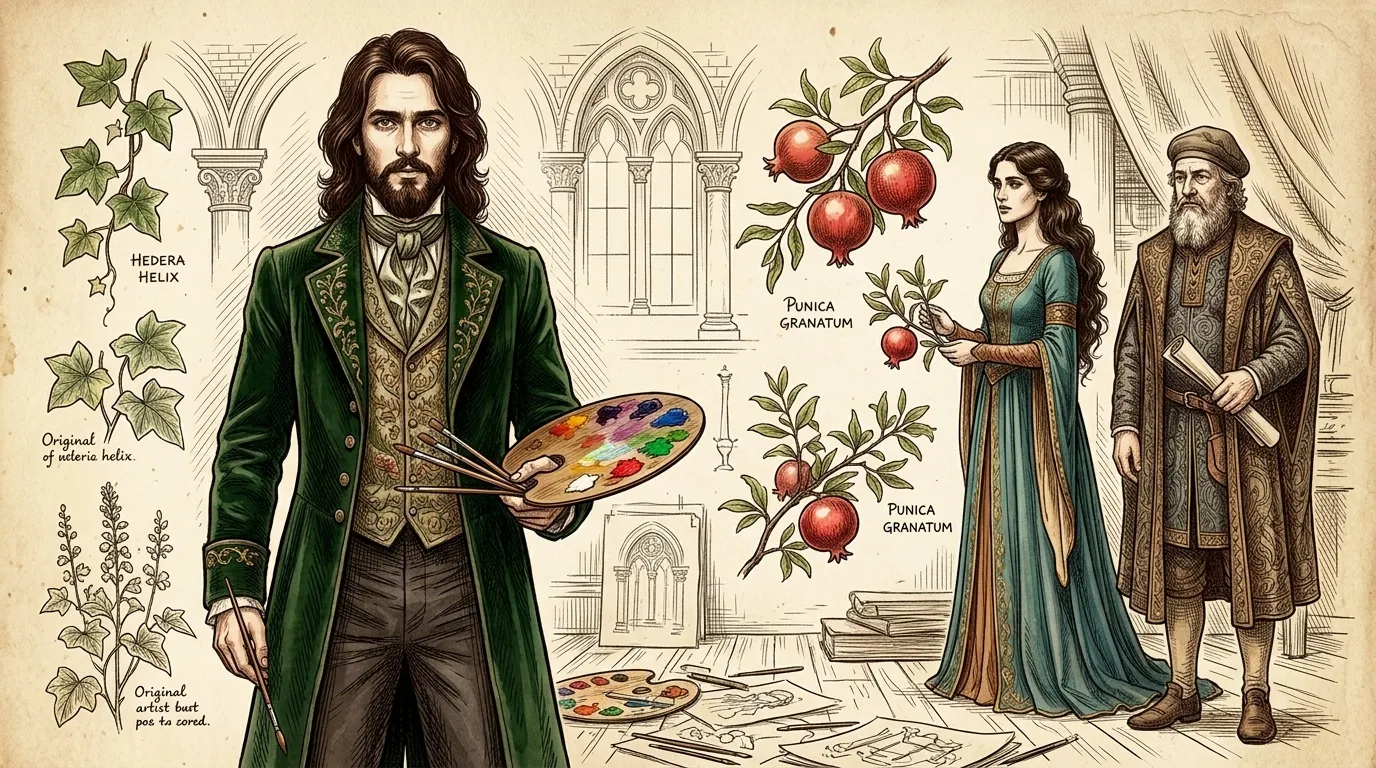
Dante Gabriel Rossetti stands before his nearly completed masterpiece, Proserpine, in his London studio in 1874. The painting, an oil on canvas measuring 30 3/4 x 15 1/4 inches (77 x 38 cm), captures the haunting beauty of Jane Morris as the mythological Proserpine. Its creation was fraught with personal turmoil, mirroring the goddess's own captivity.
"Rossetti murmurs to himself, "'I have no wit, no words, no tears; My heart sleeps a stone' as Christina wrote. Yet, with paint, I can awaken her from the depths.""
Art Fact: Proserpine exists in three known versions, one in the Tate, another in the Birmingham Museum and Art Gallery. The apple represents the underworld from which she cannot return.
Page 2

In 1857, Rossetti, alongside William Morris and Edward Burne-Jones, was commissioned to paint murals at the Oxford Union. It was there he first saw Jane Burden, a striking beauty with dark hair and a captivating presence. Her beauty would become his obsession. He knew she was his muse.
"Rossetti exclaims to Burne-Jones, "Look! Have you ever seen such a face? She's magnificent! I must paint her!" Burne-Jones replies, "Careful, Gabriel. She is William's betrothed.""
Art Fact: Rossetti's murals at the Oxford Union were famously disastrous, fading quickly due to the experimental painting techniques used.
Page 3

Following the death of his wife, Elizabeth Siddal, Rossetti buried a book of his poems with her. Years later, consumed by regret and financial need, he exhumed her coffin to retrieve them. The experience haunted him, deepening his melancholic disposition. He knew he had to immortalize Jane, as Proserpine.
"Rossetti, visibly shaken and pale, mutters, "'The secret source of all beauty is sorrow,' as Kahil Gibran so eloquently put it. My sorrow must fuel my art. Jane... Proserpine...""
Art Fact: Rossetti's guilt and grief following his wife's death profoundly influenced his art, leading to more introspective and emotionally charged works.
Page 4

A trip to Florence in 1867 exposed Rossetti to the intense colors and symbolic richness of the Italian Renaissance masters. This visit deeply influenced his palette and compositional style, pushing him towards a more vibrant and emotionally resonant Pre-Raphaelitism. He decided that Proserpine would be as vibrant as the frescoes he had witnessed.
"Rossetti exclaims to his companion, "Look at the way those colours sing, the way light dances across those frescoes! I will paint like that, from the depths of my soul!""
Art Fact: Rossetti's trip to Italy marked a shift in his artistic style, leading to richer colors and more dramatic compositions, inspired by the Italian Renaissance masters.
Page 5

Rossetti was fascinated by the myth of Proserpine, who was condemned to spend part of each year in the underworld after eating pomegranate seeds. He saw a parallel between Proserpine's captivity and his own obsessive love for Jane Morris, who was married to his friend William.
"Rossetti reflects, "'We are each our own devil, and we make this world our hell,' as Oscar Wilde would later write. I am trapped by my own desires, just as Proserpine is bound to Hades by the pomegranate.""
Art Fact: The pomegranate, a central symbol in the painting, represents Proserpine's captivity and the inescapable consequences of her actions.
Page 6

Jane Morris possessed a captivating, melancholic beauty that deeply resonated with Rossetti. He saw her as the embodiment of Proserpine, a goddess trapped in a world of shadows and longing. Her expression became a key element in his portrayal.
"Rossetti tells Jane during a sitting, "Your face, Jane, holds a universe of sorrow. It is the very soul of Proserpine. I must capture it on canvas.""
Art Fact: Jane Morris's melancholic beauty and her position in a complicated love triangle became central themes in Rossetti's depiction of Proserpine.
Page 7

Rossetti's health deteriorated under the strain of his obsessive love for Jane and his addiction to chloral. His mental state became increasingly fragile, fueling the emotional intensity of his art. The darker, more somber aspects of Proserpine reflected his inner turmoil.
"Rossetti, agitated, paces in his studio, muttering, "'The worst solitude is to be destitute of sincere friendship,' Francis Bacon wrote. But my art... my art is the only friend I need!""
Art Fact: Rossetti's mental and physical decline contributed to the increasingly dark and emotionally charged atmosphere of his later works, including Proserpine.
Page 8

As Rossetti painted Proserpine, he increasingly envisioned her as a prisoner of the underworld, her beauty forever tinged with sadness and regret. He aimed to capture not just her physical appearance, but her inner torment.
"Rossetti says to himself as he paints, "She is not just beautiful; she is tragic. That is her beauty—she is a goddess of sorrow. I must show all!""
Art Fact: Rossetti's vision of Proserpine as a prisoner of the underworld, tinged with sadness and regret, is a key element in the painting's enduring appeal.
Page 9

Rossetti completed several versions of Proserpine before his death in 1882. The painting became one of his most iconic works, capturing the beauty and sorrow of Jane Morris and solidifying his reputation as a leading Pre-Raphaelite artist. The final brushstrokes reflected all the emotions he felt for her, his obsession, and his grief.
"Rossetti, exhausted but satisfied, whispers, "It is finished. She will be remembered, as will I. This work, this Proserpine, will last forever.""
Art Fact: Proserpine remains one of Rossetti's most iconic and celebrated works, a testament to his artistic skill and his complicated relationship with Jane Morris.
Page 10

Today, 'Proserpine' hangs in the Tate Britain, captivating viewers with its haunting beauty and symbolic richness. Dante Gabriel Rossetti's vision of the goddess continues to resonate, reminding us of the power of art to capture the complexities of love, loss, and the human condition. His legacy is complete.
"An art historian remarks to a student, "Look closely, and you can still feel Rossetti's passion in every brushstroke. As Shakespeare wrote, 'She will not fade, for she is made so fair.'""
Art Fact: Rossetti's Proserpine continues to inspire and move audiences, ensuring his place as a master of the Pre-Raphaelite movement.
About this story
- Location: United Kingdom
- Audience: general readers
Questions and answers
Questions and answers about Proserpine by Dante Gabriel Rossetti (London, UK — 1874)
Read Wonder Arts on your phone
Wonder Arts is available on Android. Get Wonder Arts on Google Play.
More Wonder Arts stories
- Rain, Steam and Speed by J.M.W. Turner (London, UK — 1844)
- Realism Emerges by Courbet (Paris, France — c. 1850)
- Rebellious Slave by Michelangelo (Paris, France — 1513)
- Requiem by Wolfgang Amadeus Mozart (Vienna, Austria — 1791)
- Rijksmuseum (Amsterdam, Netherlands — 1800)
- Romanticism Rises by Goya (Europe — c. 1800)