Rijksmuseum (Amsterdam, Netherlands — 1800)
Rijksmuseum (Amsterdam, Netherlands — 1800) — an illustrated arts story. 10 illustrated pages, free to read on Wonder Arts.
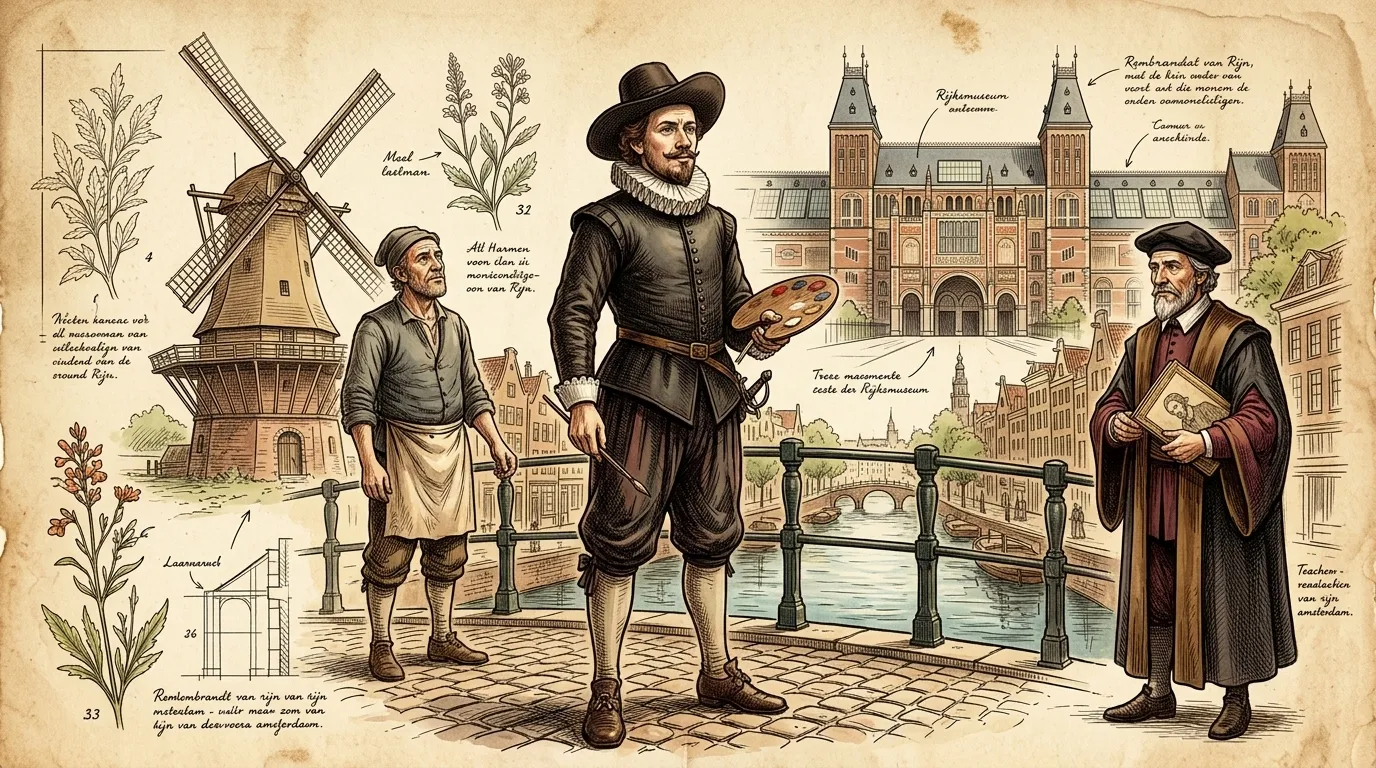
Page 1

Rembrandt van Rijn stands before his monumental canvas, 'The Night Watch,' completed in 1642. The painting, officially titled 'Militia Company of District II under the Command of Captain Frans Banninck Cocq,' measures approximately 11.91 x 14.44 feet and currently resides in the Rijksmuseum, Amsterdam. A controversial masterpiece, it was initially criticized for its dramatic departure from traditional group portraiture, a gamble that would ultimately secure his immortality.
"Rembrandt mutters, almost to himself, 'Let them criticize. I have captured life, movement, and the very soul of Amsterdam!'"
Art Fact: The painting was commissioned by Captain Frans Banninck Cocq and his militia company. Rembrandt broke from convention by portraying the group in action, rather than in a static pose.
Page 2

Young Rembrandt, barely a boy, stands beside his father, Harmen Gerritszoon van Rijn, at the family's windmill. The rhythmic creak and grind of the mill fill the air as Harmen explains the intricacies of the machinery. 'Always observe the light, Rembrandt,' his father says, 'See how it changes the color of the wood, the texture of the grain?'.
"Harmen says, 'Remember what Seneca said, 'Every new beginning comes from some other beginning's end.' The light will teach you everything.'"
Art Fact: Rembrandt's early life in Leiden, surrounded by the textures and light of the mill, profoundly influenced his artistic eye.
Page 3

In Pieter Lastman's bustling Amsterdam studio, Rembrandt observes his master meticulously applying layers of paint. Lastman, a master of historical and biblical scenes, imparts invaluable techniques. 'The key, Rembrandt,' Lastman booms, 'is to tell a story with light and shadow!'.
"Lastman says, 'Use chiaroscuro to create drama. As Leonardo da Vinci said, 'Painting embraces all the ten functions of the eye; that is to say, darkness, light, body and colour, shape and location, distance and nearness, motion and rest.''"
Art Fact: Pieter Lastman's tutelage instilled in Rembrandt a love for narrative and a mastery of dramatic lighting.
Page 4

Rembrandt attends Dr. Nicolaes Tulp's public anatomy lesson. The cadaver lies exposed, a stark contrast to the somber attire of the observing physicians. The demonstration of the arm's musculature enthralls Rembrandt. He sketches furiously, capturing the tension and the awe in the room.
"Dr. Tulp proclaims, 'Observe carefully, gentlemen! Knowledge of the human form is the foundation of all great art!'. One of the observers states, 'As Hippocrates said, 'Wherever the art of medicine is loved, there is also a love of Humanity.'"
Art Fact: Rembrandt's attendance at anatomy lessons honed his understanding of human anatomy, crucial to his realistic portrayals.
Page 5

Saskia van Uylenburgh, Rembrandt's future wife, enters his studio, radiating warmth and light. Her vivacious personality captivates the artist. She becomes his muse, inspiring countless portraits and etchings. Her presence banishes the shadows that had begun to creep into his work.
"Rembrandt, captivated, declares, 'Saskia, you are the sun that brightens my world!'. Saskia playfully responds, 'Nonsense, Rembrandt. But you may paint me as Venus if you wish!'."
Art Fact: Saskia's arrival marked a turning point in Rembrandt's life and art, bringing joy and inspiration.
Page 6

Captain Frans Banninck Cocq and Lieutenant Willem van Ruytenburch arrive at Rembrandt's studio to commission a group portrait of their militia company. Rembrandt, eager to break from convention, proposes a dynamic scene, filled with action and individuality. The Captain, though initially hesitant, is eventually won over by Rembrandt's vision.
"Captain Cocq says, 'Rembrandt, your ideas are bold, but can you deliver a portrait that captures the essence of our company?'. Rembrandt confidently says, 'Gentlemen, I will create a masterpiece! Remember what Michelangelo said: 'Every block of stone has a statue inside it and it is the task of the sculptor to discover it.' I will carve your likeness in paint!'"
Art Fact: The commission for 'The Night Watch' presented Rembrandt with an opportunity to revolutionize group portraiture.
Page 7

Following the unveiling of 'The Night Watch,' criticisms flood Amsterdam's artistic circles. Some find the composition chaotic, the individual likenesses obscured. Rembrandt, though stung by the negativity, stands by his artistic choices. He believes he has captured something far greater than a mere group portrait.
"A critic scoffs, 'Rembrandt, your painting is a muddle! Where is the order, the clarity?'. Rembrandt responds, 'Order is not life, sir. I have painted the energy, the spirit of Amsterdam! As Vincent van Gogh stated: 'I dream my painting, and then I paint my dream'.'"
Art Fact: The initial reception to 'The Night Watch' was mixed, with some critics failing to appreciate its innovative approach.
Page 8

Years pass. Saskia's death plunges Rembrandt into grief. Commissions dwindle, and financial hardship descends. Yet, through his darkest days, he continues to paint, exploring the depths of human emotion and the power of light and shadow.
"Rembrandt, overcome with sorrow, whispers, 'Even in the deepest darkness, there is light. I will find it in my art. As Helen Keller once wrote, 'Although the world is full of suffering, it is also full of the overcoming of it.''"
Art Fact: Rembrandt's personal tragedies fueled his artistic exploration of human emotion and the enduring power of the human spirit.
Page 9

In his later years, Rembrandt's genius is once again recognized. Students flock to his studio, eager to learn from the master of light and shadow. Though financial struggles persist, his artistic legacy is secure. The world begins to understand 'The Night Watch' not as a chaotic mess, but as a revolutionary masterpiece.
"A student remarks, 'Master Rembrandt, your understanding of light is unparalleled!'. Rembrandt replies, 'Light is the soul of painting, young one. It reveals all. Remember what Confucius said: 'Study the past if you would define the future'.'."
Art Fact: Rembrandt's later years saw a resurgence of recognition for his artistic genius and innovative techniques.
Page 10

Centuries later, 'The Night Watch' hangs proudly in the Rijksmuseum, Amsterdam, captivating millions of visitors each year. Rembrandt's spirit lives on through his art, inspiring generations of artists to push boundaries and explore the depths of human experience. His legacy remains a testament to the power of innovation and the enduring beauty of the human soul.
"Narrator states, 'Rembrandt's work survives because he saw beyond the surface, capturing the very essence of humanity. As Maya Angelou wrote, 'Nothing can dim the light which shines from within.'"
Art Fact: Rembrandt's 'The Night Watch' remains one of the most iconic and beloved paintings in the world, a testament to his artistic genius and lasting legacy.
About this story
- Audience: general readers
Questions and answers
Questions and answers about Rijksmuseum (Amsterdam, Netherlands — 1800)
Read Wonder Arts on your phone
Wonder Arts is available on Android. Get Wonder Arts on Google Play.
More Wonder Arts stories
- Romanticism Rises by Goya (Europe — c. 1800)
- Rouen Cathedral Series by Claude Monet (Rouen, France — 1894)
- Roundhay Garden Scene by Louis Le Prince (Leeds, UK — 1888)
- Saint George by Donatello (Florence, Italy — 1417)
- Saint Longinus by Gian Lorenzo Bernini (Vatican City — 1638)
- Saint Mark by Donatello (Florence, Italy — 1413)