Saint Longinus by Gian Lorenzo Bernini (Vatican City — 1638)
Saint Longinus by Gian Lorenzo Bernini (Vatican City — 1638) — an illustrated arts story. 10 illustrated pages, free to read on Wonder Arts.

Page 1

Gian Lorenzo Bernini stood before his creation in the Vatican, the Basilica di San Pietro, in 1638. Saint Longinus, a marble sculpture soaring over 13 feet, represented a pivotal moment in Baroque sculpture. This masterpiece, valued immeasurably, captures the instant Longinus, the Roman soldier who pierced Christ's side, converted to Christianity upon witnessing the miracle.
"Bernini muttered to himself, adjusting the folds of the saint's robe. "Did I capture the divine moment, the ecstasy of realization?""
Art Fact: Saint Longinus, located in St. Peter's Basilica, Rome, stands over 13 feet tall. Commissioned by Pope Urban VIII, it represents Longinus's conversion at the Crucifixion, marking a high point in Baroque sculpture.
Page 2

Years earlier, Bernini labored over countless sketches. He sought the precise gesture, the perfect tilt of the head, to convey Longinus's epiphany. He needed to understand the saint's internal transformation to bring it to life in stone. The initial sketch held the seeds of the sculpture's final, triumphant form.
" "The pose...it must reflect not only surprise, but also a profound spiritual awakening," Bernini explained to his assistant, Luigi. Luigi responded, "Yes, maestro, the conflict within the soul must be evident.""
Art Fact: Bernini's initial sketches were crucial in developing the emotional intensity and dynamic pose of Saint Longinus. He experimented extensively with different gestures and facial expressions to capture the moment of spiritual awakening.
Page 3

Bernini insisted on studying cadavers to understand the musculature of a man in spiritual ecstasy. He believed true art mirrored nature, so he needed a perfect portrayal of Longinus's face. The artist aimed for a look that transcended mere physical representation.
"The Cardinal asked Bernini, "Why so much focus on the face?" Bernini answered, "Because the face is the mirror of the soul. In it lies the truth of his transformation.""
Art Fact: Bernini's dedication to anatomical accuracy led him to study cadavers extensively, ensuring his sculpture reflected a deep understanding of human anatomy and emotional expression.
Page 4

Presenting his scale model to Pope Urban VIII was a nerve-wracking moment. The Pope's satisfaction was essential for the commission's continuation. Bernini meticulously explained his artistic choices, emphasizing the spiritual significance of the sculpture.
"Bernini stated, "Your Holiness, the sculpture seeks to capture the moment of divine inspiration, when Longinus recognizes the truth. As Cicero said, 'The face is a picture of the mind as the eyes are its interpreter.'""
Art Fact: Pope Urban VIII's approval was crucial for the commission. Bernini skillfully presented his artistic vision, emphasizing the spiritual significance of the sculpture to secure papal support.
Page 5

Bernini personally oversaw the selection of the marble from the Carrara quarries. He sought the purest, most flawless stone to embody Longinus's divine moment. The journey to the quarry was long, but the quality of the marble was paramount.
"Bernini said to the quarry master, "Only the purest marble will suffice. This sculpture must endure for eternity, reflecting the permanence of faith.""
Art Fact: Bernini's personal involvement in selecting the marble from the Carrara quarries demonstrates his commitment to quality and ensuring the sculpture's lasting beauty and spiritual impact.
Page 6

As Saint Longinus neared completion, Bernini felt the weight of placing it within St. Peter's Basilica. He contemplated the immense space and the impact his sculpture would have on the faithful. The Basilica had to complement the sculpture, and the sculpture had to enhance the Basilica.
""How do I ensure my creation resonates within such a grand space?" Bernini wondered, walking the hallowed halls. "Michelangelo, a master artist, once said, 'I saw the angel in the marble and carved until I set him free.' I only hope my work does him justice.""
Art Fact: Bernini faced a significant challenge in placing Saint Longinus within the grandeur of St. Peter's Basilica, considering the immense scale and ensuring his sculpture harmonized with the existing architectural and artistic context.
Page 7
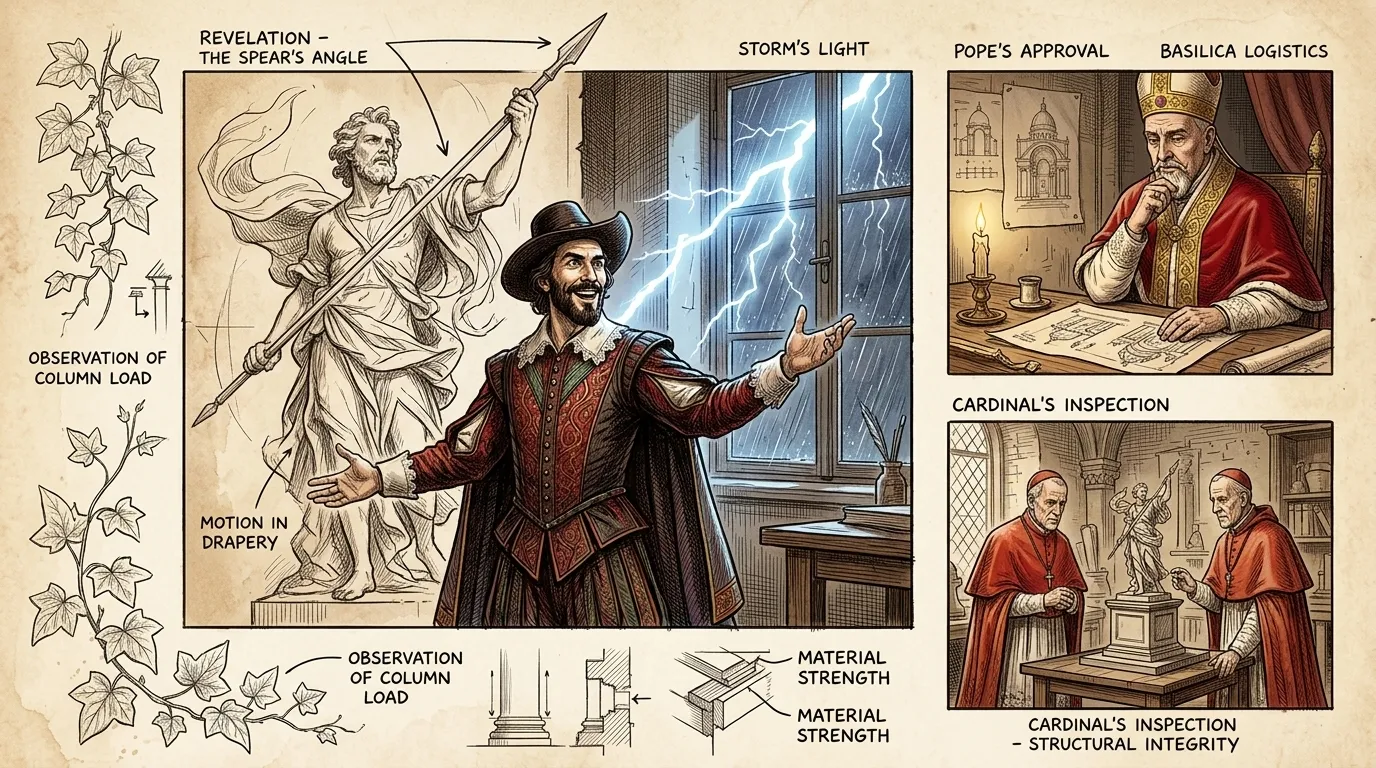
Bernini struggled to convey the sheer force of Longinus's spiritual transformation. One night, inspired by a sudden storm, he envisioned the sculpture bursting with dynamic movement. The drapery billowed, the arms outstretched, the face alight with ecstasy.
"Bernini cried, "Eureka! The sculpture must be alive with movement, reflecting the dynamism of divine intervention! It should capture the essence of Longinus' spiritual eruption."
Art Fact: Bernini's breakthrough came with the realization that he needed to infuse the sculpture with dynamic movement, capturing the intensity of Longinus's spiritual transformation and conveying the moment's raw energy.
Page 8

With the form complete, Bernini meticulously polished the marble, refining every detail to perfection. He sought to capture the soft texture of skin, the flow of drapery, the spark of divine inspiration. Each detail was meticulously refined.
"Bernini said to his assistant, "The final polish is crucial. It's where the sculpture breathes, where the spirit shines through the marble.""
Art Fact: Bernini dedicated considerable time to polishing the marble, meticulously refining every detail to achieve the desired level of realism, texture, and emotional resonance in Saint Longinus.
Page 9

The completed Saint Longinus was unveiled to the world. The sculpture inspired awe and reverence, becoming an instant masterpiece. Bernini's vision had triumphed, and the sculpture became an eternal symbol of faith.
"Cardinal Barberini commented, "Bernini has captured the very essence of faith. Longinus stands not just as a statue, but as a testament.""
Art Fact: The unveiling of Saint Longinus marked a momentous occasion. It solidified Bernini's reputation as a master sculptor and secured the sculpture's place as a symbol of faith and artistic achievement within St. Peter's Basilica.
Page 10

Centuries later, Saint Longinus still inspires millions who visit St. Peter's Basilica. Bernini's genius lives on through the sculpture, a testament to human creativity and spiritual devotion. Though Bernini is gone, his influence has prevailed through his art. Saint Longinus continues to captivate audiences.
"Modern visitors whispered, marveling at the sculpture. As Leonardo da Vinci said, 'Painting embraces all the ten functions of the eye; that is to say, darkness, light, body and colour, substance and form, motion and rest, distance and proximity.' Bernini's work stands as a testament to artistic vision across time."
Art Fact: Bernini's Saint Longinus continues to inspire and captivate visitors to St. Peter's Basilica. It stands as a lasting testament to human creativity and spiritual devotion, ensuring Bernini's legacy endures through time.
About this story
- Audience: general readers
Questions and answers
Questions and answers about Saint Longinus by Gian Lorenzo Bernini (Vatican City — 1638)
Read Wonder Arts on your phone
Wonder Arts is available on Android. Get Wonder Arts on Google Play.
More Wonder Arts stories
- Saint Mark by Donatello (Florence, Italy — 1413)
- Salisbury Cathedral (Salisbury, UK — 1258)
- Sallie Gardner at a Gallop by Eadweard Muybridge (California, USA — 1878)
- Sleeping Hermaphroditus by Polycles (Rome, Italy — c. 2nd Century AD)
- Smithsonian Institution (Washington D.C., USA — 1846)
- Snap the Whip by Winslow Homer (USA — 1872)