Sleeping Hermaphroditus by Polycles (Rome, Italy — c. 2nd Century AD)
Sleeping Hermaphroditus by Polycles (Rome, Italy — c. 2nd Century AD) — an illustrated arts story, set in Italy. 10 illustrated pages, free to read on Wonder Arts.
Page 1

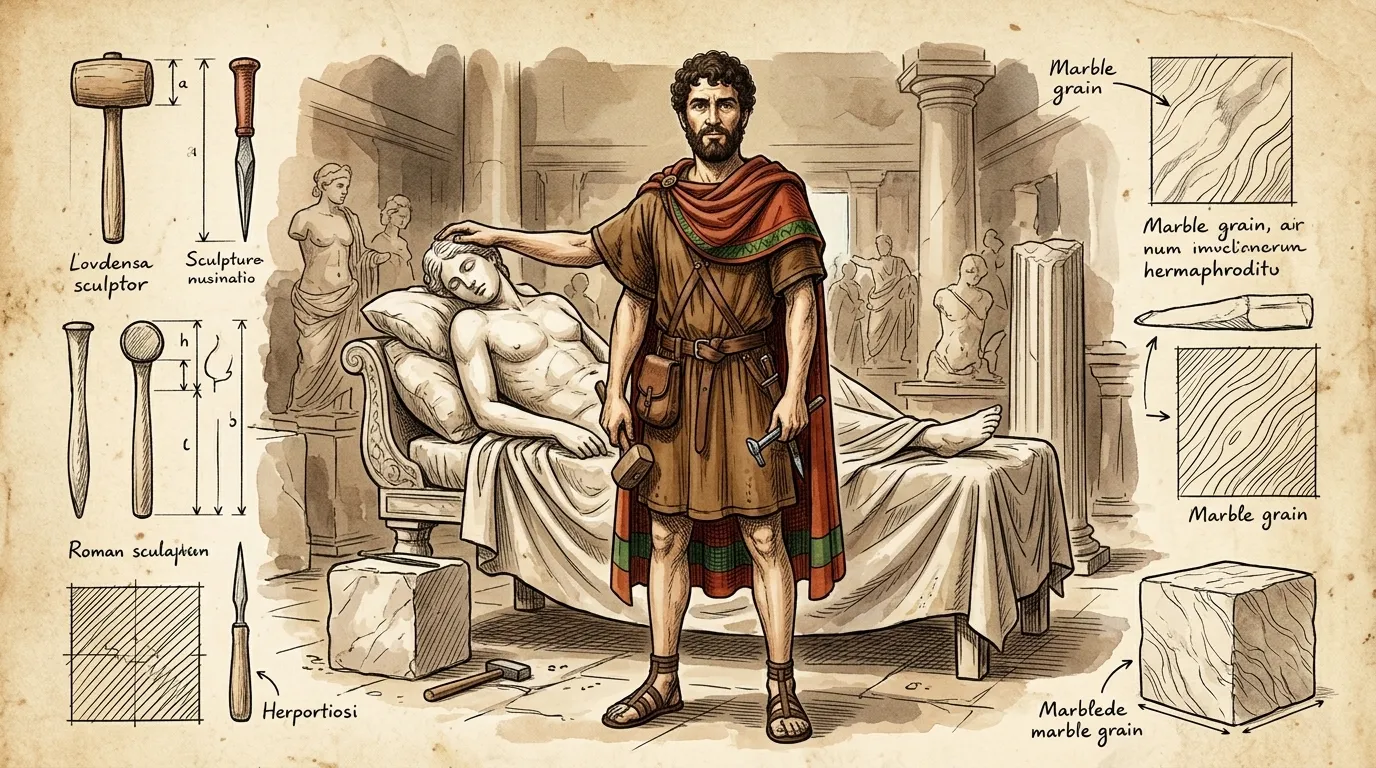
The Roman sculptor Polycles, stands before his creation, the Sleeping Hermaphroditus. The statue, a marble masterpiece, captures the mythical figure in a state of serene slumber. It will eventually be housed in the Louvre Museum in Paris. Measuring 200 cm in length, this Roman copy of a Hellenistic original has captivated viewers for centuries with its androgynous beauty.
""Perfection isn't about adhering to a single form," Polycles muses, running a hand over the smooth marble, "It's about capturing the essence of beauty, wherever it may lie. As Plato said, 'Beauty lies in the eyes of the beholder,' and I hope they find it here.""
Art Fact: Sleeping Hermaphroditus, a Roman copy of a Hellenistic sculpture, is known for its androgynous portrayal and is currently housed in the Louvre Museum.
Page 2

Polycles hears stories of the Greek sculptors of old. Their tales of crafting gods and heroes out of stone inspire him. He pores over scrolls detailing their techniques, learning of balance and proportion. He seeks to understand how they captured the very essence of life in cold, unyielding marble.
"A visiting scholar tells Polycles, "The Greeks believed beauty was a mathematical equation. They saw perfect proportions everywhere, in nature and in the human form. Learn those ratios, and you'll unlock the secret to timeless art.""
Art Fact: The influence of Greek sculpture on Roman art was profound, shaping artistic ideals and techniques.
Page 3
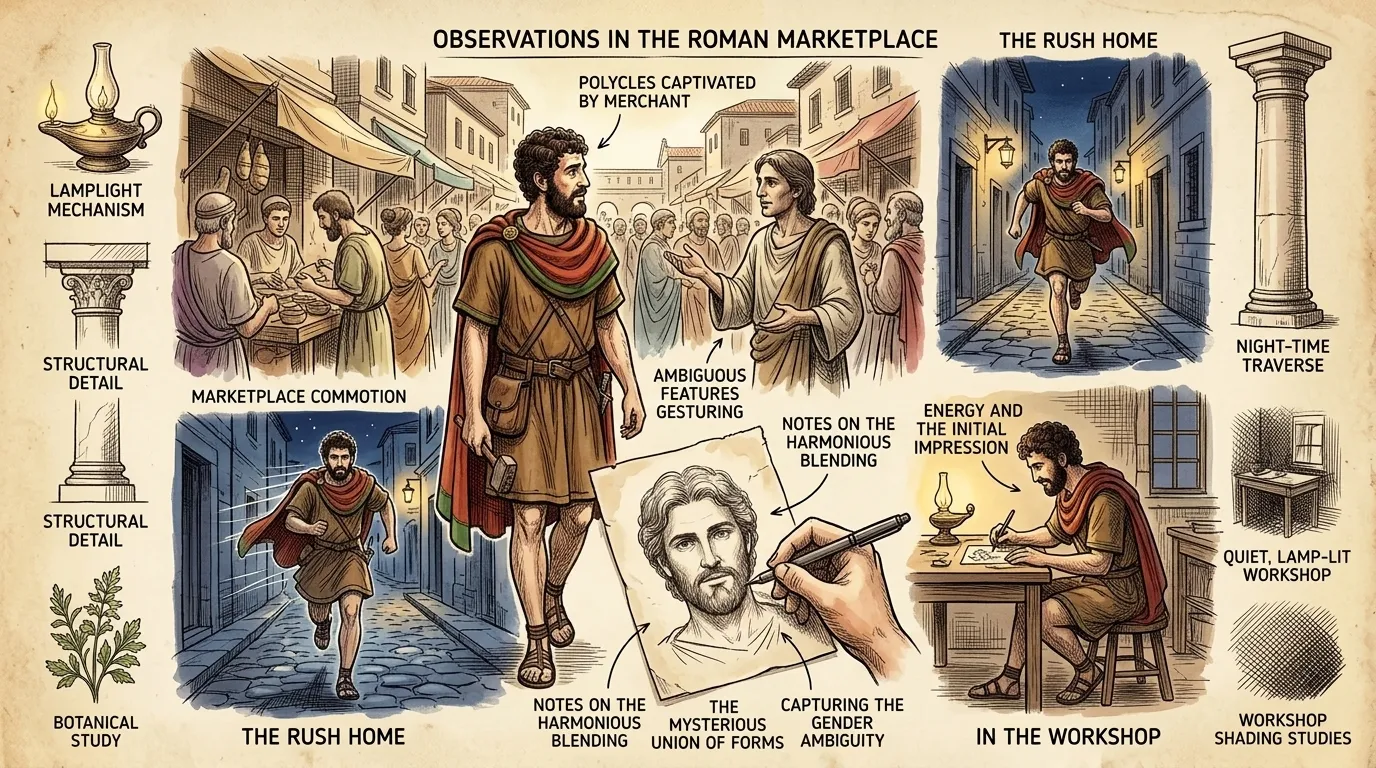
In the bustling marketplace, Polycles observes a traveling merchant. The merchant's ambiguous features strike him as both male and female, captivating him. He rushes home to sketch the figure, fascinated by the blending of genders. The memory of that face will stay with him for years.
""What is so striking about that face?" Polycles wonders aloud. "There's a balance, a harmony, that transcends the conventional. As Aristotle said, 'The aim of art is to represent not the outward appearance of things, but their inward significance.' I must capture that significance.""
Art Fact: The concept of the androgyne, blending male and female characteristics, has been a recurring theme in art and mythology.
Page 4

A wealthy Roman patron approaches Polycles. He desires a sculpture for his villa, something unique and captivating. The patron mentions the myth of Hermaphroditus, son of Hermes and Aphrodite. The seed of an idea begins to sprout in Polycles's mind. He proposes a figure of stunning beauty and ambiguous gender.
"The Roman patron proclaims, "I want something that speaks of elegance, of mystery! A figure that challenges the common perception of beauty. The story of Hermaphroditus has that quality.""
Art Fact: Wealthy patrons played a significant role in supporting artists and shaping artistic trends in ancient Rome.
Page 5

Polycles travels to the marble quarries of Carrara. He seeks the perfect block of stone, one without flaw. He spends days examining each piece, feeling its texture, listening to its resonance. Finally, he finds it – a block of pure white marble, promising to bring his vision to life.
""This marble..." Polycles whispers, touching the cold surface. "It has a soul. As Michelangelo said, 'I saw the angel in the marble and carved until I set him free.' I must find the form within this stone.""
Art Fact: Carrara marble was highly prized by sculptors for its purity and fine grain.
Page 6

Back in his workshop, Polycles takes up his chisel. With a deep breath, he strikes the marble. The first blow is the most daunting. As chips fly, he begins to reveal the form hidden within the stone. He understands the difficult task set before him.
""This is more than just cutting stone," Polycles murmurs. "It's a dialogue. The marble speaks, and I must listen. As Leonardo da Vinci said, 'Every now and then go away, have a little relaxation, for when you come back to your work your judgment will be surer.'""
Art Fact: Sculpting marble is a painstaking process that requires skill, patience, and a deep understanding of the material.
Page 7

Days turn into weeks as Polycles works tirelessly. The figure of Hermaphroditus begins to emerge from the marble. He focuses on capturing the delicate curves of the body, the soft folds of the drapery. He wants to convey a sense of peaceful rest and quiet beauty.
"Polycles tells a visiting artist, "I want to show the moment of transition, between waking and sleeping, male and female. A moment of pure potential. As Marcus Aurelius said, 'Everything we hear is an opinion, not a fact. Everything we see is a perspective, not the truth.' I want to capture a truth beyond perspective.""
Art Fact: The challenge of sculpting a convincing human form in marble requires exceptional skill and anatomical knowledge.
Page 8

Polycles adds the final details – the curve of the lips, the delicate eyelashes, the subtle swell of the breasts. He imagines the touch of Aphrodite herself gracing the marble. The sculpture is complete, a masterpiece of androgynous beauty, now ready for its place in the patron's villa.
""It is finished," Polycles sighs, stepping back to admire his work. "May it inspire contemplation and wonder. As Seneca said, 'Every new beginning comes from some other beginning's end.' This work will live on, past my own end.""
Art Fact: The Sleeping Hermaphroditus embodies the Hellenistic ideals of beauty and the Roman fascination with mythology.
Page 9

Centuries pass. The Sleeping Hermaphroditus is rediscovered, admired, and copied. Kings and emperors covet it. Artists find inspiration in its fluid lines and sensual form. It resides in the Louvre Museum, a testament to Polycles's skill and the enduring power of beauty.
"An art historian exclaims, "Polycles's creation transcends time. It continues to provoke thought and admiration. As Victor Hugo said, 'Nothing is so powerful as an idea whose time has come.'""
Art Fact: The Sleeping Hermaphroditus remains one of the most celebrated sculptures of antiquity, admired for its beauty and its exploration of androgyny.
Page 10

The Sleeping Hermaphroditus rests eternally in the Louvre. Polycles's work lives on through it. Visitors from across the globe come to admire his timeless creation. Polycles's vision continues to inspire and captivate, proving that true beauty never fades.
""Polycles sculpted more than just marble," a museum curator declares. "He sculpted a dream, an ideal, a timeless vision of beauty. His work survives because, as Goethe said, 'Beauty is a manifestation of secret natural laws, which otherwise would have been hidden from us forever.'""
Art Fact: Polycles's legacy endures through the Sleeping Hermaphroditus, a testament to the power of art to transcend time and culture.
About this story
- Location: Italy
- Audience: general readers
Questions and answers
Questions and answers about Sleeping Hermaphroditus by Polycles (Rome, Italy — c. 2nd Century AD)
Read Wonder Arts on your phone
Wonder Arts is available on Android. Get Wonder Arts on Google Play.
More Wonder Arts stories
- Smithsonian Institution (Washington D.C., USA — 1846)
- Snap the Whip by Winslow Homer (USA — 1872)
- Snow Storm by J.M.W. Turner (London, UK — 1842)
- St. Mark’s Basilica (Venice, Italy — 1094)
- St. Peter’s Basilica (Vatican City — 1626)
- Statue of Liberty by Frédéric Auguste Bartholdi (New York City, USA — 1886)