Ploughing in the Nivernais by Rosa Bonheur (France — 1849)
Ploughing in the Nivernais by Rosa Bonheur (France — 1849) — an illustrated arts story, set in France. 10 illustrated pages, free to read on Wonder Arts.

Page 1

Rosa Bonheur stands proudly before her monumental canvas, 'Ploughing in the Nivernais,' completed in 1849. This Realism masterpiece, measuring over eight feet wide, captures the raw beauty and power of the French countryside. Currently residing at the Musée d'Orsay in Paris, the painting was a sensation at the 1849 Salon, cementing Bonheur's reputation as a leading artist. It's rumored that Bonheur wore men's clothing to gain access to farms and fields, defying societal norms to authentically depict rural life.
""This painting is more than just a depiction of labor," Rosa muses, gazing at her work. "It is a tribute to the land and the animals that sustain us, a celebration of their strength and beauty.""
Art Fact: Ploughing in the Nivernais (1849) by Rosa Bonheur, Musée d'Orsay, Paris. Oil on canvas, 217 cm 400 cm.
Page 2

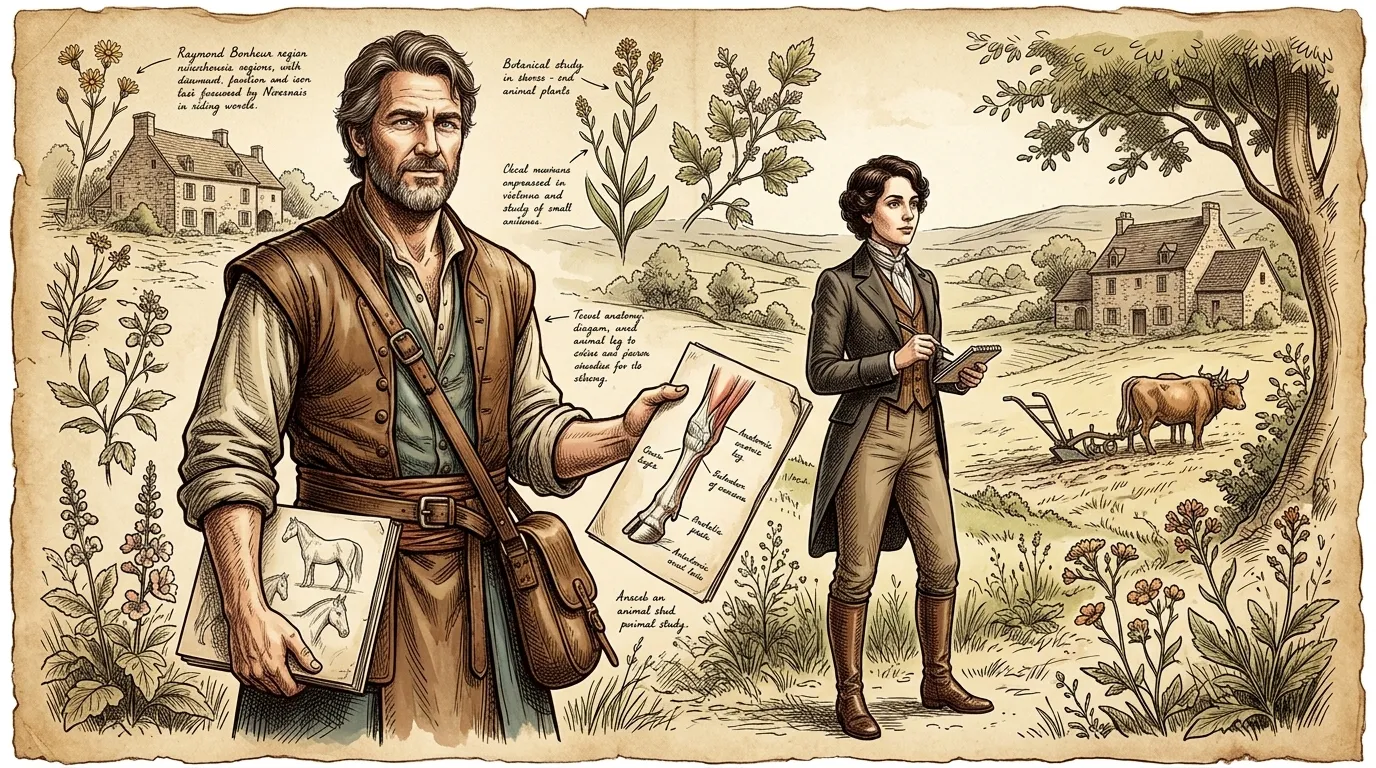
As a young girl, Rosa's father, Raymond Bonheur, a fellow artist, encouraged her artistic pursuits. He believed in learning through direct observation, taking her to the Parisian slaughterhouses. These experiences, though unsettling, were formative. She meticulously sketched the animals, studying their anatomy and musculature. Rosa later recalled, "I learned to see the beauty in every creature, even in death."
"Raymond says, "Observe closely, Rosa. Understand the way the muscles move, the structure of the bones. Only then can you truly capture their essence." Rosa replies, "It is... overwhelming, Papa. But I see what you mean. Their strength is undeniable.""
Art Fact: Rosa's early exposure to animal anatomy laid the foundation for her realistic depictions.
Page 3

Rosa admired the writings of George Sand, a celebrated novelist who challenged societal norms. Sand's portrayal of strong, independent women resonated deeply with Bonheur. Reading 'Indiana,' Rosa felt a profound connection to Sand's characters, who defied expectations and pursued their own paths. She thought of her own ambitions and the obstacles she would face as a woman in the art world.
"Rosa, reading aloud from 'Indiana,' murmurs, "'There is only one happiness in life, to love and be loved.' But is that truly all? What of our own aspirations, our own desires?" She sets the book down, her brow furrowed."
Art Fact: George Sand's writings inspired Rosa to challenge gender roles and pursue her artistic ambitions.
Page 4

To study animals in their natural habitat, Rosa needed access to farms and fields, spaces often restricted to men. She obtained a special permit from the police, allowing her to wear men's clothing. This was not a mere affectation; it was a practical necessity. Dressed as a man, she could move freely, observe without drawing unwanted attention, and sketch with greater ease.
"The police officer, looking at the official document, says, "Mademoiselle Bonheur, this permit allows you to wear masculine attire for artistic purposes only. Any misuse, and it will be revoked." Rosa responds firmly, "I assure you, Monsieur, my intentions are purely artistic. I only wish to study animals in their natural surroundings.""
Art Fact: Rosa's decision to wear men's clothing was a practical step towards achieving her artistic goals.
Page 5

Rosa visited the Nivernais region of France to observe the annual agricultural fair. She was captivated by the sight of teams of oxen, their powerful bodies straining as they ploughed the fields. She spent days sketching the animals, capturing their strength and the rhythm of their movements. It was here that the idea for 'Ploughing in the Nivernais' began to take shape.
"Rosa, sketching furiously, exclaims, "Look at the power in their muscles! The way they work together, a unified force!" Her companion replies, "It's a sight to behold, Rosa. You truly capture their essence.""
Art Fact: The Nivernais agricultural fair provided Rosa with the inspiration and subject matter for her masterpiece.
Page 6

Before embarking on the final painting, Rosa undertook extensive anatomical studies. She frequented animal markets, sketching and studying the anatomy of horses, oxen, and bulls. These detailed studies ensured the accuracy and realism of her animal depictions. She became known for her deep understanding of animal anatomy.
"Rosa, examining a horse, says to herself, "The scapula, the humerus... the articulation is key to understanding their movement." Kai replies, "Mademoiselle Bonheur, your dedication is truly remarkable.""
Art Fact: Rosa's dedication to anatomical studies ensured the accuracy of her animal depictions.
Page 7

When 'Ploughing in the Nivernais' was exhibited at the 1849 Salon, it was an immediate success. Critics and the public alike praised its realism, its power, and its evocation of rural life. Rosa Bonheur had achieved widespread recognition. One critic wrote, "Mademoiselle Bonheur has produced a work of such strength and vitality that it surpasses many paintings by her male contemporaries."
"A critic remarks, "Mademoiselle Bonheur has captured the very soul of the French countryside!" Rosa, overhearing, smiles modestly. "I merely sought to portray the beauty and strength I witnessed," she replies."
Art Fact: 'Ploughing in the Nivernais' was a sensation at the 1849 Salon, launching Rosa to fame.
Page 8

The painting cemented Bonheur's legacy as France's most acclaimed female painter. Years later, reflecting on her life, Rosa recalled a quote from Leonardo da Vinci, "'He who loves practice without theory is like the sailor who boards ship without a rudder and compass...' Da Vinci was right, my constant study helped me create art that resonates across time."
"Rosa says to Sonja "I am grateful for the opportunities I had and that I could show how beautiful animal life is. Never stop improving yourself. We are capable of far more than we think!""
Art Fact: Bonheur's dedication to artistic pursuits paid off in the long run
Page 9

Near the end of her career, Rosa became sick with a mysterious illness, but never lost hope of recovery. She was thankful for her opportunities.
"As Rosa lay in her bed, she said "If I ever make it out of here, I will create something even more beautiful than the Nivernais!""
Art Fact: It's unknown what caused the death of Rosa Bonheur
Page 10

Today, 'Ploughing in the Nivernais' continues to inspire awe at the Musée d'Orsay. Rosa Bonheur's legacy extends beyond her artistic skill. She paved the way for female artists, proving that women could achieve greatness in a field dominated by men. Her dedication to realism, her passion for animals, and her defiance of societal norms make her a true visionary. Her works survive because she showed the world through her unique lens.
"A museum visitor whispers, "Look at the light, the detail... it's breathtaking!" Another adds, "Rosa Bonheur was a true master, capturing the heart of the French countryside.""
Art Fact: Rosa Bonheur's 'Ploughing in the Nivernais' continues to inspire generations with its realistic depiction of rural life.
About this story
- Location: France
- Audience: general readers
More Wonder Arts stories
- Pointillism by Georges Seurat (Paris, France — 1886)
- Still Life with Apples by Paul Cézanne (France — 1890)
- A Burial at Ornans by Gustave Courbet (France — 1849)
- A Cavalier by Frans Hals (Australia — 1624)
- A Sunday on La Grande Jatte by Georges Seurat (Paris, France — 1884)
- Abbey in the Oakwood by Caspar David Friedrich (Germany — 1810)