Pointillism by Georges Seurat (Paris, France — 1886)
Pointillism by Georges Seurat (Paris, France — 1886) — an illustrated arts story, set in France. 10 illustrated pages, free to read on Wonder Arts.

Page 1

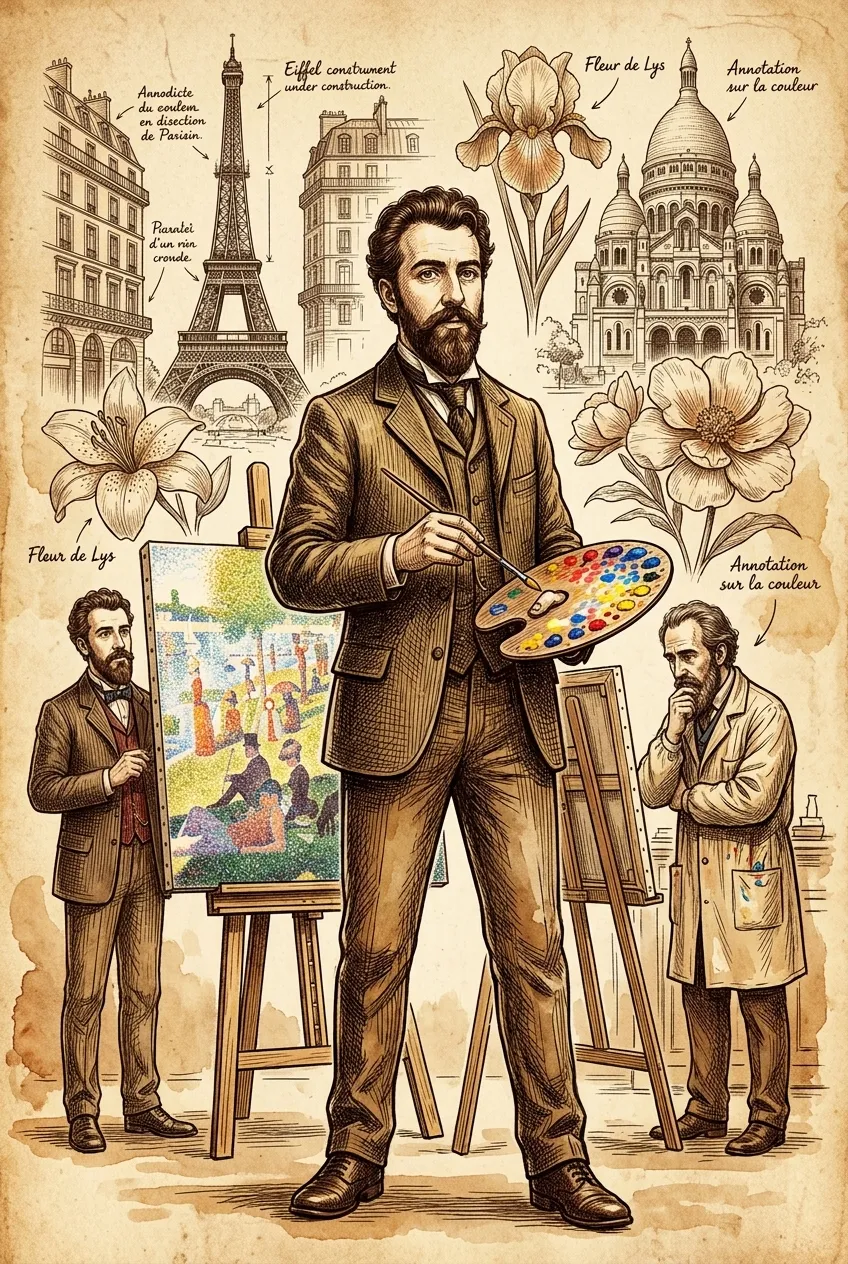
Georges Seurat, a meticulous artist with a vision, stands before his masterpiece, 'A Sunday on La Grande Jatte' (1884-1886). The painting, a monumental 6 feet 8 inches by 10 feet, shimmers with countless tiny dots of pure color, a revolutionary technique he called Pointillism. The air crackles with unspoken questions. Would the world understand his vision?
""Will they see the harmony, the science, the emotion in these dots?" Seurat mused, his gaze fixed on the canvas. He ran a hand through his hair, a gesture of both pride and trepidation. "Only time will tell.""
Art Fact: 'A Sunday on La Grande Jatte' resides in the Art Institute of Chicago, a testament to Seurat's innovative technique and enduring legacy. Its creation sparked considerable debate, dividing the art world between admiration and ridicule.
Page 2

Seurat filled notebooks with countless sketches, meticulously studying human form and light. His friend, Edmond Aman-Jean, also an artist, often joined him, critiquing and encouraging his explorations. They sat by the Seine, observing the ebb and flow of Parisian life, seeking inspiration for what would become a groundbreaking style. Seurat relentlessly pursued a scientific approach to art, seeking the perfect balance.
""Georges, you are dissecting the world with your pencil!" Edmond exclaimed, peering over Seurat's shoulder at the dense sketches. Seurat replied, "Edmond, I seek to understand the fundamental forms, the underlying structure. Only then can I truly represent reality.""
Art Fact: Seurat's early sketches reveal his deep understanding of academic drawing, a foundation he would later challenge with his revolutionary Pointillist technique.
Page 3

A pivotal moment arrived when Seurat encountered Michel Eugène Chevreul's 'The Laws of Contrast of Colour.' This scientific treatise explained how colors interact and influence each other when placed side-by-side. He shared this discovery with Camille Pissarro, an established Impressionist artist. This revelation ignited a spark in Seurat, solidifying his vision for a new art form based on optical mixing.
""Camille, have you read Chevreul?" Seurat asked, his eyes shining with excitement. "He explains how our eyes perceive color, how juxtaposing hues can create greater luminosity!" Camille Pissarro, with a thoughtful expression, leaned closer. "So, you plan to build art not with pigment, but with light itself?""
Art Fact: Michel Eugène Chevreul's work became the scientific bedrock for Pointillism, influencing Seurat's understanding of color theory and optical perception.
Page 4

Seurat began experimenting tirelessly with small, distinct dots of pure color, meticulously layering them on the canvas. He mixed no colors on the palette, instead relying on the viewer's eye to blend the hues. His friend Paul Signac, a fellow artist, watched with fascination and skepticism as Seurat painstakingly applied each dot. Would this radical technique yield a harmonious image, or a chaotic mess?
""Georges, this is madness!" Paul Signac exclaimed, watching Seurat work. "You're building an image dot by dot! It will take you years!" Seurat, unfazed, replied, "Patience, Paul. The result will be a luminosity unlike anything you've ever seen. The colors will sing!""
Art Fact: Seurat's studio became a laboratory, a space for rigorous experimentation and meticulous application of his revolutionary Pointillist technique.
Page 5

Seurat's first major painting in this new style, 'Bathers at Asnières,' was rejected by the Paris Salon in 1884. This rejection stung, but it also fueled his determination. He knew his work challenged conventional notions of art. His fellow painter Émile Bernard understood his pain, offering support and encouragement to continue pushing boundaries.
""Émile, they dismissed it!" Seurat exclaimed, his voice tinged with frustration. "They call it 'flat' and 'lifeless'!" Émile Bernard, a young artist with a sympathetic gaze, reassured him, "Georges, they fear what they don't understand. Your vision is unique. Don't let their ignorance deter you.""
Art Fact: 'Bathers at Asnières' now hangs in the National Gallery, London, a testament to Seurat's genius and the art world's initial reluctance to embrace his revolutionary style.
Page 6

Undeterred, Seurat joined the Salon des Indépendants, a society of artists who rejected the traditional Salon's rigid standards. Here, he could exhibit his work without censorship. It was here where the public would be exposed to "Sunday on La Grande Jatte", showing a new way of how light interacts with colors on a canvas. Signac and Pissarro encouraged Seurat to keep pushing the boundaries and to ignore the nay-sayers and critics.
""Georges, you must ignore the critics!" Signac encouraged Seurat, "Show the world your vision! This new way of painting is revolutionary, show it with strength!" Pissarro nodded in agreement, "And it's a chance for the public to experience your creation without the constraints of the official Salon.""
Art Fact: The Salon des Indépendants provided a platform for Seurat to showcase his innovative Pointillist technique and challenge the established art world.
Page 7

'A Sunday on La Grande Jatte' sparked intense debate. Some critics lauded Seurat's innovative technique, praising its luminosity and scientific precision. Others dismissed it as cold and lifeless, lacking the spontaneity of Impressionism. The artist Félix Fénéon recognized the profound significance of Seurat's work, championing it as a new form of modern art. The painting became a battleground for opposing aesthetic philosophies.
""This is not art, it's science!" one critic exclaimed, his face contorted in disapproval. Félix Fénéon countered, his voice ringing with conviction, "This is the future of art! Seurat has captured light and color in a way never before imagined!""
Art Fact: The initial reception of 'A Sunday on La Grande Jatte' was a mix of fascination and derision, fueling a vigorous debate about the nature of modern art.
Page 8

Despite the controversy, Seurat's Pointillism profoundly influenced subsequent generations of artists. His scientific approach to color and light paved the way for new artistic explorations. As Voltaire once said, 'I disapprove of what you say, but I will defend to the death your right to say it.' Seurat's bold vision opened up possibilities for artistic freedom.
""This is the power of innovation," Signac later reflected. "Seurat's vision, though initially misunderstood, has inspired countless artists to explore the boundaries of color and light.""
Art Fact: Seurat's Pointillism left an indelible mark on the history of art, inspiring countless artists to embrace new techniques and challenge conventional notions of artistic expression.
Page 9

Today, 'A Sunday on La Grande Jatte' resides in the Art Institute of Chicago, where it continues to captivate and inspire. Its meticulous detail and vibrant colors draw crowds from around the world. The painting serves as a testament to Seurat's innovative spirit and enduring legacy.
"Museum director James Cuno once said, 'The painting's presence here is a source of pride and inspiration.' Indeed, it's become one of the most iconic works in the museum's collection.""
Art Fact: 'A Sunday on La Grande Jatte' remains a cornerstone of the Art Institute of Chicago, attracting visitors from around the globe eager to experience Seurat's Pointillist masterpiece.
Page 10

Georges Seurat's vision endures, his meticulous dots of color continuing to shimmer with life and light. His innovative technique transformed the art world, inspiring generations of artists to explore the possibilities of color and perception. In the end, Seurat showed the world that even the smallest dots can create a masterpiece that lasts forever. His pointillist style would soon after become well known and iconic.
"As Seurat once wrote in a letter, "Some say they see poetry in my paintings; I see only science." His art would change painting forever. "
Art Fact: Georges Seurat's dedication to his vision and his groundbreaking technique ensured his place in art history, his legacy forever intertwined with 'A Sunday on La Grande Jatte'.
About this story
- Location: France
- Audience: general readers
More Wonder Arts stories
- Still Life with Apples by Paul Cézanne (France — 1890)
- A Burial at Ornans by Gustave Courbet (France — 1849)
- A Cavalier by Frans Hals (Australia — 1624)
- A Sunday on La Grande Jatte by Georges Seurat (Paris, France — 1884)
- Abbey in the Oakwood by Caspar David Friedrich (Germany — 1810)
- Abstract Expressionism by Jackson Pollock (New York, USA — 1940s)