Surrealism by André Breton (Paris, France — 1924)
Surrealism by André Breton (Paris, France — 1924) — an illustrated arts story, set in France. 10 illustrated pages, free to read on Wonder Arts.
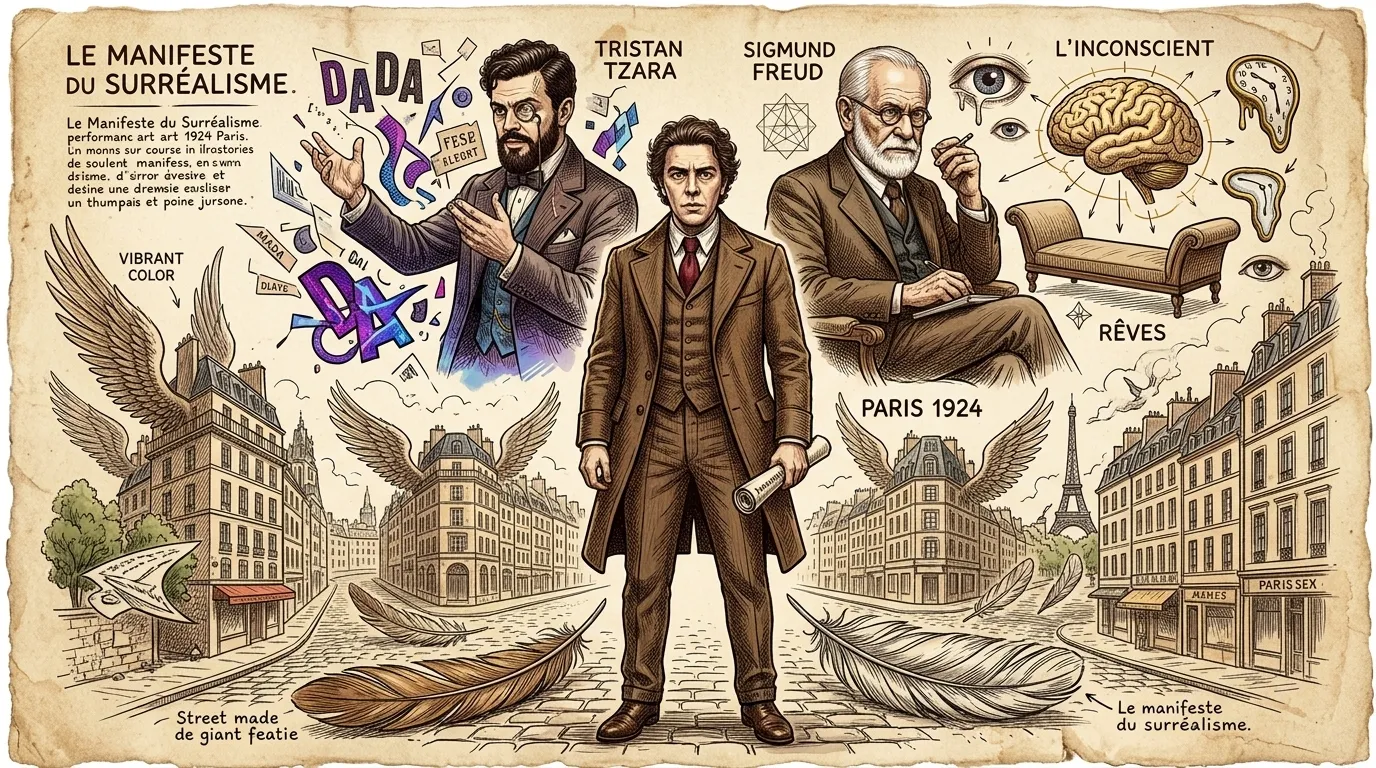
Page 1
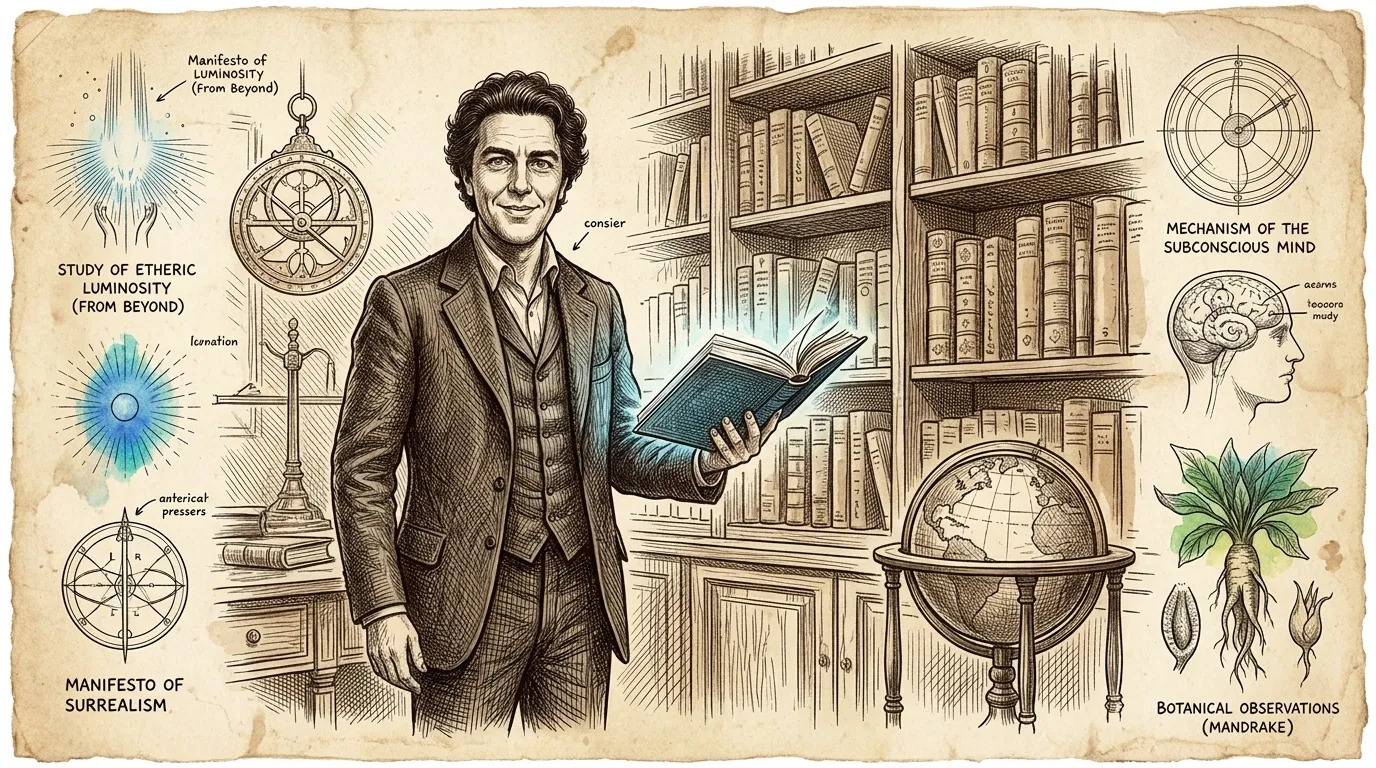
André Breton, the father of Surrealism, stands proudly before his literary masterpiece, the 'Manifesto of Surrealism,' published in 1924. This work, not a painting but a philosophical call to arms, unleashed a new way of seeing and creating. The manifesto is more than just words; it's a gateway to the subconscious, a realm Breton believed held the key to true artistic expression. Its dimensions were small, but its impact was monumental.
""I believe in the future resolution of these two states, dream and reality, which are seemingly so contradictory, into a kind of absolute reality, a surreality," Breton had declared, his voice echoing the fervor of his vision."
Art Fact: The 'Manifesto of Surrealism' sparked a movement that transcended art, influencing literature, film, and philosophy.
Page 2

Young André sits in a bustling classroom, but his mind is far away. He is engrossed in a book of poetry, the words of Baudelaire igniting his imagination. He looks up and tells his friend about how moved he was by the words. Baudelaire's exploration of the subconscious resonates deeply with him, planting the seeds of his future surrealist vision.
""Did you know, Gustave Flaubert was once put on trial for corrupting public morals with his words?" André excitedly tells his classmate, "His words were like paintings!""
Art Fact: Charles Baudelaire's symbolist poetry was a major influence on Breton's early artistic development.
Page 3

The horrors of World War I confront Breton head-on as he serves as a medical orderly. The psychological wounds he witnesses will forever alter his perception of reality. He begins to question the rationality of the world, seeking refuge in the irrational and the dreamlike. After seeing the horrors that man is capable of, he makes a promise to himself to make the world a better place.
""It is better to take as guide the songs of a madman," Breton mutters to himself, quoting the philosopher Gaston Bachelard, "than the treatises of reason.""
Art Fact: Breton's wartime experiences profoundly impacted his worldview and fueled his rejection of rationalism.
Page 4

In Zurich, Breton discovers the subversive art of Dada. He is drawn to its anti-establishment spirit and its embrace of absurdity. Dada's rejection of logic inspires him to push the boundaries of artistic expression. André and his fellow Dada members decide to rebel against logic.
""Dada is nonsense, and that's precisely its point!" Tristan Tzara proclaims, waving his arms emphatically."
Art Fact: Dada's influence on Breton laid the groundwork for his development of Surrealism.
Page 5

Breton delves into the study of psychoanalysis, particularly the work of Sigmund Freud. He becomes fascinated by the power of dreams and the unconscious mind. He sees dreams as a source of untapped creativity, a realm where the laws of logic do not apply. In the school tree library, he learns about the secrets of the unconscious mind.
""The interpretation of dreams is the royal road to a knowledge of the unconscious activities of the mind," Freud wrote, and Breton couldn't agree more. He believed it was the way to express creativity."
Art Fact: Freud's theories of psychoanalysis provided the theoretical framework for Surrealism.
Page 6

Breton experiments with automatic writing, a technique designed to bypass the conscious mind and tap into the flow of the unconscious. He discovers a stream of unexpected imagery and associations, a world of pure creative potential. He starts to see the art school giant tree as a vessel for the unconscious mind.
""Let your pen flow freely," Breton urges his fellow artists, "without any conscious control or censorship.""
Art Fact: Automatic writing became a key technique for accessing the subconscious in Surrealist art.
Page 7

In 1924, Breton publishes the 'Manifesto of Surrealism,' formally launching the movement. He defines Surrealism as pure psychic automatism, a way to express the true functioning of thought, free from the constraints of reason. He believed in the power of the mind. The manifesto goes on to influence many future artists.
""Surrealism, noun, Masculine. Pure psychic automatism, by which one proposes to express – verbally, by means of the written word, or in any other manner – the actual functioning of thought," Breton wrote in his manifesto."
Art Fact: The 'Manifesto of Surrealism' served as the foundational text of the Surrealist movement.
Page 8

Surrealism spreads rapidly, attracting artists, poets, and filmmakers from around the world. The movement challenges conventional notions of art, beauty, and reality. Surrealist works appear in galleries and magazines, sparking both admiration and outrage. The world is never the same.
""We must break free from the shackles of reason and embrace the illogical, the irrational, the dreamlike!" Breton declares at a Surrealist gathering."
Art Fact: Surrealism became a major force in 20th-century art, literature, and culture.
Page 9

Even after Breton's death, Surrealism's influence endures. The movement's exploration of the subconscious and its embrace of the irrational continue to inspire artists and thinkers. The world still looks to Surrealism for its inspiration. In fact, today Surrealism is taught to those wanting to better understand the unconscious mind.
""As Picasso said, 'Everything you can imagine is real.' And Surrealism showed us how to imagine the impossible," says a young artist, inspired by Breton's legacy."
Art Fact: Surrealism's impact can be seen in contemporary art, film, literature, and popular culture.
Page 10
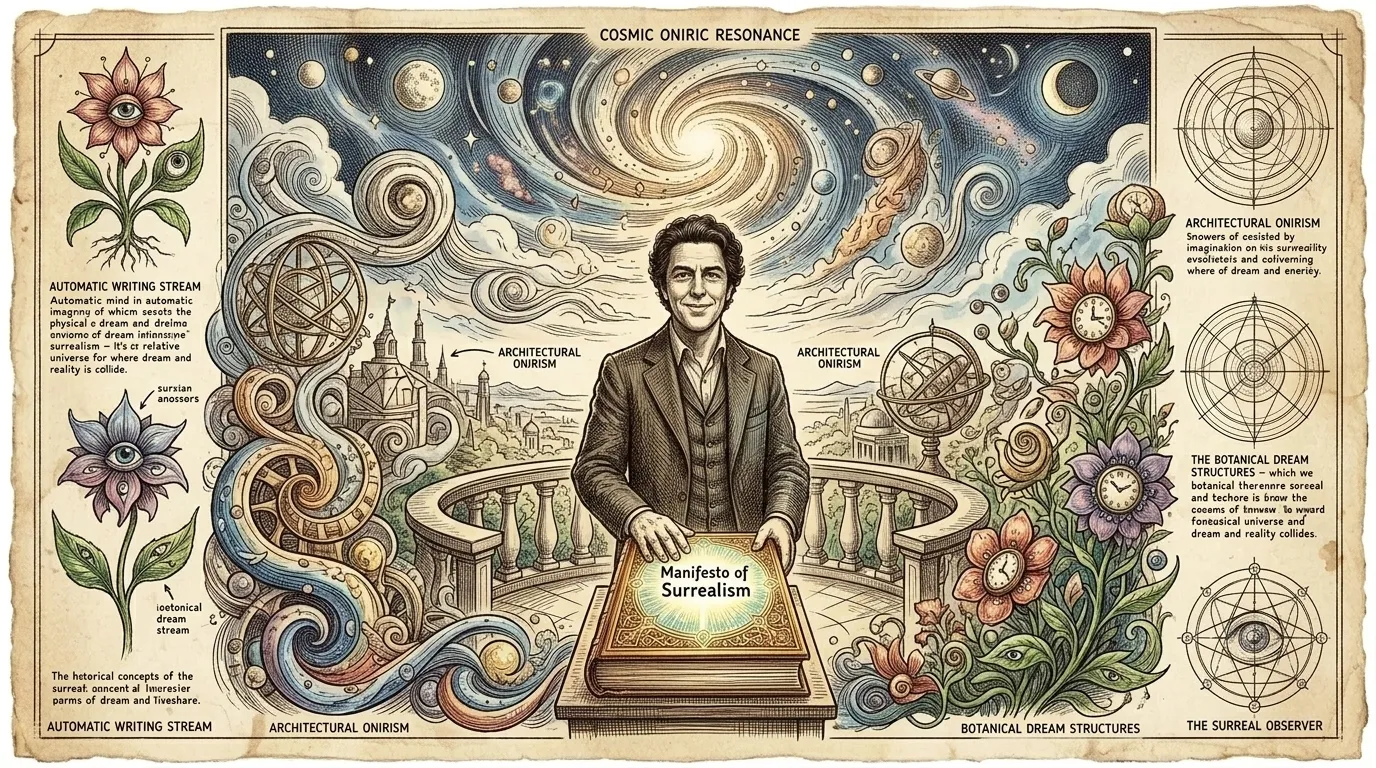
André Breton's legacy lives on through his 'Manifesto of Surrealism' and the countless artists he inspired. His vision of a world where dream and reality merge continues to challenge and captivate. The words and images of Surrealism echo through time, reminding us of the power of the imagination. He would be proud of how his works influenced many.
""The only limit to our realization of tomorrow will be our doubts of today," Breton's voice seems to whisper, echoing the words of Franklin D. Roosevelt."
Art Fact: Breton's 'Manifesto of Surrealism' remains a powerful testament to the enduring power of the imagination.
About this story
- Location: France
- Audience: general readers
Questions and answers
Questions and answers about Surrealism by André Breton (Paris, France — 1924)
Read Wonder Arts on your phone
Wonder Arts is available on Android. Get Wonder Arts on Google Play.
More Wonder Arts stories
- Sydney Opera House (Sydney, Australia — 1973)
- Symbolism by Gustave Moreau (France — c. 1880)
- Symphonie Fantastique by Hector Berlioz (Paris, France — 1830)
- Symphony No.5 by Ludwig van Beethoven (Vienna, Austria — 1808)
- Temple of Artemis (Ephesus, Turkey — c. 550 BC)
- Temple of Karnak (Luxor, Egypt — c. 2000 BC)