Symbolism by Gustave Moreau (France — c. 1880)
Symbolism by Gustave Moreau (France — c. 1880) — an illustrated arts story, set in France. 10 illustrated pages, free to read on Wonder Arts.
Page 1

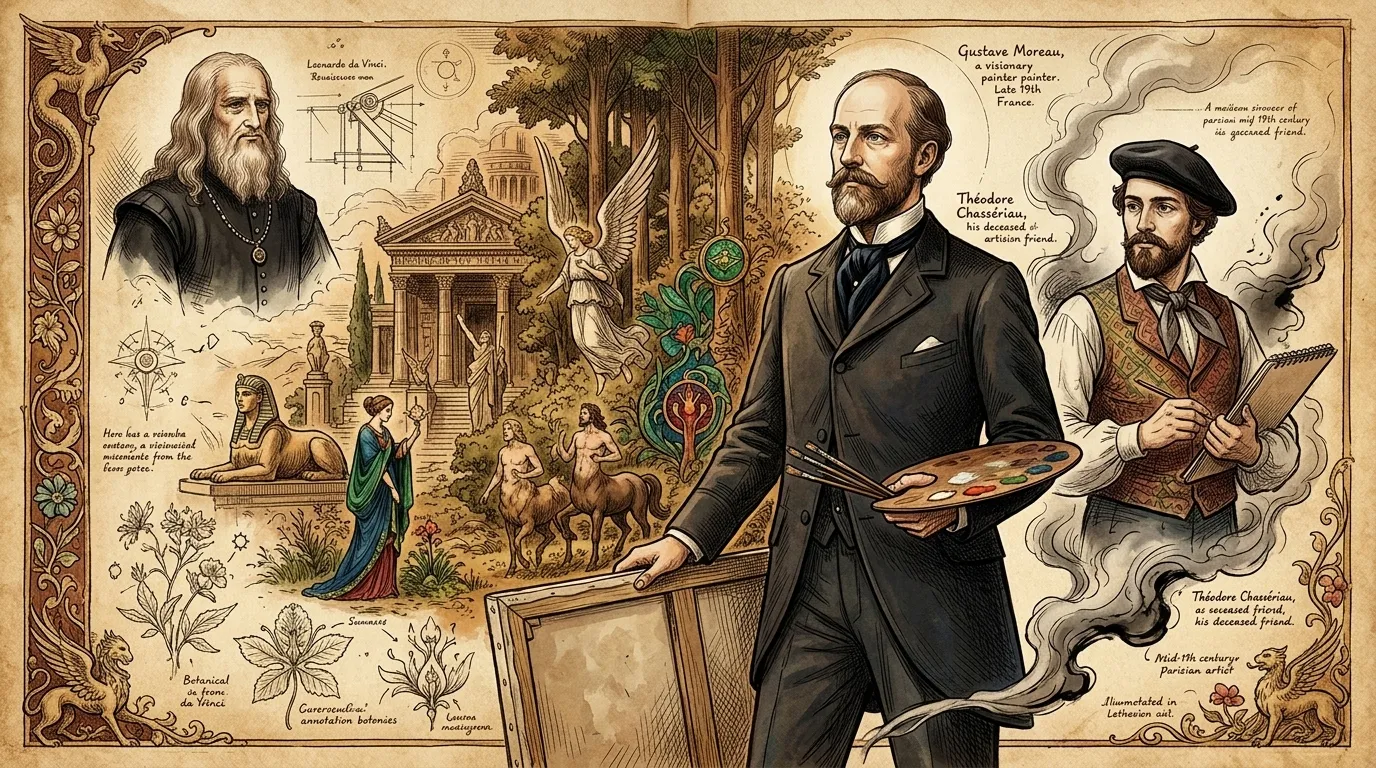
Gustave Moreau, a visionary of the Symbolist movement, stands before his magnum opus, 'Jupiter and Semele.' Completed circa 1895, this colossal oil painting, measuring over 8 feet tall, now resides in the Musée Gustave Moreau in Paris. Its intricate details and mystical aura captivated critics, yet its true meaning remains a subject of endless interpretation.
"Moreau murmurs, "'The more I study, the more insatiable do I feel my genius is,' as Leonardo da Vinci once said. Indeed, this canvas feels like only a beginning.""
Art Fact: Jupiter and Semele's dimensions are 212 x 118 cm. One critic famously said viewing it was 'like entering a fever dream.'
Page 2

“A fever dream… perhaps,” Théodore Chassériau muses, stepping closer to examine the painting’s swirling forms. “Though I suspect Semele felt something far more real.”
Marcus Aurelius nods slowly. “The pursuit of knowledge often demands a reckoning with power – and its consequences.” Émile Zola scribbles furiously in his notebook. "It's the *truth* of sensation, isn't it? Raw, overwhelming… like witnessing societal decay."
Socrates raises an eyebrow. “Or perhaps simply observing human nature?” Albert Camus adds quietly, “And finding within it both beauty and absurdity.” Matisse, sketching rapidly, murmurs, “The color… it’s almost violent.” Rouault grunts in agreement. The Student remains silent, eyes wide with wonder.
Page 3

Émile Zola approaches, his gaze sweeping over the weathered tombstones. “A curious preoccupation, Gustave,” he observes, hands clasped behind his back. “To seek immortality through pigment and canvas when all things crumble to dust.”
Moreau turns, a flicker of defiance in his eyes. “Is not art itself a rebellion against that dust, Émile? A defiant echo against the silence?” He gestures towards Chassériau’s grave. “Théodore understood this. To capture a fleeting beauty… to wrestle meaning from chaos…”
A young Student scribbles furiously in a notebook, attempting to document their exchange. Socrates nods slowly, his expression unreadable.
Page 4
The somber atmosphere of a Parisian cemetery. Moreau stands beside the grave of his dear friend and fellow artist, Théodore Chassériau. Grief etched on his face, he contemplates the fragility of life and the enduring power of art.
""'Death smiles at us all, but all a man can do is smile back,' Marcus Aurelius once said," Moreau laments, placing a single flower on the grave. "His art... it will endure.""
Art Fact: Chassériau's death in 1856 deeply affected Moreau, leading him to explore themes of mortality and the afterlife in his art.
Page 5

Moreau studies ancient texts and illustrations, fascinated by the biblical figure of Salomé. He pores over detailed sketches, capturing the essence of her allure and dangerous power. The story of Salomé would become a recurring theme in his work.
""'The Devil is a woman dressed in silk,' as my father used to say," Moreau mutters, sketching furiously. "Salomé... a fatal beauty, indeed.""
Art Fact: Moreau's fascination with Salomé reflects the Symbolist interest in femmes fatales and the dark side of human nature.
Page 6

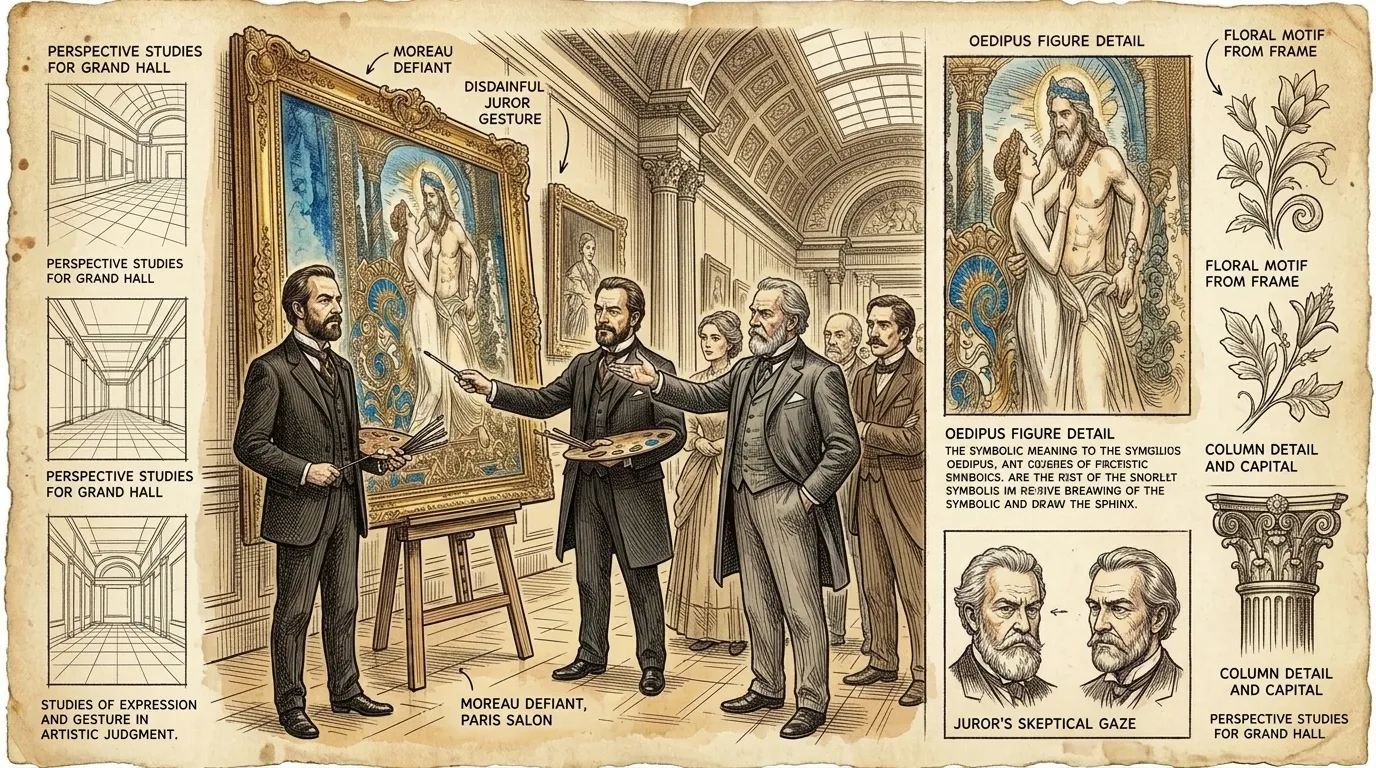
Moreau stands before the jury of the Paris Salon, his painting 'Oedipus and the Sphinx' receiving harsh criticism. The rejection stings, but it fuels his determination to forge his own artistic path.
"One juror sneers, "Moreau, this is utter chaos! The public will never understand such... symbolism!" Moreau retorts, "'The artist is nothing without the gift, but the gift is nothing without work,' Émile Zola wrote. I shall persist.""
Art Fact: Despite initial rejection, 'Oedipus and the Sphinx' eventually gained recognition and helped establish Moreau's reputation.
Page 7

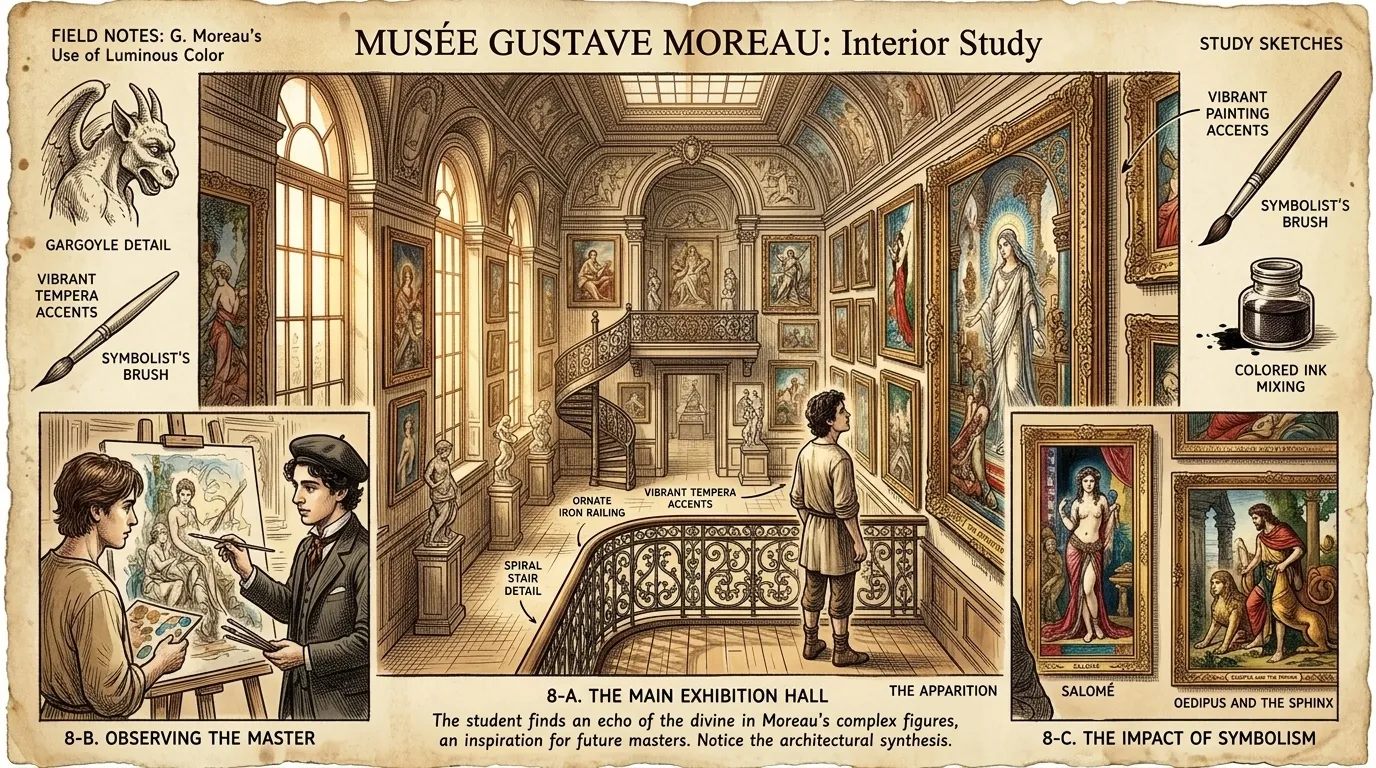
Moreau finds solace and inspiration in his personal museum, a sanctuary filled with his art and collected treasures. He wanders through the labyrinthine rooms, surrounded by the echoes of his imagination.
""'To be happy, we must not be too concerned with others,' Albert Camus declared," Moreau muses, gazing at a tapestry. "Here, in this sanctuary, I find my true self.""
Art Fact: Moreau's personal museum became a testament to his unique artistic vision and a source of inspiration for future generations.
Page 8
An elderly Moreau, now a respected professor at the École des Beaux-Arts, stands before his students, sharing his artistic philosophy. Among them, future masters like Matisse and Rouault listen intently.
""'The only true wisdom is in knowing you know nothing,' Socrates wisely stated," Moreau says to his students. "Therefore, question everything, and seek your own truth in art.""
Art Fact: Moreau's influence as a teacher was profound, shaping the course of modern art through his students.
Page 9

In his final years, Moreau continues to paint, driven by an insatiable creative urge. He stands before his unfinished masterpiece, 'Jupiter and Semele,' knowing his time is drawing near. It is a grand, symbolic representation of unattainable beauty.
"Moreau sighs, "'All I know is that I know nothing,' the ancient Greek Socrates told us," he whispers. "Yet, still, I must paint... until my last breath.""
Art Fact: Moreau continued working on 'Jupiter and Semele' until his death in 1898, leaving it as a testament to his lifelong pursuit of artistic perfection.
Page 10
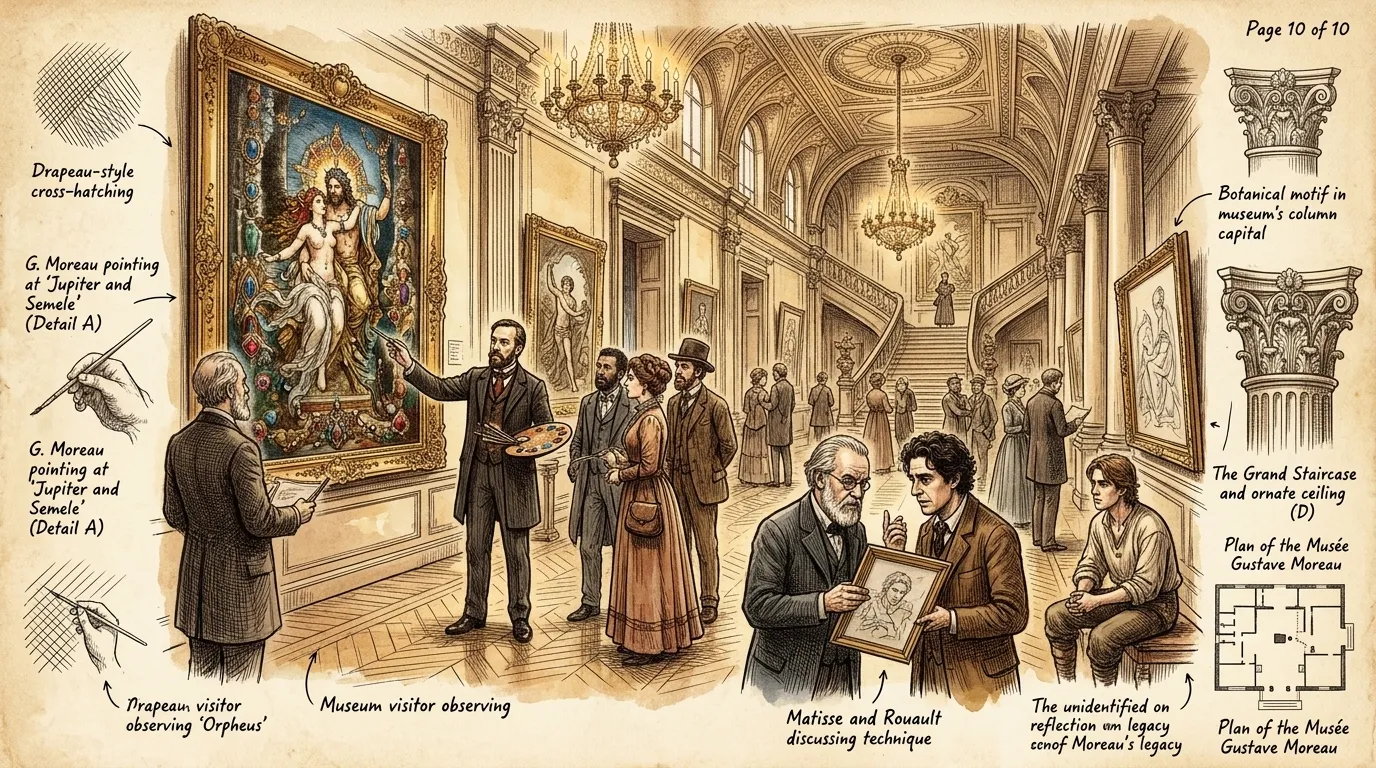
The Musée Gustave Moreau in Paris, filled with the artist's masterpieces, stands as a beacon for dreamers and artists alike. Moreau's legacy endures, inspiring generations to explore the depths of the imagination. Why does Moreau's work survive forever? Because it invites us into the labyrinth of our own souls.
"A student is heard saying, "Moreau's art is more than just paint on canvas, it's a portal to another world.""
Art Fact: The Musée Gustave Moreau preserves the artist's vision, ensuring that his art continues to inspire and provoke.
About this story
- Location: France
- Audience: general readers
Questions and answers
Questions and answers about Symbolism by Gustave Moreau (France — c. 1880)
Read Wonder Arts on your phone
Wonder Arts is available on Android. Get Wonder Arts on Google Play.
More Wonder Arts stories
- Symphonie Fantastique by Hector Berlioz (Paris, France — 1830)
- Symphony No.5 by Ludwig van Beethoven (Vienna, Austria — 1808)
- Temple of Artemis (Ephesus, Turkey — c. 550 BC)
- Temple of Karnak (Luxor, Egypt — c. 2000 BC)
- The Alhambra (Granada, Spain — 13th Century)
- The Angelus by Jean-François Millet (France — 1859)