The Apotheosis of Homer by Jean-Auguste-Dominique Ingres (France — 1827)
The Apotheosis of Homer by Jean-Auguste-Dominique Ingres (France — 1827) — an illustrated arts story, set in France. 10 illustrated pages, free to read on Wonder Arts.
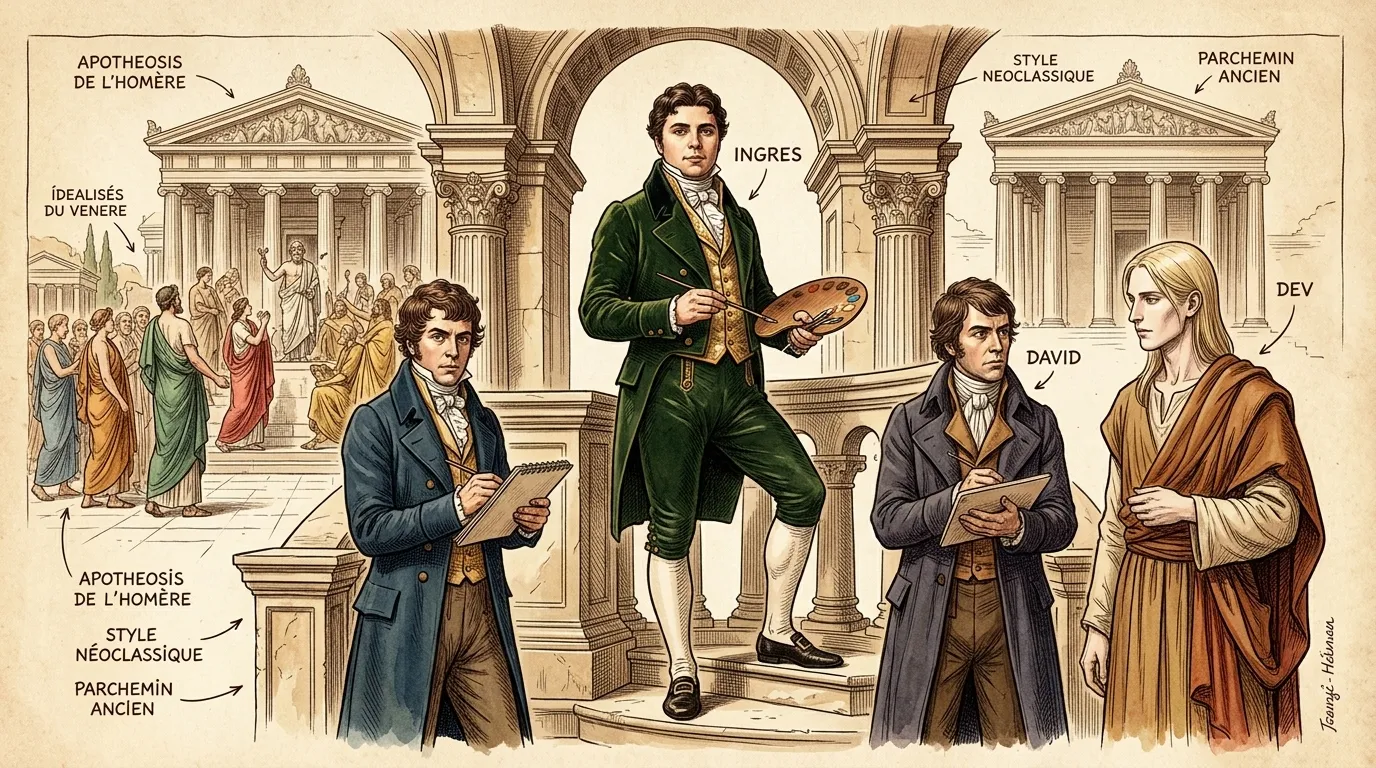
Page 1
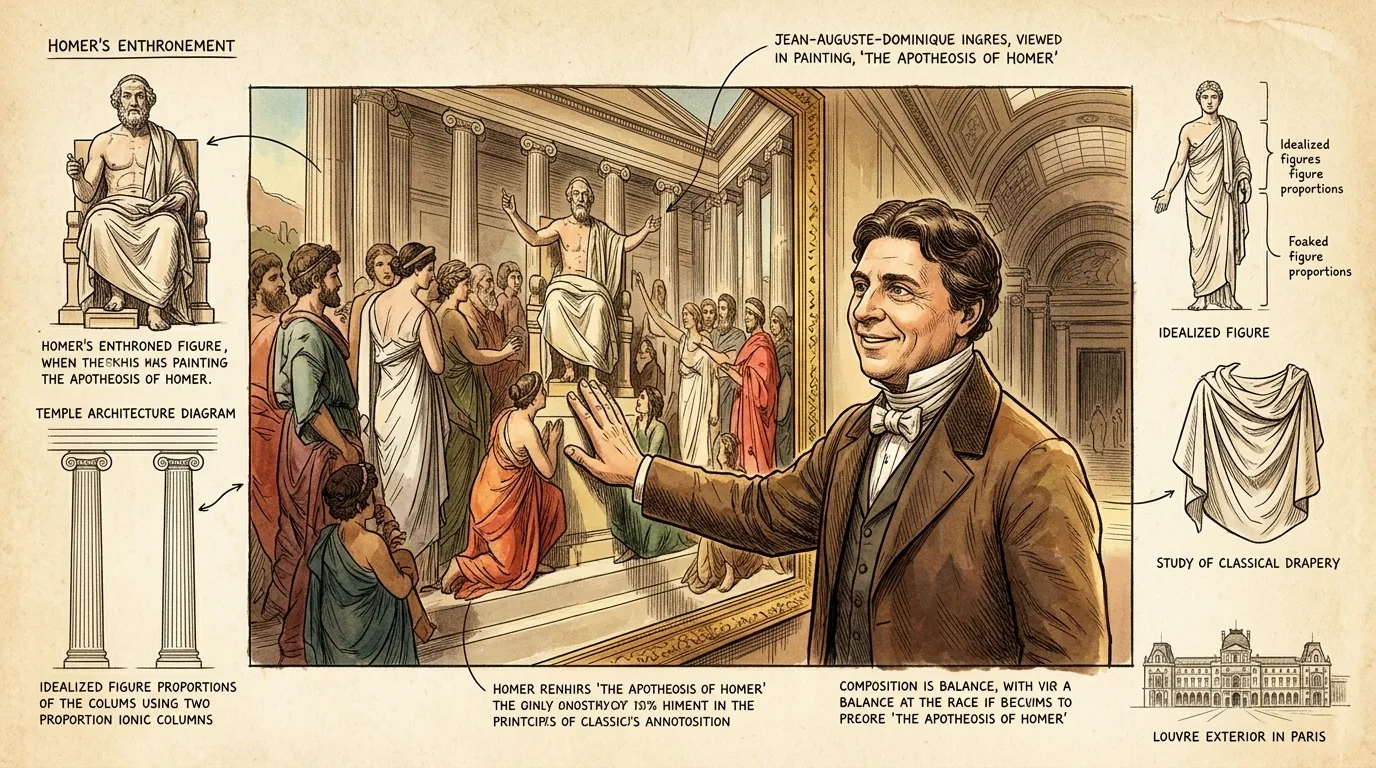
Jean-Auguste-Dominique Ingres, a master of the Neoclassical style, stood before his monumental painting, 'The Apotheosis of Homer.' Completed in 1827, this artwork, measuring over 13 feet wide, represented the culmination of his artistic ideals. Currently residing in the Louvre Museum, Paris, it's estimated to be worth millions due to its historical significance and masterful execution. The painting was controversial, with many critics questioning his choice of figures and their arrangement.
""This is more than just a painting," Ingres murmured, running a hand over the smooth canvas. "It is a declaration of artistic principles, a testament to the enduring power of the classics.""
Art Fact: Ingres faced considerable criticism for 'The Apotheosis of Homer,' with some contemporaries finding the composition static and the figures too academic.
Page 2
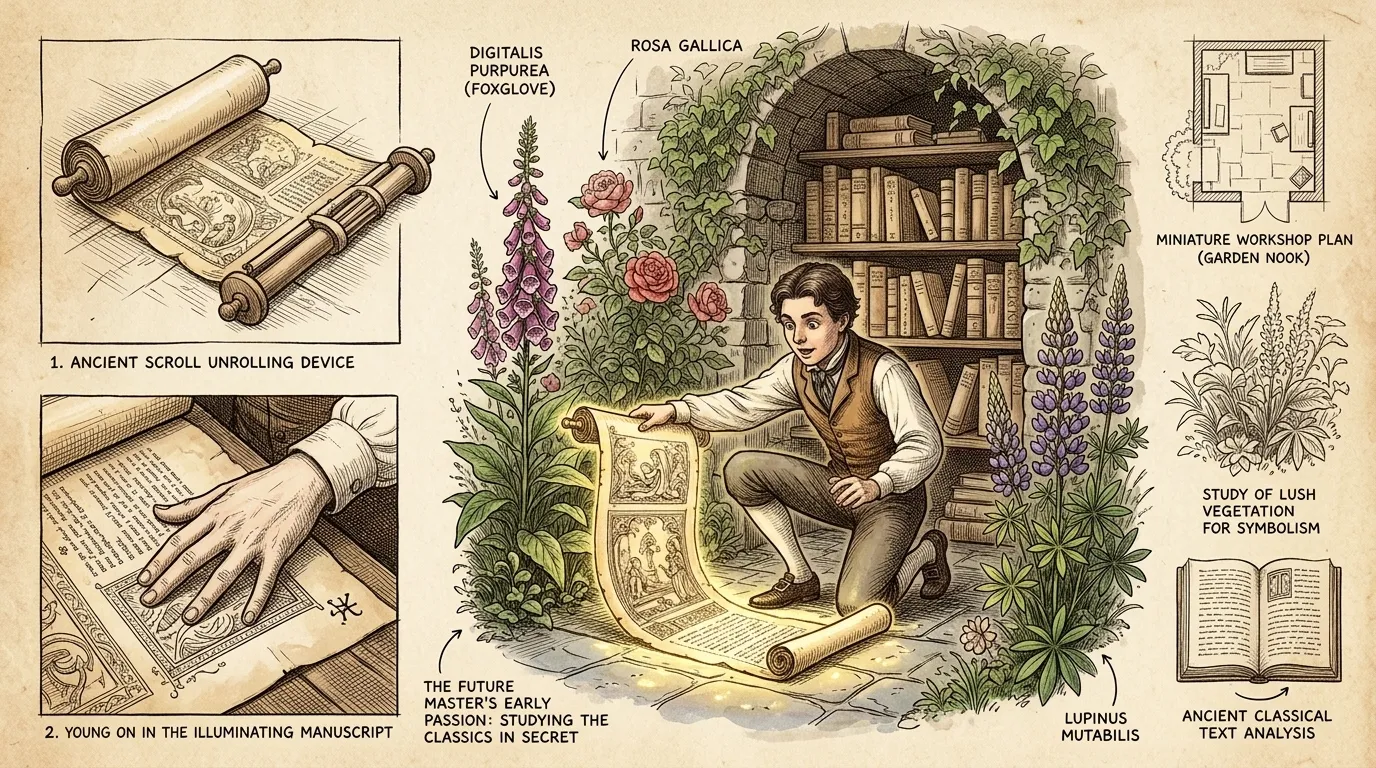
Young Ingres lived in the idyllic miniature society living within a garden. His garden home was lush with flowers, each blossom towering over the tiny beings within. Inside his workshop, a miniature library filled with miniature parchment books sparked Ingres' passion for art and the classics. One day, while exploring a hidden nook, he discovered a collection of ancient scrolls detailing the lives of great artists. It would set the trajectory for his entire career.
""The world is full of beauty waiting to be captured, Ingres," his mentor, Jacques-Louis David, once told him. "But true art requires discipline and a deep understanding of form.""
Art Fact: Ingres's early training with his father, a painter and sculptor, provided him with a solid foundation in drawing and composition.
Page 3
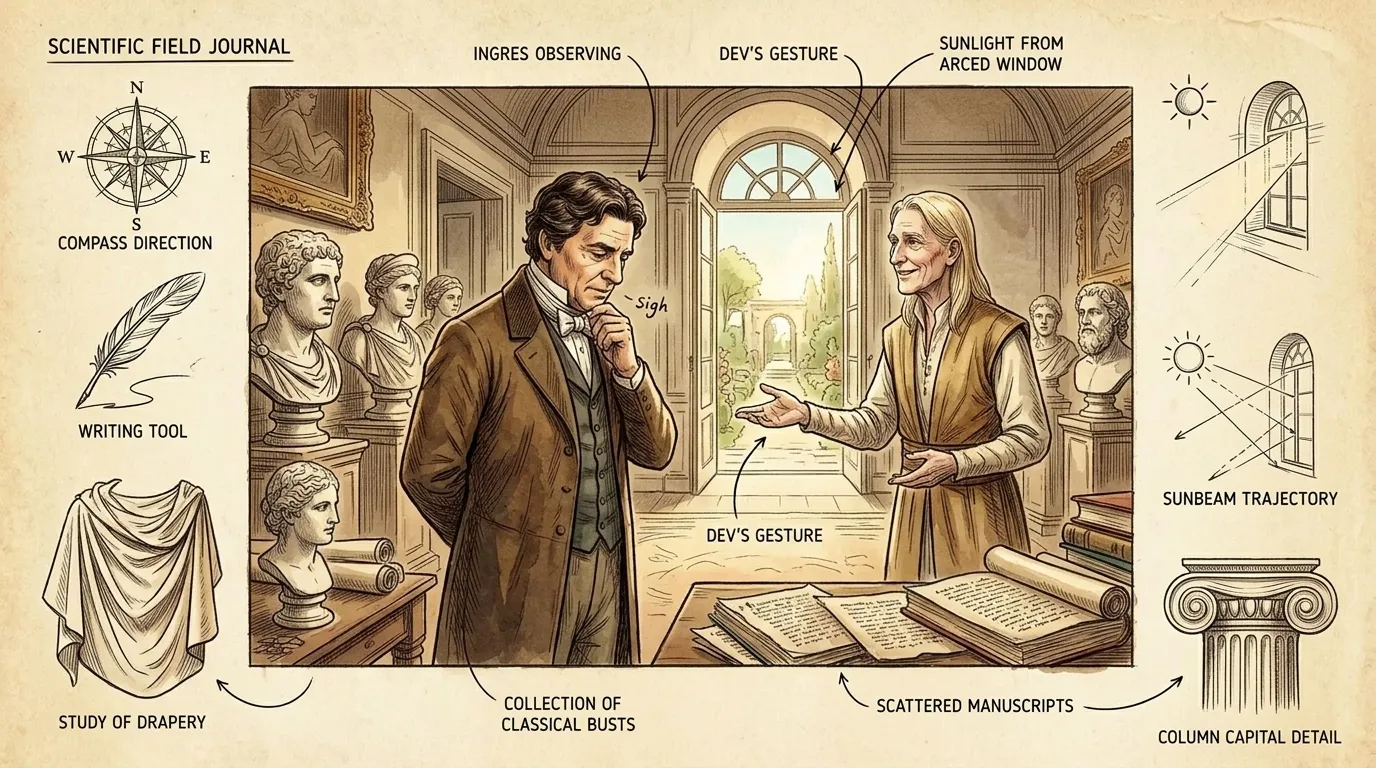
As Ingres grew, the weight of artistic tradition pressed heavily upon him. He understood that he could only be great by acknowledging the past. He had a rival in his friend, Felix, who championed a new and rebellious style. But it was an older elder, Dev, who would ultimately convince Ingres of the value of hard work.
"Idris sighed, "Dev, tell me. How do I acknowledge my past?" Dev, an elderly woman in her 60s male, tall and lean, with porcelain skin with pink cheeks and medium-length straight blonde hair tucked behind his ears, smiled. "As Sir Isaac Newton said, 'If I have seen further it is by standing on the shoulders of giants.'" Dev said. "Find inspiration in the masters, but always strive to create something uniquely your own.""
Art Fact: Ingres deeply admired the works of Raphael and considered him a model of artistic perfection. Raphael's influence is evident in Ingres's meticulous draftsmanship and idealized forms.
Page 4

The opportunity to study in Rome arrived—a pivotal moment. Rome was to be a turning point in his artistic journey. Surrounded by classical ruins and Renaissance masterpieces, Ingres meticulously studied the works of Raphael and ancient sculptors. He sketched tirelessly, seeking to absorb the principles of harmony, balance, and idealized beauty that defined classical art.
""Rome is the heart of art," Ingres exclaimed to Felix, a spirited 9-year-old male, average height with a round face, with porcelain skin with pink cheeks and straight black hair combed back neatly. "Here, I will find the true path to artistic greatness!""
Art Fact: Ingres won the Prix de Rome in 1806, which provided him with a scholarship to study at the French Academy in Rome.
Page 5
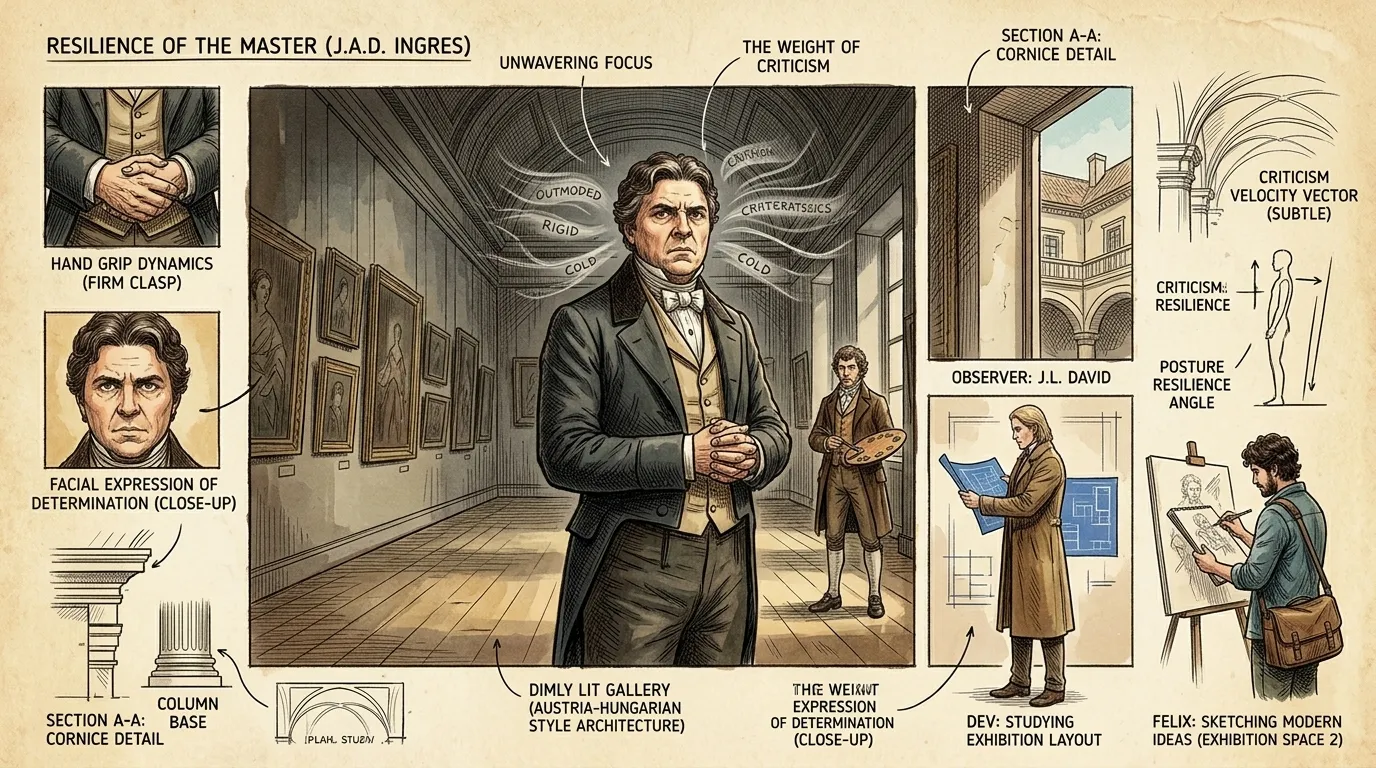
His early submissions to the Paris Salon were met with harsh criticism. The rejection stung, but Ingres remained steadfast. Detractors said his portraits were lifeless, others derided his neoclassical style, and many hated his choice of characters. This taught him that great art demands a resilient spirit. He became determined to prove his critics wrong.
""They say my work lacks feeling!" Ingres exclaimed, his voice filled with frustration. "They fail to see the depth of emotion beneath the surface!""
Art Fact: Ingres's early works were often criticized for their perceived coldness and lack of emotion, a common critique of Neoclassical art.
Page 6
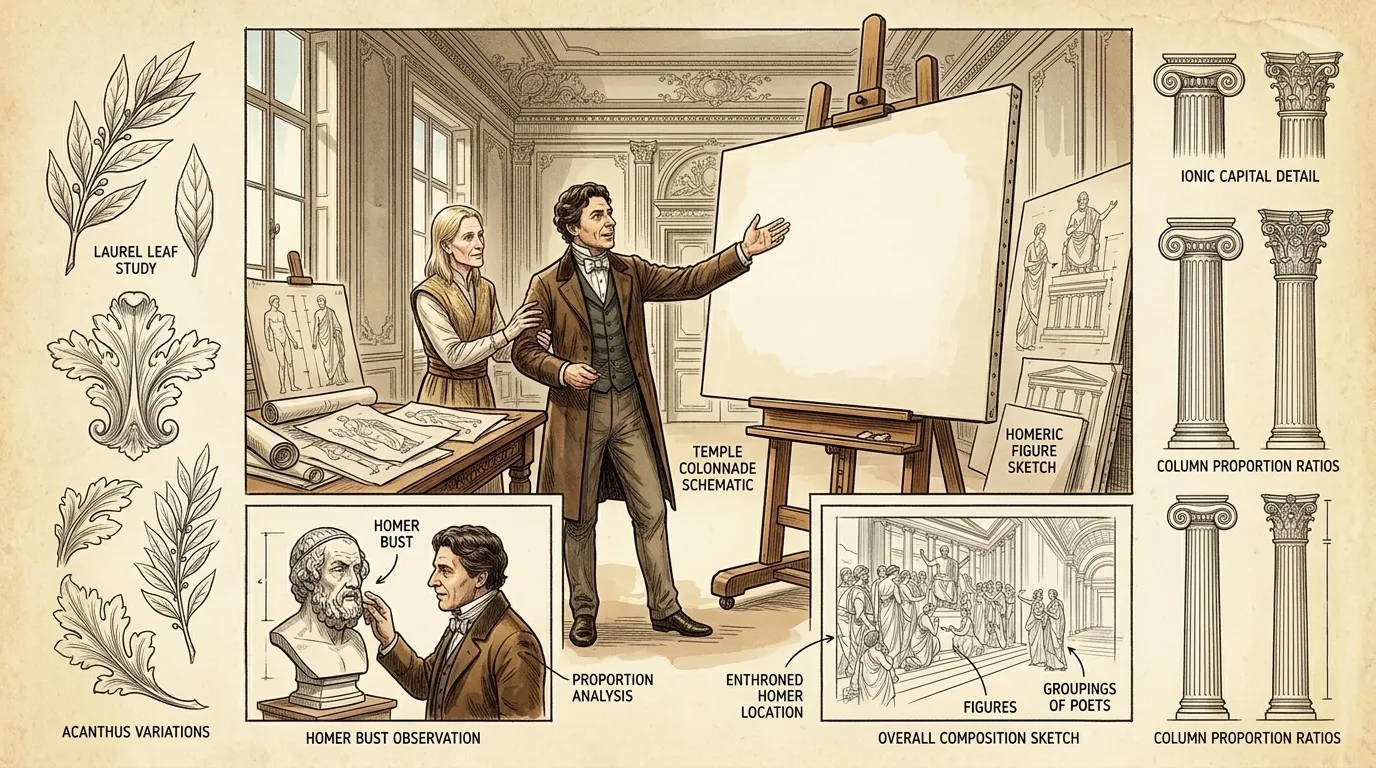
Returning to Paris, Ingres faced renewed scrutiny. It was also during this time that an elderly elder, Dev, taught him that artists can never win. To prove his detractors wrong, he embarked on his magnum opus, 'The Apotheosis of Homer.' He saw that to honor the past, he had to push himself beyond even its boundaries. Ingres envisioned a grand scene celebrating the enduring legacy of the ancient poet.
""Homer is the wellspring of all art," Ingres declared. "He is the foundation upon which our artistic tradition rests.""
Art Fact: The composition of 'The Apotheosis of Homer' draws inspiration from Raphael's 'The School of Athens,' reflecting Ingres's admiration for Renaissance masters.
Page 7
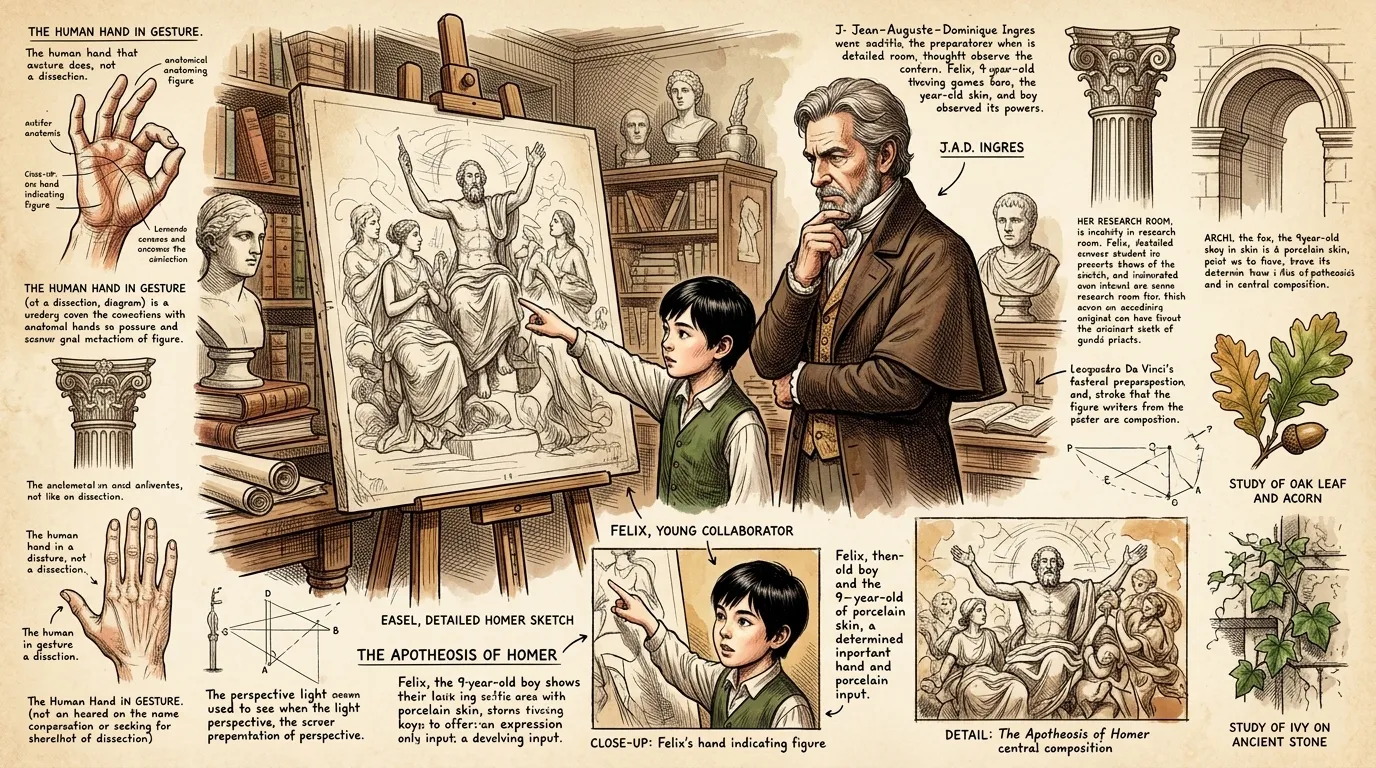
Ingres sought counsel from fellow artists and scholars. He debated the inclusion of various historical figures, each decision meticulously considered. Felix proved his old rival was someone whose opinion he now sought. Each character had to be perfect, from the great poets to the artists who celebrated art itself.
""Should we include Dante?" Ingres asked, stroking his chin thoughtfully. "His contribution to literature is undeniable, but does he truly belong in the company of Homer?""
Art Fact: Ingres made numerous preparatory drawings for 'The Apotheosis of Homer,' meticulously planning the composition and the placement of each figure.
Page 8
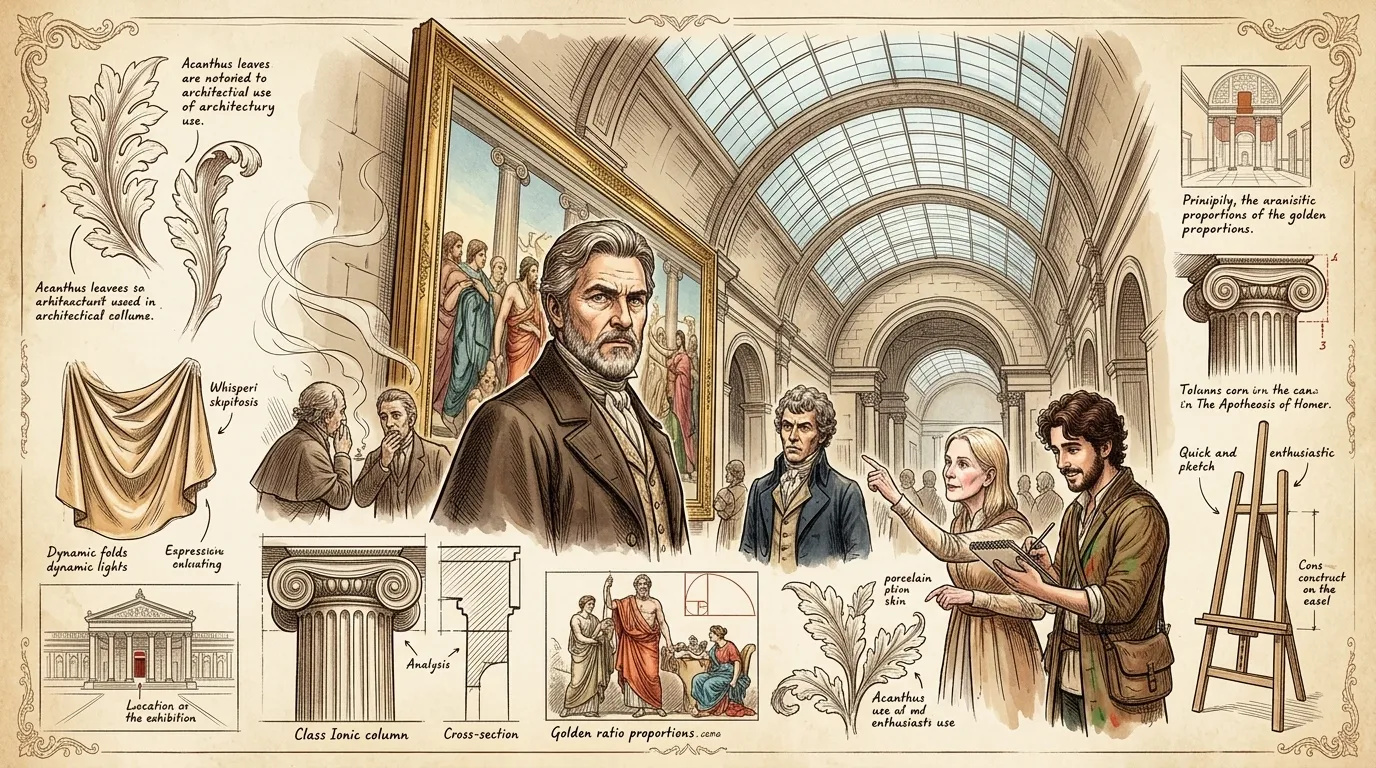
Finally, 'The Apotheosis of Homer' was unveiled to the public. Critics responded with a mixture of awe and skepticism. Some hailed it as a masterpiece of neoclassical art, while others found it cold and academic. But Ingres, now hardened by experience, brushed away the insults.
""It is not my intention to please everyone," Ingres declared. "My goal is to create art that embodies truth, beauty, and the enduring values of classical tradition.""
Art Fact: The painting was commissioned to decorate a ceiling in the Louvre Museum, further solidifying its place within the canon of French art.
Page 9
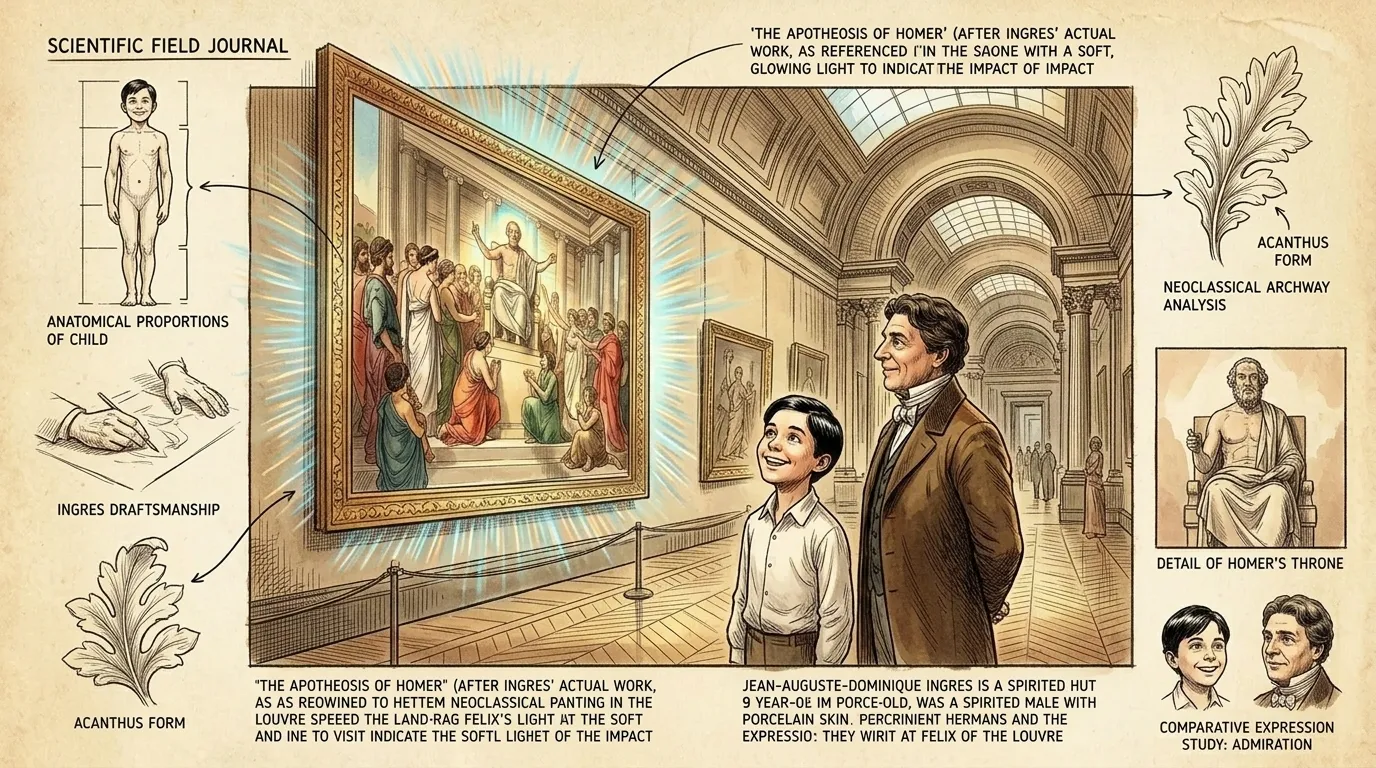
Despite the initial controversy, 'The Apotheosis of Homer' endured. It became a symbol of Ingres' artistic vision and a testament to the enduring power of classical ideals. Generations of artists studied it, drawing inspiration from its meticulous draftsmanship and idealized forms.
""Ingres, you made something amazing," Felix says. "You brought your vision to light, and made something beautiful!""
Art Fact: Ingres's emphasis on line and form influenced generations of artists, including Edgar Degas and Pablo Picasso.
Page 10
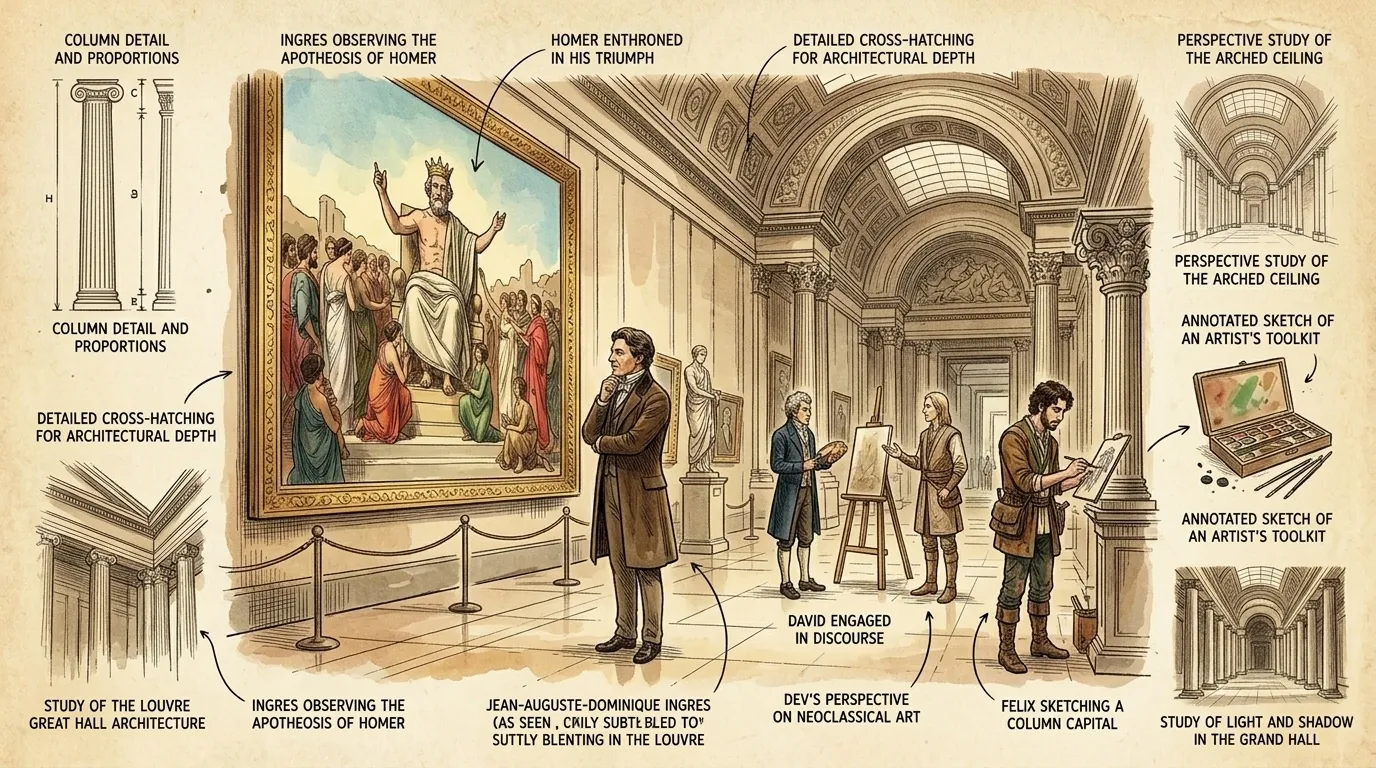
'The Apotheosis of Homer' remains a cornerstone of the Louvre Museum's collection, a testament to Ingres's unwavering dedication to classical ideals. It stands as a reminder that true art transcends time, speaking to generations long after the artist has passed. Ingres, standing next to his work, became immortal for it.
""Ingres's legacy is secure," a critic noted. "His 'Apotheosis of Homer' will continue to inspire and challenge artists for centuries to come.""
Art Fact: Ingres's meticulous approach to painting and his dedication to classical ideals made him one of the most influential artists of the 19th century.
About this story
- Location: France
- Audience: general readers
Questions and answers
Questions and answers about The Apotheosis of Homer by Jean-Auguste-Dominique Ingres (France — 1827)
Read Wonder Arts on your phone
Wonder Arts is available on Android. Get Wonder Arts on Google Play.
More Wonder Arts stories
- The Awakening Conscience by William Holman Hunt (London, UK — 1853)
- The Ballet Class by Edgar Degas (Paris, France — 1874)
- The Barque of Dante by Eugène Delacroix (Paris, France — 1822)
- The Bathers by William-Adolphe Bouguereau (France — 1879)
- The Bedroom by Vincent van Gogh (Arles, France — 1888)
- The Birth of the Renaissance by Florentine artists (Florence, Italy — c. 1400)