The Bathers by William-Adolphe Bouguereau (France — 1879)
The Bathers by William-Adolphe Bouguereau (France — 1879) — an illustrated arts story, set in France. 10 illustrated pages, free to read on Wonder Arts.

Page 1

In 1879, William-Adolphe Bouguereau stood before his completed masterpiece, 'The Bathers.' The painting, measuring an impressive 6'8" x 4'11", depicted five nude young women in a natural setting, a testament to his academic Realism. Its sale cemented his status as one of the most successful artists of his time. The art world buzzed—some praised his technical skill, others scorned his idealization. The painting resides today at the Timken Museum of Art in San Diego, California.
""It is finished," Bouguereau murmured, his voice echoing in the vast studio. "A culmination of years of study, of striving for perfection, of seeking the very essence of beauty. I hope it speaks to the viewer." "
Art Fact: The painting was acquired by a wealthy American collector shortly after its completion, fetching a high price and further establishing Bouguereau's commercial success.
Page 2

Bouguereau's artistic journey began long before 'The Bathers.' At the École des Beaux-Arts in Paris, he immersed himself in the study of classical art. He learned to paint with precision and detail to capture the human form as he mastered techniques of drawing. His professor, Jean-Louis Picot, pushed him toward perfection.
" "Remember, William," Picot said sternly, adjusting his glasses, "art is the pursuit of ideal beauty. Study the masters of antiquity. Their forms, their balance—they are the foundation of all true art." Bouguereau nodded, determined to absorb every lesson."
Art Fact: Bouguereau won the Prix de Rome in 1850, allowing him to study in Italy and further immerse himself in classical art.
Page 3

While Bouguereau found success adhering to academic traditions, a new wave of Impressionist artists emerged, challenging the established norms. Bouguereau dismissed them, clinging to his belief in classical beauty. This divergence of styles created a divide in the art world.
""Their work is mere daubing!" Bouguereau exclaimed to his friend, the painter Thomas Couture, at a gallery opening. "They abandon form, line, and all the principles of true art!" Couture sighed. "The world changes, William. We must adapt, or be left behind.""
Art Fact: Bouguereau's staunch opposition to Impressionism led to him being criticized by some as overly conservative.
Page 4
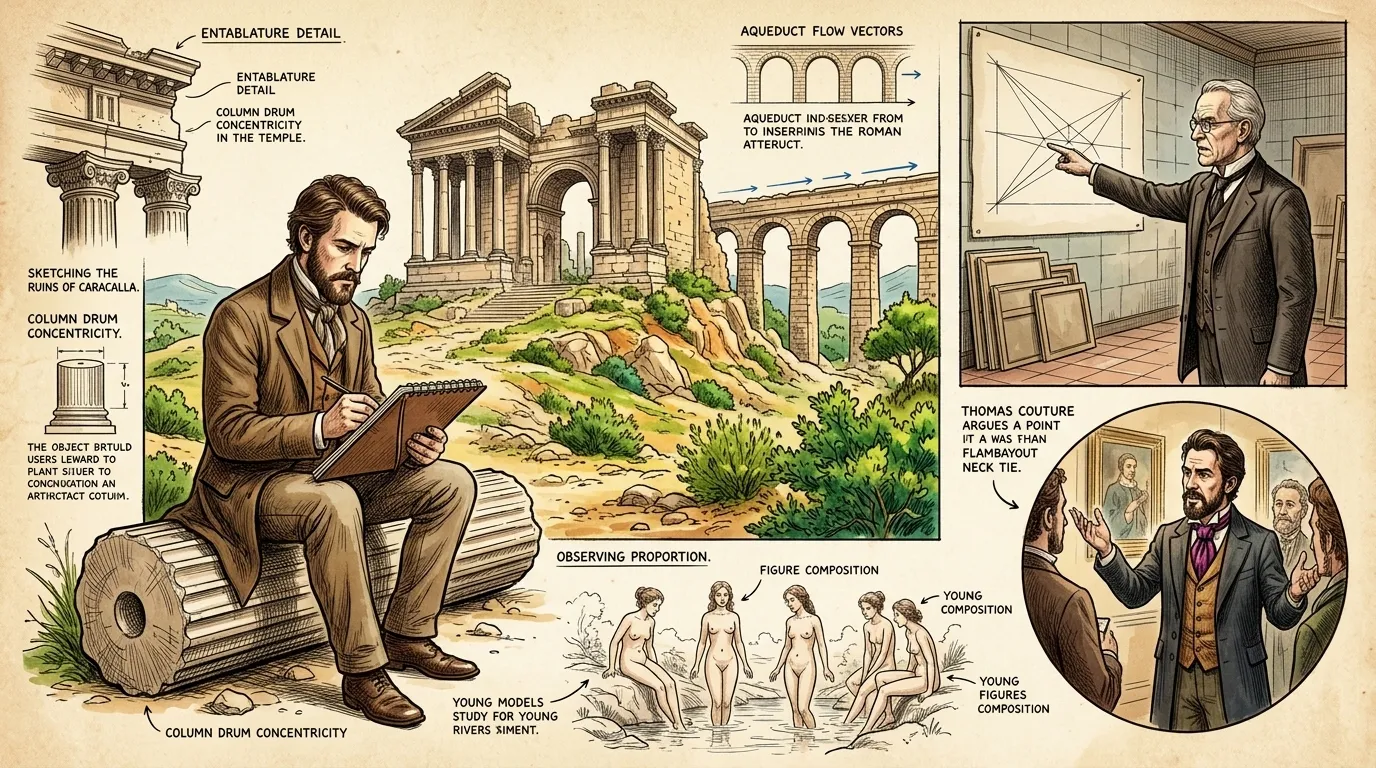
“But adapt to *what*?” Bouguereau pressed, gesturing emphatically with his hand. “To smudges and fleeting impressions? To painting light instead of form? It’s a betrayal of everything we've learned!”
Jean-Louis Picot, observing from nearby, offered a measured response. "There is skill in capturing a moment, William. A different kind of skill, perhaps."
A sharp voice interrupted them. “Skill? It’s laziness disguised as innovation!” An art critic, overhearing the conversation, approached with a disdainful expression. He fixed his gaze on Bouguereau. “You cling to the past, monsieur. The public craves something new.” A museum-goer paused, glancing at the group before moving on, seemingly uninterested in the brewing debate.
Bouguereau scoffed. "Let them crave it. True beauty is timeless."
Page 5

Jean-Louis Picot observed Bouguereau’s meticulous approach, a stark contrast to the looser brushwork favored by Couture. “You build from within,” Picot remarked, gesturing towards the canvas where figures began to emerge as delicate forms. “Not just skin and muscle, but the very essence of life.”
Bouguereau nodded, adjusting the light on one of his models. "The challenge isn't merely *representing* the body, but imbuing it with a sense of spirit – a fleeting emotion, a moment of quiet contemplation." He glanced at an Art Critic sketching nearby. “Even in stillness, there is movement; even in form, there is feeling.”
A Museum-goer paused to watch, captivated by the scene unfolding within the studio. Bouguereau continued, "It's about capturing that ephemeral quality—the breath between breaths."
Page 6

Bouguereau dedicated himself to mastering the human figure. He believed that the beauty and expressiveness of the human form were essential to conveying emotion and meaning in his art. Years of study and practice honed his ability to depict the body with remarkable accuracy and grace. He echoed Leonardo Da Vinci, 'Painting embraces all the ten functions of the eye; that is to say: darkness, light, body and color, shape and location, distance and nearness, motion and rest.' He considered each of these when painting the figures in his 'The Bathers.'
""The figure is the foundation," Bouguereau said to a student in his studio, carefully studying the model's pose. "Master the anatomy, understand the structure, and you can unlock the secrets of beauty.""
Art Fact: Bouguereau was a renowned teacher and his students went on to achieve successful careers in their own right.
Page 7
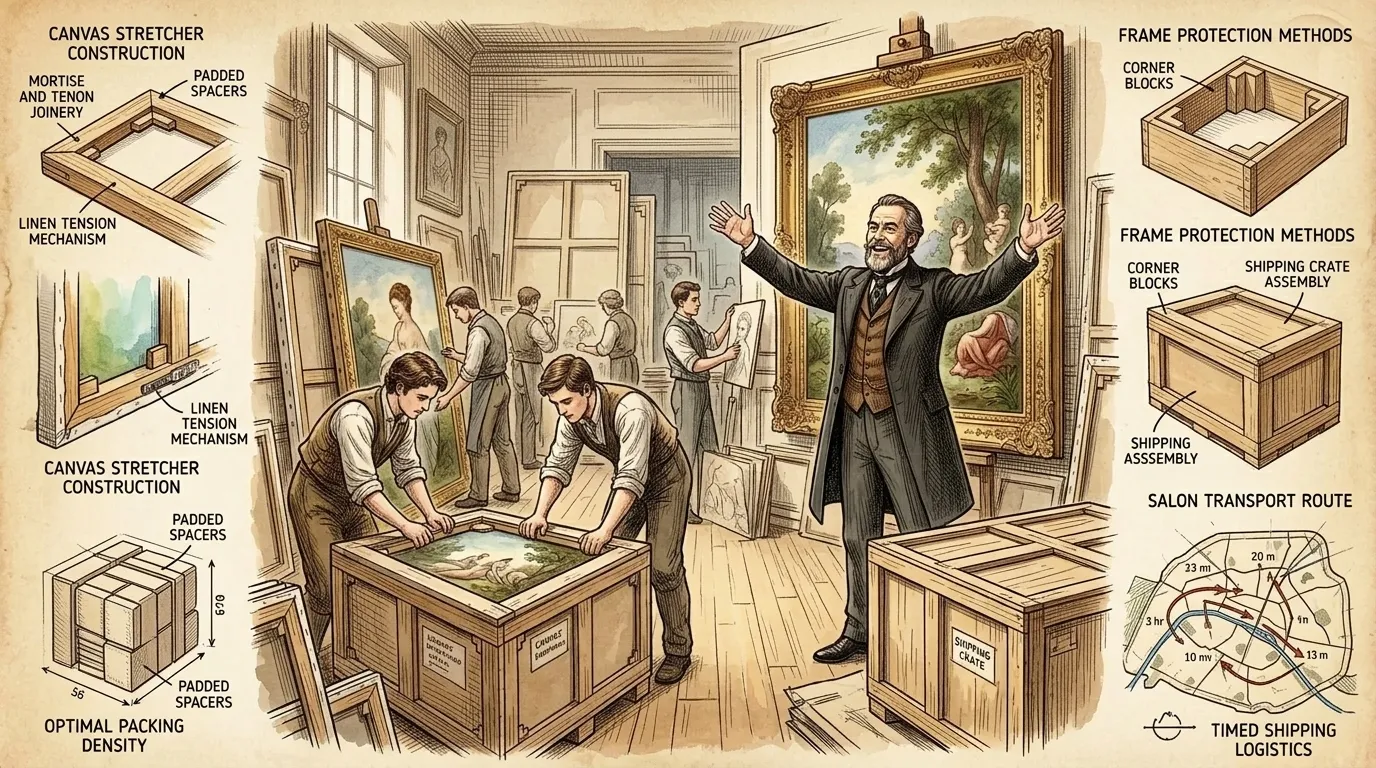
Bouguereau relentlessly submitted works to the Paris Salon. His paintings were accepted and gained positive attention, and this allowed him to obtain recognition and commissions. His meticulous technique and adherence to traditional academic standards appealed to the Salon's jury, further boosting his visibility and commercial success.
""The Salon is our stage!" Bouguereau exclaimed to his studio assistants. "We must show our best in hopes to win the hearts of the jury and the public.""
Art Fact: His Salon successes made him a sought-after artist among wealthy collectors.
Page 8

Bouguereau started working on 'The Bathers.' The composition focused on idealizing classical beauty and depicting an innocence of youth. In depicting the nude female body, he sought to create a timeless scene of elegance, with the five bathers arranged naturally along the river.
"Bouguereau, looking intently at his canvas, asked the models, "Can you shift slightly to the left, my dear? Yes, that is perfection!""
Art Fact: The painting shows Bouguereau's skill and vision for what he wanted to convey.
Page 9

After the painting's release, some art critics saw the scene as a formulaic one that idealized the nude female form. Others saw it as the epitome of beauty. But the painting has stood the test of time to make it one of his most famous.
"An art critic, looking at the painting, says, "Bouguereau's painting is exquisite, even though the vision is controversial!""
Art Fact: Despite some criticism, "The Bathers" has remained one of Bouguereau's famous works.
Page 10

Bouguereau's artistic vision continues to resonate with art lovers around the world. His meticulous technique, his idealized figures, and his timeless themes continue to inspire and captivate. As the artist himself said, 'One has to seek Beauty and Truth, Sir! Forget all the rubbish you have heard and read! And then believe neither your own nor anyone else's opinion.' Bouguereau's ability to portray timeless beauty is why his work survives forever.
""Why does 'The Bathers' continue to captivate?" A museum-goer asks. "Because it represents an ideal of beauty, an innocence that transcends time.""
Art Fact: Timeless beauty continues to be what people seek when gazing upon the painting.
About this story
- Location: France
- Audience: general readers
Questions and answers
Questions and answers about The Bathers by William-Adolphe Bouguereau (France — 1879)
Read Wonder Arts on your phone
Wonder Arts is available on Android. Get Wonder Arts on Google Play.
More Wonder Arts stories
- The Bedroom by Vincent van Gogh (Arles, France — 1888)
- The Birth of the Renaissance by Florentine artists (Florence, Italy — c. 1400)
- The Birth of Tragedy by Anselm Feuerbach (Germany — 1870)
- The Birth of Venus by William-Adolphe Bouguereau (France — 1879)
- The Burghers of Calais by Auguste Rodin (Calais, France — 1889)
- The Card Players by Paul Cézanne (France — 1895)