The Birth of Tragedy by Anselm Feuerbach (Germany — 1870)
The Birth of Tragedy by Anselm Feuerbach (Germany — 1870) — an illustrated arts story, set in Germany. 10 illustrated pages, free to read on Wonder Arts.
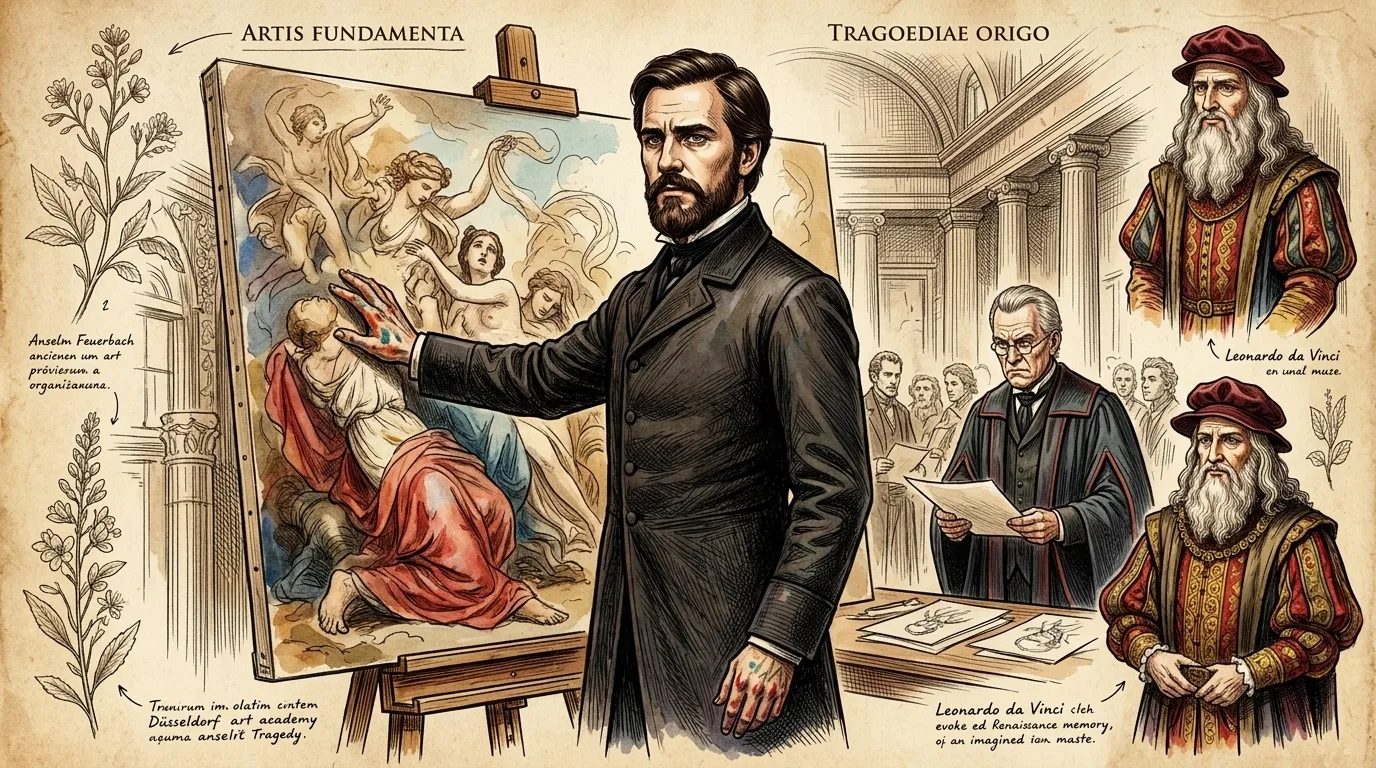
Page 1
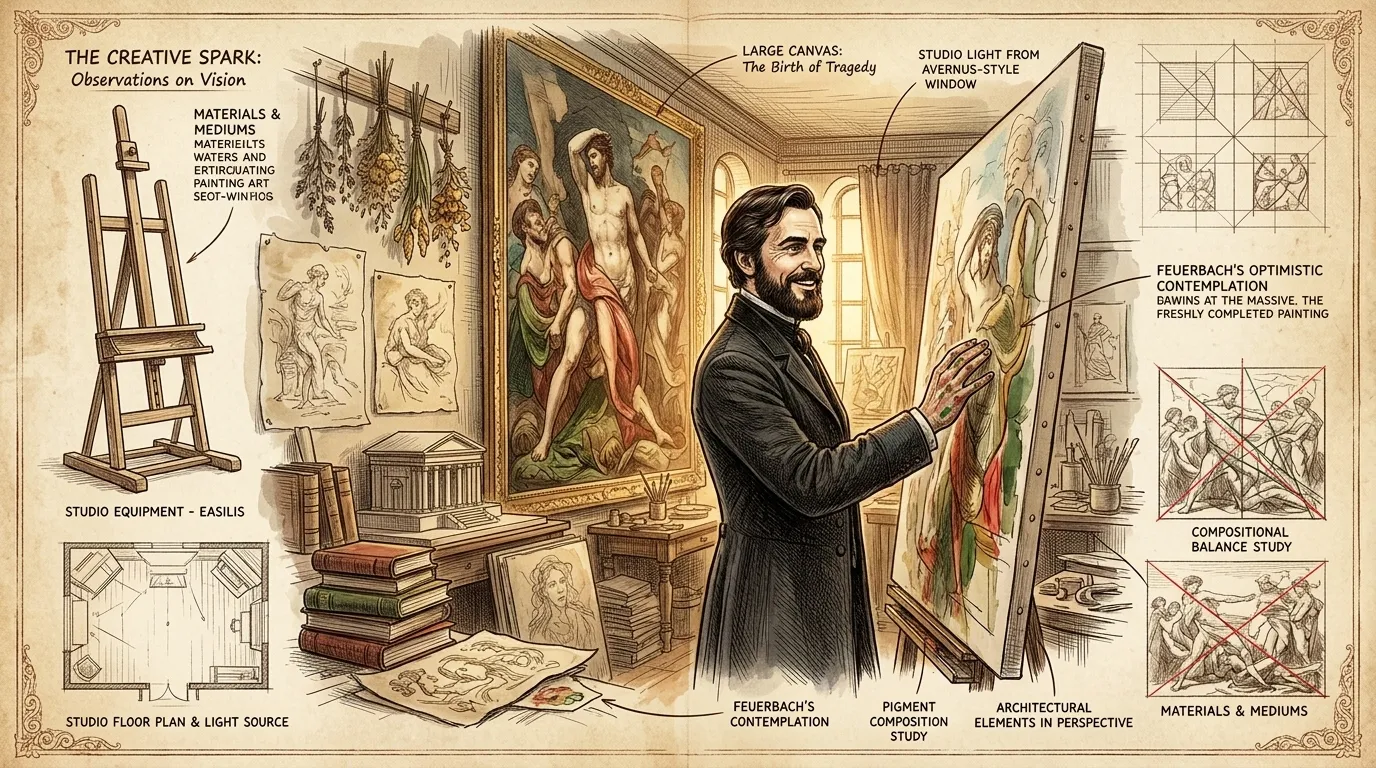
Anselm Feuerbach gazes upon his magnum opus, 'The Birth of Tragedy,' completed in 1870. This Realism masterpiece, measuring 265 x 420 cm, now hangs in the Neue Nationalgalerie, Berlin. Its somber beauty masks a personal struggle; Feuerbach poured his heart into this work, facing constant criticism.
""At last," Feuerbach murmurs, running a paint-stained hand across the canvas. "My vision... complete. But will they ever truly see it?""
Art Fact: Feuerbach faced constant rejection for his classical style in a rapidly modernizing art world. 'The Birth of Tragedy' represents his attempt to reconcile classical ideals with contemporary sensibilities.
Page 2
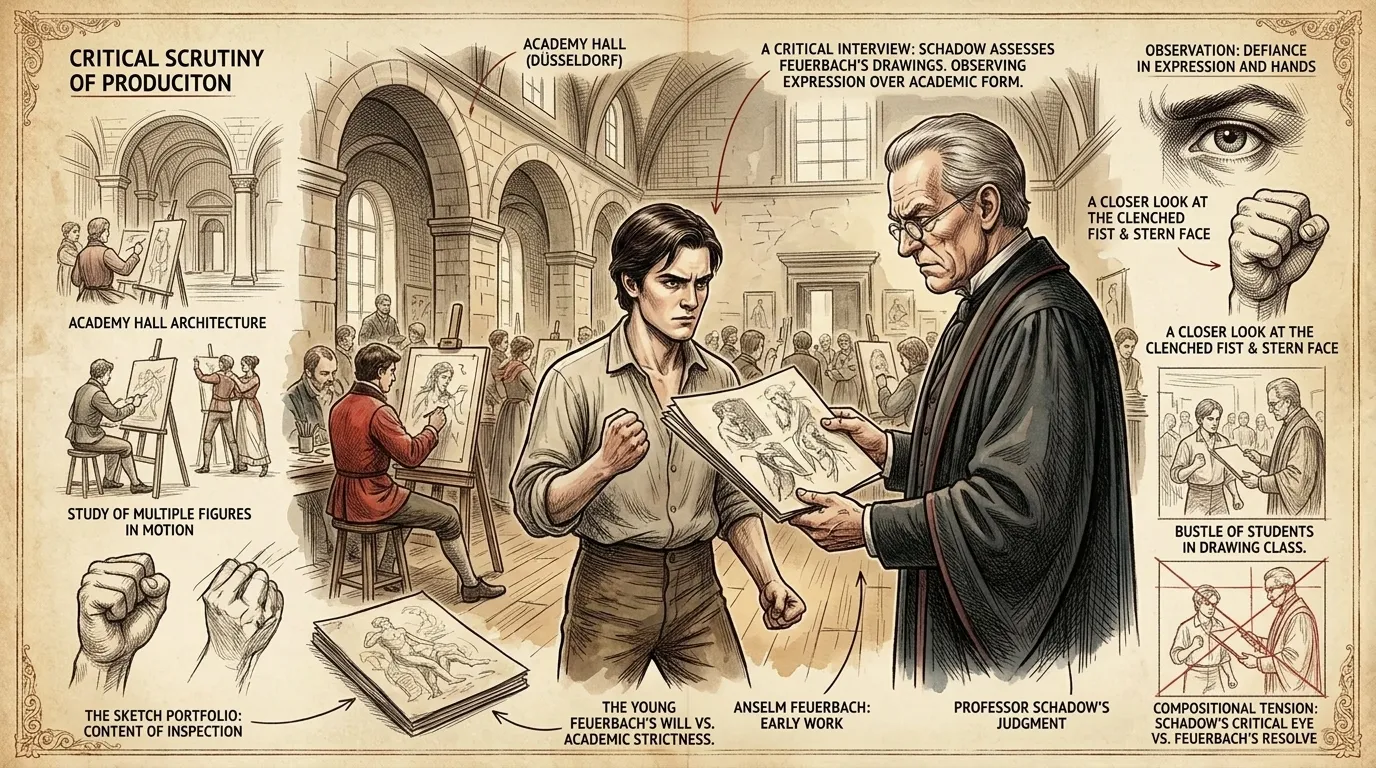
A young Feuerbach arrives at the Düsseldorf Academy, eager to learn from the masters. Professor Schadow, a stern figure, observes his early sketches with a critical eye. The air buzzes with the energy of aspiring artists.
""Feuerbach, your lines are competent, but lack passion," Schadow booms, adjusting his spectacles. "Art must stir the soul, young man!" Feuerbach responds, clenching his fists, "I aim to find the balance, sir, between the soul and the technical aspects.""
Art Fact: Karl Ferdinand Schadow was a prominent figure in the Düsseldorf school of painting, known for his classical and historical subjects. Feuerbach's early training under him shaped his later artistic style.
Page 3
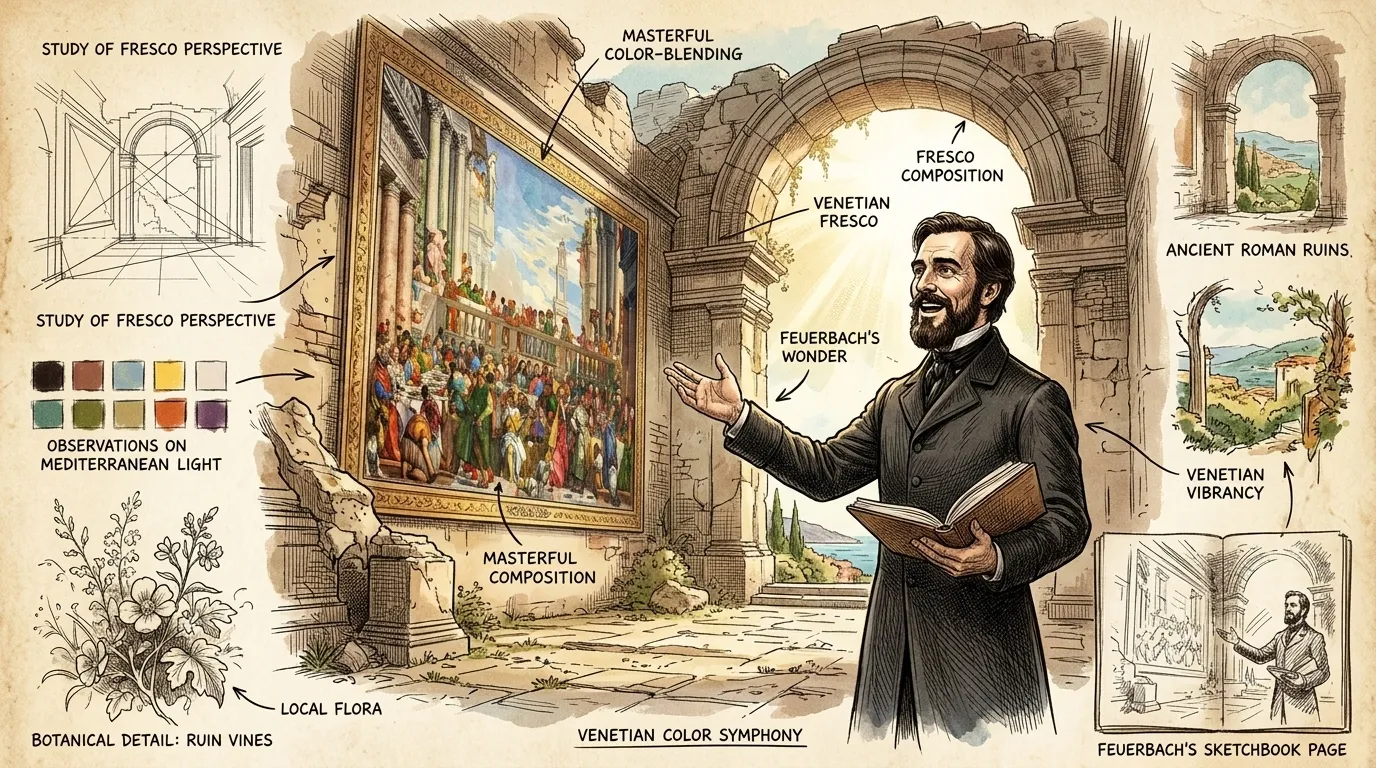
Drawn by the ancient ruins and vibrant light, Feuerbach travels to Italy. In Venice, he marvels at the works of Titian and Veronese, their mastery of color igniting a new fire within him.
""The light, the color!" Feuerbach exclaims, sketchbook in hand, eyes wide with wonder. "Italy breathes life into art. 'As Leonardo da Vinci said, painting embraces all the ten functions of the eye; that is to say, darkness, light, body and colour, shape and location, distance and nearness, motion and rest,'" he states, trying to recall the exact quote, "all these are incorporated within painting. This is where true art lives!"."
Art Fact: Feuerbach spent much of his artistic life in Italy, finding inspiration in the classical ruins and the works of the Italian masters. This period was crucial in developing his mature style.
Page 4
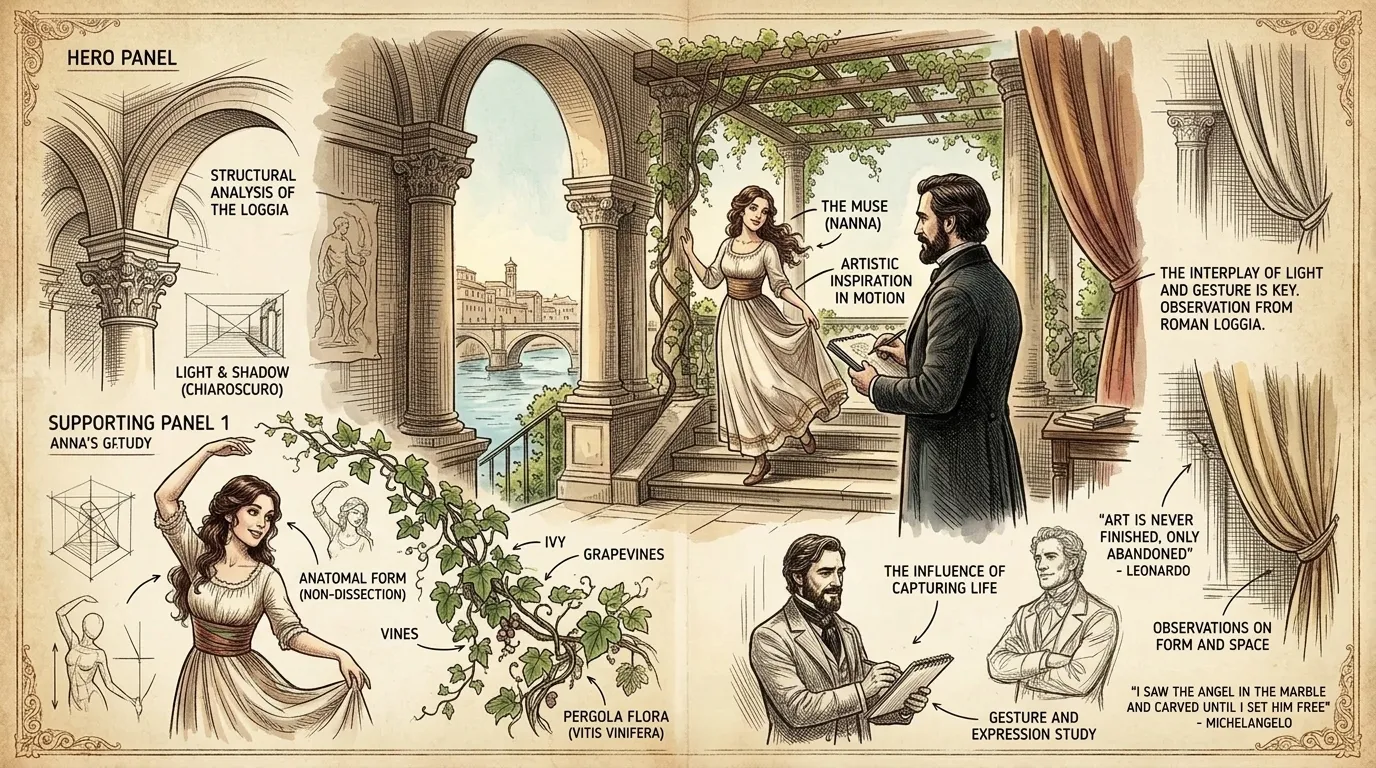
In Rome, Feuerbach meets Anna Risi, a striking woman who becomes his muse and model. Their passionate relationship fuels his creativity, bringing a new intensity to his work. He begins to see the form of tragedy.
""Anna, your presence... it is like a breath of fresh air. It stirs the artistic soul," Feuerbach says, admiring her form as she poses. Anna replies, a playful smile on her lips, "Only if my presence makes you see the world, Herr Feuerbach!"."
Art Fact: Anna Risi, known as 'Nanna,' was Feuerbach's most important model. Their tumultuous relationship greatly influenced his work, adding depth and emotion to his classical subjects.
Page 5
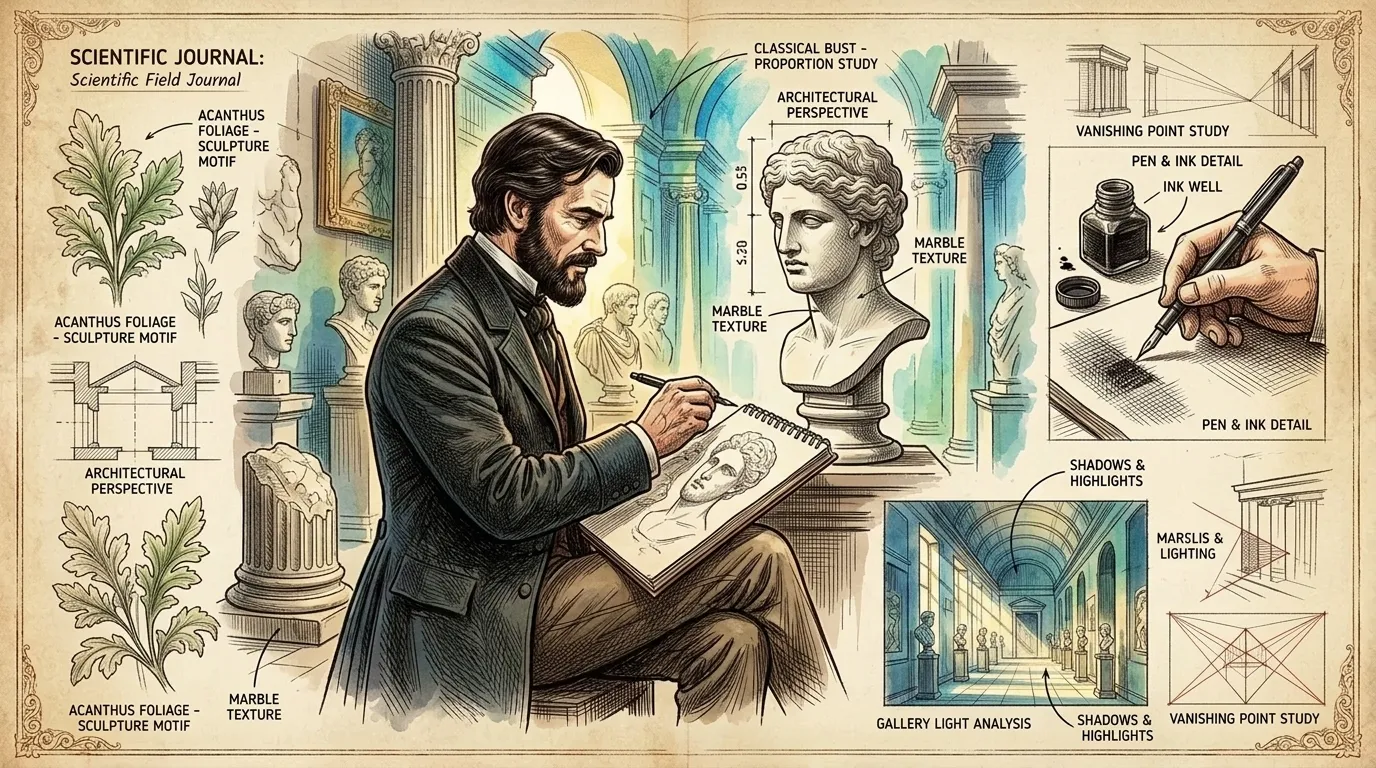
“But what *is* tragedy, Nanna?” Feuerbach asks, sketching rapidly in his notebook. “Is it merely sorrow? No…it is the collision of the ideal with the real, isn’t it? The beautiful striving against the inevitable.”
Professor Schadow, observing from a distance, nods slowly. "A potent observation, Anselm. Though Leonardo and Michelangelo understood this implicitly – the struggle *is* the art."
Nanna laughs softly, shifting her pose. “Perhaps tragedy is simply life, Herr Feuerbach, seen through an artist’s eyes.” She pauses, then adds with a knowing glance, “And perhaps it's also a handsome painter desperately trying to capture beauty before it fades.”
Feuerbach blushes, but his gaze remains fixed on Nanna. He sees not just a model, but the embodiment of both grace and vulnerability – the very essence of tragedy itself.
Page 6
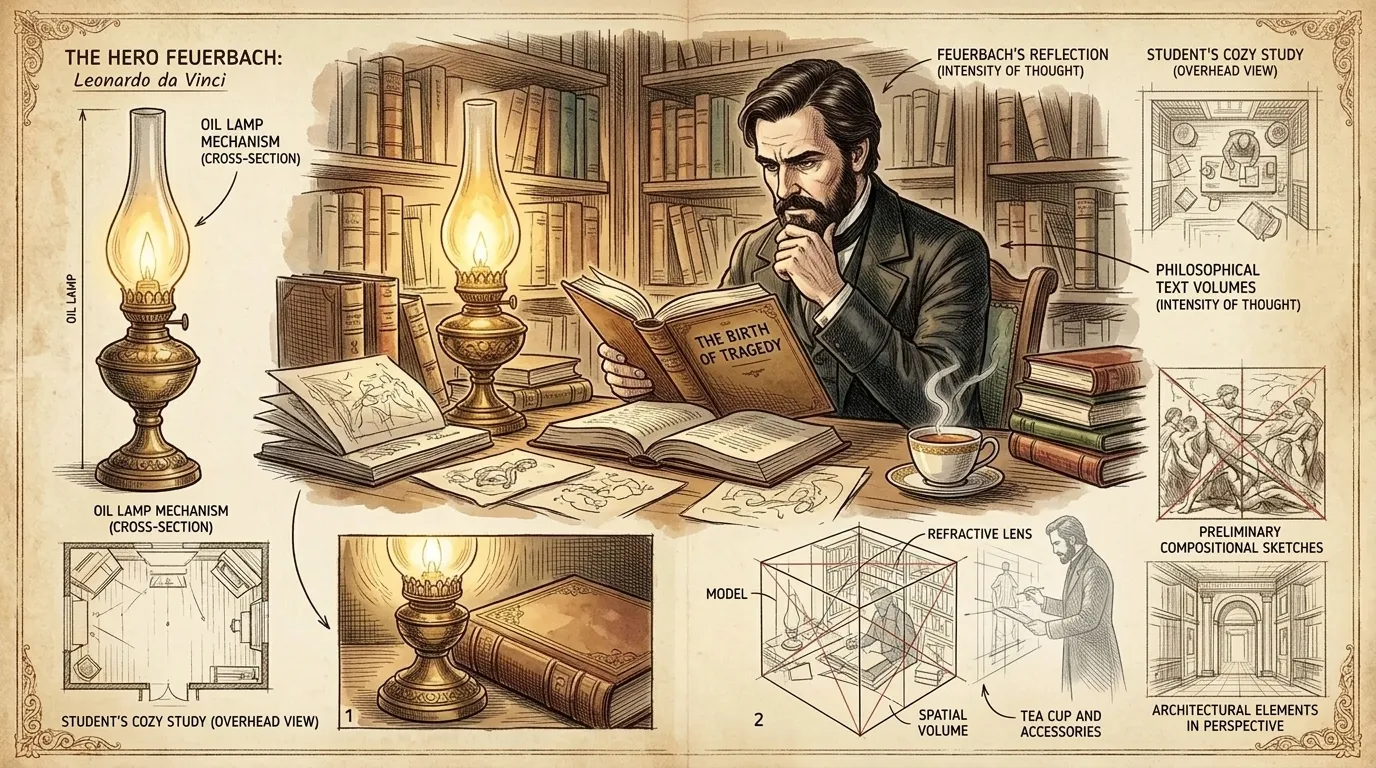
Professor Schadow observes Feuerbach’s work, a critical eye assessing each line. “A bold undertaking, Anselm,” he comments, adjusting his spectacles. “But remember, tragedy must not merely depict sorrow; it must *ennoble* it.”
Leonardo da Vinci, seemingly materialized from the canvas itself, offers a subtle nod. "The balance, my friend, lies in revealing the beauty within the suffering." Nanna Risi quietly arranges charcoal sticks, her presence a comforting stillness. Michelangelo, ever the perfectionist, grunts his approval at a particularly well-rendered muscle structure.
Feuerbach pauses, considering their input. “It is not enough to show pain,” he replies, resuming his sketching. “One must glimpse the divine spark *within* that pain—the potential for transcendence.”
Page 7
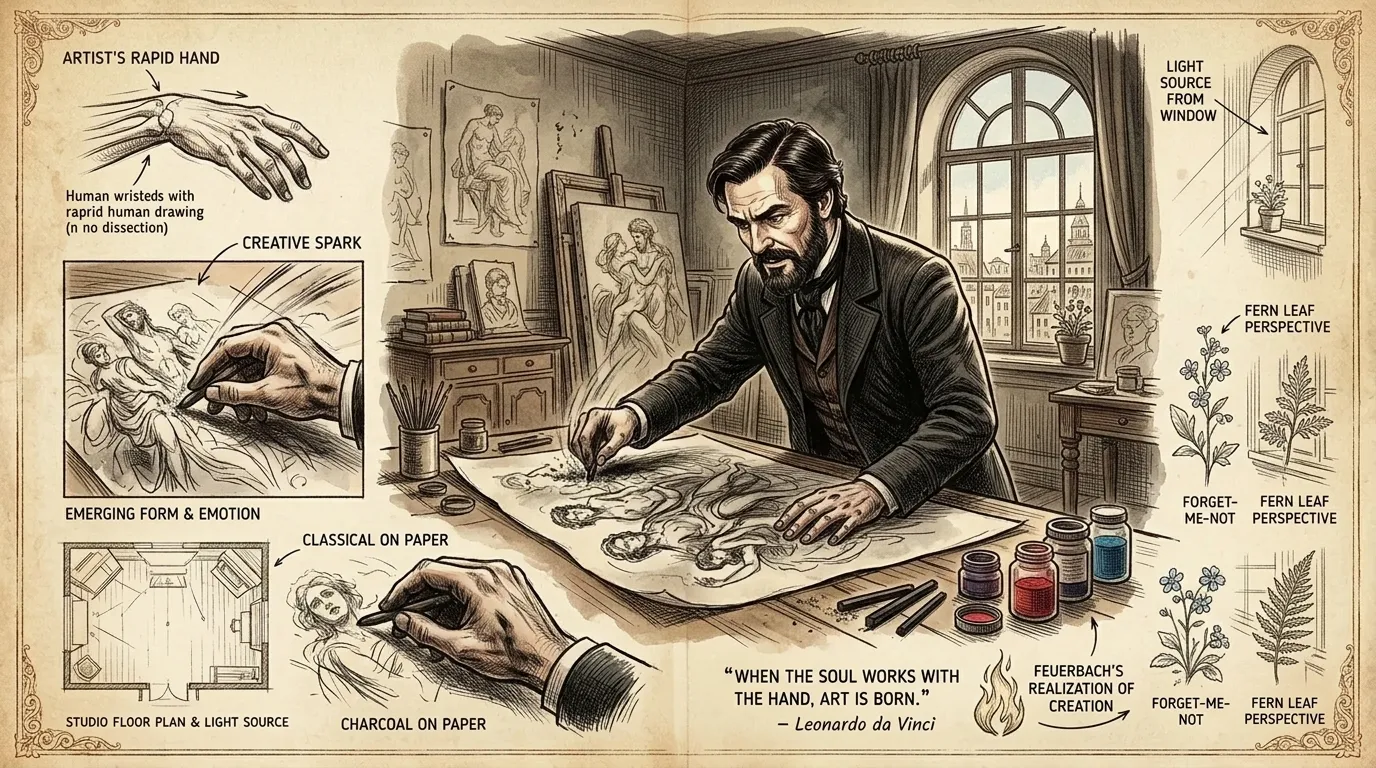
Fueled by Nietzsche's ideas and his personal experiences, Feuerbach begins sketching the first concepts for 'The Birth of Tragedy.' Figures emerge from the darkness, imbued with a sense of classical grandeur and profound sorrow.
""Let the figures rise from the depths of human experience," Feuerbach mutters, his hand moving rapidly across the paper. "Let them embody the eternal struggle between light and shadow.""
Art Fact: The initial sketches for 'The Birth of Tragedy' reveal Feuerbach's attempt to merge classical forms with a sense of emotional depth and philosophical inquiry.
Page 8
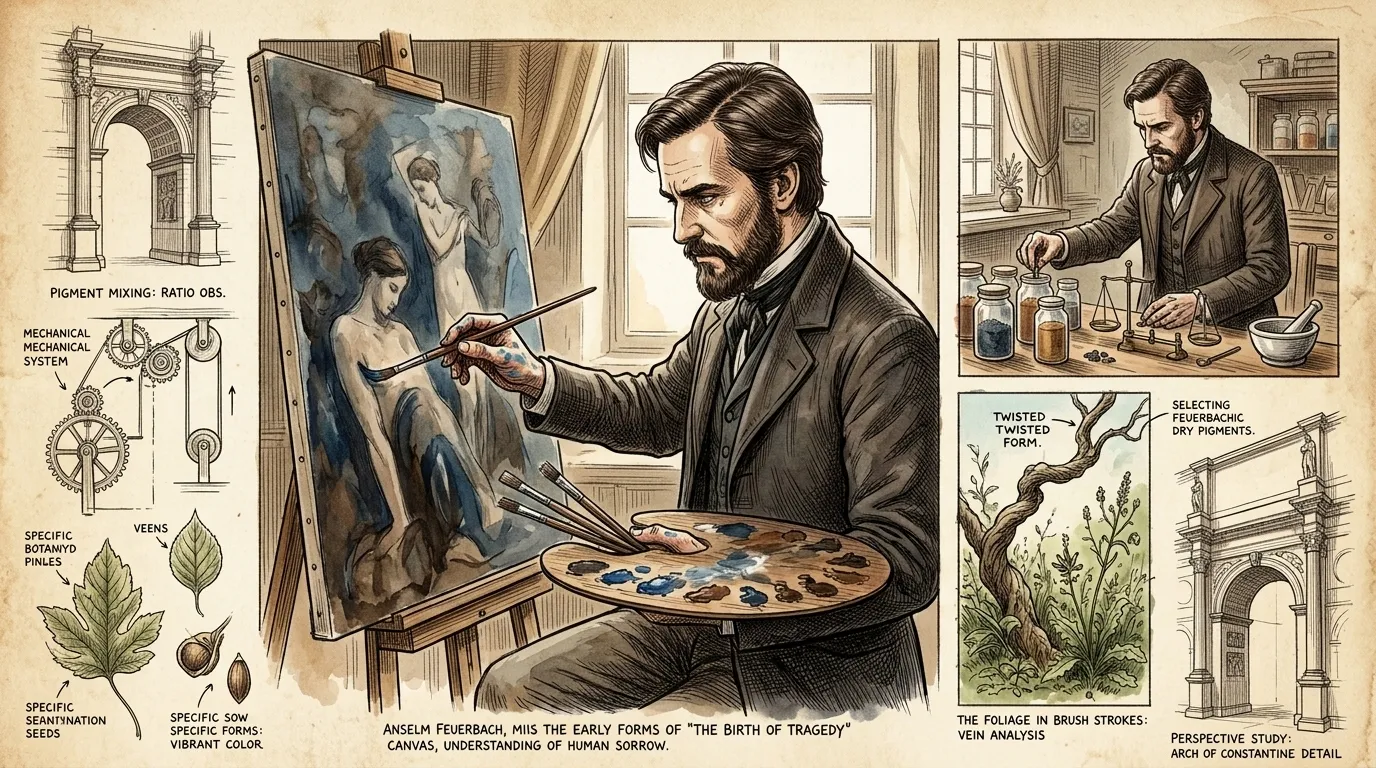
As Feuerbach paints, a somber palette of blues and browns dominates the canvas. These colors reflect the personal losses and existential anxieties that permeate the work. He realizes that tragedy is also a part of life.
""These somber hues... they are the very essence of human sorrow," Feuerbach says, mixing pigments on his palette. "They must speak of the pain that is interwoven with the joy of existence.""
Art Fact: The color palette of 'The Birth of Tragedy' is deliberately somber, reflecting the themes of loss, suffering, and the tragic nature of human existence that Feuerbach explores in the painting.
Page 9
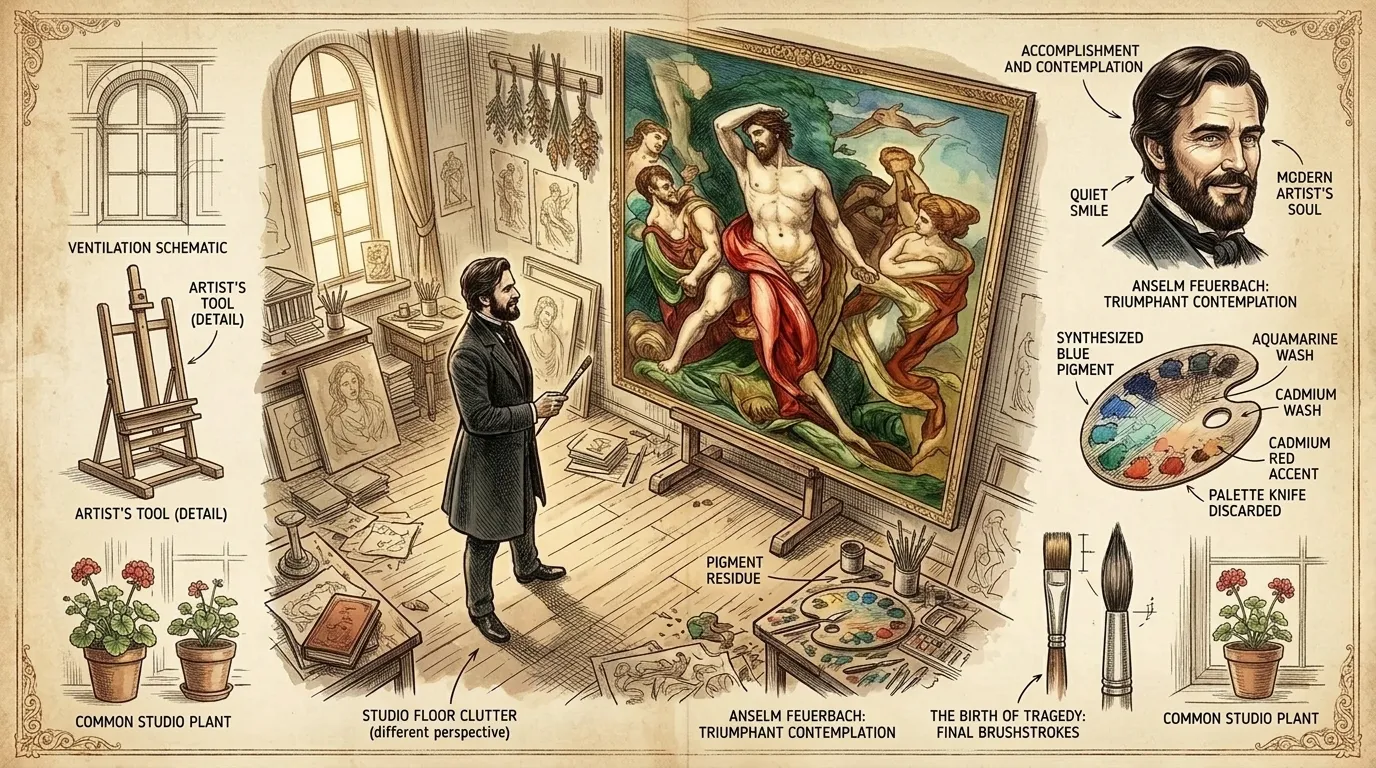
After months of intense labor, Feuerbach puts the final brushstrokes on 'The Birth of Tragedy.' The painting stands as a testament to his artistic vision, a synthesis of classical ideals and modern sensibilities.
""It is done," Feuerbach whispers, stepping back to admire his creation. "A work born of pain, yet filled with beauty...""
Art Fact: The completion of 'The Birth of Tragedy' marked a significant achievement in Feuerbach's career, solidifying his reputation as one of Germany's leading Realism painters.
Page 10
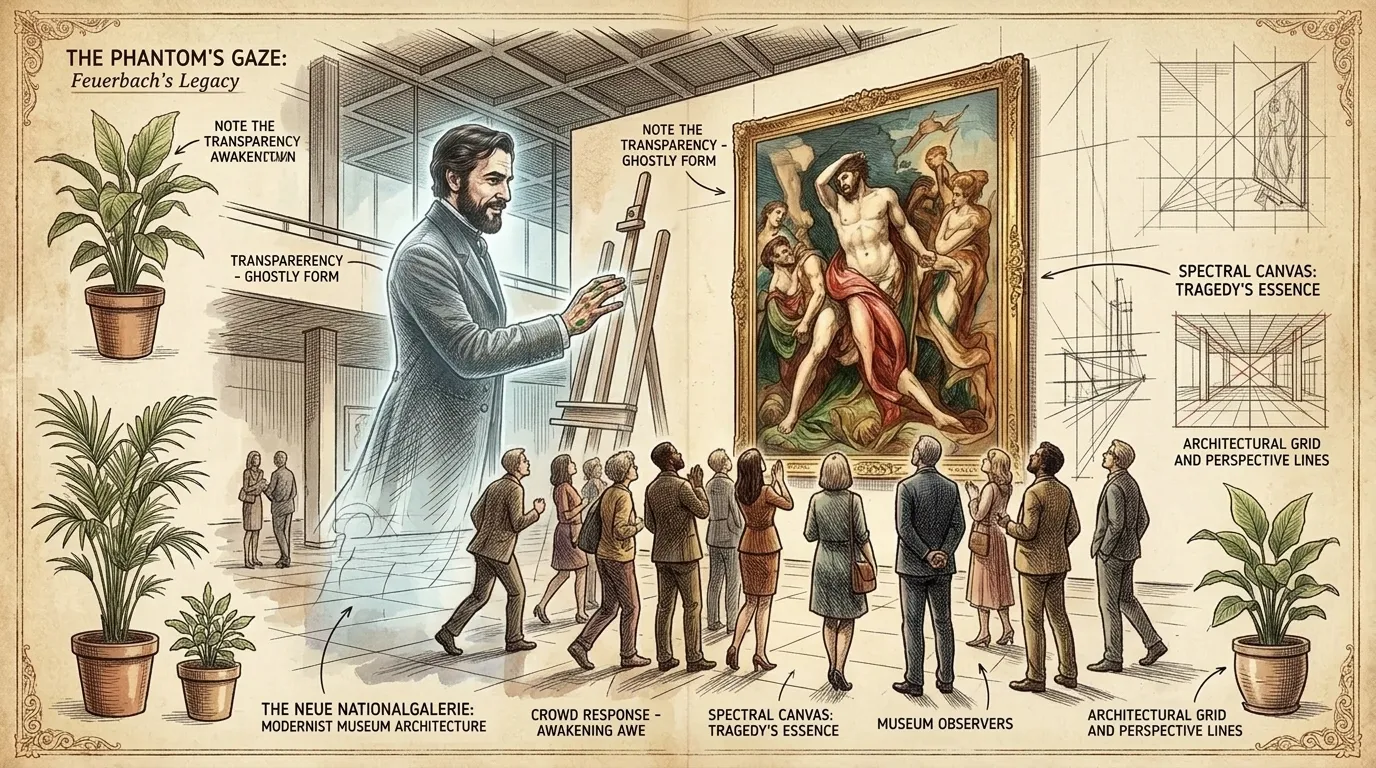
Today, 'The Birth of Tragedy' hangs in the Neue Nationalgalerie, Berlin, inspiring artists and viewers alike. Feuerbach's vision endures, a timeless exploration of the human condition. His art lives on because, 'The true work of art is but a shadow of the divine perfection', as Michelangelo said; Feuerbach strived for his own personal version of the divine.
""It is a testament to passion," whispers a ghostly silhouette of Feuerbach, watching modern admirers gaze at his artwork. "The pursuit of beauty through the tragic is a legacy that will inspire forever.""
Art Fact: 'The Birth of Tragedy' remains a powerful and influential work of art, reminding us of the beauty and meaning that can be found even in the face of tragedy.
About this story
- Location: Germany
- Audience: general readers
Questions and answers
Questions and answers about The Birth of Tragedy by Anselm Feuerbach (Germany — 1870)
Read Wonder Arts on your phone
Wonder Arts is available on Android. Get Wonder Arts on Google Play.
More Wonder Arts stories
- The Birth of Venus by William-Adolphe Bouguereau (France — 1879)
- The Burghers of Calais by Auguste Rodin (Calais, France — 1889)
- The Card Players by Paul Cézanne (France — 1895)
- The Colosseum (Rome, Italy — 80 AD)
- The Concert by Johannes Vermeer (Boston, USA — 1664)
- The Course of Empire by Thomas Cole (USA — 1836)