The Burghers of Calais by Auguste Rodin (Calais, France — 1889)
The Burghers of Calais by Auguste Rodin (Calais, France — 1889) — an illustrated arts story, set in France. 10 illustrated pages, free to read on Wonder Arts.
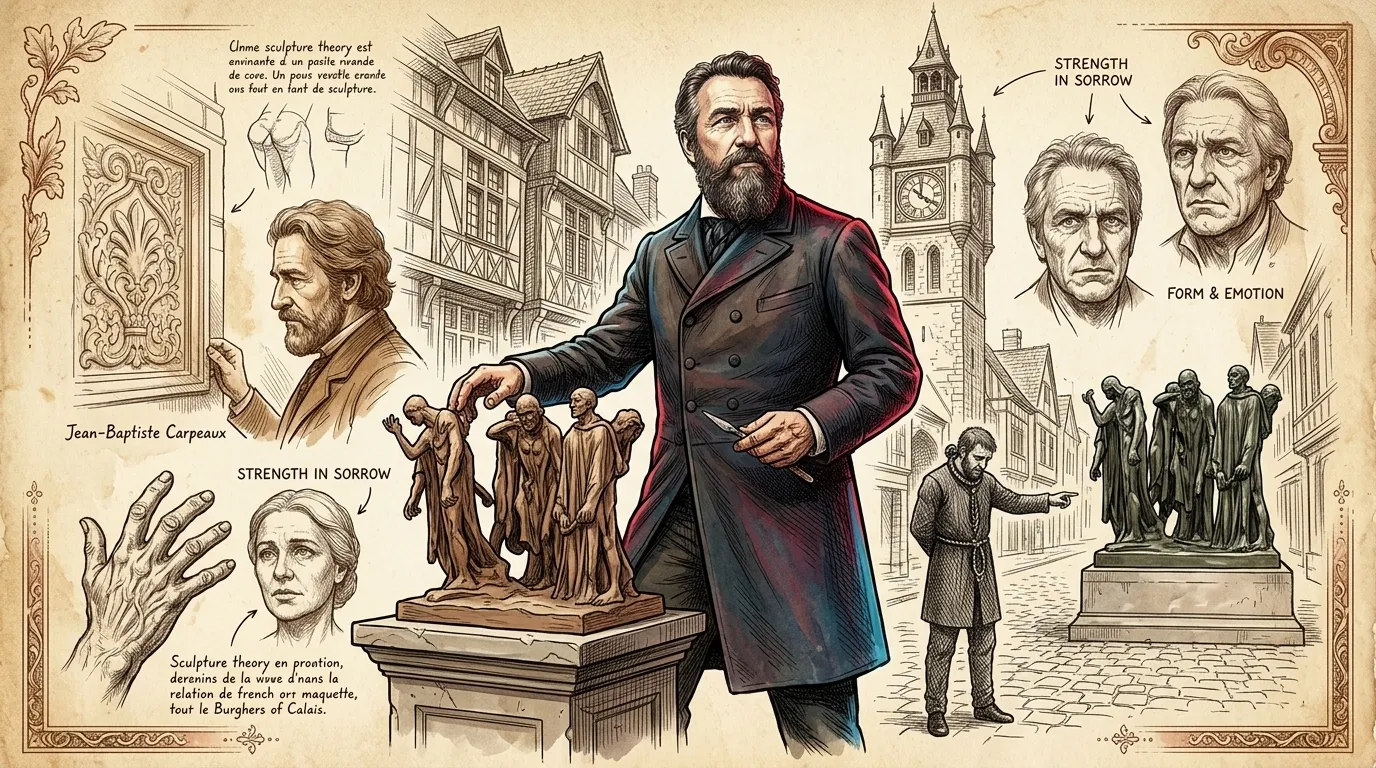
Page 1
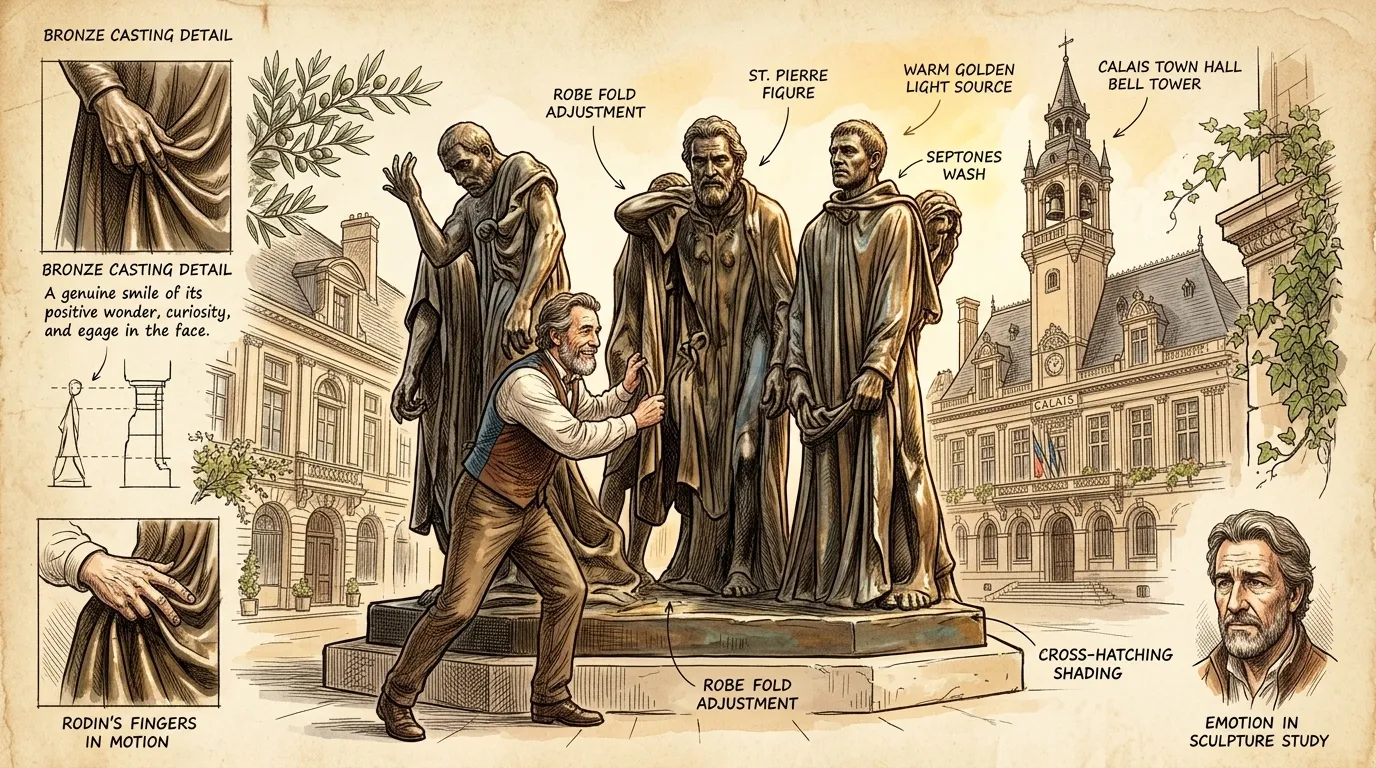
Auguste Rodin stands before his monumental sculpture, 'The Burghers of Calais,' completed in 1889. Located in Calais, France, this bronze masterpiece captures the sacrifice of six leading citizens who offered their lives to save their city in 1347 during the Hundred Years' War. The sculpture, measuring approximately 2 meters in height and 2.2 meters in length, is celebrated for its raw emotion and departure from traditional heroic monuments. What many don't realize is that Rodin originally intended for the sculpture to be placed at ground level, allowing the people of Calais to walk among the figures and truly understand their despair.
"Rodin murmurs to himself, adjusting the drape of Eustache de Saint Pierre's robe, "As Leonardo da Vinci said, 'Painting embraces all the ten functions of the eye; that is to say, darkness, light, body and colour, shape and location, distance and nearness, motion and rest.' I strive to capture all these in bronze, the weight of their sacrifice heavy as stone.""
Art Fact: The Burghers of Calais depicts Eustache de Saint Pierre, Jacques de Wissant, Pierre de Wissant, Jean de Fiennes, Andrieu d'Andres, and Jean d'Aire offering themselves to King Edward III in exchange for the city's safety.
Page 2
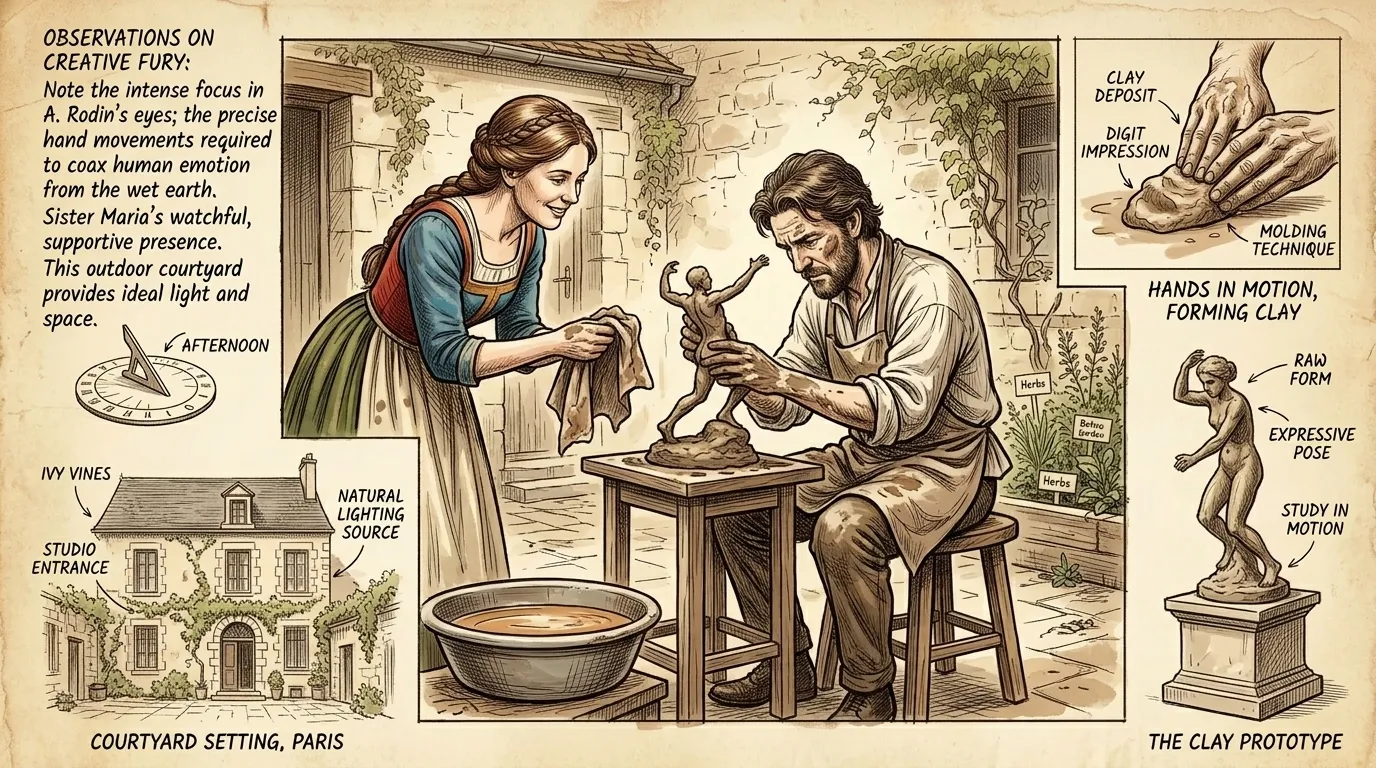
Young Auguste, even as a boy, found solace and expression not in books, but in clay. He would spend hours molding figures from the earth he gathered near his home in Paris. His sister Maria watched him, captivated by his intense focus. She brought him scraps of fabric, the texture inspiring him.
"Maria asks, handing Auguste a piece of worn cloth, "What will you make today, Auguste? Another soldier? Another king?" Auguste, his hands already covered in clay, replies, "No, Maria. Today, I will make sorrow. Today, I will make a father who will sacrifice himself.""
Art Fact: Rodin's early fascination with form and texture laid the foundation for his later revolutionary work in sculpture.
Page 3
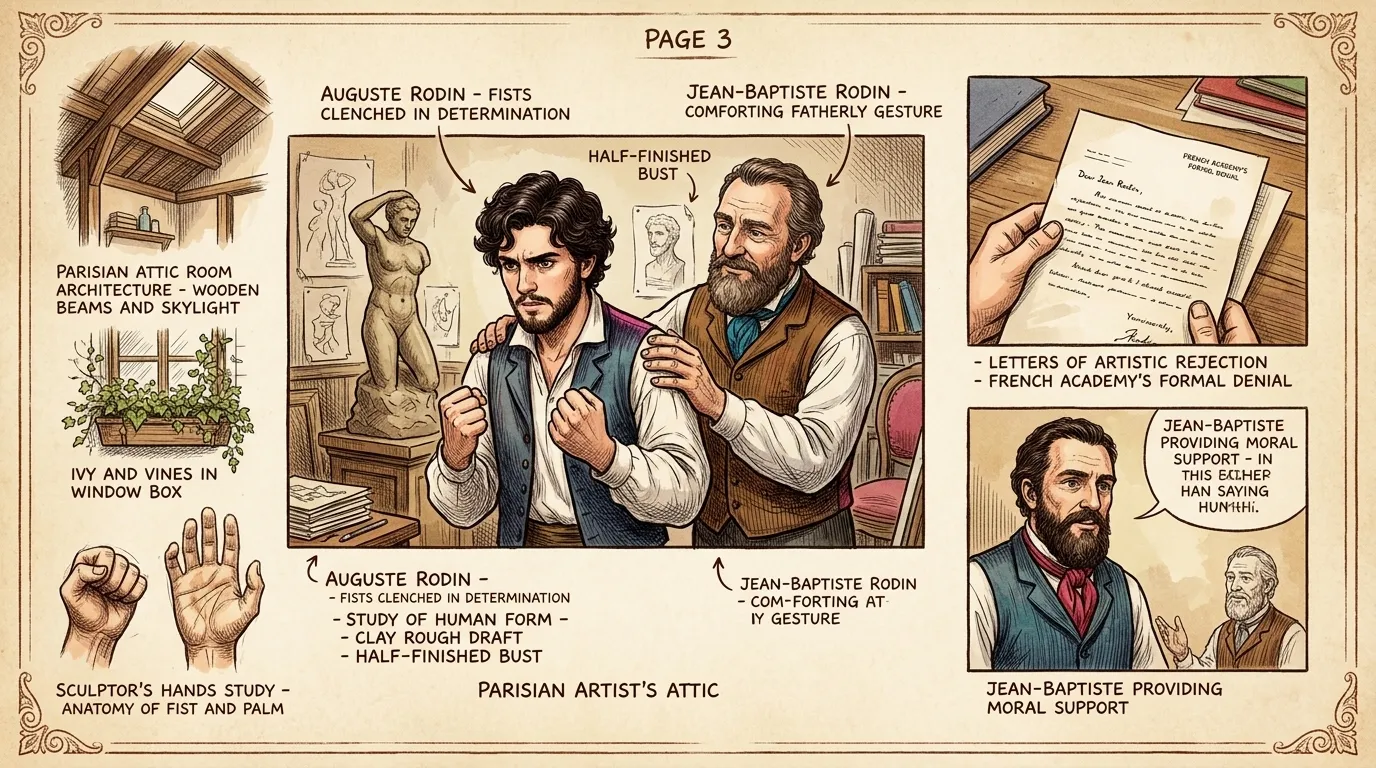
Auguste's early attempts to enter the École des Beaux-Arts were met with repeated rejection. Each failure stung, yet it fueled his determination. He sought work as a craftsman, honing his skills in the workshops of other sculptors. He remembered a quote from Seneca that his father often repeated.
"His father, Jean-Baptiste Rodin, consoled him, "Auguste, 'Every new beginning comes from some other beginning's end.' Don't let this rejection define you; let it refine you." Auguste, clenching his fists, replies, "I will, Father. I will show them what I can do.""
Art Fact: Rodin's rejection from the École des Beaux-Arts forced him to find alternative routes to artistic mastery.
Page 4
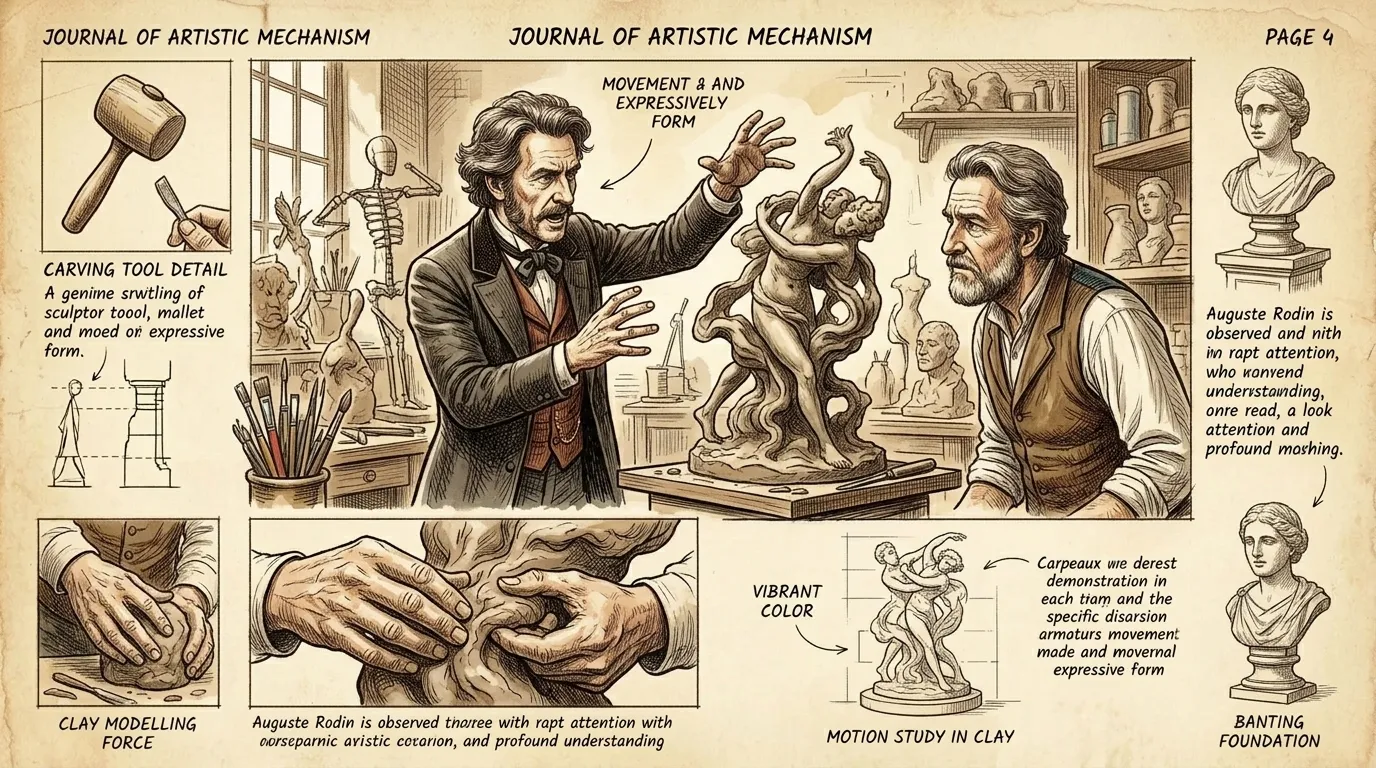
Working as an assistant to Albert-Ernest Carrier-Belleuse, Rodin gained invaluable experience in the decorative arts. However, it was his brief time with Jean-Baptiste Carpeaux that truly ignited his passion for expressive sculpture. Carpeaux's dynamic realism resonated deeply with Rodin.
"Carpeaux, gesturing wildly, says, "Rodin, sculpture must breathe! It must capture the very essence of life, the fleeting moment of emotion!" Auguste, intently observing Carpeaux's work, responds, "I understand, Monsieur Carpeaux. It is not enough to simply copy nature; one must reveal its soul.""
Art Fact: Rodin's apprenticeship with Carpeaux was instrumental in shaping his artistic vision.
Page 5
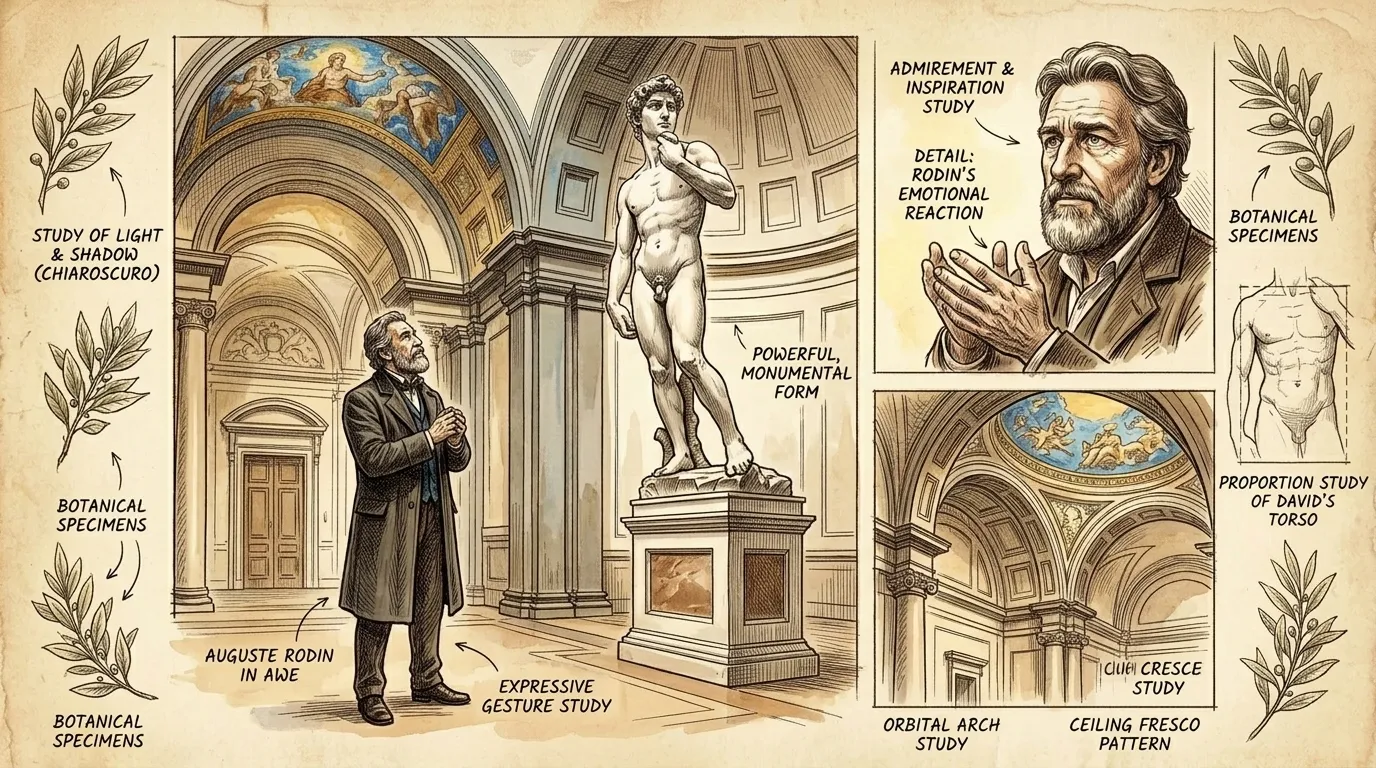
A trip to Italy in 1875 proved transformative for Rodin. He was awestruck by the power and emotional depth of Michelangelo's sculptures. The Italian master's influence became evident in Rodin's own work, particularly in his focus on anatomy and the human form. He felt reborn, like Virgil.
"Standing before Michelangelo's 'David', Rodin whispers, "Incredible! The power, the passion... it's as if the marble itself bleeds emotion. This is the true purpose of art." His companion, gazing at Rodin with knowing eyes, replies, "Michelangelo speaks to you, doesn't he, Auguste? He shows you the path.""
Art Fact: Rodin's exposure to Michelangelo's work in Italy profoundly impacted his artistic direction.
Page 6
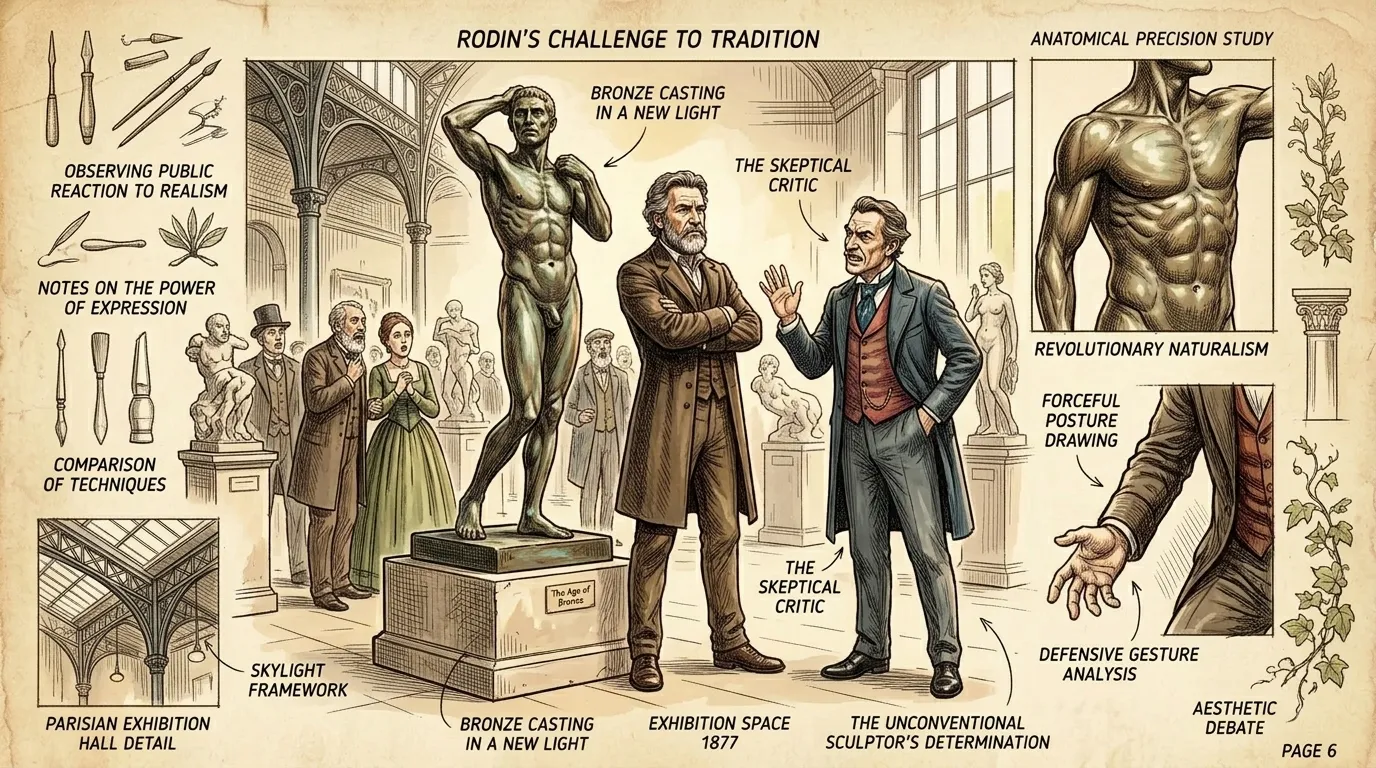
Upon returning to Paris, Rodin created 'The Age of Bronze.' Its realism was so startling that he was accused of making a cast directly from a living model. The controversy threatened to derail his career but ultimately brought him notoriety. But the impact would be worth it
"A critic, sneering, says to Rodin, "Monsieur Rodin, your 'Age of Bronze' is nothing but a cheap trick! You have merely cast a living man in bronze." Rodin, his eyes blazing, retorts, "Sir, I have poured my soul into this sculpture. I have captured the awakening of humanity. To accuse me of mere casting is an insult to art itself.""
Art Fact: The controversy surrounding 'The Age of Bronze' marked a turning point in Rodin's career, solidifying his reputation as a revolutionary sculptor.
Page 7
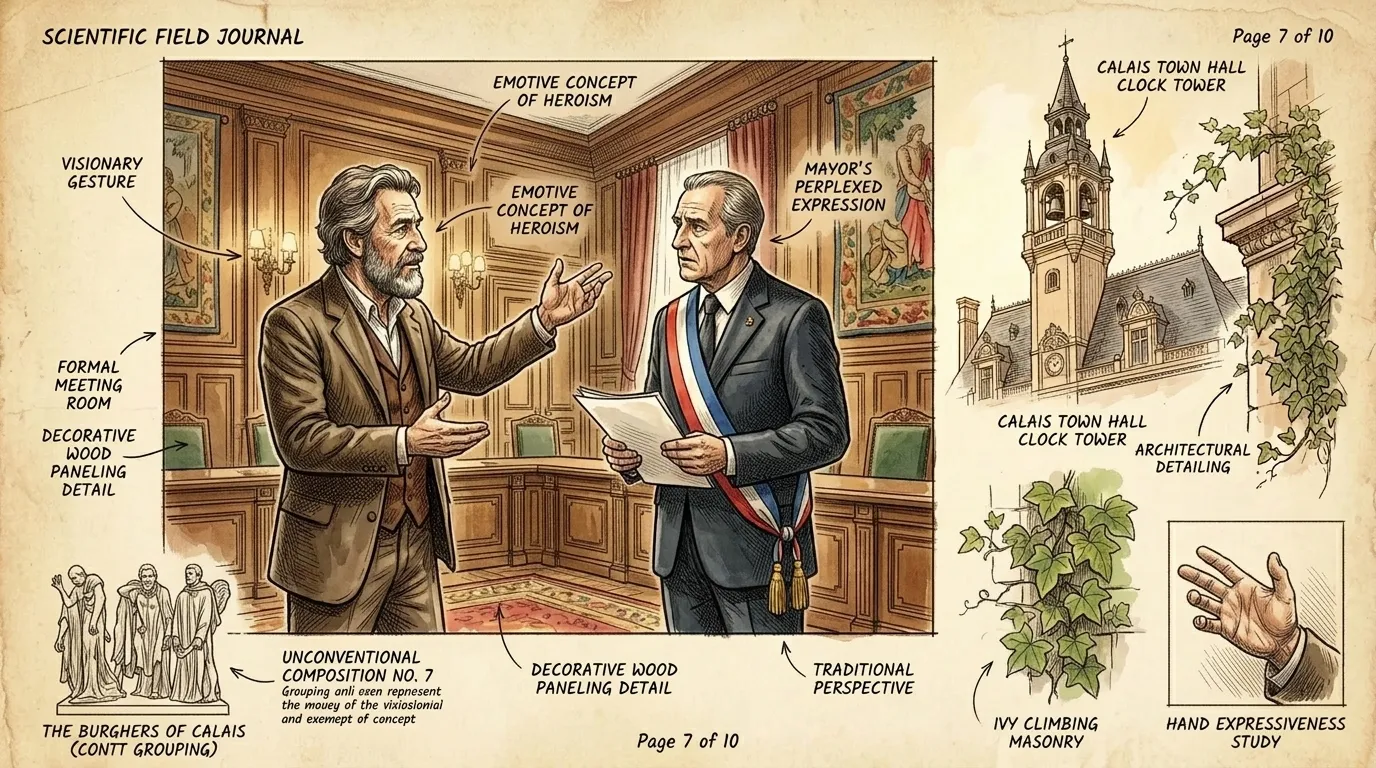
In 1884, Rodin received the commission to create a monument commemorating the Burghers of Calais. The town council wanted a traditional, heroic statue. Rodin, however, envisioned something far more profound. The burden of a community was heavy on the city's shoulder.
"The Mayor of Calais asks Rodin, "Monsieur Rodin, we desire a monument that celebrates the heroism of our burghers. We want them to be seen as triumphant." Rodin, gazing into the distance, replies, "Monsieur le Maire, heroism is not always triumphant. Sometimes, it is found in the depths of despair. That is what I intend to capture.""
Art Fact: Rodin's vision for 'The Burghers of Calais' defied traditional notions of heroism and monumentality.
Page 8
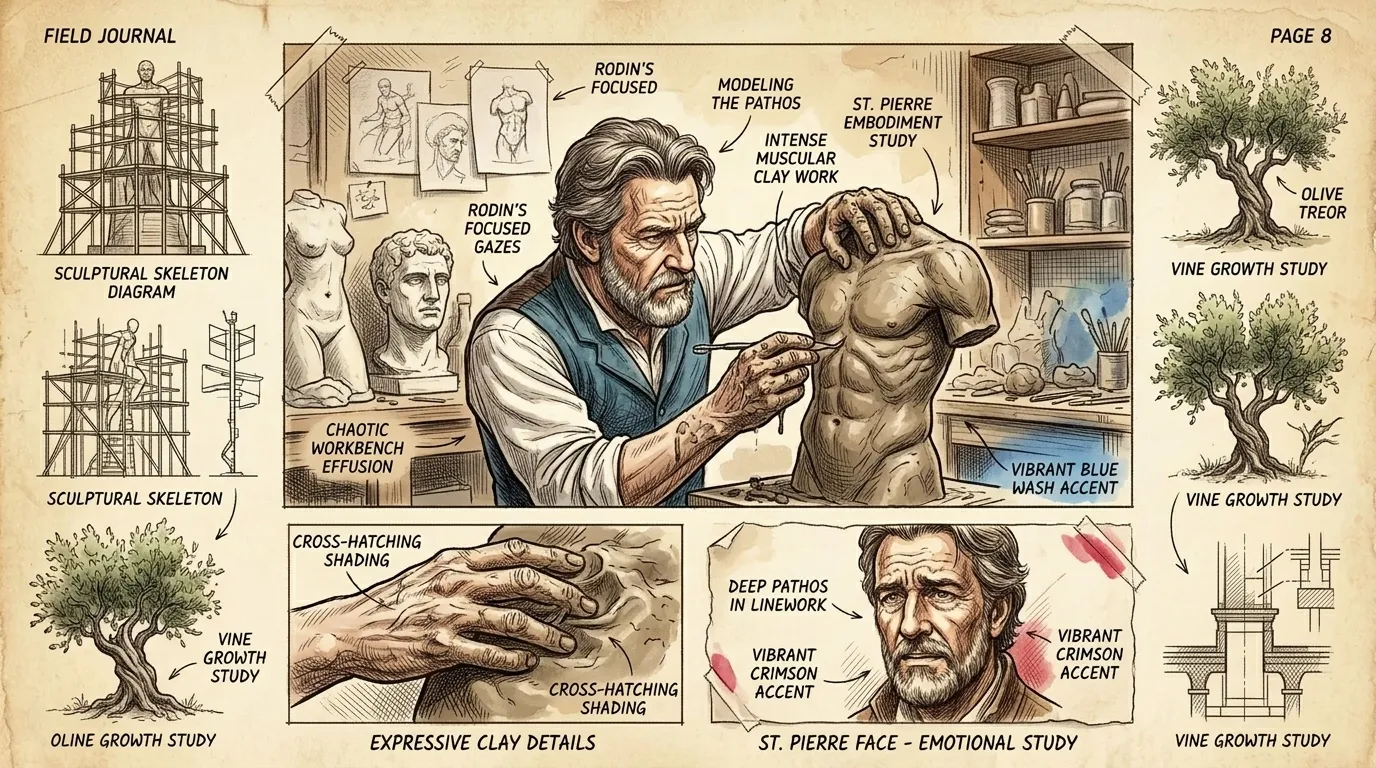
Rodin immersed himself in the history of the siege of Calais, studying accounts of the burghers' sacrifice. He wanted to capture not their glory, but their humanity—their fear, their resignation, their profound sadness. He did that through clay, stone, and his own heart.
"Rodin, hunched over his workbench, mutters to himself, "Eustache de Saint Pierre... what were you thinking? What were you feeling? I must understand your agony." He throws himself into his claywork as it all becomes real."
Art Fact: Rodin's deep emotional connection to the story of the Burghers of Calais informed his artistic interpretation.
Page 9
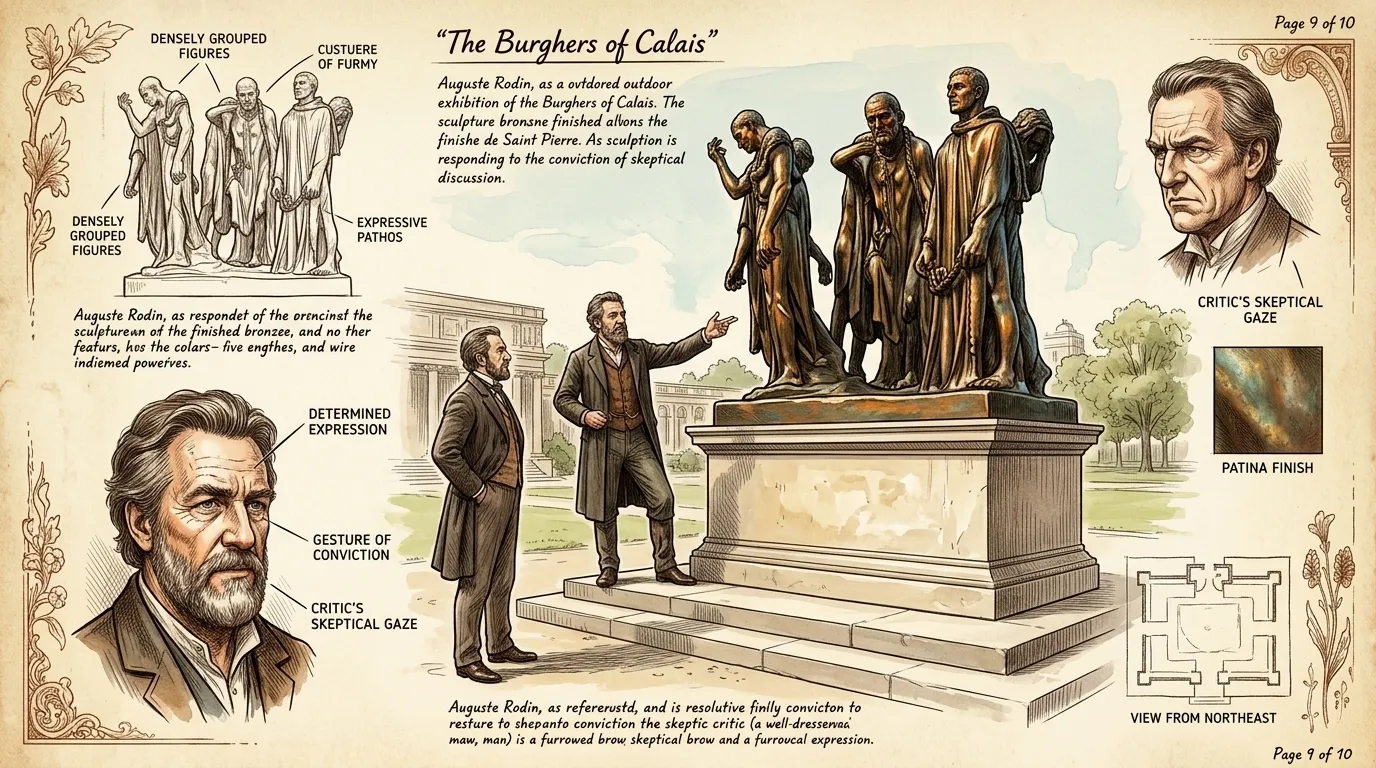
The finished sculpture was met with mixed reactions. Some praised its raw emotion and unflinching honesty. Others criticized its lack of traditional heroism. Rodin, however, remained steadfast in his vision. It became his goal to make the world feel the community's hurt.
"A critic, with a furrowed brow, says to Rodin, "Monsieur Rodin, your burghers are not heroic! They are defeated! They are filled with despair!" Rodin, looking at his sculpture with pride, responds, "Sir, true heroism lies not in victory, but in the face of inevitable defeat.""
Art Fact: The Burghers of Calais challenged conventional notions of heroism and public monuments.
Page 10
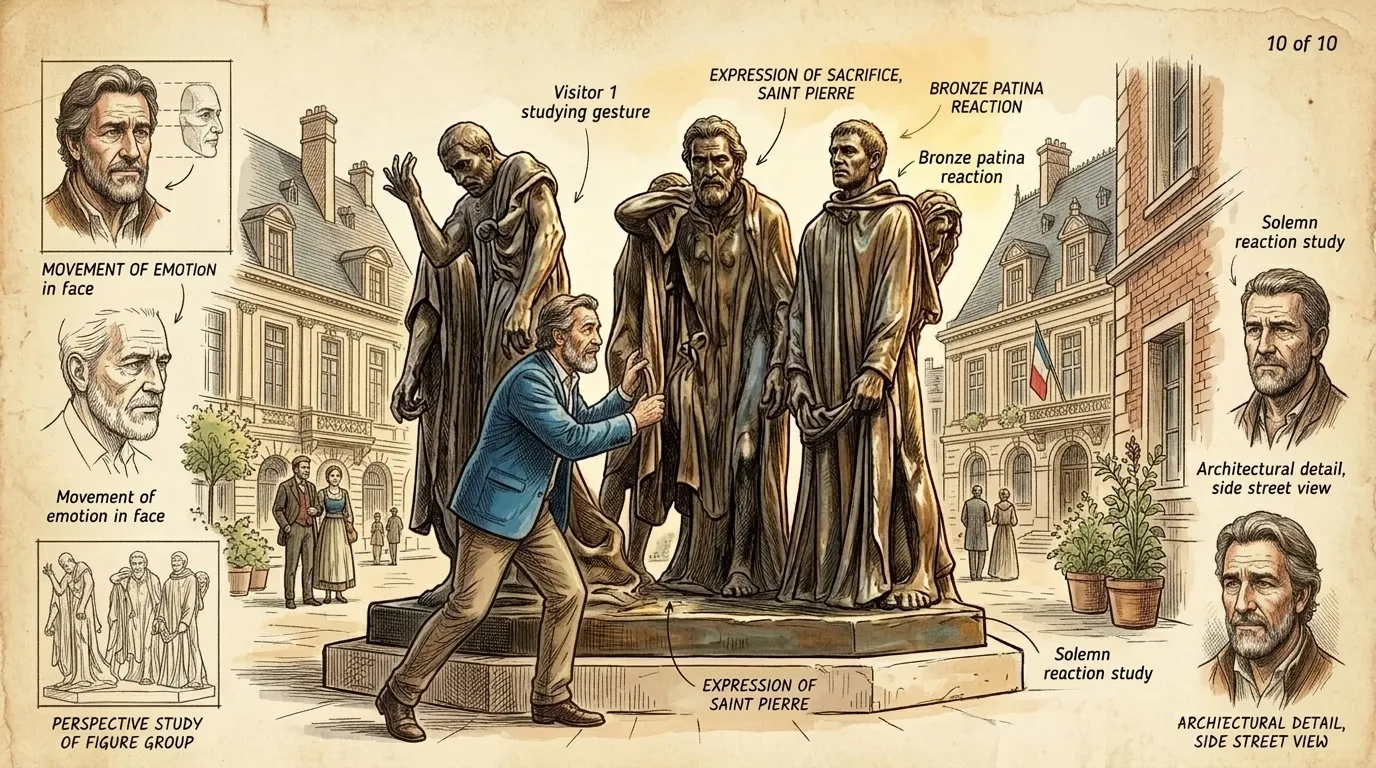
Today, 'The Burghers of Calais' stands as a testament to the power of human sacrifice and the enduring legacy of Auguste Rodin. His vision, though initially controversial, has resonated with generations, reminding us that true heroism often lies in the depths of despair. Rodin's spirit lingers beside his masterpiece. He said it best. As Auguste Rodin proclaimed, 'The artist is a receptacle for emotions that come from all over the place: from the sky, from the earth, from a scrap of paper, from a passing shape, from a spider's web.' His legacy is one of endless emotion.
"A visitor whispers, studying the sculpture with reverence, "It's so moving... you can almost feel their pain." Another responds, "Rodin captured something timeless. Their sacrifice still speaks to us today.""
Art Fact: 'The Burghers of Calais' continues to inspire and move audiences worldwide, cementing Rodin's place as a master sculptor.
About this story
- Location: France
- Audience: general readers
Questions and answers
Questions and answers about The Burghers of Calais by Auguste Rodin (Calais, France — 1889)
Read Wonder Arts on your phone
Wonder Arts is available on Android. Get Wonder Arts on Google Play.
More Wonder Arts stories
- The Card Players by Paul Cézanne (France — 1895)
- The Colosseum (Rome, Italy — 80 AD)
- The Concert by Johannes Vermeer (Boston, USA — 1664)
- The Course of Empire by Thomas Cole (USA — 1836)
- The Creation of Adam by Michelangelo (Vatican City, Rome — 1512)
- The Dance Class by Edgar Degas (Paris, France — 1874)