The Colosseum (Rome, Italy — 80 AD)
The Colosseum (Rome, Italy — 80 AD) — an illustrated arts story, set in Italy. 10 illustrated pages, free to read on Wonder Arts.
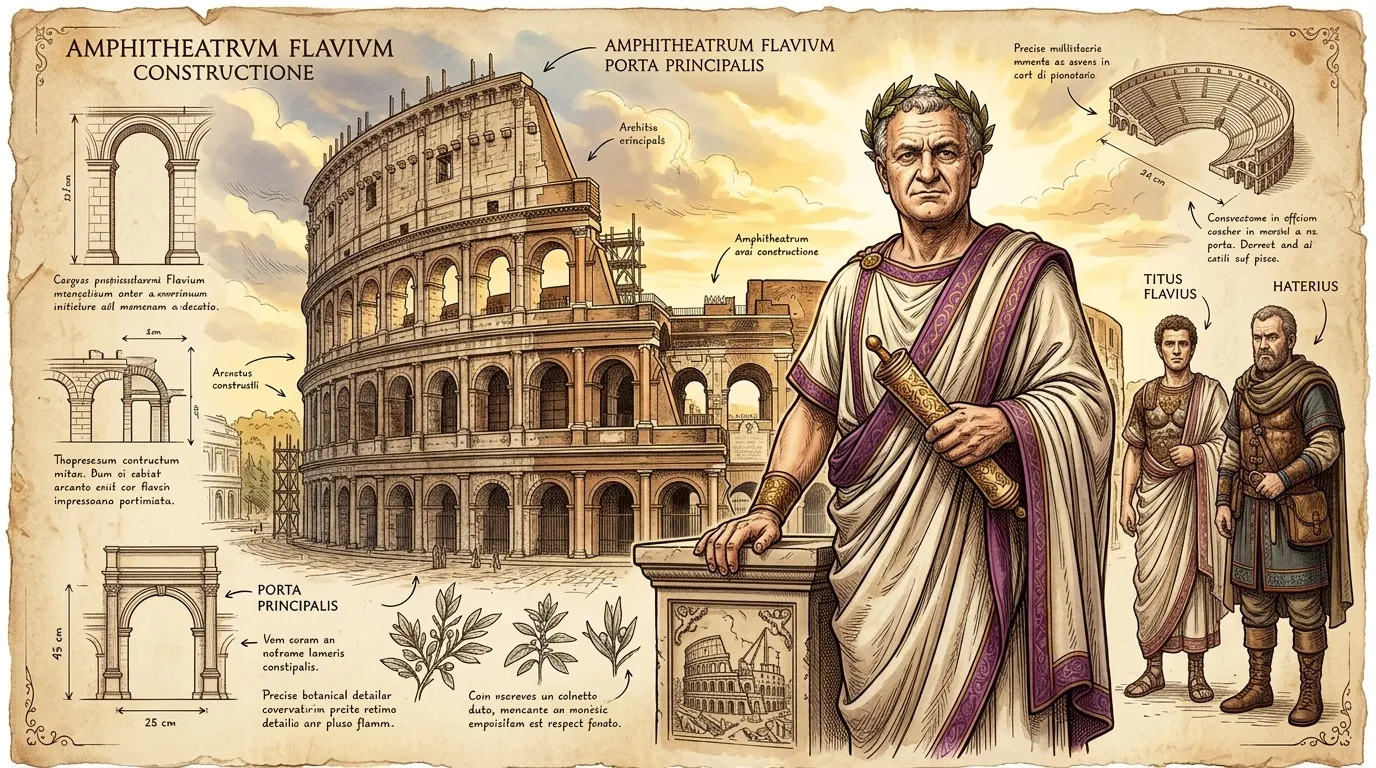
Page 1

Titus Flavius, son of Emperor Vespasian, gazed upon the newly completed Colosseum in 80 AD. This amphitheater, capable of holding 50,000 spectators, was a gift to the Roman people, a testament to the Flavian dynasty's power. The Colosseum, originally known as the Flavian Amphitheater, stood nearly 160 feet tall and measured 620 by 513 feet. Its value then, and now, is immeasurable.
"Titus murmured, "May this arena serve as a lasting symbol of our commitment to the people of Rome, a place for entertainment and unity.""
Art Fact: The Colosseum's construction began under Emperor Vespasian around 70-72 AD and was completed by his son Titus in 80 AD. It was primarily used for gladiatorial contests and public spectacles.
Page 2

Vespasian visited the quarries of Tivoli, the source of the gleaming travertine stone. The harsh sun beat down on the workers as they toiled, shaping the massive blocks. Vespasian observed their methods, understanding the immense labor required to realize his vision.
"Vespasian asked, "Tell me, how do you ensure the stone's durability?" A foreman replied, "We select only the densest layers, Emperor, and carefully carve along the natural grain to prevent cracking.""
Art Fact: Travertine, a form of limestone, was the primary building material for the Colosseum. The quarries near Tivoli, about 20 miles from Rome, provided a plentiful source of this durable stone.
Page 3

A gladiator named Priscus knelt before his lanista, vowing to fight with honor and courage. He understood the grim reality of the arena, where life and death were entertainment. His training had been brutal, pushing him to his physical and mental limits.
"Priscus declared, "I swear by the gods to fight with all my strength and skill, to bring glory to Rome, or die trying!" The lanista, a stern man, responded, "Remember your training, gladiator. Your life is now forfeit; your purpose is to entertain.""
Art Fact: Gladiators were often slaves, prisoners of war, or condemned criminals who were trained to fight in the arena. Their fates were determined by the whims of the crowd and the emperor.
Page 4

The architect Haterius, oversaw the complex construction. He envisioned the intricate network of arches, vaults, and corridors that would support the massive structure. His meticulous planning ensured the smooth flow of spectators and the efficient staging of events.
"Haterius explained, "The key to its strength lies in the careful placement of the arches. Each one supports the weight above, distributing it evenly throughout the structure.""
Art Fact: While the exact identity of the Colosseum's architect is debated, Haterius is a plausible candidate due to his prominence in Roman construction during that period. Roman engineering was crucial for the Colosseum's success.
Page 5

Emperor Titus addressed the crowd during the inaugural games. He promised lavish spectacles and free entertainment for all. His words resonated with the Roman people, who embraced the Colosseum as a symbol of their city's glory.
"Titus proclaimed, "Let the games begin! Let the Colosseum be a place of joy and spectacle for all the citizens of Rome!" The crowd roared its approval, their voices echoing through the arena."
Art Fact: The inaugural games of the Colosseum lasted for 100 days and included gladiatorial combats, animal hunts, and even mock naval battles.
Page 6

The arena floor was flooded to stage a mock naval battle, a Naumachia. Ships clashed, and gladiators fought to the death in a spectacle of astonishing scale. The crowd watched in awe as the Colosseum transformed into a temporary sea.
"A spectator shouted, "Look! The ships are ramming each other! This is a sight unlike any other!" His companion replied, "Only in Rome could such a spectacle be staged!""
Art Fact: Naumachiae, or mock naval battles, were a rare but impressive feature of the Colosseum's early years. The arena could be flooded and drained relatively quickly to accommodate these events.
Page 7

Exotic animals from across the Roman Empire were brought to the Colosseum for hunts, Venationes. Lions, tigers, elephants, and bears battled gladiators in a display of Roman power and dominion.
"A gladiator yelled, "By Jupiter, that lion is fierce!" Another responded, "Hold your ground! We must show no fear!""
Art Fact: Venationes showcased the vast reach of the Roman Empire, with animals being imported from Africa, Asia, and Europe for these events.
Page 8

The gladiator, Flamma, a Thracian warrior, battled with unmatched skill. He was offered freedom multiple times but chose to remain a gladiator, a testament to his love of combat and the arena's allure. He embodies the paradoxical nature of the Colosseum.
"The crowd chanted, "Flamma! Flamma!" A Roman senator remarked, "He could be free, yet he chooses to fight. What drives such a man?""
Art Fact: Flamma was one of the few gladiators who repeatedly earned his freedom but chose to remain in the arena. His story highlights the complex motivations of these fighters.
Page 9

Centuries passed, and the Colosseum weathered earthquakes, fires, and neglect. Yet, it remained standing, a testament to the engineering prowess of the Romans. As the philosopher Seneca once said, 'Every new beginning comes from some other beginning's end.' The Colosseum's end as an arena marked a new beginning as a historical monument.
"An old scholar mused, "These stones have witnessed so much. They whisper stories of emperors, gladiators, and the rise and fall of empires.""
Art Fact: The Colosseum suffered significant damage from earthquakes, particularly in 847 and 1349. Much of its stone was later repurposed for other building projects.
Page 10

Today, the Colosseum stands as a UNESCO World Heritage site, attracting millions of visitors each year. It remains a powerful symbol of Roman ingenuity and a reminder of the empire's enduring legacy. The spirit of its creators, engineers, and even the gladiators, lingers in the stones. The echoes continue, because, in the words of the poet Virgil, 'The gates of hell are open night and day; Smooth the descent, and easy is the way.' The Colosseum is a testament to what can be achieved.
"A modern tourist whispers, "Imagine the spectacle, the roar of the crowd... It's breathtaking." A historian nearby says, "It is more than just stone; it is a living chronicle of a civilization.""
Art Fact: The Colosseum continues to be one of Rome's most popular tourist destinations, attracting millions of visitors each year. Its architectural and historical significance is recognized worldwide.
About this story
- Location: Italy
- Audience: general readers
Questions and answers
Questions and answers about The Colosseum (Rome, Italy — 80 AD)
Read Wonder Arts on your phone
Wonder Arts is available on Android. Get Wonder Arts on Google Play.
More Wonder Arts stories
- The Concert by Johannes Vermeer (Boston, USA — 1664)
- The Course of Empire by Thomas Cole (USA — 1836)
- The Creation of Adam by Michelangelo (Vatican City, Rome — 1512)
- The Dance Class by Edgar Degas (Paris, France — 1874)
- The Death of Sardanapalus by Eugène Delacroix (Paris, France — 1827)
- The Dying Gaul by Epigonus (Rome, Italy — c. 230 BC)