The Birth of Venus by William-Adolphe Bouguereau (France — 1879)
The Birth of Venus by William-Adolphe Bouguereau (France — 1879) — an illustrated arts story, set in France. 10 illustrated pages, free to read on Wonder Arts.
Page 1

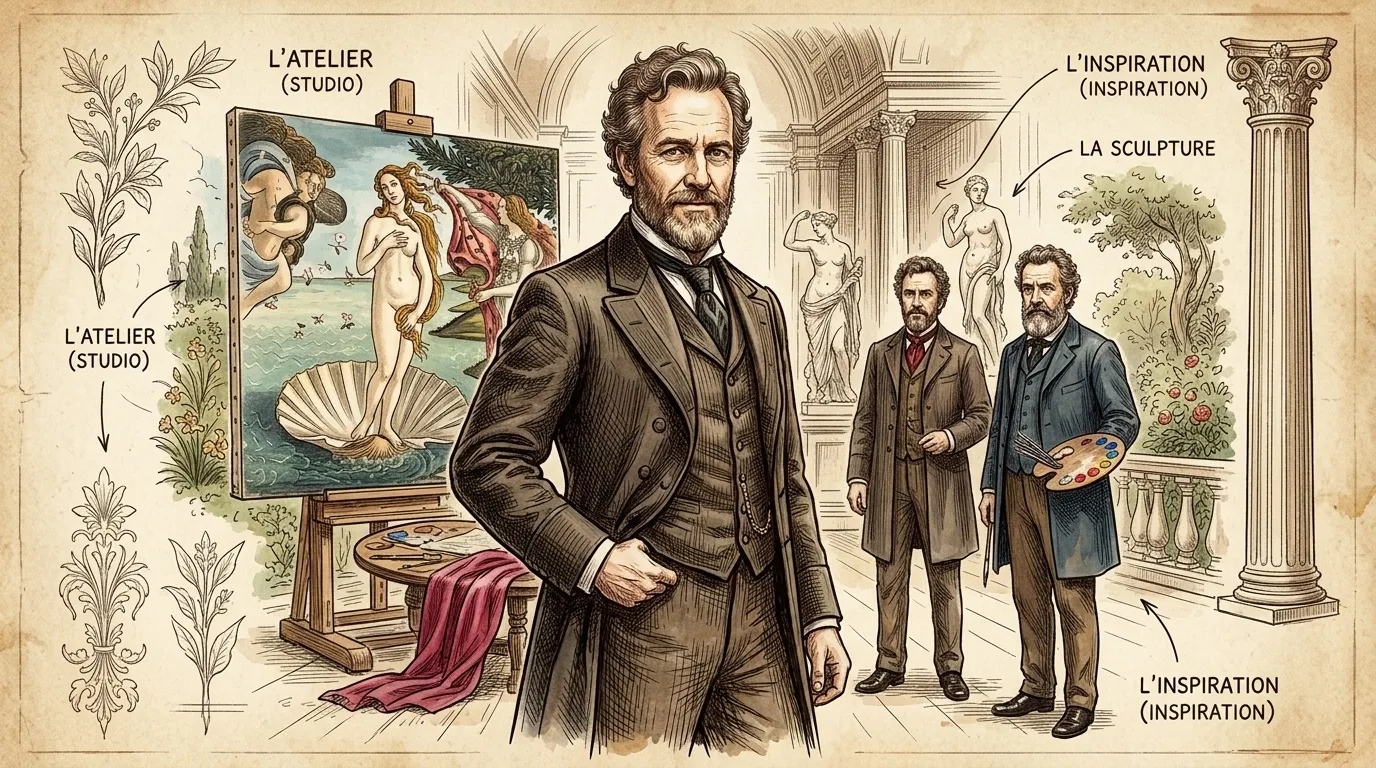
William-Adolphe Bouguereau, the master of academic painting, gazes upon his masterpiece, 'The Birth of Venus,' completed in 1879. The canvas, measuring 218 x 300 cm, shimmers with a pearlescent light, a testament to Bouguereau's meticulous technique. Housed in the Musée d'Orsay, Paris, its fame belies a period of critical scorn and accusations of sentimentality, a shadow that never quite dimmed the public's love for its idealized beauty.
""After all the sketches and trials, she has finally emerged," Bouguereau murmurs, a faint smile gracing his lips. "Venus, born of the sea, just as Apelles envisioned centuries ago.""
Art Fact: The Birth of Venus, William-Adolphe Bouguereau, 1879, Musée d'Orsay, Paris. Oil on canvas, 218 x 300 cm.
Page 2

A young Bouguereau, barely a teenager, meticulously sketches a cherubic face from a religious fresco in the chapel of his uncle, a priest in Saint-Étienne. He pores over the delicate lines and soft shading. 'Practice makes perfect' Uncle Eugène would say. At that moment, Bouguereau realized he was destined to become a painter.
""The human form, Eugène, is the ultimate expression of divine beauty," young Adolphe declared, carefully rendering the angel's wing. His uncle smiled. "Indeed, my boy, but remember, 'the devil is in the details,' as Flaubert wisely noted." The angel in the fresco becomes a starting point for many Venus figures."
Art Fact: Bouguereau's early training emphasized precise drawing and idealized forms, laying the foundation for his academic style.
Page 3

Paris, 1846. Bouguereau, now a determined young man, stands before the École des Beaux-Arts. After much effort, he had been accepted to the Academy, despite his father's initial reservations. The scent of turpentine and ambition fills the air. This is where he hones his skills and gains recognition.
""So, you finally decided to follow your dream," his friend Louis said, clapping him on the back. "Remember what Balzac said: 'The future belongs to those who believe in the beauty of their dreams.'" Bouguereau nodded, his eyes fixed on the grand entrance of the École. "And I intend to seize it.""
Art Fact: The École des Beaux-Arts was the center of artistic training in France, shaping Bouguereau's artistic development.
Page 4

Rome, 1850. Bouguereau, winner of the Prix de Rome, studies the masterpieces of the Renaissance in the Villa Medici. He is struck by the beauty of Raphael's frescoes. The clarity of line and grace of form inspire him. The foundations of his style solidifying.
""Look at the harmony, the balance, the sheer perfection!" Bouguereau exclaims to his fellow artist, Jean-Léon Gérôme, pointing to a detail in Raphael's 'The Triumph of Galatea'. Gérôme nods, thoughtfully stroking his beard. "As Leonardo da Vinci said, 'Painting embraces all the ten functions of the eye; that is to say, darkness, light, body and color, shape and situation, distance and nearness, motion and rest.' Raphael understood this implicitly."
Art Fact: The Prix de Rome allowed Bouguereau to study the great masters in Italy, deeply influencing his style.
Page 5

Paris, 1855. Bouguereau exhibits his works at the Salon. Critics praise his technical skill, but some question his lack of originality. Despite the mixed reviews, he gains the attention of wealthy patrons. He felt compelled to conform to certain standards.
""Your technique is impeccable, Monsieur Bouguereau," a prominent critic remarks, adjusting his spectacles. "But tell me, where is the innovation? Where is the soul?" Another voice chimes in, "'The greatest glory in living lies not in never falling, but in rising every time we fall,' as Nelson Mandela would say. Keep pushing, Monsieur Bouguereau!""
Art Fact: The Salon was crucial for an artist's success in 19th-century France, providing exposure and opportunities for commissions.
Page 6

Bouguereau's dedication to idealized beauty is increasingly viewed by the avant-garde as outdated. Impressionism is emerging. Some called his work sentimental and shallow. Despite this, his patrons adore his work.
"Monet scoffed, "Bouguereau? He's just painting pretty pictures for the bourgeoisie!" Degas replied, "Let him paint what he wants. As Voltaire said, 'I disapprove of what you say, but I will defend to the death your right to say it'." Bouguereau remained steadfast."
Art Fact: The rise of Impressionism challenged Bouguereau's academic style, leading to critical debates about the direction of art.
Page 7

During a visit to the seashore in Brittany, Bouguereau witnesses a group of young women bathing in the waves. The play of light on their skin and the fluidity of their movements captivates him. This scene inspires him to paint 'The Birth of Venus'.
""The light, the light!" Bouguereau exclaims to his assistant, sketching furiously in his notebook. "The way it dances on their skin, like pearls in the seafoam! It is Aphrodite herself emerging from the waves!" The assistant nodded, "Indeed, 'beauty in things exists in the mind which contemplates them,' as David Hume has said. You must capture this on canvas, Monsieur.""
Art Fact: Nature becomes a source of inspiration for Bouguereau, influencing the composition and atmosphere of 'The Birth of Venus'.
Page 8

Back in his studio, Bouguereau begins working on preliminary sketches for 'The Birth of Venus'. He experiments with different poses and compositions, striving for the perfect balance of beauty and grace. The studio walls are covered with charcoal sketches, revealing the evolution of the painting.
""She must be perfect, ethereal, divine!" Bouguereau muttered, adjusting the pose of a nude model. "Michelangelo said, 'I saw the angel in the marble and carved until I set him free.' I must do the same for Venus!""
Art Fact: Bouguereau's meticulous approach involved extensive sketching and careful study of the human form.
Page 9

The canvas comes alive with color as Bouguereau applies layer upon layer of paint. He mixes pigments to create a luminous, pearlescent effect. He adds many details to the work to give a sense of ethereal beauty. He is fully lost in the work.
""More white, more pink, a touch of blue!" Bouguereau instructs his assistant, meticulously blending colors on his palette. "As Delacroix said, 'Color should think!' And these colors shall sing of Venus's birth!""
Art Fact: Bouguereau's mastery of color and technique creates the ethereal beauty that defines 'The Birth of Venus'.
Page 10

Today, 'The Birth of Venus' hangs in the Musée d'Orsay, captivating visitors from around the world. It may have faced criticism, and fashions may change, but the allure of idealized beauty endures. Bouguereau's Venus remains an eternal symbol of love and femininity. His vision lives forever.
"From beyond, Bouguereau, in spectral form, looks on at the scene. "'Art is not what you see, but what you make others see,' as Degas said." And I have made them see beauty."
Art Fact: 'The Birth of Venus' continues to inspire awe and admiration, ensuring Bouguereau's place in art history.
About this story
- Location: France
- Audience: general readers
Questions and answers
Questions and answers about The Birth of Venus by William-Adolphe Bouguereau (France — 1879)
Read Wonder Arts on your phone
Wonder Arts is available on Android. Get Wonder Arts on Google Play.
More Wonder Arts stories
- The Burghers of Calais by Auguste Rodin (Calais, France — 1889)
- The Card Players by Paul Cézanne (France — 1895)
- The Colosseum (Rome, Italy — 80 AD)
- The Concert by Johannes Vermeer (Boston, USA — 1664)
- The Course of Empire by Thomas Cole (USA — 1836)
- The Creation of Adam by Michelangelo (Vatican City, Rome — 1512)