Thutmose III
Thutmose III — an illustrated history story. 10 illustrated pages, free to read on Wonder Egypt.
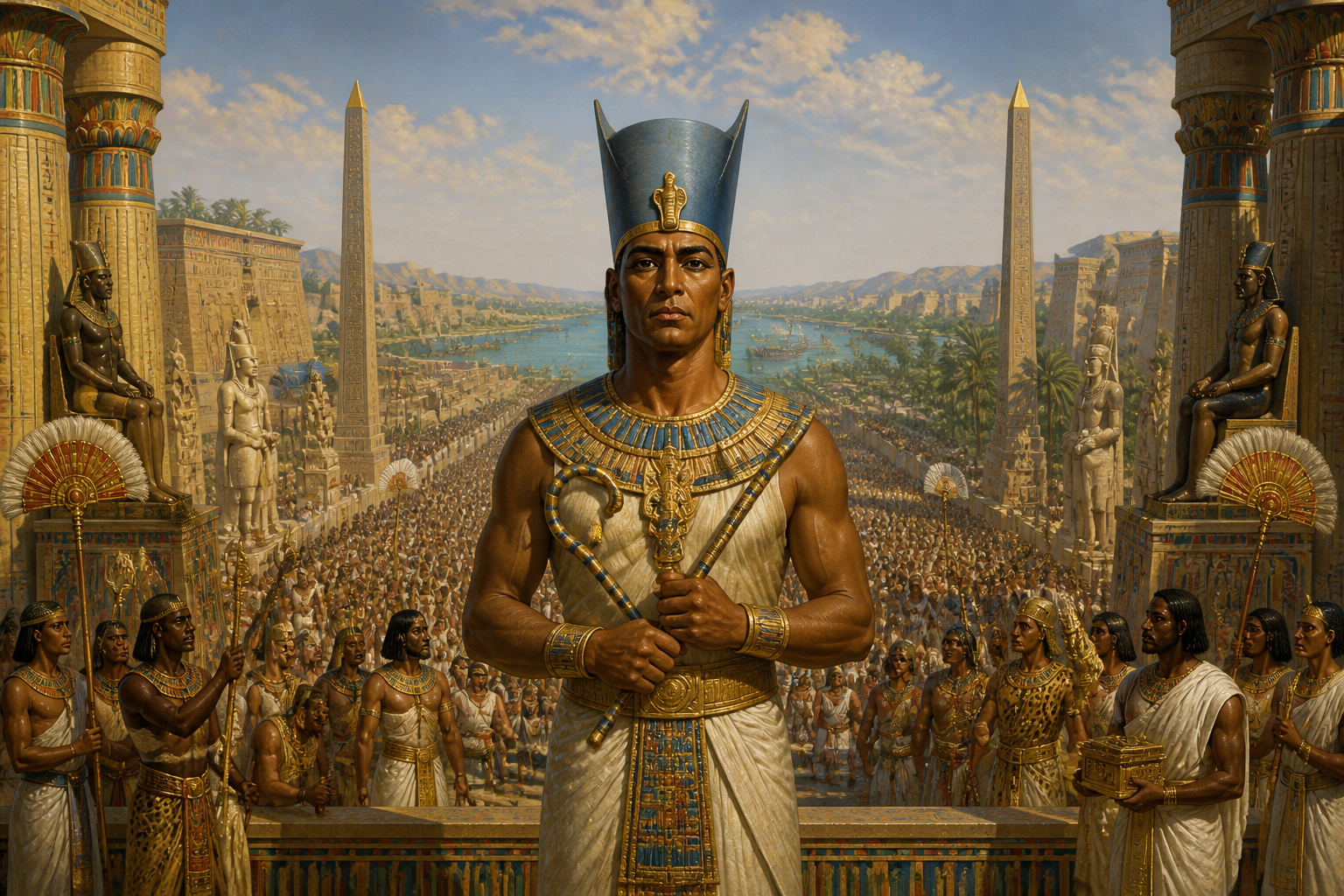
Page 1 — The Pharaoh Unveiled
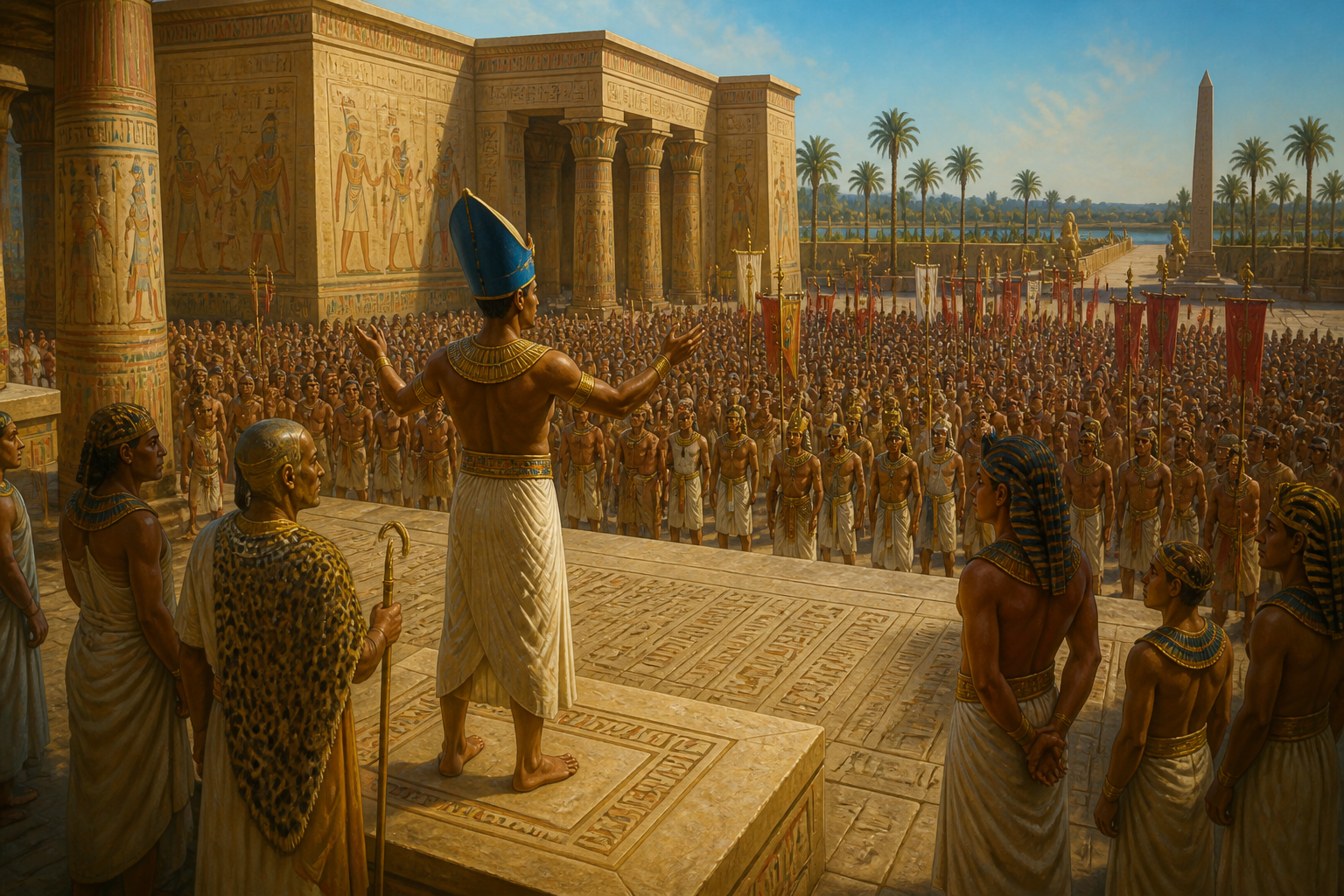
Thutmose III, often referred to as the Napoleon of Ancient Egypt for his military prowess, stands as a colossus in Egypt's storied history. Ascending to power after a lengthy regency under his stepmother Hatshepsut, Thutmose transformed from a shadowy figure into one of Egypt's most eminent rulers. During his reign, he led seventeen unforgettable military campaigns, expanding Egypt's reach to the far corners of the known world, from the Euphrates in the north to the Fourth Cataract of the Nile in the south. These conquests weren't merely for territorial gain; they were meticulously recorded on the stone walls of Karnak, a chronicle of stone that remains the earliest detailed account of warfare. Thutmose was not only a military strategist but also a visionary builder, leaving behind monumental structures that spoke of his reign's prosperity and power. Around him stood figures like his ambitious predecessor Hatshepsut, his son and successor Amenhotep II, and his loyal viziers Rekhmire and Menkheperreseneb, who helped administer his vast empire. In the tapestry of time, Thutmose III emerges as a symbol of Egyptian might, a leader whose life was woven with battles, alliances, and architectural grandeur.
Thutmose III: 'Prepare the chariots, Rekhmire. We move at dawn. The lands beyond the Euphrates await our banner.' Rekhmire: 'The men are ready, my Pharaoh. Egypt's might shall be known across the sands.'
Page 2 — The Shadow and the Light
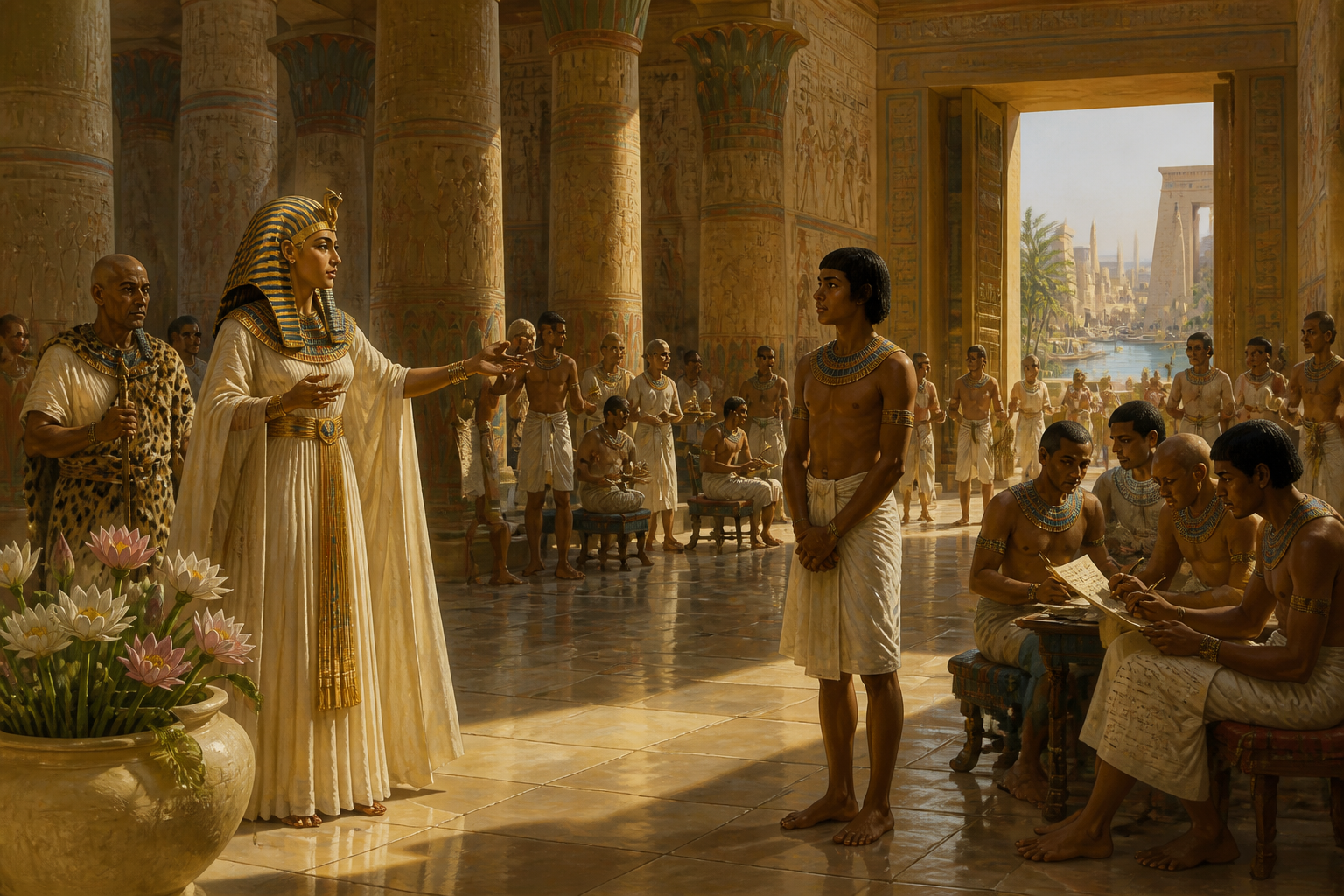
Before his reign truly began, Thutmose III spent years in the shadow of Hatshepsut, his stepmother, who ruled as king in her own right. This period might have been a source of frustration for the young pharaoh, yet it also served as an extensive apprenticeship. Hatshepsut, a powerful and astute ruler, initiated great building projects and expanded trade networks, setting the stage for Thutmose's later achievements. The two were physically distinct in the court; Hatshepsut often donned the traditional pharaoh's regalia, including the false beard, while Thutmose, then a young man in his twenties, was clad in plain white linen robes, symbolizing his non-ruling status. The court was a theater of subtle power plays, with figures like Senenmut, Hatshepsut's trusted advisor, and Neferure, her daughter, playing key roles. This time of waiting shaped Thutmose, imbuing him with a deep understanding of diplomacy and governance. It was here, within the walls of Thebes, surrounded by towering obelisks and the constant bustle of courtiers and scribes, that the future warrior king silently observed, learned, and prepared for his eventual rise to power.
Hatshepsut: 'Patience, Thutmose. Time will favor you when the gods will it.' Thutmose III: 'I await that day, stepmother, as I learn from your wisdom.'
Page 3 — The Awakening King
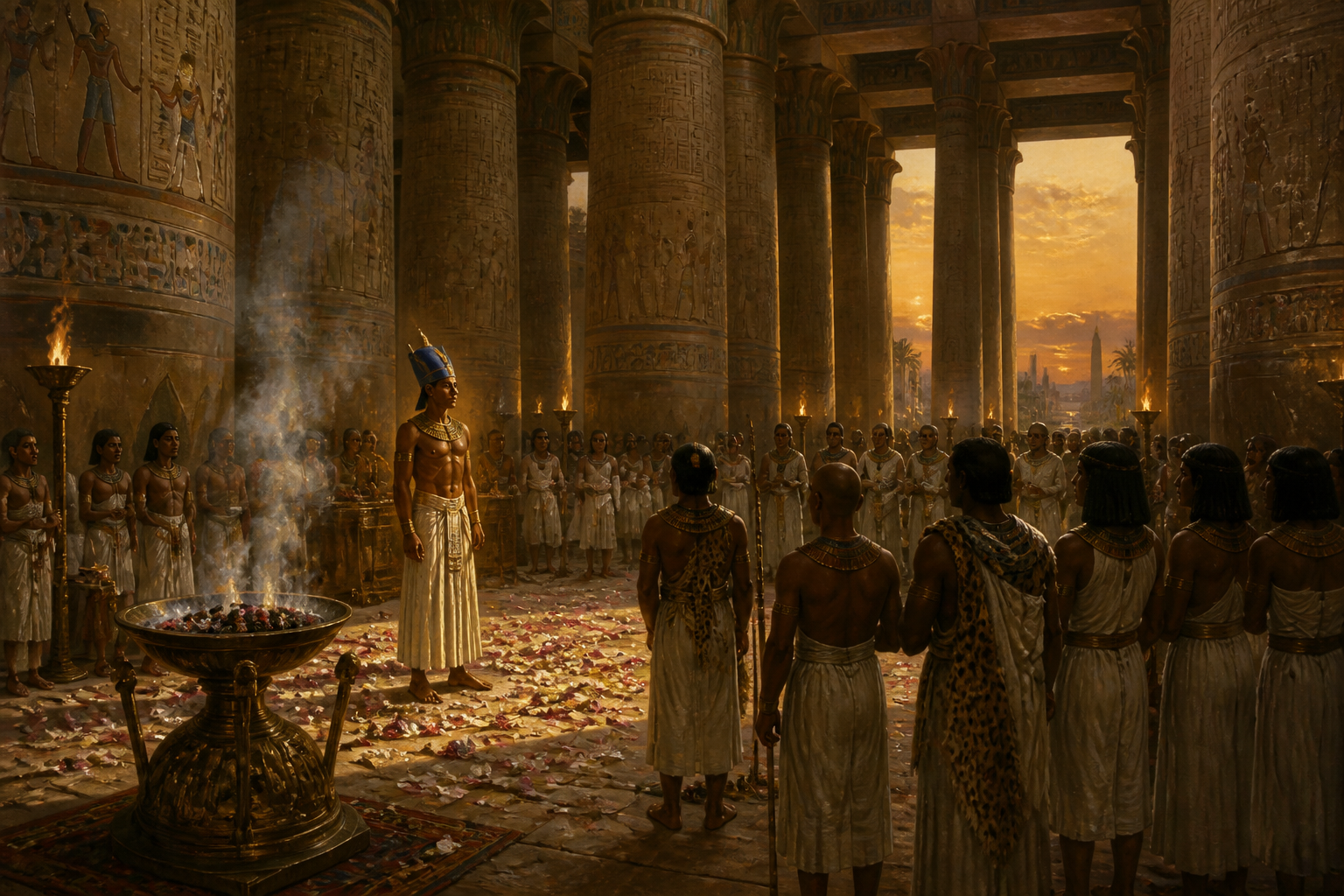
The halls of Karnak buzzed with anticipation as the announcement of Thutmose III's unchallenged ascension echoed through its chambers. With Hatshepsut's death, Thutmose emerged from the margins of power to finally embrace the mantle of full pharaonic authority. His first decree echoed a commitment to assert Egypt's dominance. Rekhmire, his sagacious vizier, stood close, offering counsel and the wisdom of years spent in administration. Menkheperreseneb, the high priest of Amun, prepared the ceremonial rites that would solidify Thutmose's divine right to rule. Satiah, the young pharaoh’s first great royal wife, was beside him, her presence a symbol of unifying strength. The new pharaoh was determined not just to lead but to expand, to build upon the legacy left to him. Yet power was not a mere gift; it was a responsibility, a mantle heavy with the expectations of the pantheon and the people. As the temple priests chanted, the scent of burning incense filled the air, and the stone walls seemed to resonate with the echoes of a king's awakening resolve, a resolve that would soon echo far beyond Egypt’s borders.
Rekhmire: 'The kingdom awaits your command, my Pharaoh. Destiny is at your feet.' Thutmose III: 'Let Amun guide us. Egypt shall rise to meet its fate.'
Page 4 — The Forge of Empire
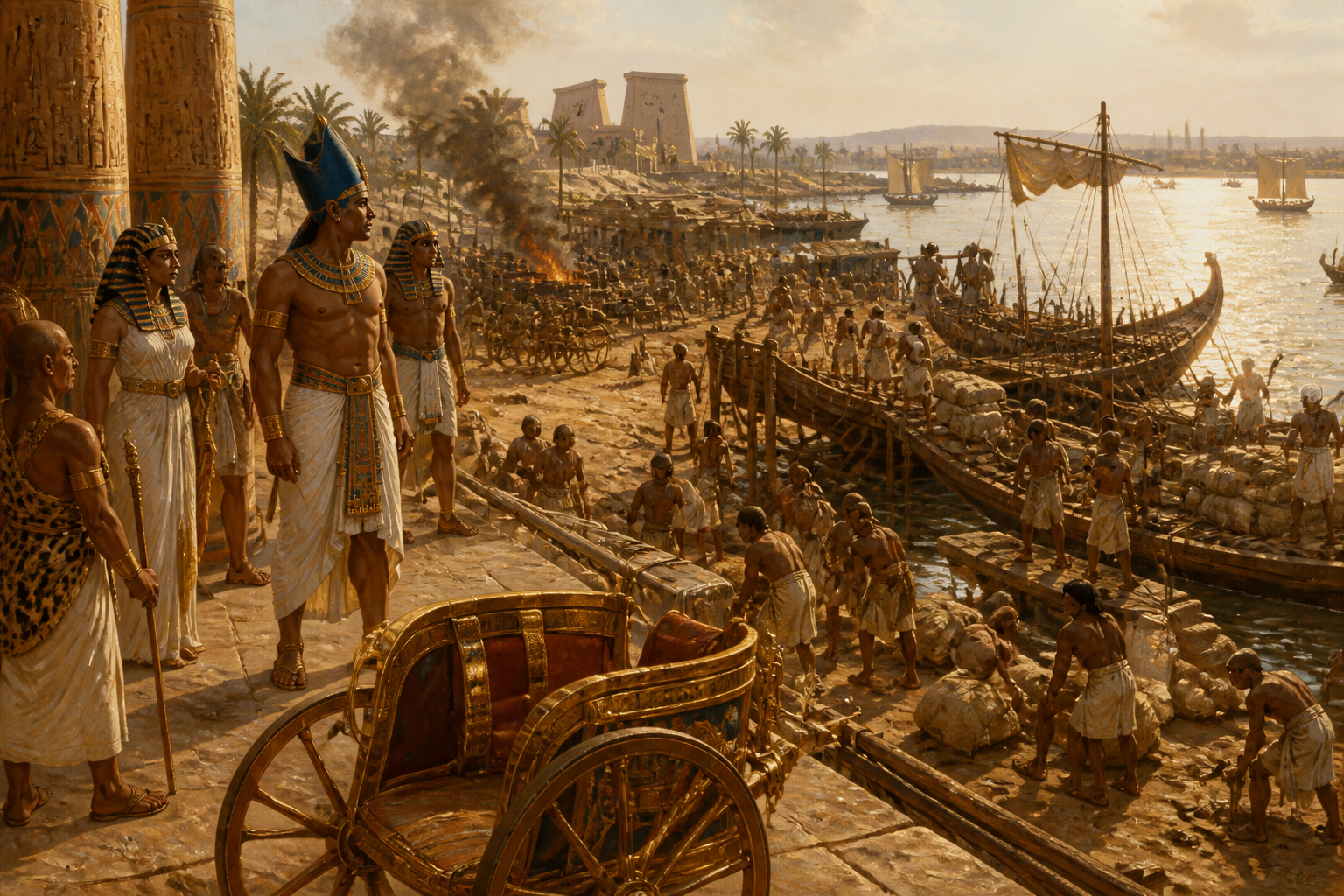
No sooner had Thutmose III firmly taken the reins of power than he began to forge an empire that would become legendary. The Levant, a region often rebellious and independent, was to be the proving ground of his resolve. The preparations for his campaign were monumental, involving the mobilization of chariots, infantry, and naval forces. On the sandy banks of the Nile, just outside the bustling shipyards of Memphis, the assembly of the mighty Egyptian war machine was underway. Amenhotep II, Thutmose's son and eager apprentice, keenly observed, learning the art of war that he would inherit. This was no mere exercise; it was a calculated march toward expansion. The air was filled with the rhythmic clang of metal on metal as armorers crafted shields and weapons, and the strong smell of tar as ships were prepared for the river journey north. Under the command of their pharaoh, the soldiers, in their kilts of light linen and heads shaven for combat readiness, offered prayers to Amun for victory. This was the beginning of a campaign that would engrave Thutmose's name in the annals of history as a conqueror who turned vision into reality.
Amenhotep II: 'Father, the men are ready, eager to march under your banner.' Thutmose III: 'Then let us show the world the might of Egypt!'
Page 5 — Conquest in Canaan
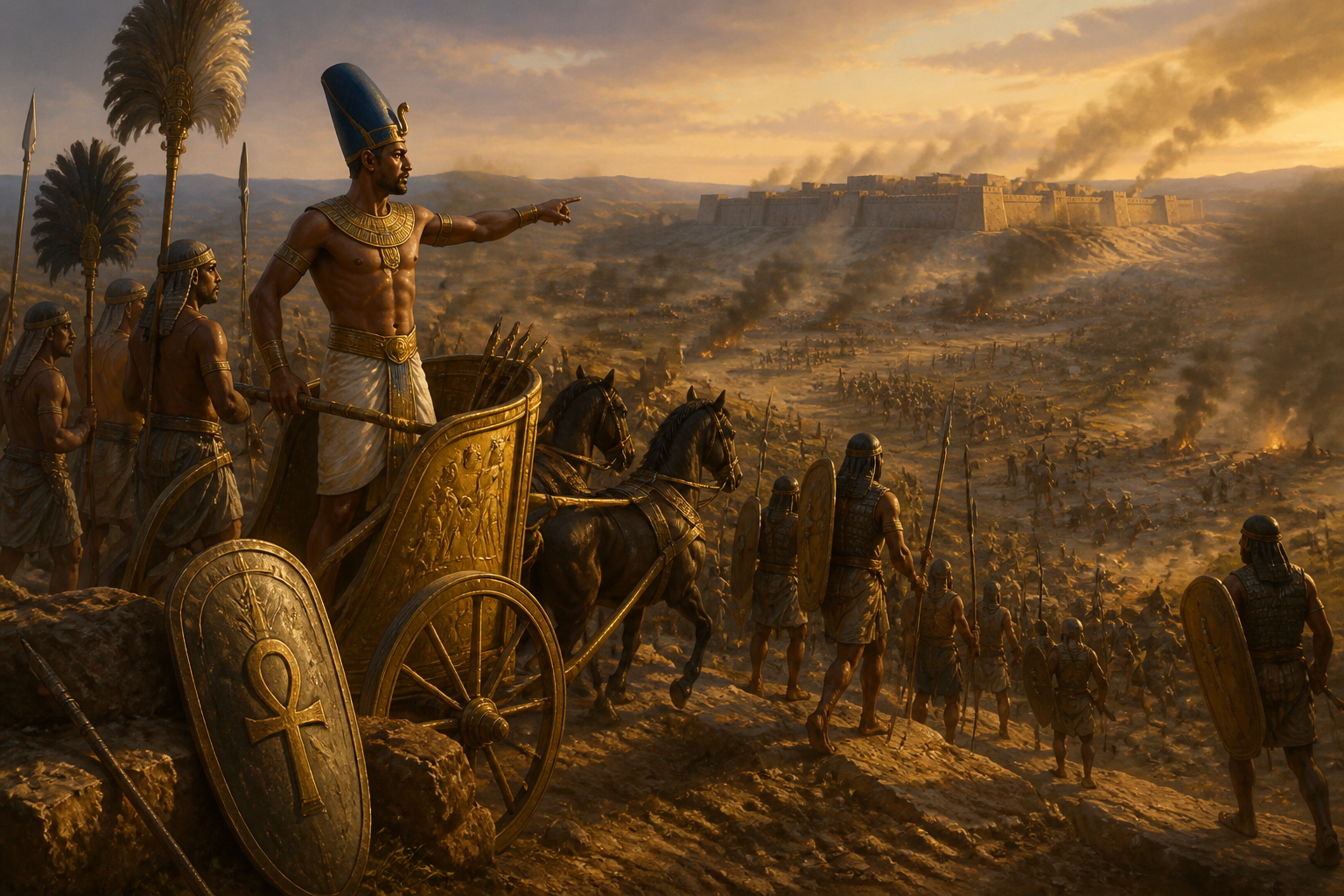
Thutmose III's campaign in Canaan was marked by the audacious siege of Megiddo, an event that would define its era. The battlefield stretched before the fortified city, where Egyptian forces, organized and disciplined, faced an assembly of rebellious Canaanite kings. The dust rose with the marching feet of thousands of men, the sound of their rhythmic marching echoing against the hills. Thutmose, riding a grand chariot, was a vision of leadership, wearing the khepresh and flanked by his loyal generals. The scent of sweat and leather permeated the air, mingling with the distant smell of campfires. His strategy was cunning; instead of a direct assault, he opted for a surprise encircling maneuver that caught the defenders off-guard. As the sun set over the horizon, casting a blood-red hue across the sky, the Egyptian forces closed in. Victory was hard-fought and resonant, with Megiddo falling into Egyptian hands, setting a precedent for Thutmose's further advances. The battle was not just a military triumph but an assertion of Egyptian dominance that sent ripples through the political landscape of the region.
General: 'The Canaanites are faltering, my lord. We have them surrounded!' Thutmose III: 'Press on! Let Megiddo be our gateway to the north!'
Page 6 — The Ritual of Victory
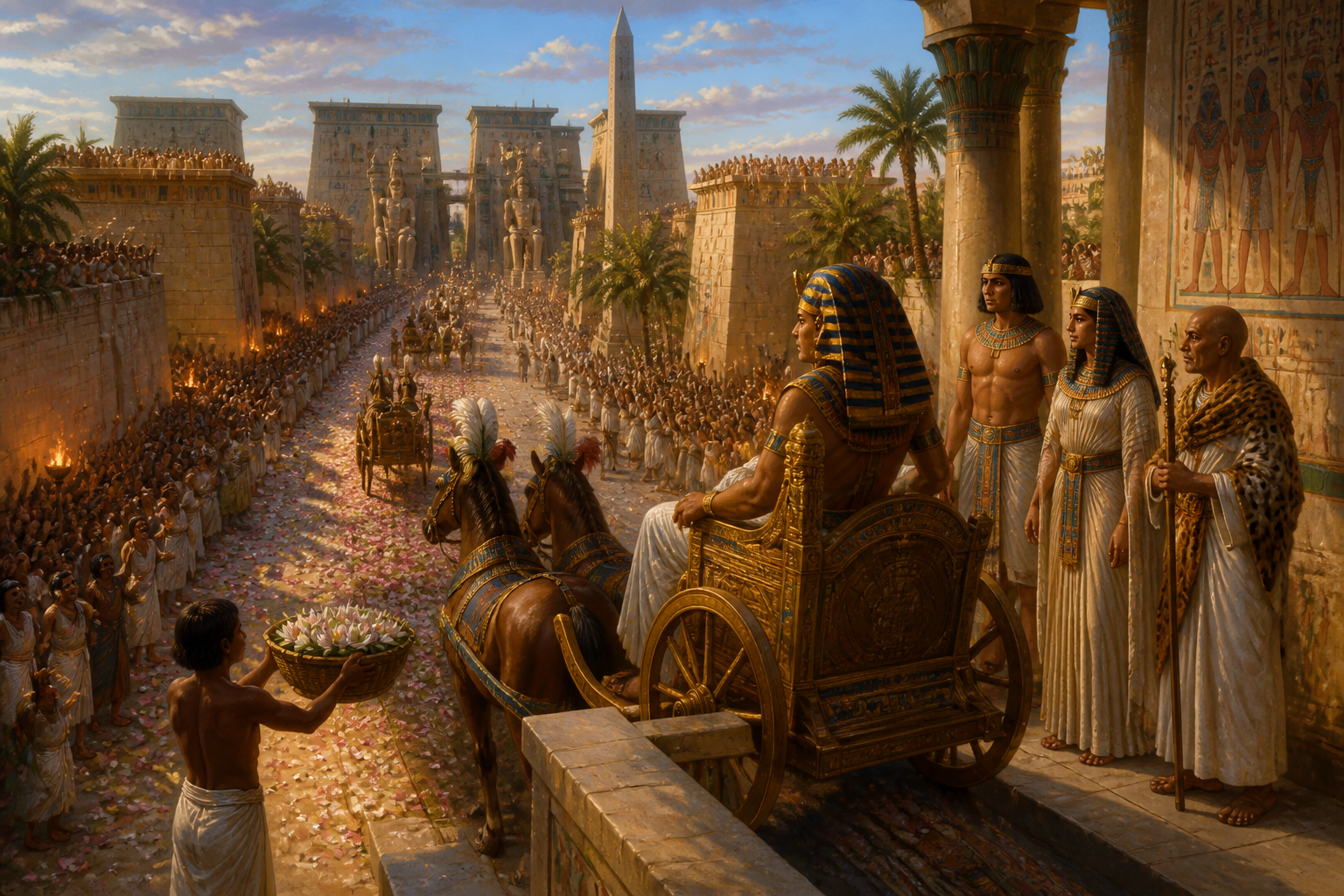
After the triumphant campaign in the north, Thutmose III returned to Egypt, where a grand victory celebration awaited him in the heart of Thebes. As the procession moved through the streets, the city pulsed with the sound of drums and the cheers of thousands. The air was perfumed with myrrh and incense, while petals of blue lotus rained down from the rooftops. Thutmose, adorned in a shimmering gold nemes and the white linen shendyt of his rank, sat high on a gilded throne atop a procession chariot. Rekhmire, the vizier, walked beside him, holding a scroll that chronicled the victories for all to hear. The people, wearing simple linen garments, lined the streets, their voices a chorus of devotion and admiration. As the procession reached the temple of Amun, the high priest Menkheperreseneb, in his elaborate leopard-skin mantle, greeted him with blessings. The scene was one of majestic unity, a testament to Thutmose's leadership and the divine favor of the gods. In the shadow of Karnak’s towering pylons, the pharaoh and his people celebrated a victory that was both military and spiritual.
Menkheperreseneb: 'The gods smile upon you, Thutmose. Egypt rejoices in your return.' Thutmose III: 'And may Amun continue to guide us in prosperity and peace.'
Page 7 — Legacy of Stone
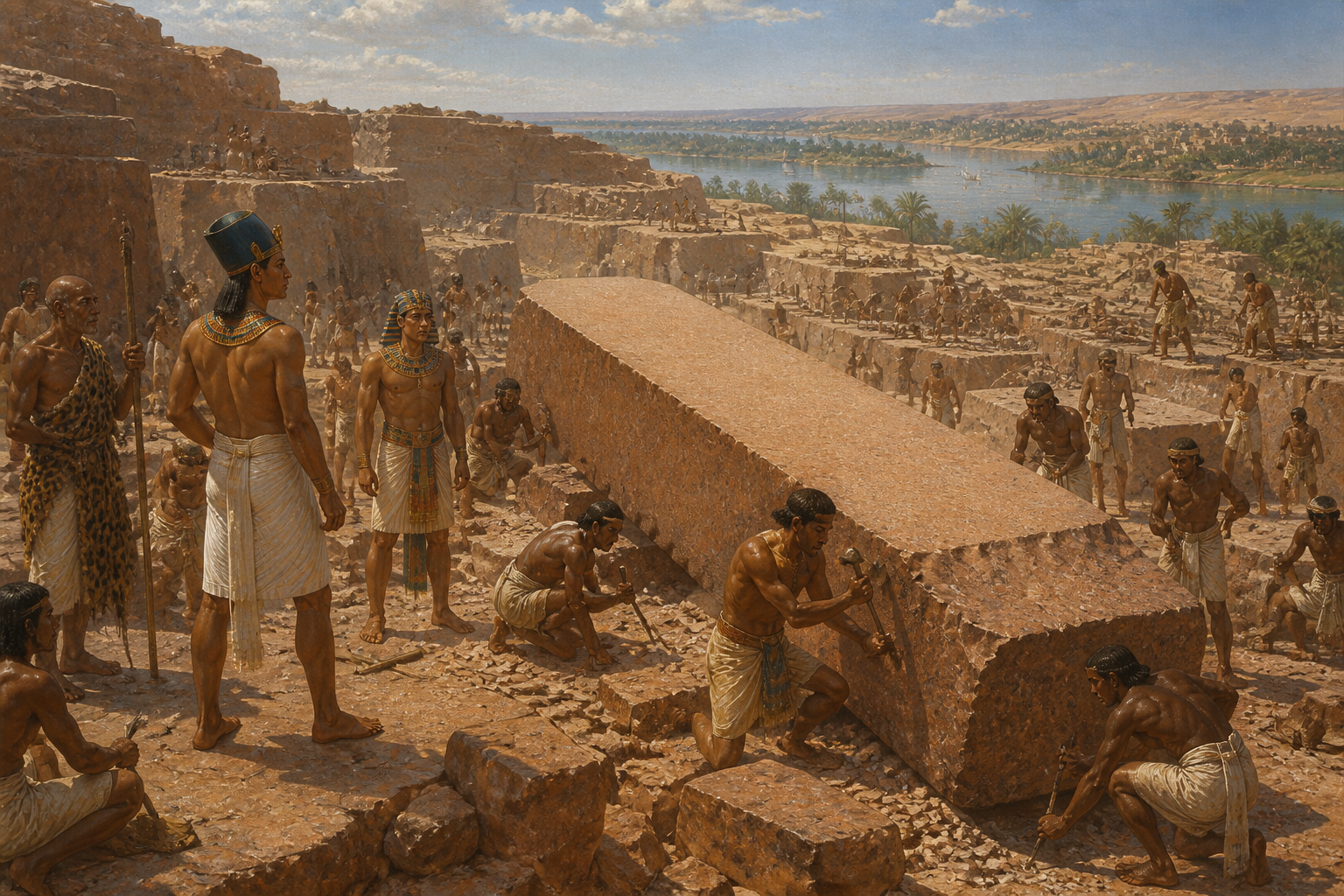
Thutmose III's vision extended beyond warfare to enduring legacies in architecture and culture. Under his reign, the temple complex at Karnak saw unprecedented expansion. His builders and architects, under the skilled guidance of Menkheperreseneb, constructed colossal pillars and obelisks that reached for the heavens. This was a time of bustling activity in the quarries of Aswan, where granite blocks were meticulously cut and prepared for transport. The air was filled with the clamor of chisels and hammers. Laborers, tanned by the sun and wearing linen loincloths, toiled under the supervision of overseers who could recite every detail of the architectural plans. The grand hypostyle hall, with its forest of towering columns, was envisioned to house the gods and celebrate the king's everlasting glory. Amidst the dust and sweat, a grand vision took shape, one that would inspire awe for millennia to come. This was not just a construction project; it was a divine enterprise that mirrored the cosmos, aligning the material world with the spiritual. Through stone and design, Thutmose III's legacy was etched in eternity, a testament to an era of Egyptian glory.
Menkheperreseneb: 'The gods favor your works, my Pharaoh. This will stand as eternal as the Nile.' Thutmose III: 'Let these stones bear witness to our greatness.'
Page 8 — The Knowledge Keepers
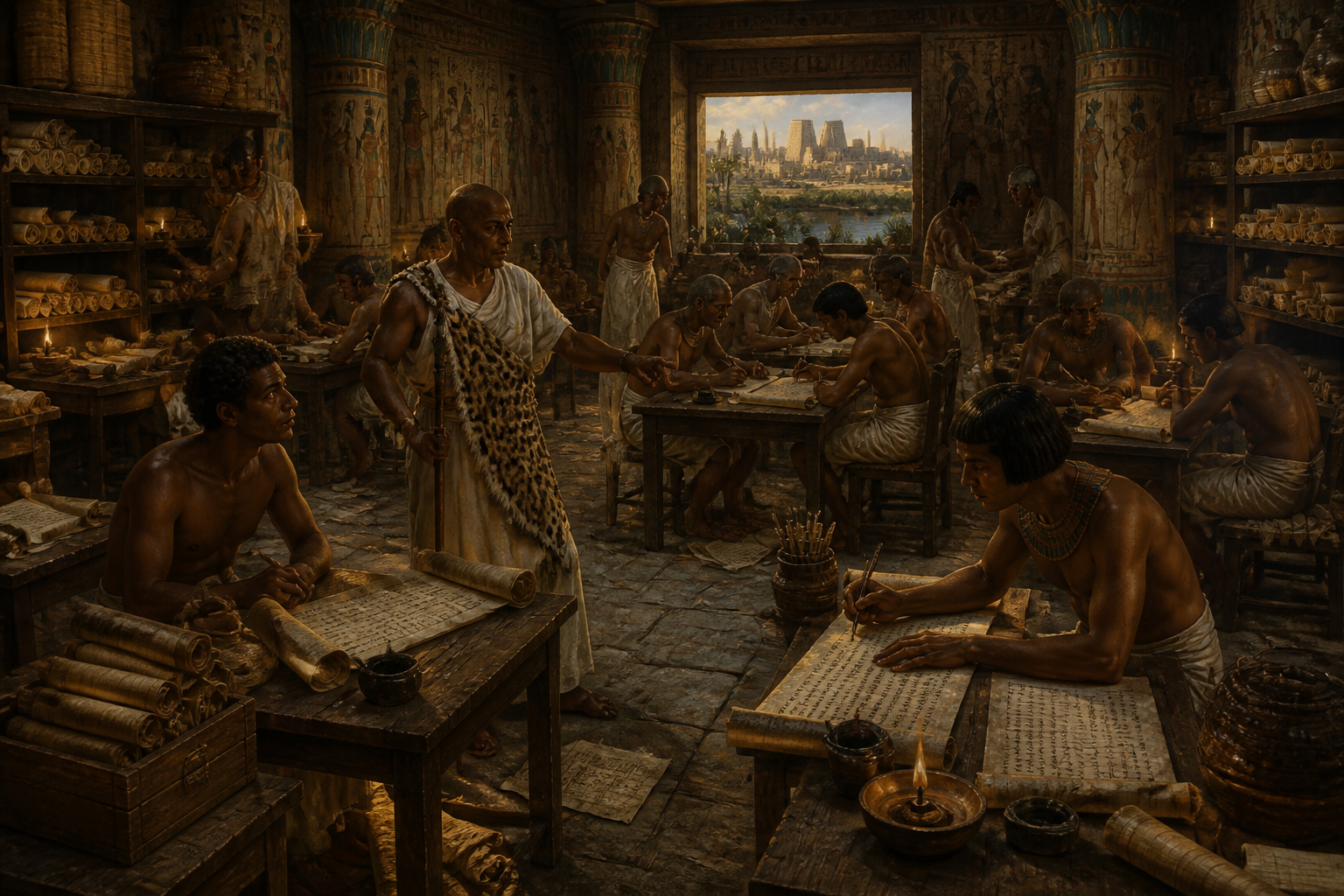
Beyond the grandeur of temples and the might of armies, Thutmose III understood the power of knowledge. His reign marked a flourishing of learning, with scribes and scholars playing essential roles in documenting and advancing Egyptian society. In the dimly lit scriptorium of Thebes, the soft scraping sound of reed pens on papyrus was constant. Scholars, dressed in simple linen robes, were hunched over tables, transcribing knowledge from older texts or recording the latest decrees. These were the invisible architects of culture, preserving the stories and orders that defined Thutmose’s Egypt. The air was thick with the smell of ink and old parchment, and sunlight filtered through narrow windows, illuminating floating dust motes. Among them, Amenhotep, a prodigious scribe, played a pivotal role in chronicling the pharaoh's campaigns, his meticulous records carved into the walls of Karnak. The importance of their work was not lost on Thutmose, who occasionally visited to confer with his intellectual allies, discussing the merits of their latest endeavors. This intellectual fervor ensured that the glories and lessons of his reign would be treasured by posterity, inspiring generations to come.
Amenhotep, the Scribe: 'Every word we write holds the weight of your deeds, my Pharaoh.' Thutmose III: 'Let them know of our triumphs and sacrifices, for knowledge is the truest legacy.'
Page 9 — Toward the Horizon
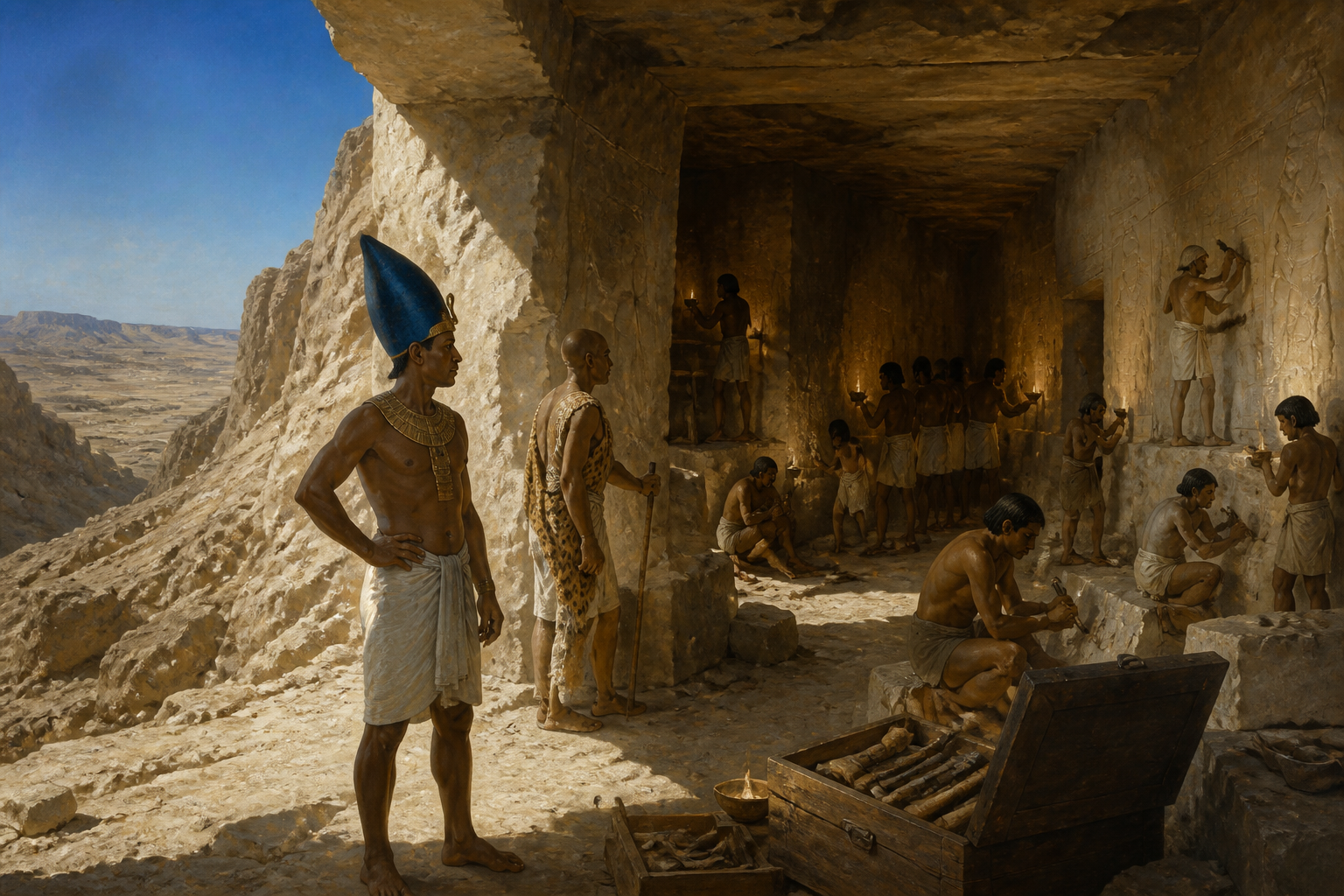
As the years passed, Thutmose III, now an experienced ruler, turned his gaze beyond the immediate concerns of empire to the mysteries of the cosmos and afterlife. The Valley of the Kings, with its limestone cliffs and hidden tombs, became a focal point of his philosophical contemplation. The tomb workers, skilled artisans of the necropolis, labored diligently, carving out the pharaoh's eternal home deep within the earth. Their tools sang through the air, a melody of devotion and duty. Thutmose visited the site often, his presence a reminder of life's fleeting nature and the hope for immortality. He wore a simple kilt and the uraeus crown on these visits, emphasizing humility before the divine. The shadowy interiors filled with the scents of fresh plaster and carved stone, while flickering oil lamps provided scant illumination. Here, surrounded by the echoes of eternity, Thutmose pondered the legacy he would leave behind. His interest in the afterlife reflected not just personal contemplation but a profound obligation to secure Egypt's spiritual continuity. Through these tombs, he sought to ensure that his reign, and the civilization it represented, would transcend the sands of time.
Thutmose III: 'Carve not just my journey, but the journey of all Egypt, that we may live among the stars.' Tomb Artisan: 'It shall be done, my Pharaoh, as enduring as the heavens.'
Page 10 — The Legacy Endures
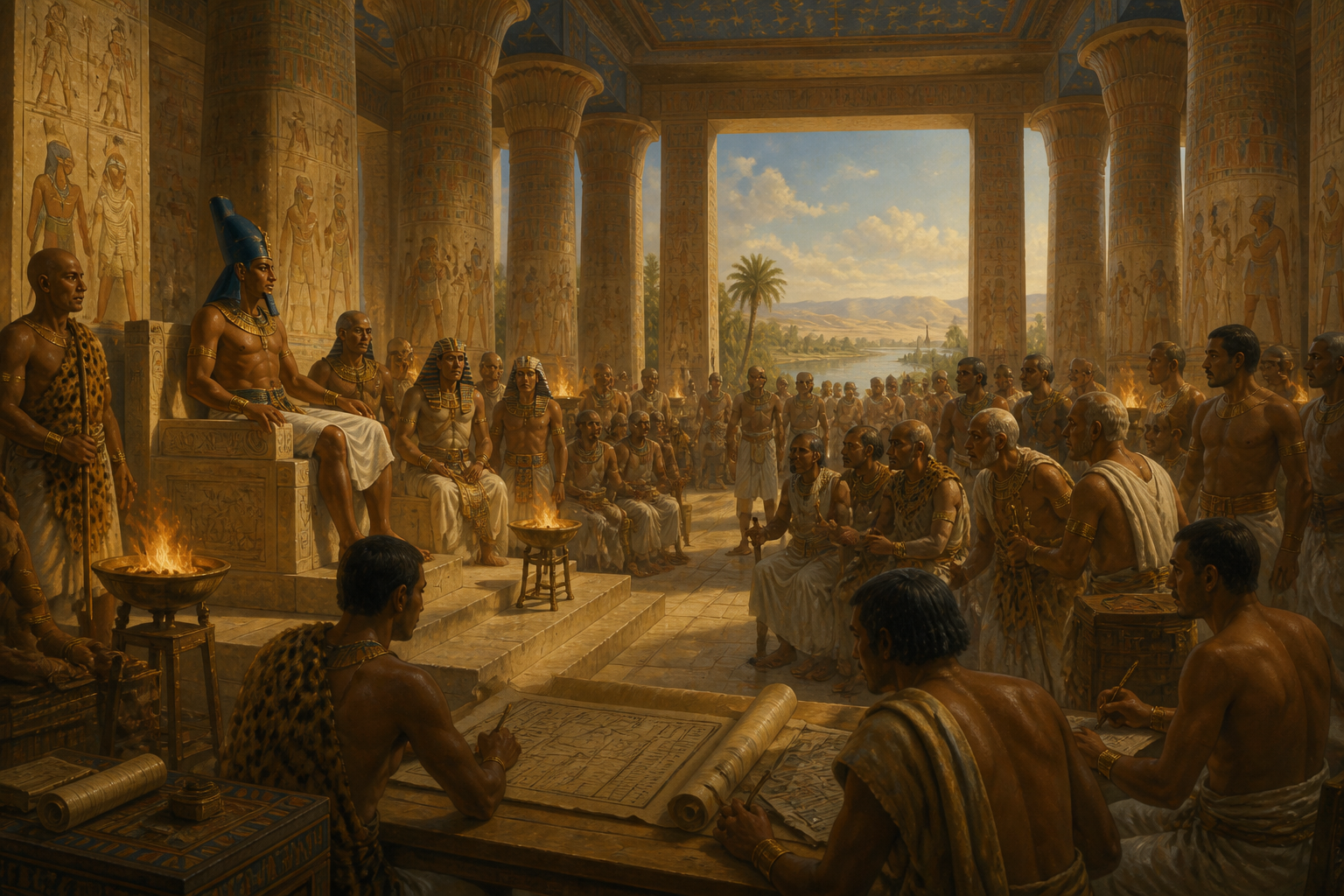
As Thutmose III's reign drew to a close, his legacy as a warrior, builder, and scholar was firmly established. The aging pharaoh, still a commanding presence, often reflected on his achievements from the grand halls of Karnak. Conversations with Amenhotep II, his son and chosen successor, revolved around ensuring the kingdom's continued prosperity. Thutmose, clad in a simple kilt and a pectoral bearing the name of Amun, imparted wisdom gained from decades of rule: the importance of balance between war and peace, the necessity of preserving tradition while embracing innovation. The air was thick with incense, and the illumination from braziers cast warm patterns on the stone floors. The court, filled with advisers and generals, buzzed with activity as strategies were debated, and alliances were forged. As the Nile flowed steadily beyond the temple walls, so too did the promise of Egypt's future. Thutmose knew that while he would soon join the ancestors, his spirit would live on in the heart of his beloved Egypt, in every stone of the temples, in the lines of history written by his scribes, and in the dreams of his people.
Thutmose III: 'Remember, my son, our strength lies not just in the sword, but in the heart of our people.' Amenhotep II: 'I will honor your legacy, father, through wisdom and might.'
About this story
- Audience: general readers
Read Wonder Egypt on your phone
Wonder Egypt is available on Android. Get Wonder Egypt on Google Play.