The Paris Commune — France (1871)

The Paris Commune — France (1871) — an illustrated history story, featuring Adolphe Thiers, Louise Michel, Louis-Nathaniel de Gallifet, set in France. 10 illustrated pages, free to read on Wonder History.

The Paris Commune — France (1871) — book cover — Wonder History
The Paris Commune — France (1871) — an illustrated history story, featuring Adolphe Thiers, Louise Michel, Louis-Nathaniel de Gallifet, set in France. 10 illustrated pages, free to read on Wonder History.

Page 1
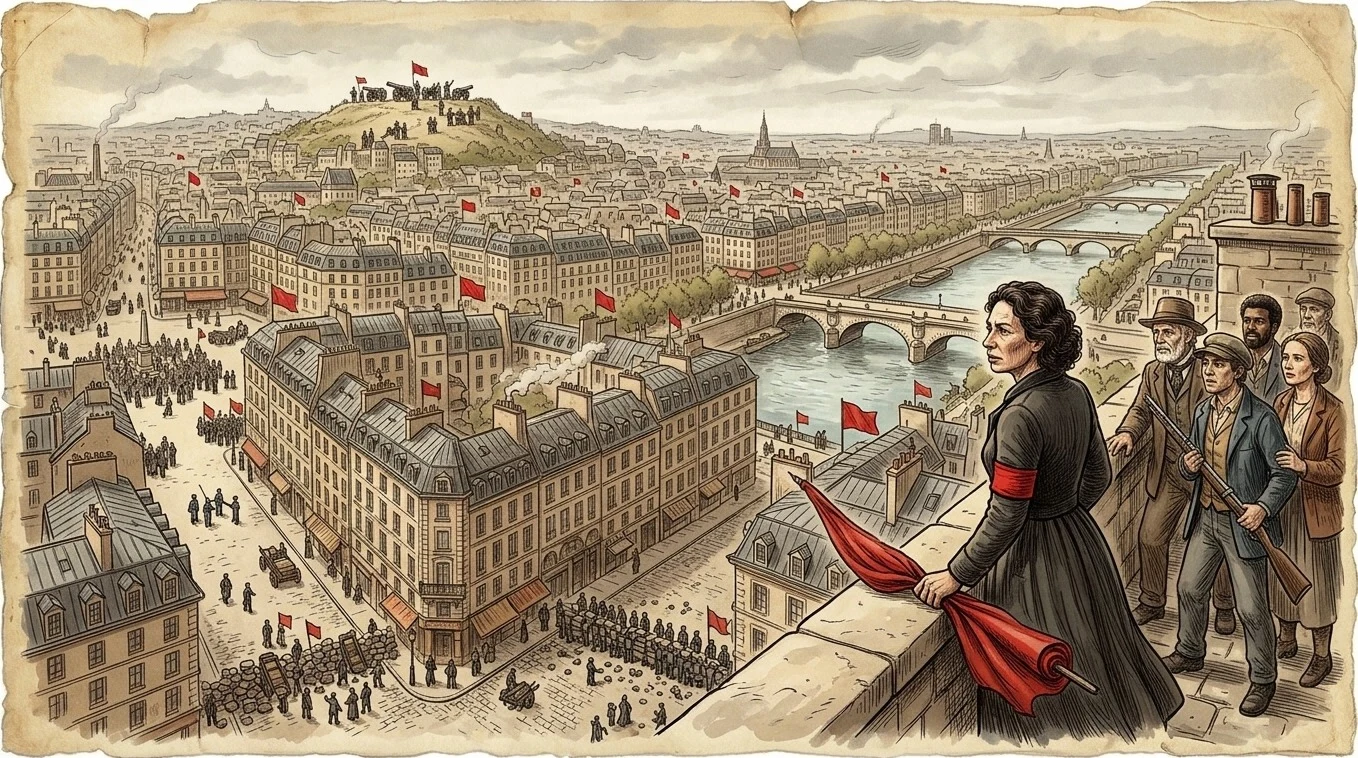
On March 28, 1871, the Paris Commune was declared, a radical government born from the ashes of war. Adolphe Thiers, President of France, watched from Versailles…
On March 28, 1871, the Paris Commune was declared, a radical government born from the ashes of war. Adolphe Thiers, President of France, watched from Versailles as the red flags rose. Louise Michel, the fiery schoolteacher, rallied the people with impassioned speeches. General Louis-Nathaniel de Gallifet, a stern military figure, prepared to crush the rebellion. But how did Paris, after enduring the Franco-Prussian War, descend into civil war?

On March 28, 1871, the Paris Commune was declared, a radical government born from the ashes of war. Adolphe Thiers, President of France, watched from Versailles as the red flags rose. Louise Michel, the fiery schoolteacher, rallied the people with impassioned speeches. General Louis-Nathaniel de Gallifet, a stern military figure, prepared to crush the rebellion. But how did Paris, after enduring the Franco-Prussian War, descend into civil war?

Page 2

The seeds of the Commune were sown during the Franco-Prussian War. "France has lost two provinces; more than money must be paid; it is necessary to pay by loss…
The seeds of the Commune were sown during the Franco-Prussian War. "France has lost two provinces; more than money must be paid; it is necessary to pay by loss of its honor," Adolphe Thiers had lamented after negotiating the armistice. He believed peace was the only option, but Parisians felt betrayed by the surrender, blaming Thiers for the humiliation and the harsh peace terms.

The seeds of the Commune were sown during the Franco-Prussian War. "France has lost two provinces; more than money must be paid; it is necessary to pay by loss of its honor," Adolphe Thiers had lamented after negotiating the armistice. He believed peace was the only option, but Parisians felt betrayed by the surrender, blaming Thiers for the humiliation and the harsh peace terms.

Page 3

Louise Michel, a dedicated teacher in Montmartre, witnessed the suffering firsthand. She provided food and education to the impoverished, her heart aching for…
Louise Michel, a dedicated teacher in Montmartre, witnessed the suffering firsthand. She provided food and education to the impoverished, her heart aching for their plight. "I saw that those who had nothing were ready to die for the sake of an ideal," she confided to a friend. Michel's commitment deepened when the National Guard, largely composed of working-class citizens, refused to disarm, defying Thiers' orders.

Louise Michel, a dedicated teacher in Montmartre, witnessed the suffering firsthand. She provided food and education to the impoverished, her heart aching for their plight. "I saw that those who had nothing were ready to die for the sake of an ideal," she confided to a friend. Michel's commitment deepened when the National Guard, largely composed of working-class citizens, refused to disarm, defying Thiers' orders.

Page 4

Thiers ordered the army to seize the cannons of the National Guard stationed on Montmartre. News spread like wildfire. Parisians, feeling threatened and…
Thiers ordered the army to seize the cannons of the National Guard stationed on Montmartre. News spread like wildfire. Parisians, feeling threatened and betrayed, poured into the streets. They surrounded the soldiers, preventing them from taking the cannons.

Thiers ordered the army to seize the cannons of the National Guard stationed on Montmartre. News spread like wildfire. Parisians, feeling threatened and betrayed, poured into the streets. They surrounded the soldiers, preventing them from taking the cannons.

Page 5

General Gallifet received orders to restore order. He was a strict disciplinarian, known for his ruthlessness during the June Days Uprising of 1848.
General Gallifet received orders to restore order. He was a strict disciplinarian, known for his ruthlessness during the June Days Uprising of 1848. "I am not here to reason, but to obey," he told his officers, preparing his troops for the inevitable clash.

General Gallifet received orders to restore order. He was a strict disciplinarian, known for his ruthlessness during the June Days Uprising of 1848. "I am not here to reason, but to obey," he told his officers, preparing his troops for the inevitable clash.

Page 6

The execution of Generals Clément Thomas and Claude Lecomte by their own troops marked a turning point. The soldiers, sympathizing with the Commune, refused to…
The execution of Generals Clément Thomas and Claude Lecomte by their own troops marked a turning point. The soldiers, sympathizing with the Commune, refused to fire on their fellow Parisians. This act of defiance signaled the complete breakdown of order.

The execution of Generals Clément Thomas and Claude Lecomte by their own troops marked a turning point. The soldiers, sympathizing with the Commune, refused to fire on their fellow Parisians. This act of defiance signaled the complete breakdown of order.

Page 7

"We can no longer ignore the voices of the people," Louise Michel declared to a crowd of supporters. She brandished a red flag, a symbol of revolution.
"We can no longer ignore the voices of the people," Louise Michel declared to a crowd of supporters. She brandished a red flag, a symbol of revolution. "As Victor Hugo said, 'There is nothing so powerful as an idea whose time has come.' And the time for a government of the people, by the people, has come to Paris!"

"We can no longer ignore the voices of the people," Louise Michel declared to a crowd of supporters. She brandished a red flag, a symbol of revolution. "As Victor Hugo said, 'There is nothing so powerful as an idea whose time has come.' And the time for a government of the people, by the people, has come to Paris!"

Page 8

The 'Bloody Week' commenced on May 21, 1871. Thiers' forces entered Paris. Street fighting raged, with barricades erected across the city.
The 'Bloody Week' commenced on May 21, 1871. Thiers' forces entered Paris. Street fighting raged, with barricades erected across the city. Louise Michel fought alongside the National Guard, tending to the wounded and inspiring resistance.

The 'Bloody Week' commenced on May 21, 1871. Thiers' forces entered Paris. Street fighting raged, with barricades erected across the city. Louise Michel fought alongside the National Guard, tending to the wounded and inspiring resistance.

Page 9

As the Commune crumbled, Louise Michel was captured. Standing before the military tribunal, she defiantly declared, "Since it seems that every heart that beats…
As the Commune crumbled, Louise Michel was captured. Standing before the military tribunal, she defiantly declared, "Since it seems that every heart that beats for freedom has no other right than a little lump of lead, I demand my share!" Her courage inspired even her captors.

As the Commune crumbled, Louise Michel was captured. Standing before the military tribunal, she defiantly declared, "Since it seems that every heart that beats for freedom has no other right than a little lump of lead, I demand my share!" Her courage inspired even her captors.

Page 10

Though the Paris Commune was brutally suppressed, its ideals of social justice and worker empowerment resonated across the world.
Though the Paris Commune was brutally suppressed, its ideals of social justice and worker empowerment resonated across the world. Over 20,000 Communards were killed. But the dream of a more equitable society lived on, influencing future generations of revolutionaries and reformers. The memory of the Commune continues to inspire those fighting for a better world.

Though the Paris Commune was brutally suppressed, its ideals of social justice and worker empowerment resonated across the world. Over 20,000 Communards were killed. But the dream of a more equitable society lived on, influencing future generations of revolutionaries and reformers. The memory of the Commune continues to inspire those fighting for a better world.

About this story

  • Historical figures: Adolphe Thiers, Louise Michel, Louis-Nathaniel de Gallifet
  • Location: France
  • Period: Modern
  • Audience: general readers

Questions and answers

Questions and answers about The Paris Commune — France (1871)

Read Wonder History on your phone

Wonder History is available on Android and iPhone and iPad. Get Wonder History on Google Play · Get Wonder History on the App Store.

More Wonder History stories

All Wonder History stories · Open the library