The Revolutions of 1848 — Europe

The Revolutions of 1848 — Europe — an illustrated history story, featuring Louis-Philippe, François Guizot, Klemens von Metternich, set in Europe. 10 illustrated pages, free to read on Wonder History.

The Revolutions of 1848 — Europe — book cover — Wonder History
The Revolutions of 1848 — Europe — an illustrated history story, featuring Louis-Philippe, François Guizot, Klemens von Metternich, set in Europe. 10 illustrated pages, free to read on Wonder History.

Page 1

February 23, 1848. On the barricades of Paris, Louis-Philippe, the Citizen King, lost his throne. Beside him stood François Guizot, his chief minister…
February 23, 1848. On the barricades of Paris, Louis-Philippe, the Citizen King, lost his throne. Beside him stood François Guizot, his chief minister, desperately trying to maintain order. Across the continent, Klemens von Metternich, the Austrian Chancellor, watched his carefully constructed system crumble. These men, and countless others, were caught in the whirlwind of revolution. But where did this upheaval begin, and why did it spread like wildfire?

February 23, 1848. On the barricades of Paris, Louis-Philippe, the Citizen King, lost his throne. Beside him stood François Guizot, his chief minister, desperately trying to maintain order. Across the continent, Klemens von Metternich, the Austrian Chancellor, watched his carefully constructed system crumble. These men, and countless others, were caught in the whirlwind of revolution. But where did this upheaval begin, and why did it spread like wildfire?

Page 2

In Vienna, Klemens von Metternich addressed Emperor Ferdinand I, his voice steady even as couriers hurried past the door with news from Paris.
In Vienna, Klemens von Metternich addressed Emperor Ferdinand I, his voice steady even as couriers hurried past the door with news from Paris. "Sire, if we grant one demand, we will be asked for all of them by Friday. A concession is not a gift. It is an admission." Ferdinand blinked slowly at him and asked only, "But are they permitted to do this?" Metternich, for once, had no answer ready.

In Vienna, Klemens von Metternich addressed Emperor Ferdinand I, his voice steady even as couriers hurried past the door with news from Paris. "Sire, if we grant one demand, we will be asked for all of them by Friday. A concession is not a gift. It is an admission." Ferdinand blinked slowly at him and asked only, "But are they permitted to do this?" Metternich, for once, had no answer ready.

Page 3

The Revolutions of 1848 — Europe — page 3 illustration — Wonder History

In Paris, a young revolutionary, Alphonse de Lamartine, spoke to the restless crowd, raising both hands until the shouting fell away. "In three days you have won a republic. Now you must be worthy of it." A man near the front called out for the red flag to be raised over the Hôtel de Ville. "No," Lamartine answered. "That flag has been carried round the Champ de Mars dragged in the blood of the people. The tricolour has carried the name of France around the world."

Page 4

\"The King is gone!\" shouted Émile Girardin, his voice hoarse from running. \"Louis-Philippe has fled Paris! He has abdicated in favor of his grandson!\" News…
\"The King is gone!\" shouted Émile Girardin, his voice hoarse from running. \"Louis-Philippe has fled Paris! He has abdicated in favor of his grandson!\" News spread quickly through the city, igniting both jubilation and uncertainty. The people had won, but what would come next?

\"The King is gone!\" shouted Émile Girardin, his voice hoarse from running. \"Louis-Philippe has fled Paris! He has abdicated in favor of his grandson!\" News spread quickly through the city, igniting both jubilation and uncertainty. The people had won, but what would come next?

Page 5

In Vienna, students and workers united to demand change. A young student, Wenzel Messenhauser, stood before the Imperial Palace, leading the charge, "Metternich…
In Vienna, students and workers united to demand change. A young student, Wenzel Messenhauser, stood before the Imperial Palace, leading the charge, "Metternich must go! We demand a constitution! We demand liberty!" The crowd surged forward, their voices echoing through the city's streets, shaking the foundations of the empire.

In Vienna, students and workers united to demand change. A young student, Wenzel Messenhauser, stood before the Imperial Palace, leading the charge, "Metternich must go! We demand a constitution! We demand liberty!" The crowd surged forward, their voices echoing through the city's streets, shaking the foundations of the empire.

Page 6

"Resignation is inevitable," Metternich said to his advisors. "The old order crumbles before our very eyes." Addressing the agitated crowd from the palace…
"Resignation is inevitable," Metternich said to his advisors. "The old order crumbles before our very eyes." Addressing the agitated crowd from the palace balcony, he announced, "I, Klemens von Metternich, resign my post as Chancellor! May God guide Austria through these tumultuous times!" The crowd roared, the sound echoing throughout the city.

"Resignation is inevitable," Metternich said to his advisors. "The old order crumbles before our very eyes." Addressing the agitated crowd from the palace balcony, he announced, "I, Klemens von Metternich, resign my post as Chancellor! May God guide Austria through these tumultuous times!" The crowd roared, the sound echoing throughout the city.

Page 7

In Pest, Lajos Kossuth, a fiery Hungarian patriot, addressed the Diet, "Our nation cries out for freedom! Let us demand self-governance from Vienna, and let us…
In Pest, Lajos Kossuth, a fiery Hungarian patriot, addressed the Diet, "Our nation cries out for freedom! Let us demand self-governance from Vienna, and let us have it! Remember what the Roman philosopher Seneca said: 'Every new beginning comes from some other beginning's end'. This is our ending, let us begin anew!" Kossuth's words ignited the Hungarian Revolution.

In Pest, Lajos Kossuth, a fiery Hungarian patriot, addressed the Diet, "Our nation cries out for freedom! Let us demand self-governance from Vienna, and let us have it! Remember what the Roman philosopher Seneca said: 'Every new beginning comes from some other beginning's end'. This is our ending, let us begin anew!" Kossuth's words ignited the Hungarian Revolution.

Page 8

General Joseph Radetzky von Radetz led the Austrian forces against the Italians. He shouted to his troops, "For the Emperor and for Austria!
General Joseph Radetzky von Radetz led the Austrian forces against the Italians. He shouted to his troops, "For the Emperor and for Austria! Drive these rebels from our land!" Cannons roared, muskets fired, and bayonets clashed as the two armies met in a bloody struggle for control of Lombardy.

General Joseph Radetzky von Radetz led the Austrian forces against the Italians. He shouted to his troops, "For the Emperor and for Austria! Drive these rebels from our land!" Cannons roared, muskets fired, and bayonets clashed as the two armies met in a bloody struggle for control of Lombardy.

Page 9
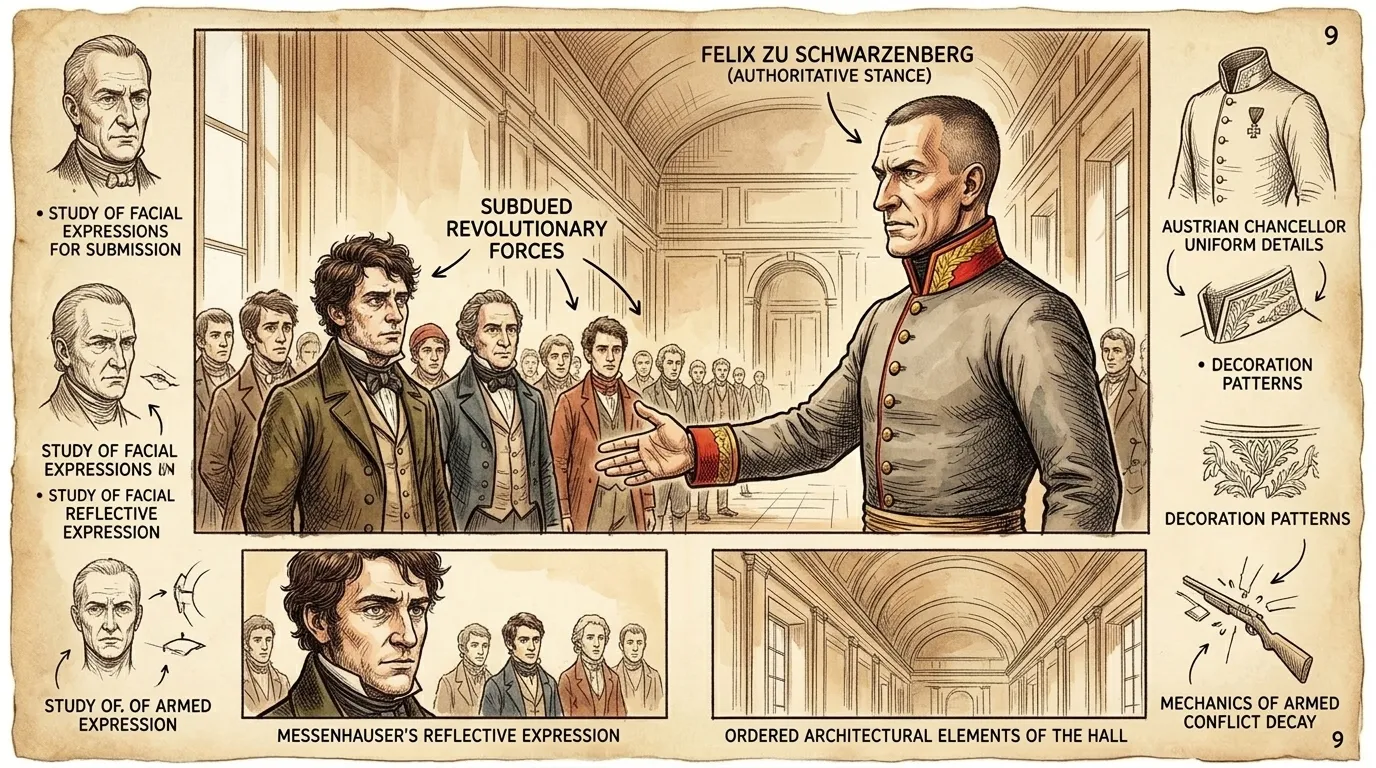
Prince Felix zu Schwarzenberg, the new Austrian Chancellor, addressed the remnants of the revolutionary forces, "The Emperor has spoken.
Prince Felix zu Schwarzenberg, the new Austrian Chancellor, addressed the remnants of the revolutionary forces, "The Emperor has spoken. The rebellions are quelled. Order is restored." He stood rigid, his face devoid of emotion, as the last embers of hope were extinguished throughout the Austrian Empire.

Prince Felix zu Schwarzenberg, the new Austrian Chancellor, addressed the remnants of the revolutionary forces, "The Emperor has spoken. The rebellions are quelled. Order is restored." He stood rigid, his face devoid of emotion, as the last embers of hope were extinguished throughout the Austrian Empire.

Page 10

Though the revolutions of 1848 were largely suppressed, Europe would never be the same. New ideas had taken root, and the seeds of nationalism and liberalism…
Though the revolutions of 1848 were largely suppressed, Europe would never be the same. New ideas had taken root, and the seeds of nationalism and liberalism had been sown. Though absolutism returned, the people had tasted freedom, and the desire for change would continue to simmer beneath the surface. The revolutions of 1848 acted as the crucible of modern Europe.

Though the revolutions of 1848 were largely suppressed, Europe would never be the same. New ideas had taken root, and the seeds of nationalism and liberalism had been sown. Though absolutism returned, the people had tasted freedom, and the desire for change would continue to simmer beneath the surface. The revolutions of 1848 acted as the crucible of modern Europe.

About this story

  • Historical figures: Louis-Philippe, François Guizot, Klemens von Metternich
  • Location: Europe
  • Period: Modern
  • Audience: general readers

Questions and answers

Questions and answers about The Revolutions of 1848 — Europe

Read Wonder History on your phone

Wonder History is available on Android and iPhone and iPad. Get Wonder History on Google Play · Get Wonder History on the App Store.

More Wonder History stories

All Wonder History stories · Open the library