The Scientific Revolution — Europe (1473, Europe)
The Scientific Revolution — Europe (1473, Europe) — an illustrated history story, featuring Nicolaus Copernicus, Andreas Vesalius, Francis Bacon, set in Europe. 10 illustrated pages, free to read on Wonder History.
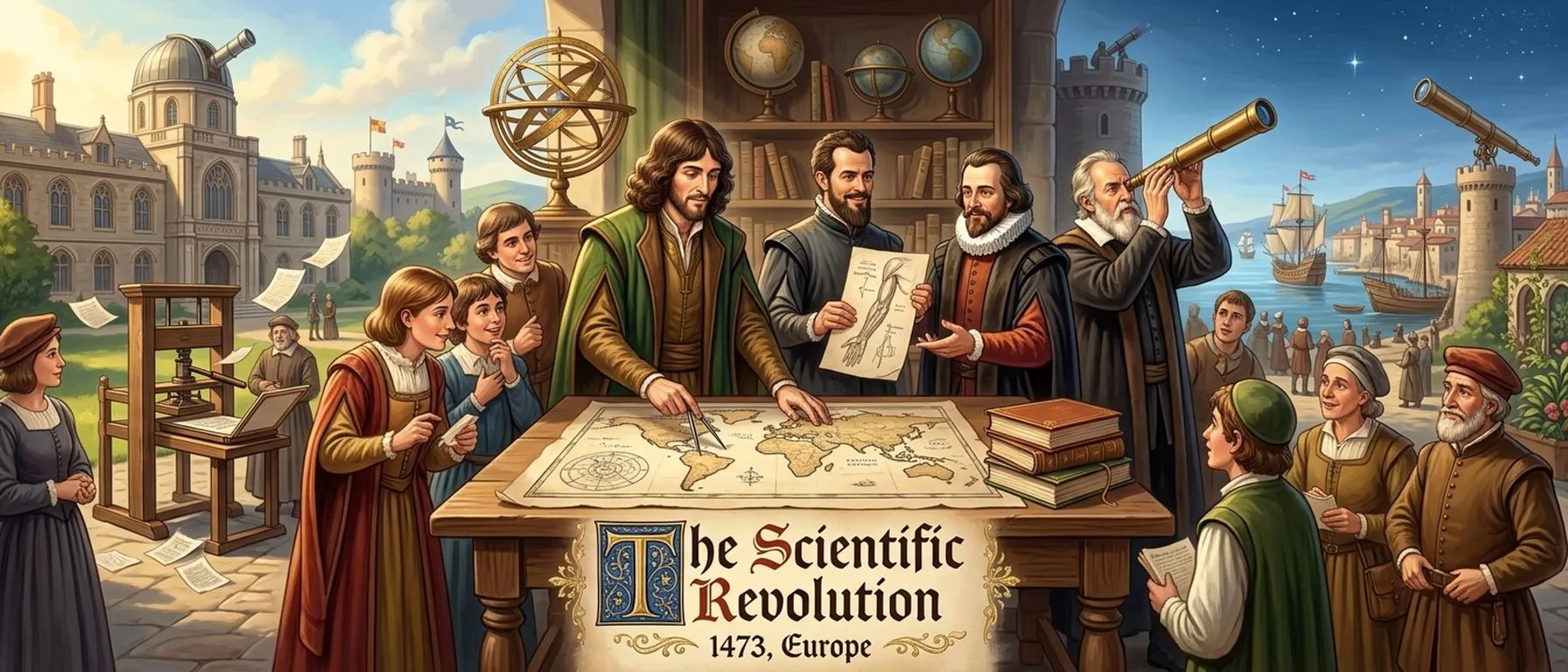
Page 1

On the frosty morning of February 19, 1473, Nicolaus Copernicus, future astronomer of Poland, entered a world teeming with both ancient beliefs and nascent scientific curiosity. Alongside him stood Andreas Vesalius, a Belgian anatomist poised to revolutionize medicine. Across Europe, figures like Francis Bacon, an English philosopher, and Galileo Galilei, an Italian physicist, prepared to challenge the very foundations of knowledge. But where did this quest for scientific truth begin?
Page 2

Young Nicolaus, in his scholar's robes, pored over ancient texts at the University of Krakow. "Ptolemy's geocentric model just doesn't feel right," he muttered to Georg von Peuerbach, a mathematician lecturing nearby. "All the planets, the sun, everything revolving around Earth?" Georg stroked his chin. "Questioning the ancients can be dangerous, Nicolaus. But curiosity is a powerful force."
Page 3

"There is a new star in the sky!" Andreas Vesalius exclaimed, bursting into the anatomy theatre in Paris. He ran to Jan Steven van Calcar, a gifted artist rendering anatomical diagrams. "What does this mean for our understanding of the human body? Can we learn new insights?" A somber Jan replied, while meticulously copying a medical illustration, "'The more I learn, the more I realize how much I don't know', as Socrates said".
Page 4

In England, Francis Bacon meticulously recorded his observations in a garden, amongst the towering flora. "We must proceed through inductive reasoning, not simply accepting the authority of the ancients," he declared to William Gilbert, who was experimenting with magnets nearby. "We must observe, experiment, and then deduce!"
Page 5

Galileo Galilei, in his study in Padua, peered through his improved telescope. "I can see mountains on the Moon!" he gasped to Marina Gamba, his partner, standing beside him. "And Jupiter has its own moons! The heavens are not perfect, unchanging spheres!" Marina leaned forward, her expression a mix of awe and concern. "Such discoveries could bring trouble, Galileo."
Page 6

Copernicus, now older, meticulously crafted his heliocentric theory, 'De revolutionibus orbium coelestium'. He looked at his friend, Tiedemann Giese, who had been studying it. "The Earth moves around the Sun," he explained to Tiedemann Giese in Frombork. "This changes everything!"
Page 7

"These new ideas are dangerous!" Cardinal Robert Bellarmine thundered in Rome. He pointed a finger at one of Galileo's books. "They undermine the authority of the Church!" Pope Urban VIII listened intently, his expression grim. "Galileo must be silenced."
Page 8

"I can't recant my findings," Galileo exclaimed in Florence. Cardinal Francesco Barberini pointed to him. "But I must bow to the Church's authority!" Before the court, Galileo bowed, his voice trembling, as he declared, 'Eppur si muove...'" The officials standing by looked concerned.
Page 9

Decades later, Isaac Newton, an English mathematician, sat beneath an apple tree. "If I have seen further, it is by standing on the shoulders of giants," he mused, remembering the contributions of Copernicus, Galileo, and others. A falling apple sparked a new revolution in understanding gravity. The scientific revolution was accelerating.
Page 10

Today, telescopes span the globe, allowing us to peer deeper into the cosmos than ever before. Medical advancements save countless lives, thanks to the foundations laid by Vesalius. Scientific inquiry continues, building on the revolutionary spirit of the past. The quest for knowledge marches on.
About this story
- Historical figures: Nicolaus Copernicus, Andreas Vesalius, Francis Bacon
- Location: Europe
- Period: Middle Ages
- Audience: general readers
Questions and answers
Questions and answers about The Scientific Revolution — Europe (1473, Europe)
Read Wonder History on your phone
Wonder History is available on Android. Get Wonder History on Google Play.