The Siege of Vicksburg (1863, USA)
The Siege of Vicksburg (1863, USA) — an illustrated history story, featuring Ulysses S. Grant, John C. Pemberton, David Dixon Porter, set in USA. 10 illustrated pages, free to read on Wonder History.
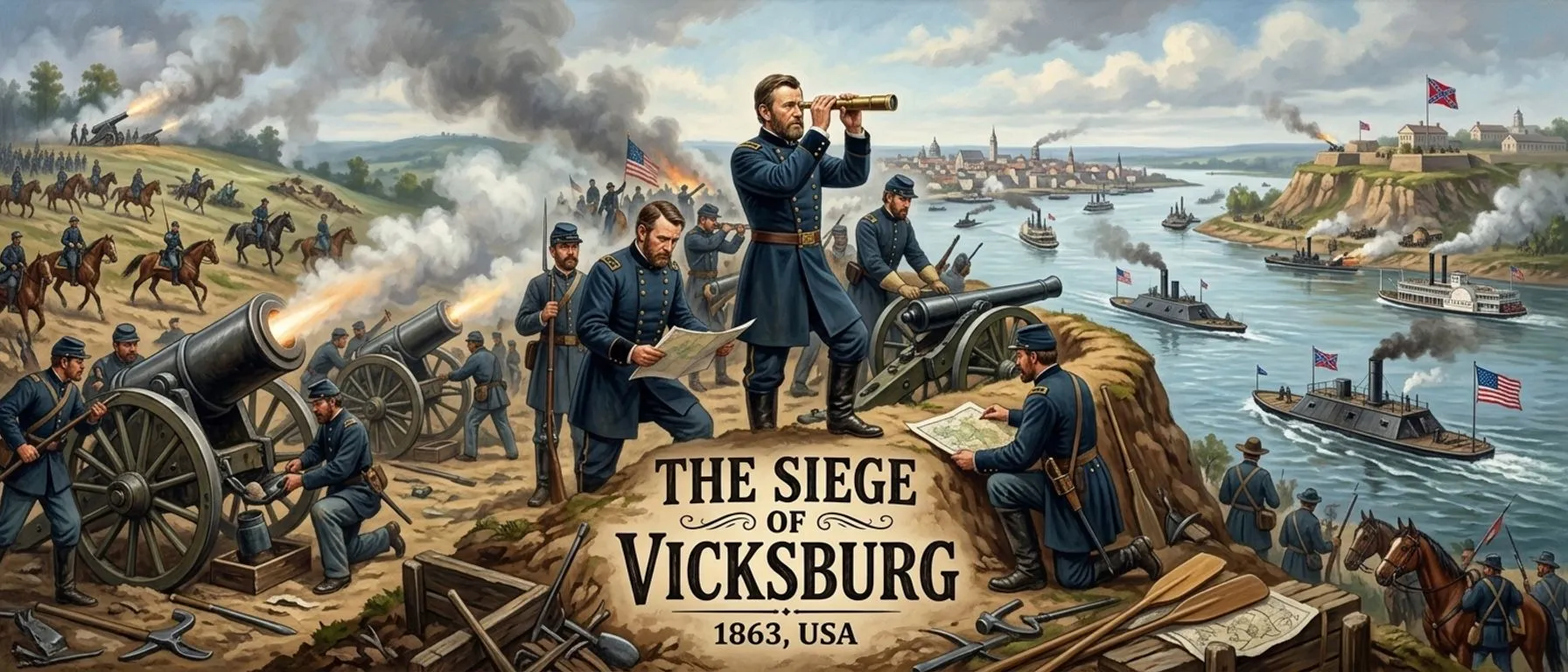
Page 1

April 1863. Union General Ulysses S. Grant, stern-faced and resolute, Confederate General John C. Pemberton, pale and determined, and Admiral David Dixon Porter, gazing up from the Mississippi River, found their destinies colliding at Vicksburg. This strategic city, perched high on the bluffs, controlled the river, and its capture was vital to the Union. For 47 days, Grant's forces relentlessly bombarded the city; the Siege of Vicksburg had begun. How did this crucial campaign unfold, and what made Vicksburg the key to the Confederacy's fate?
Page 2

In 1862, the Confederacy still held Vicksburg, a seemingly impenetrable fortress. 'Vicksburg is the nailhead that holds the South together,' Confederate President Jefferson Davis declared. He knew control of the Mississippi River was essential to Confederate survival. The Union's initial attempts to seize Vicksburg by direct assault had failed, costing them many lives and resources.
Page 3

Grant devised a daring new strategy: march his army south through Louisiana, cross the Mississippi below Vicksburg, and attack from the rear. 'It is to be done,' Grant told his staff, his eyes gleaming with determination. The plan was risky, cutting his army off from its supply lines, but Grant believed it was the only way to take the city.
Page 4

Admiral Porter's fleet ran the gauntlet of Confederate guns at Vicksburg, a daring feat of naval skill. Exploding shells rained down on the ironclads as they navigated the treacherous currents. 'Damn the torpedoes, full speed ahead!' became the apocryphal cry, though Porter's courage was undeniable. His success allowed Grant's army to cross the river and begin their assault.
Page 5

Grant's initial assaults on Vicksburg's fortifications failed, resulting in heavy casualties. The Confederate defenses, manned by determined soldiers, proved too strong to overcome quickly. Union soldiers dug in, beginning a prolonged siege. 'We must starve them out,' Grant realized, his face grim.
Page 6

Inside Vicksburg, civilians and soldiers alike endured relentless bombardment and dwindling supplies. The city became a network of caves and underground shelters as people sought refuge from the shelling. Food grew scarce; people ate mules and even rats to survive. Confederate General Pemberton tried to lift the siege, but Grant repelled his advances.
Page 7

As weeks turned into months, the situation inside Vicksburg grew desperate. 'We cannot hold out much longer,' Pemberton confided to his officers, his voice heavy with resignation. Union forces tightened their grip on the city, cutting off all escape routes and supply lines. Disease and starvation ravaged the Confederate garrison and civilian population.
Page 8

On July 3, 1863, Pemberton sent a message to Grant, signaling his willingness to negotiate surrender. Grant insisted on unconditional surrender, and Pemberton had no choice but to accept. 'We have met the enemy, and they are ours,' Grant telegraphed to Washington. On July 4, Vicksburg officially surrendered, a devastating blow to the Confederacy.
Page 9

The surrender of Vicksburg marked a turning point in the Civil War. The Union now controlled the entire Mississippi River, effectively splitting the Confederacy in two. 'A house divided against itself cannot stand,' Abraham Lincoln had said before the war, and Vicksburg proved his point. The Confederacy was weakened and its ultimate defeat became inevitable.
Page 10

Today, Vicksburg National Military Park stands as a memorial to the soldiers and civilians who endured the siege. The park preserves the battlefield, trenches, and gun emplacements, reminding visitors of the human cost of war. Though time has passed, the lessons learned at Vicksburg about resilience, strategy, and the importance of unity continue to resonate. The scars of war may heal, but the memory endures.
About this story
- Historical figures: Ulysses S. Grant, John C. Pemberton, David Dixon Porter
- Location: USA
- Period: Modern
- Audience: general readers
Questions and answers
Questions and answers about The Siege of Vicksburg (1863, USA)
Read Wonder History on your phone
Wonder History is available on Android. Get Wonder History on Google Play.