The Spanish Conquest of the Aztec Empire — Mexico (1519)

The Spanish Conquest of the Aztec Empire — Mexico (1519) — an illustrated history story, featuring Hernán Cortés, Moctezuma II, Bernal Díaz del Castillo, set in Mexico. 10 illustrated pages, free to read on Wonder History.

The Spanish Conquest of the Aztec Empire — Mexico (1519) — book cover — Wonder History
The Spanish Conquest of the Aztec Empire — Mexico (1519) — an illustrated history story, featuring Hernán Cortés, Moctezuma II, Bernal Díaz del Castillo, set in Mexico. 10 illustrated pages, free to read on Wonder History.

Page 1
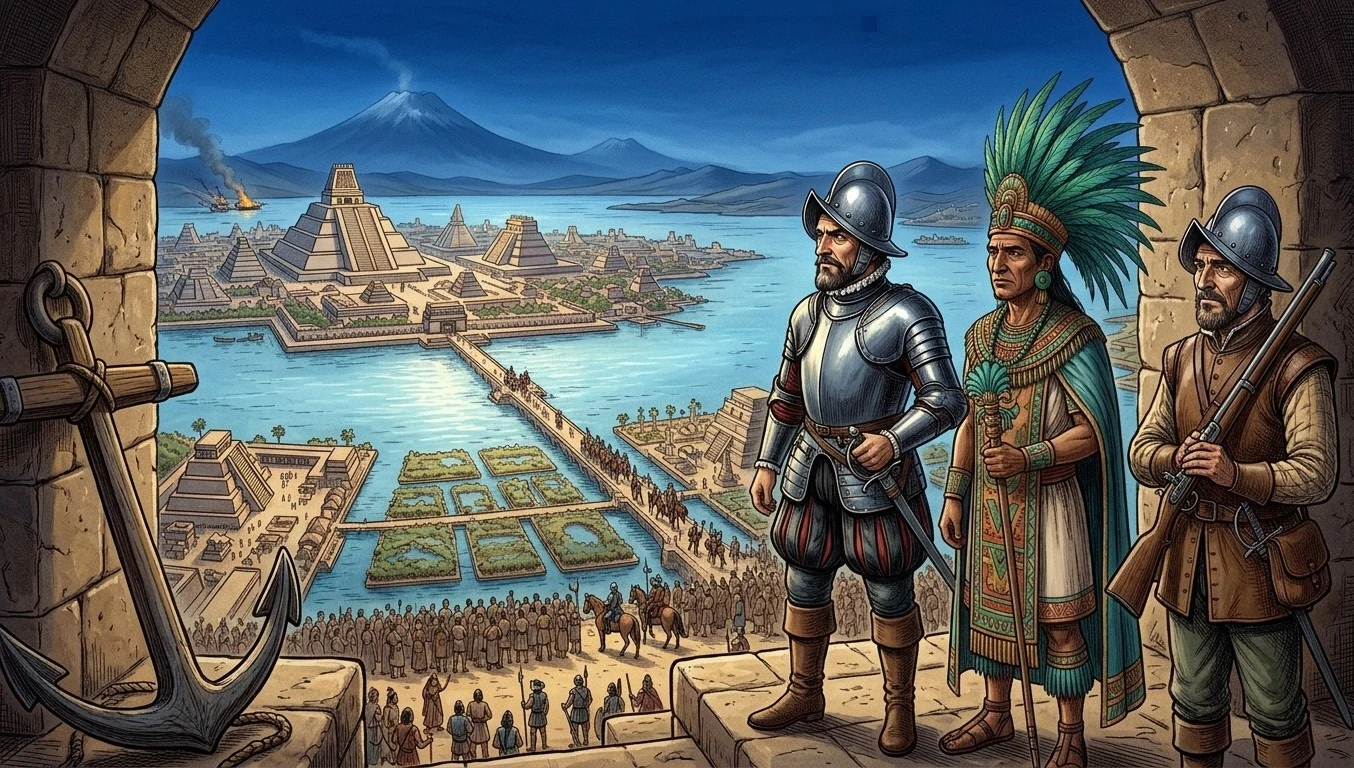
On November 8, 1519, Hernán Cortés, the ambitious Spanish conquistador; Moctezuma II, the wise Aztec emperor; and Bernal Díaz del Castillo, the observant…
On November 8, 1519, Hernán Cortés, the ambitious Spanish conquistador; Moctezuma II, the wise Aztec emperor; and Bernal Díaz del Castillo, the observant Spanish soldier, stood at the crossroads of history. The Aztec capital, Tenochtitlan, a city of 200,000, glittered before them, a prize and a peril. But how did a small band of Spaniards come to challenge the mightiest empire in Mesoamerica?

On November 8, 1519, Hernán Cortés, the ambitious Spanish conquistador; Moctezuma II, the wise Aztec emperor; and Bernal Díaz del Castillo, the observant Spanish soldier, stood at the crossroads of history. The Aztec capital, Tenochtitlan, a city of 200,000, glittered before them, a prize and a peril. But how did a small band of Spaniards come to challenge the mightiest empire in Mesoamerica?

Page 2

Years before, in 1511, Bernal Díaz, a young adventurer seeking fortune, sailed to the New World with Diego Velázquez. 'Cuba is not enough,' Velázquez declared.
Years before, in 1511, Bernal Díaz, a young adventurer seeking fortune, sailed to the New World with Diego Velázquez. 'Cuba is not enough,' Velázquez declared. 'There are greater riches to be found further west!' He organized expeditions, driven by tales of gold and powerful empires, knowing the Spanish crown craved expansion and resources.

Years before, in 1511, Bernal Díaz, a young adventurer seeking fortune, sailed to the New World with Diego Velázquez. 'Cuba is not enough,' Velázquez declared. 'There are greater riches to be found further west!' He organized expeditions, driven by tales of gold and powerful empires, knowing the Spanish crown craved expansion and resources.

Page 3

In 1519, Cortés, defying Velázquez's authority, set sail from Cuba with 500 soldiers, 100 sailors, 16 horses, and a handful of cannon.
In 1519, Cortés, defying Velázquez's authority, set sail from Cuba with 500 soldiers, 100 sailors, 16 horses, and a handful of cannon. As Cortés rallied his men, he declared, 'Fortune favors the bold!' He knew their mission was risky, but the potential reward—wealth, land, and glory—outweighed the danger.

In 1519, Cortés, defying Velázquez's authority, set sail from Cuba with 500 soldiers, 100 sailors, 16 horses, and a handful of cannon. As Cortés rallied his men, he declared, 'Fortune favors the bold!' He knew their mission was risky, but the potential reward—wealth, land, and glory—outweighed the danger.

Page 4

Landing on the coast of Veracruz, Cortés made a strategic decision. 'Burn the ships!' he ordered. Bernal Díaz watched in disbelief as the vessels went up in…
Landing on the coast of Veracruz, Cortés made a strategic decision. 'Burn the ships!' he ordered. Bernal Díaz watched in disbelief as the vessels went up in flames. 'Now,' Cortés explained, 'there is no turning back. We either conquer or die.' This act, though drastic, motivated his men to fight with unwavering resolve.

Landing on the coast of Veracruz, Cortés made a strategic decision. 'Burn the ships!' he ordered. Bernal Díaz watched in disbelief as the vessels went up in flames. 'Now,' Cortés explained, 'there is no turning back. We either conquer or die.' This act, though drastic, motivated his men to fight with unwavering resolve.

Page 5

Cortés allied with the Tlaxcalans, bitter rivals of the Aztecs. Xicotencatl the Younger, a Tlaxcalan war chief, initially resisted, but after several battles…
Cortés allied with the Tlaxcalans, bitter rivals of the Aztecs. Xicotencatl the Younger, a Tlaxcalan war chief, initially resisted, but after several battles, he recognized the Spaniards' power and the potential to overthrow Moctezuma. 'Let us unite,' Xicotencatl declared, 'and together, we will break the Aztec yoke!'

Cortés allied with the Tlaxcalans, bitter rivals of the Aztecs. Xicotencatl the Younger, a Tlaxcalan war chief, initially resisted, but after several battles, he recognized the Spaniards' power and the potential to overthrow Moctezuma. 'Let us unite,' Xicotencatl declared, 'and together, we will break the Aztec yoke!'

Page 6

The march to Tenochtitlan was fraught with peril. Pedro de Alvarado, Cortés's lieutenant, known for his ruthlessness, led the vanguard.
The march to Tenochtitlan was fraught with peril. Pedro de Alvarado, Cortés's lieutenant, known for his ruthlessness, led the vanguard. As Bernal Díaz recounted, 'Alvarado was quick to anger and swift to punish.' They faced ambushes, skirmishes, and the constant threat of Aztec warriors.

The march to Tenochtitlan was fraught with peril. Pedro de Alvarado, Cortés's lieutenant, known for his ruthlessness, led the vanguard. As Bernal Díaz recounted, 'Alvarado was quick to anger and swift to punish.' They faced ambushes, skirmishes, and the constant threat of Aztec warriors.

Page 7

Upon entering Tenochtitlan, Moctezuma II welcomed Cortés with lavish gifts and treated him as an honored guest. 'He believed, perhaps foolishly,' Bernal Díaz…
Upon entering Tenochtitlan, Moctezuma II welcomed Cortés with lavish gifts and treated him as an honored guest. 'He believed, perhaps foolishly,' Bernal Díaz wrote, 'that Cortés was a god.' But Cortés, distrustful and ever-watchful, saw an opportunity for conquest. He was already devising a plan to seize the Aztec capital, a city built on water and ambition.

Upon entering Tenochtitlan, Moctezuma II welcomed Cortés with lavish gifts and treated him as an honored guest. 'He believed, perhaps foolishly,' Bernal Díaz wrote, 'that Cortés was a god.' But Cortés, distrustful and ever-watchful, saw an opportunity for conquest. He was already devising a plan to seize the Aztec capital, a city built on water and ambition.

Page 8

Cortés seized Moctezuma and held him hostage. When Alvarado massacred Aztec nobles during a religious festival, the city erupted in revolt.
Cortés seized Moctezuma and held him hostage. When Alvarado massacred Aztec nobles during a religious festival, the city erupted in revolt. As unrest escalated, Moctezuma, attempting to quell the uprising, addressed his people from a rooftop. 'Remember,' he pleaded, 'as Aristotle said, 'The ultimate value of life depends upon awareness and the power of contemplation rather than upon mere survival.' But he was met with stones and arrows.

Cortés seized Moctezuma and held him hostage. When Alvarado massacred Aztec nobles during a religious festival, the city erupted in revolt. As unrest escalated, Moctezuma, attempting to quell the uprising, addressed his people from a rooftop. 'Remember,' he pleaded, 'as Aristotle said, 'The ultimate value of life depends upon awareness and the power of contemplation rather than upon mere survival.' But he was met with stones and arrows.

Page 9

Moctezuma died soon after, and the Spaniards were forced to flee Tenochtitlan during the 'Night of Sorrows.' Bernal Díaz wept as he watched his comrades fall.
Moctezuma died soon after, and the Spaniards were forced to flee Tenochtitlan during the 'Night of Sorrows.' Bernal Díaz wept as he watched his comrades fall. Cortés, though defeated for the moment, vowed to return and conquer the city, fueled by grief and ambition.

Moctezuma died soon after, and the Spaniards were forced to flee Tenochtitlan during the 'Night of Sorrows.' Bernal Díaz wept as he watched his comrades fall. Cortés, though defeated for the moment, vowed to return and conquer the city, fueled by grief and ambition.

Page 10

Cortés returned, laid siege to Tenochtitlan, and, after months of brutal fighting, conquered the Aztec Empire in 1521. The city was razed, its temples…
Cortés returned, laid siege to Tenochtitlan, and, after months of brutal fighting, conquered the Aztec Empire in 1521. The city was razed, its temples destroyed, and a new Spanish capital was built upon its ruins. Mexico, as it became known, was transformed, forever changed by the clash of cultures and the ambitions of men.

Cortés returned, laid siege to Tenochtitlan, and, after months of brutal fighting, conquered the Aztec Empire in 1521. The city was razed, its temples destroyed, and a new Spanish capital was built upon its ruins. Mexico, as it became known, was transformed, forever changed by the clash of cultures and the ambitions of men.

About this story

  • Historical figures: Hernán Cortés, Moctezuma II, Bernal Díaz del Castillo
  • Location: Mexico
  • Period: Early Modern
  • Audience: general readers

Questions and answers

Questions and answers about The Spanish Conquest of the Aztec Empire — Mexico (1519)

Read Wonder History on your phone

Wonder History is available on Android and iPhone and iPad. Get Wonder History on Google Play · Get Wonder History on the App Store.

More Wonder History stories

All Wonder History stories · Open the library