Home Solar Inverter
Home Solar Inverter — an illustrated inventions story, set in Global. 10 illustrated pages, free to read on Wonder Inventions.
Page 1
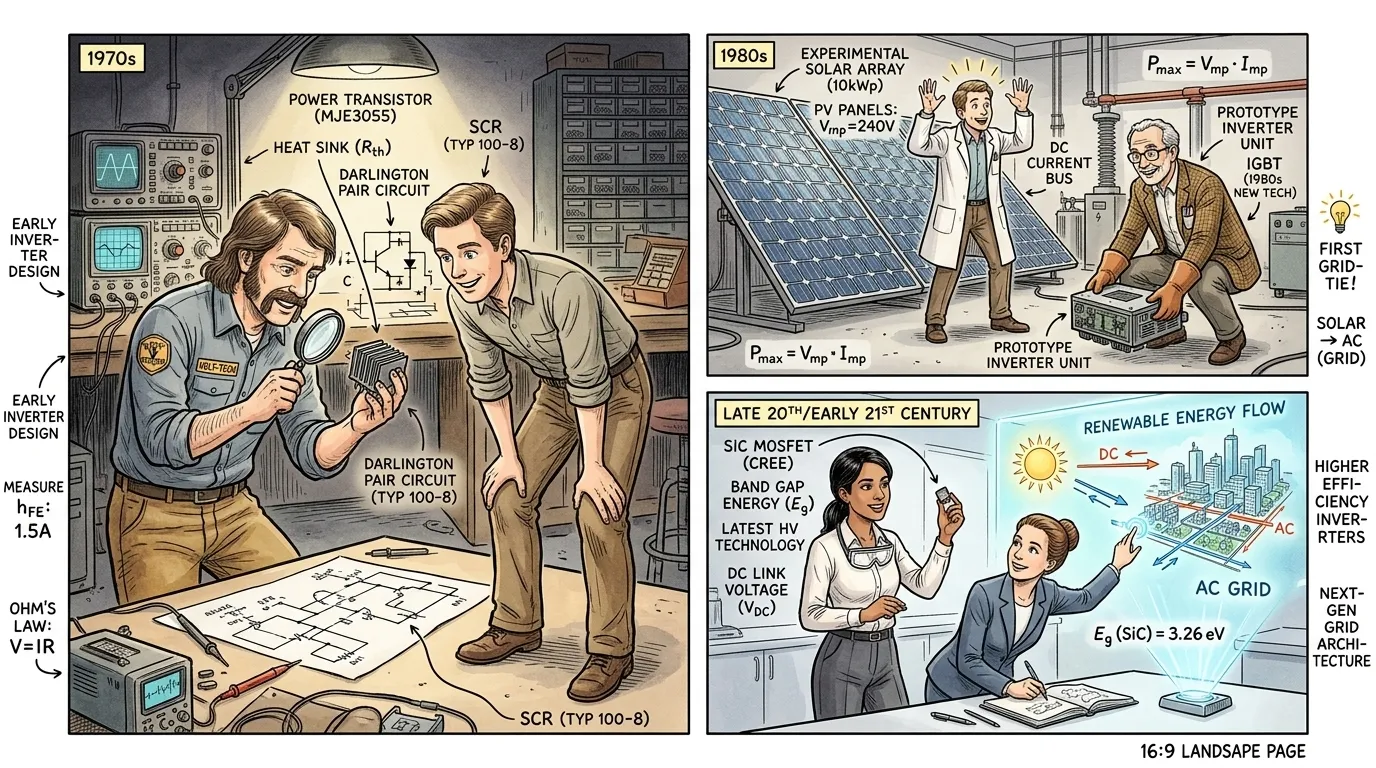
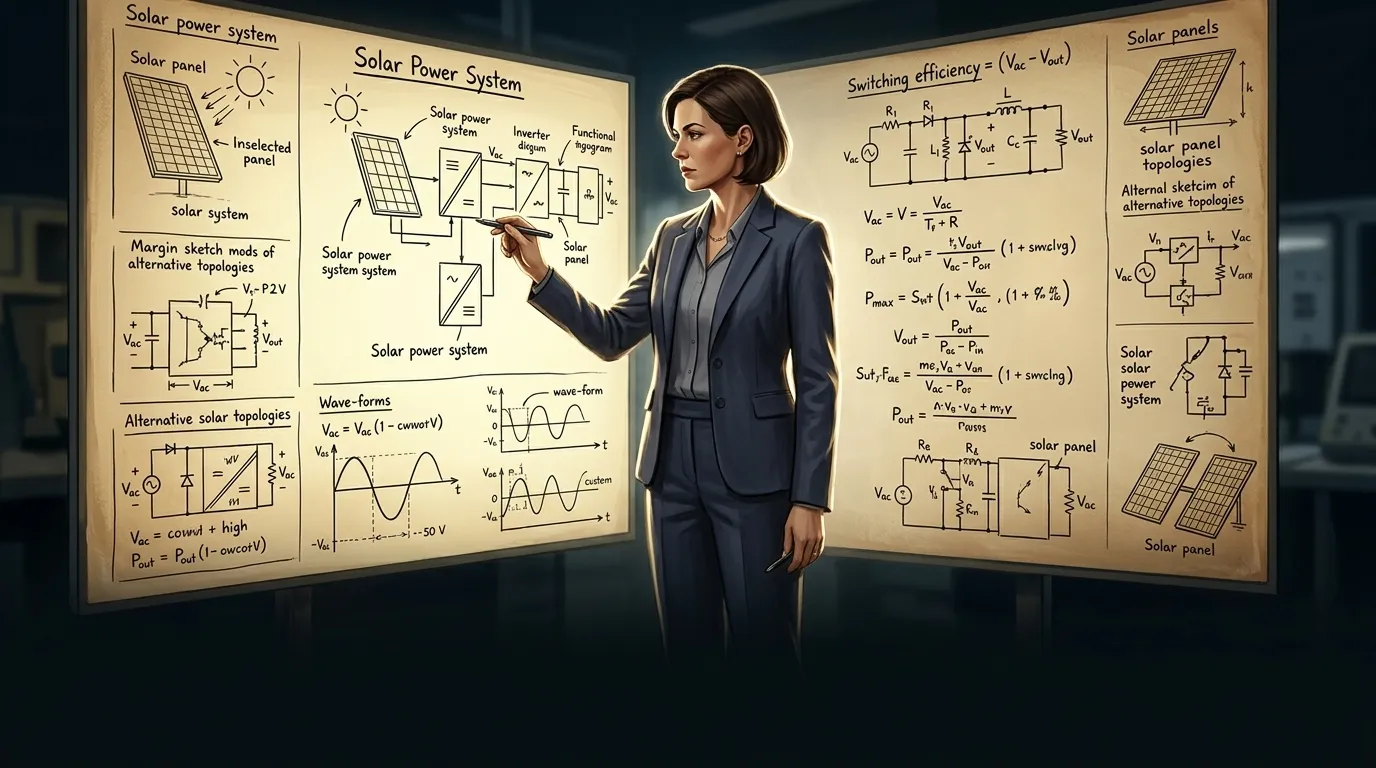
For decades, humanity dreamed of harnessing the sun's boundless energy. Yet, a fundamental electrical challenge persisted: solar panels produce Direct Current (DC), while homes and national grids operate on Alternating Current (AC). This critical incompatibility, often overlooked, was the silent barrier to widespread solar adoption. The invention of the Home Solar Inverter, a complex piece of power electronics, would revolutionize this equation, transforming raw solar power into usable electricity and enabling homes to become energy producers.
"As one pioneering engineer, Dr. Lena Volkov, once remarked when contemplating this challenge, 'The important thing is not to stop questioning. Curiosity has its own reason for existence,' attributing Albert Einstein. 'Without that constant inquiry, we'd never have asked how to truly integrate solar into every household.' The drive to efficiently bridge this DC-to-AC gap became paramount, demanding sophisticated engineering solutions for seamless grid synchronization."
Page 2
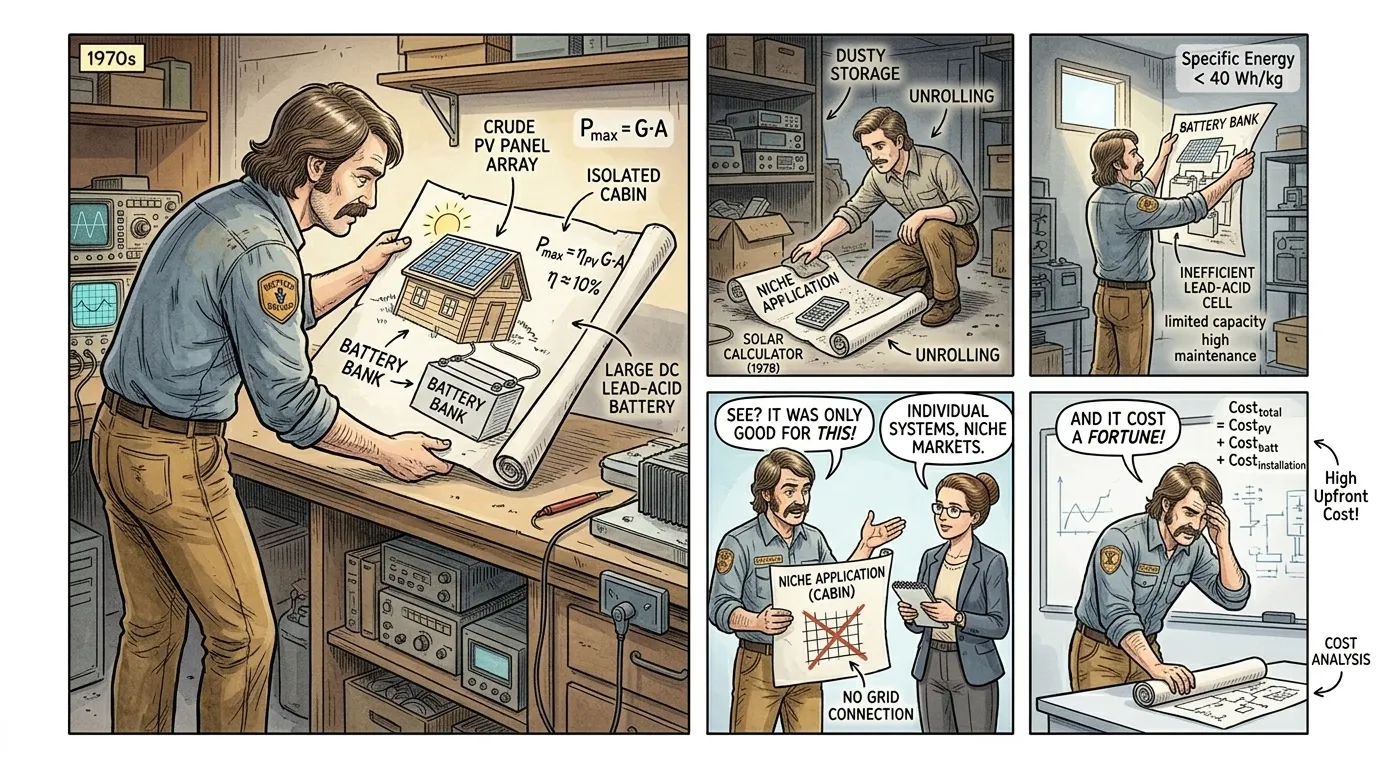
Before the advent of efficient solar inverters, solar photovoltaic systems were largely confined to niche applications: remote cabins, spacecraft, and experimental sites. These early systems often relied on bulky, inefficient mechanical or rudimentary electronic converters, or simply stored DC power in large battery banks. The dream of interconnected, grid-tied solar remained largely out of reach due to the immense technical hurdles.
"Many early attempts wrestled with the sheer scale of the conversion problem. These pioneers understood the basic principle, but the execution was crude. They grappled with significant power losses and the inability to reliably match the grid's precise alternating current rhythm. 'We could make light, yes, but not power a community,' explained a retired electrical technician from the 1970s, reflecting on the isolated nature of early solar projects. Their methods were a far cry from the seamless integration required for modern homes."
Page 3
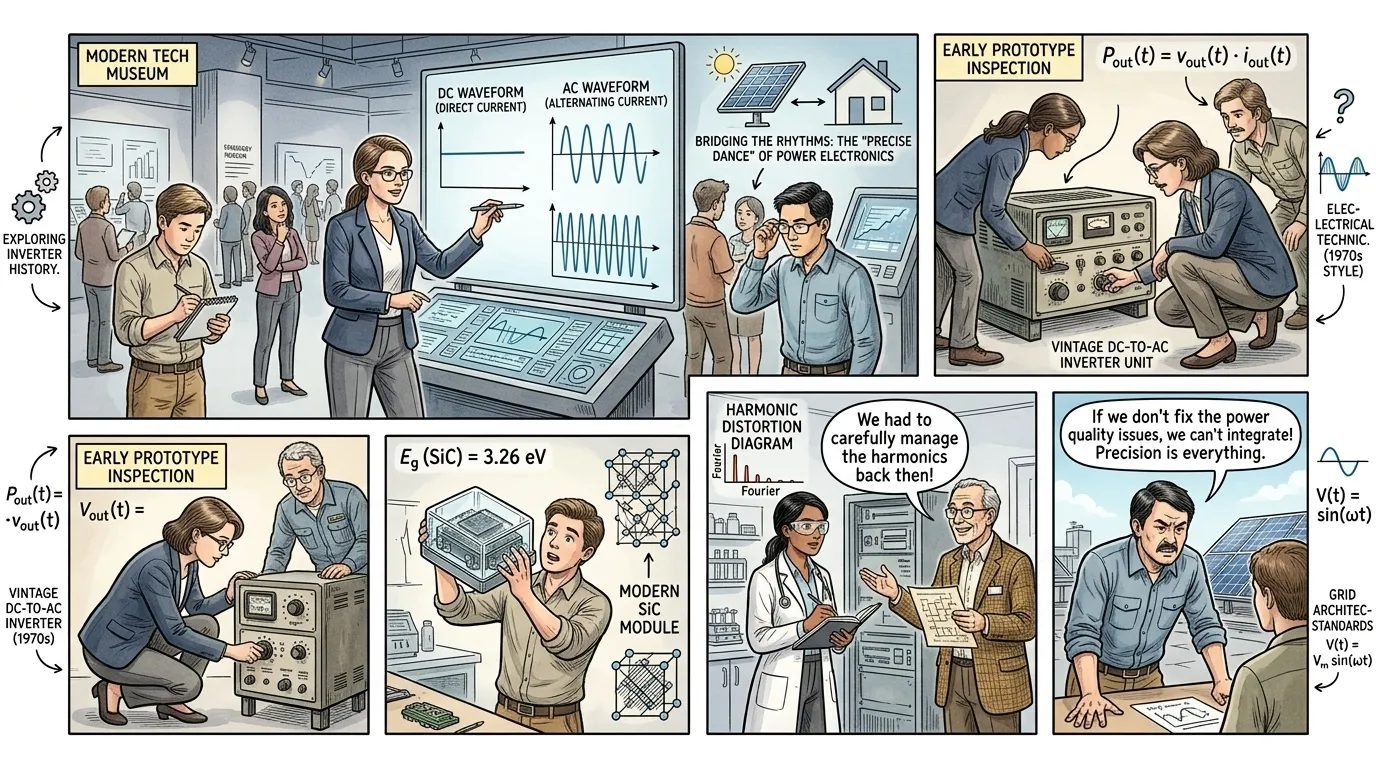
The heart of the problem lies in the very nature of electricity generated by solar cells. Photovoltaic panels produce Direct Current (DC), where electrons flow in one constant direction. However, the world's established electrical infrastructure, from power plants to household outlets, operates on Alternating Current (AC), where the direction of electron flow rapidly reverses many times per second. This fundamental difference meant a sophisticated intermediary was indispensable.
"Electrical engineers faced a stark choice: either completely redesign homes and grids to run on DC, an unthinkable proposition, or devise a way to accurately and efficiently transform DC into AC. As Dr. Eleanor Vance, a historian of energy systems, notes, 'This wasn't just about changing a flow; it was about orchestrating a precise dance between two entirely different rhythms of electrical energy.' The challenge was to create an AC waveform identical to the grid's, perfectly synchronized and without disruption. The quest for this 'perfect dance' defined decades of research."
Page 4
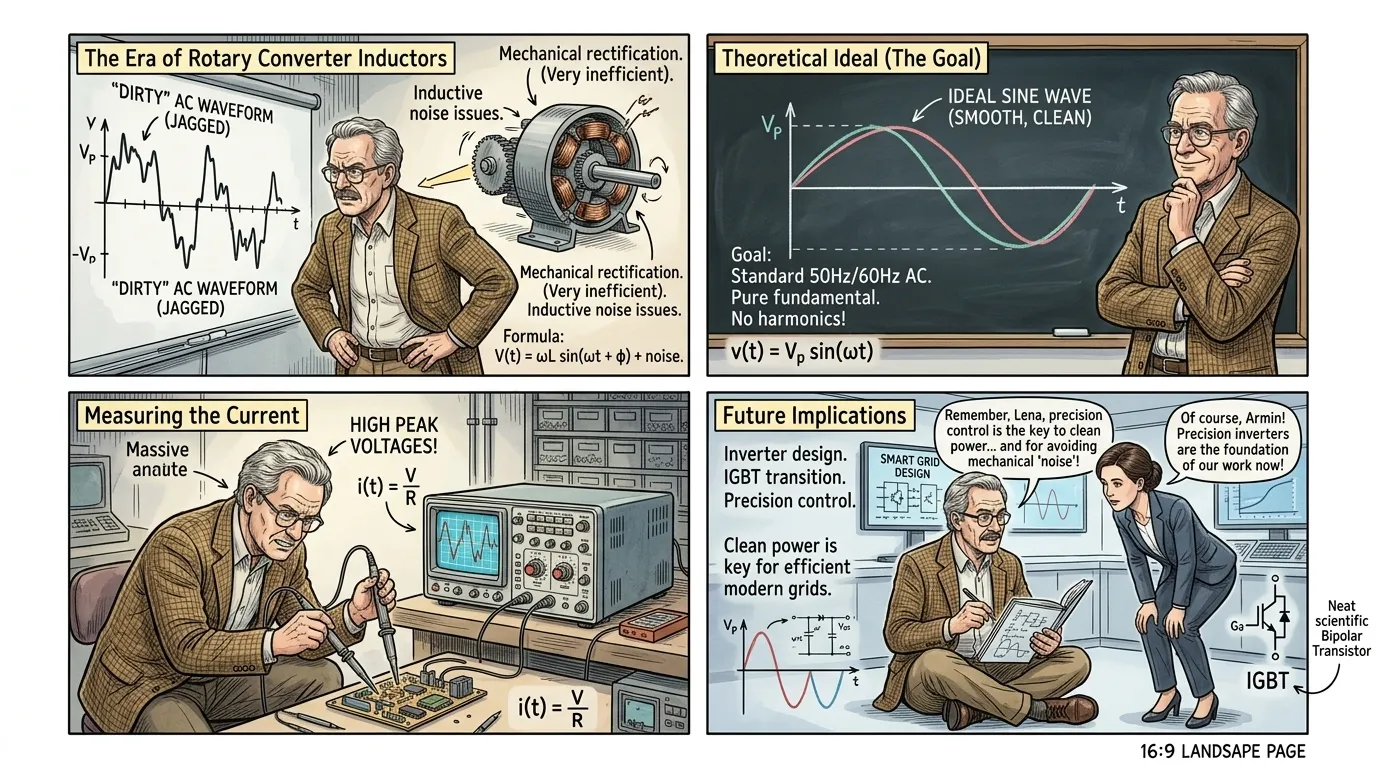
Early attempts at DC-to-AC conversion were often rudimentary and inefficient. Mechanical rotary converters, essentially spinning motors and generators, were noisy and suffered significant energy losses. Later electronic designs used basic switching circuits with large, power-hungry components that produced 'dirty' AC power—waveforms that were choppy and irregular, incompatible with sensitive electronics or the stable utility grid. These pioneering efforts, while foundational, underscored the magnitude of the engineering challenge.
"Engineers from the 1980s, facing these limitations, often found themselves in a bind. 'We could convert it, but not well,' remarked Professor Armin Müller, a retired power electronics expert, recounting the frustrations. 'The grid demands a pure sine wave, like a perfectly tuned instrument. Our early converters sounded more like a cacophony.' This 'dirty' power could damage appliances and destabilize the grid, making widespread solar integration seem like a distant dream. Each iteration, though imperfect, provided valuable lessons, driving the relentless pursuit of precision and efficiency."
Page 5
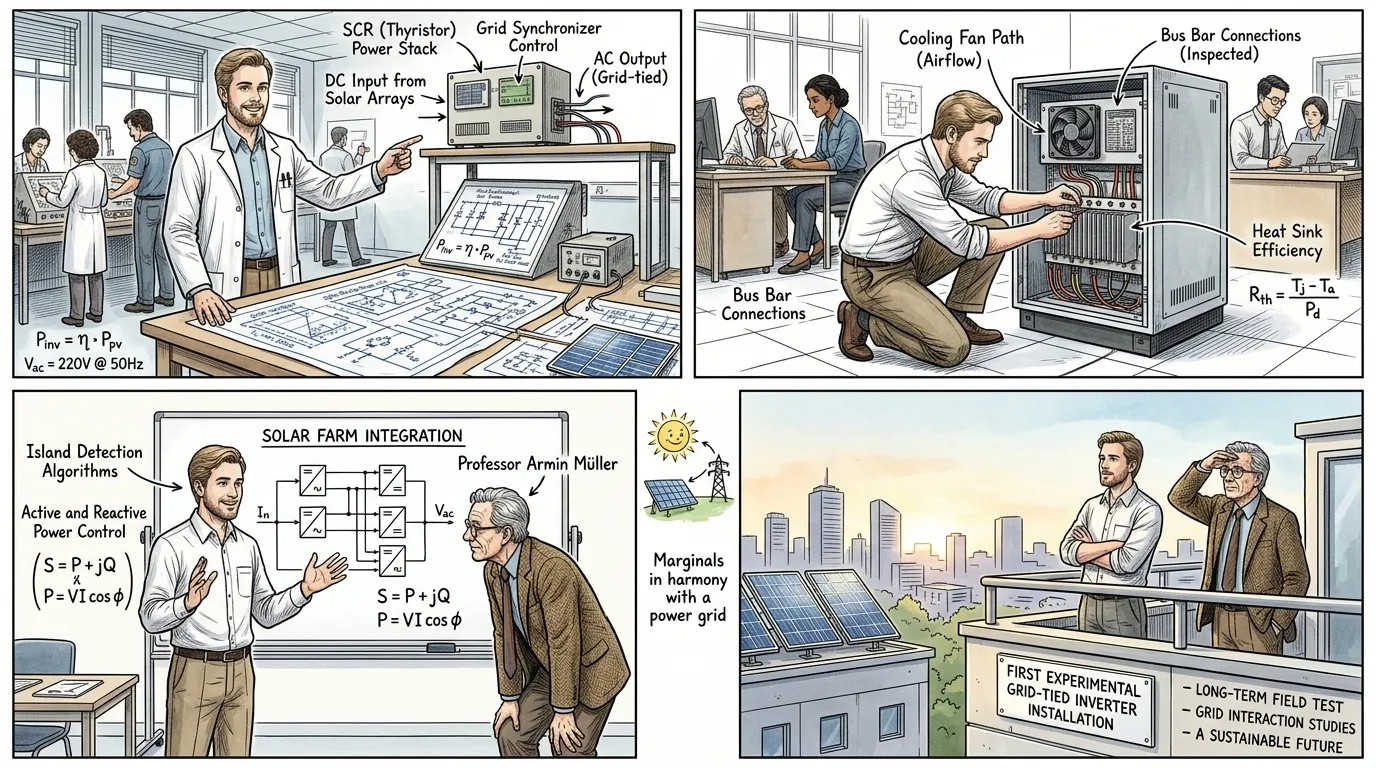
The true turning point arrived with the development of the 'grid-tie' inverter. While a collaborative effort by many, German engineer Werner Kleinkauf is often credited with developing some of the first practical grid-tied solar inverters in the 1980s. His work, particularly at the Fraunhofer Institute for Solar Energy Systems, focused on creating reliable systems that could synchronize perfectly with the existing utility grid, allowing excess solar power to be fed back, rather than just stored.
"Kleinkauf and his team recognized that merely converting DC to AC was not enough; the output had to precisely match the grid's voltage, frequency, and phase. 'The grid is a giant, precise orchestra,' Kleinkauf himself might have mused, 'and our inverter must play in perfect harmony.' This insight led to the integration of sophisticated control algorithms and high-speed semiconductor switches. The technical literature of the time reflects a burgeoning understanding of power electronics that could finally meet the grid's stringent demands, moving solar from isolated curiosities to potential grid contributors."
Page 6
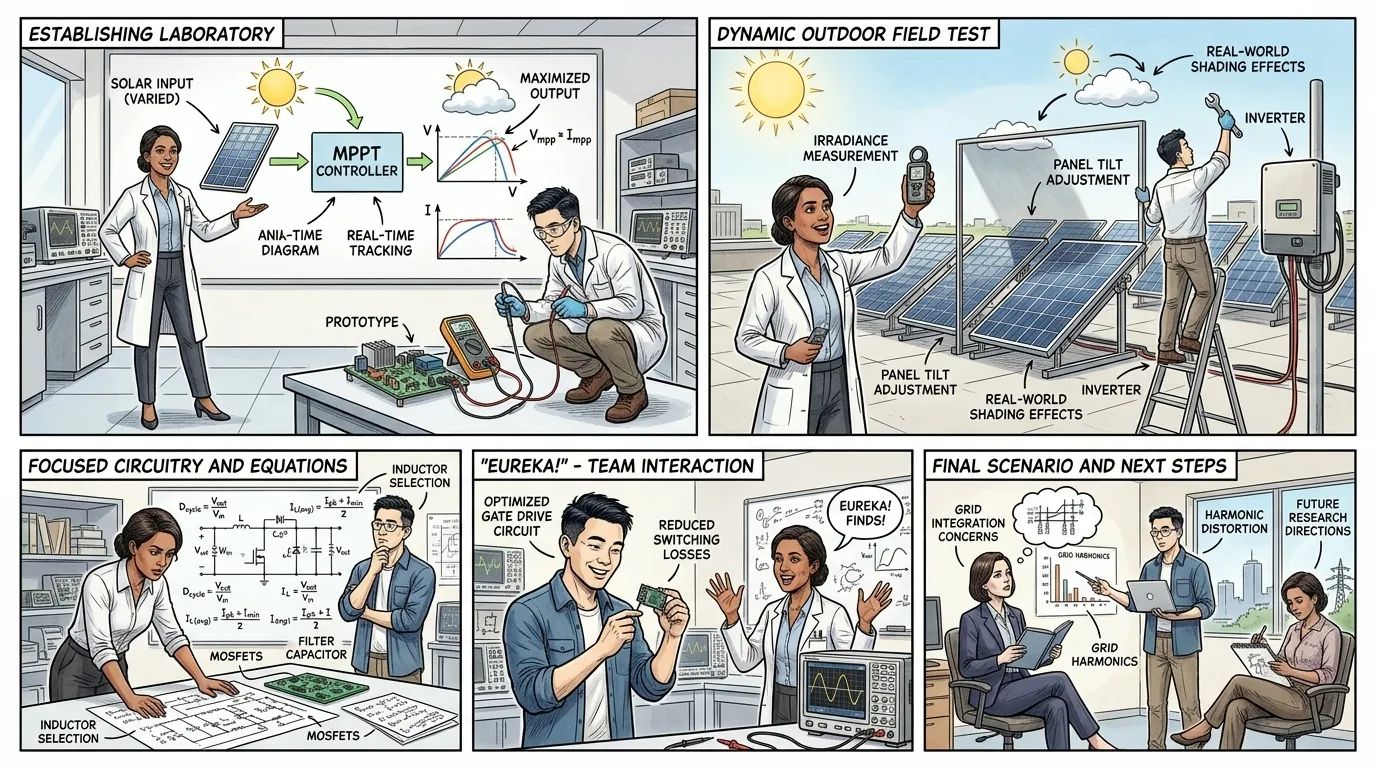
A critical innovation that vastly improved inverter efficiency was Maximum Power Point Tracking (MPPT). Solar panels' output voltage and current vary significantly with sunlight intensity and temperature. An MPPT controller continuously monitors these variables, actively adjusting the electrical load presented to the panels to draw the maximum possible power at any given moment. This intelligent optimization ensures that every ray of sunlight is utilized to its fullest potential.
"Engineers discovered that merely connecting panels wasn't enough; the system needed to dynamically 'find' the sweet spot. 'It's like tuning an instrument in real-time,' explained Dr. Anya Sharma, a power electronics specialist. 'The MPPT algorithm constantly listens to the panel's output, making tiny adjustments to ensure the most power is extracted, no matter the weather.' Without MPPT, a significant portion of potential solar energy would simply be lost, making solar systems far less economically viable and diminishing their environmental impact. This elegant solution maximized energy harvest."
Page 7
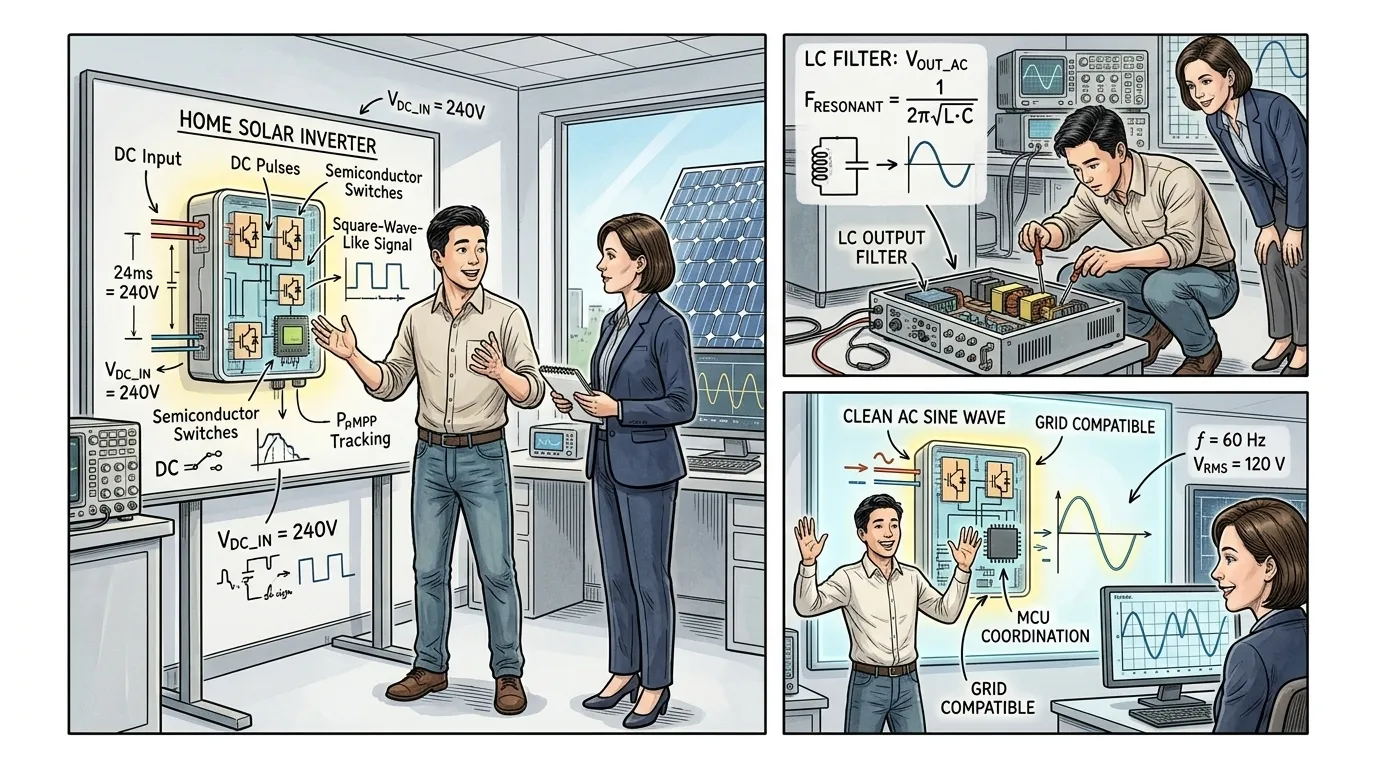
The core function of the inverter is the DC-to-AC conversion. After MPPT, the inverter uses high-speed semiconductor switches—typically Insulated Gate Bipolar Transistors (IGBTs) or MOSFETs—to rapidly switch the DC voltage on and off hundreds or thousands of times per second. This generates a square-wave-like pulsing DC, which is then passed through an intricate output filter. This filter, often an LC (inductor-capacitor) network, smooths the choppy pulses into a clean, grid-compatible sine wave. A sophisticated microcontroller orchestrates this entire process, ensuring perfect synchronization with the utility grid's frequency and phase, and providing crucial safety features.
"This rapid switching and filtering is where the 'magic' of the inverter truly happens. 'Imagine rapidly flicking a light switch on and off to mimic a smooth curve,' explains electrical engineer Marcus Chen. 'The filter then acts like a sculptor, refining those raw pulses into the perfect sine wave the grid demands.' The microcontroller constantly monitors the grid, adjusting the inverter's output in real-time to prevent power surges or disruptions. This precise control is vital for grid stability, transforming variable solar input into a reliable, high-quality power source."
Page 8
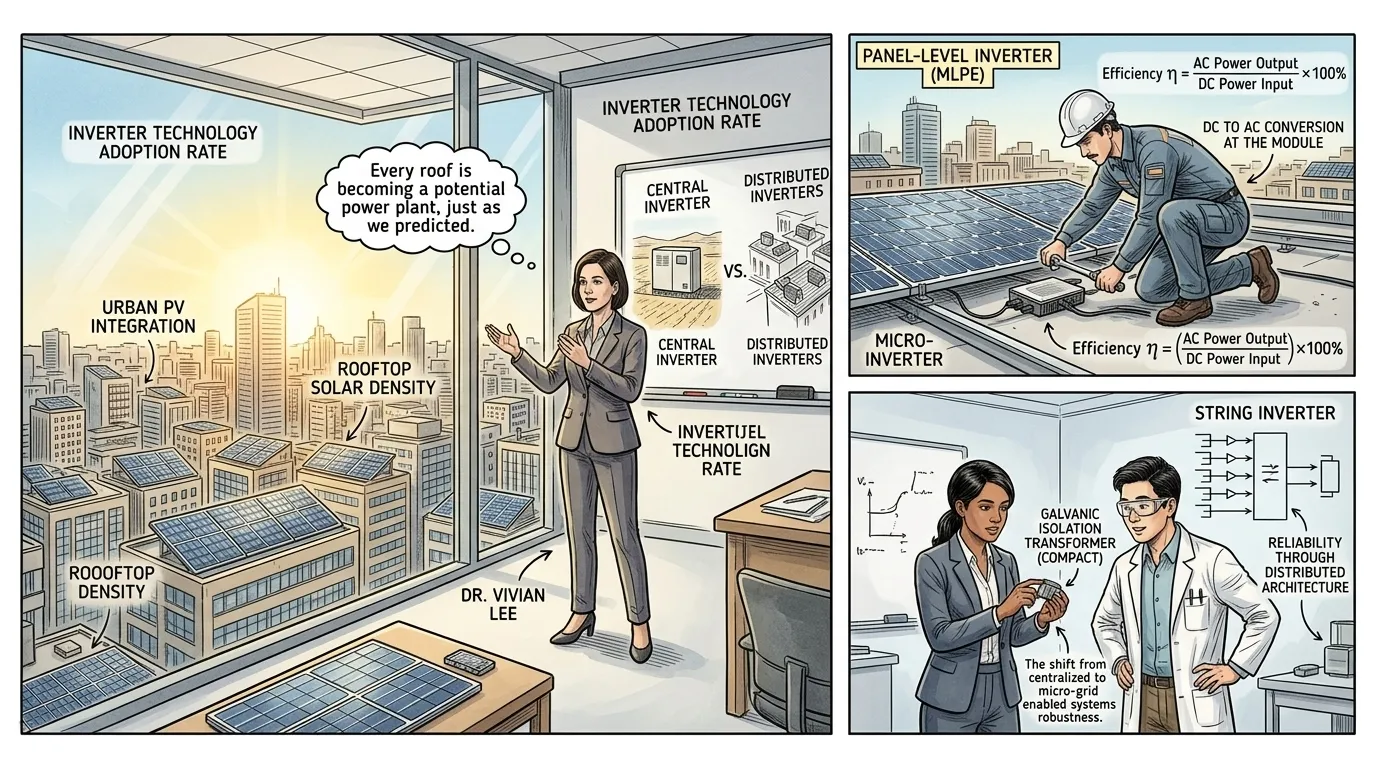
With highly efficient, reliable, and increasingly affordable grid-tie inverters, the solar revolution gained unstoppable momentum in the 21st century. Governments enacted feed-in tariffs and incentives, making rooftop solar economically attractive for millions. The technology evolved rapidly, moving from large central inverters to smaller, more distributed string inverters, and eventually to micro-inverters—small units placed directly under each solar panel. This distributed approach increased resilience and individual panel optimization.
"The market quickly recognized the potential. 'Suddenly, every roof became a potential power plant,' observed industry analyst Dr. Vivian Lee. 'The inverter made it feasible, taking solar from an expensive experiment to a mainstream energy source.' This proliferation was a testament to the continuous engineering advancements that drove down costs and improved performance. The shift towards distributed inverter architectures also addressed issues of shading and panel-level monitoring, optimizing energy harvesting across diverse installations."
Page 9
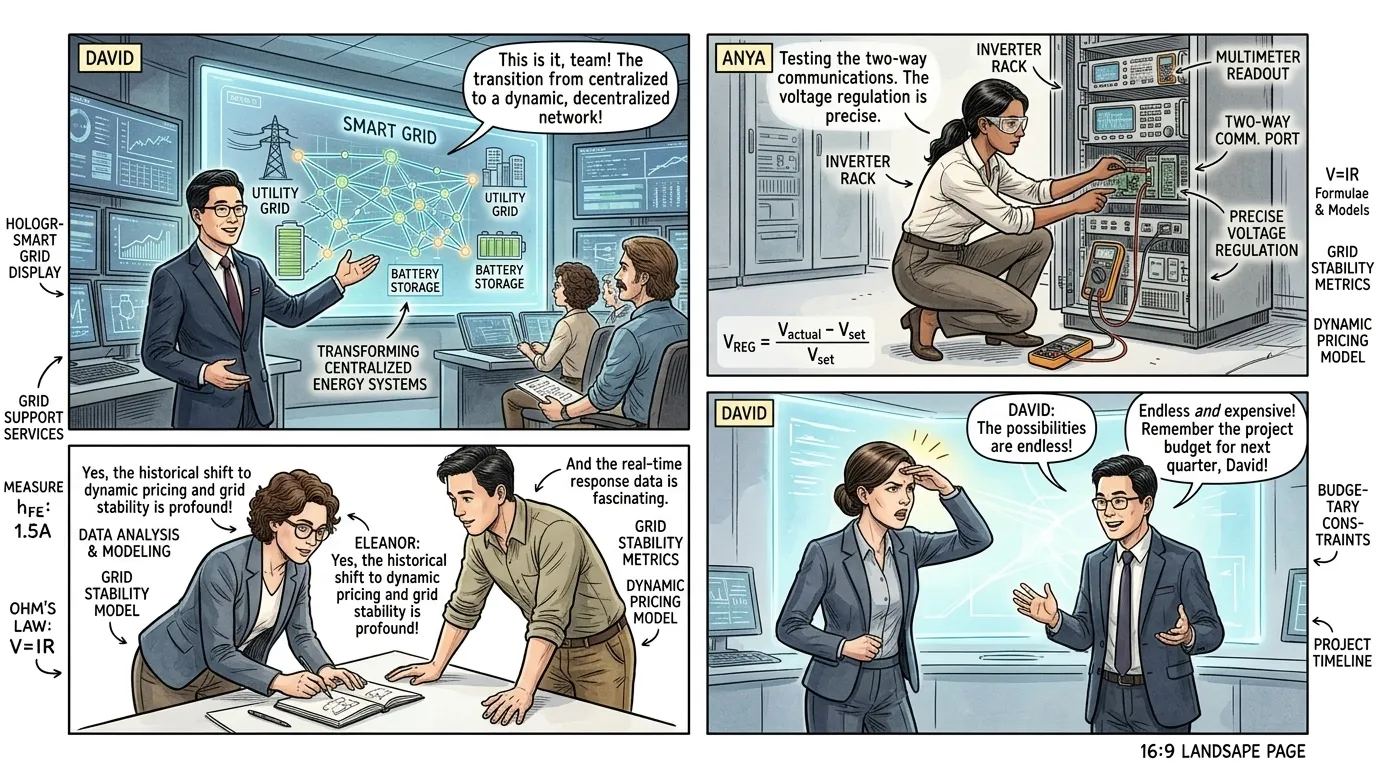
Beyond merely converting power, modern inverters have become intelligent energy managers, playing a crucial role in the evolving 'smart grid.' They communicate with utilities, manage battery storage, and even provide grid support services like voltage and frequency regulation. This bidirectional flow of information and power is transforming centralized energy systems into a more resilient, decentralized network. The inverter stands as the gateway, enabling homes to not just consume, but actively participate in the energy ecosystem.
"The implications for energy independence and grid stability are profound. 'Our inverters are no longer just converters; they are active participants in grid management,' stated Chief Grid Architect, Engineer David Kim. 'They're the unsung heroes of a more resilient and sustainable energy future.' These advanced capabilities are critical for integrating intermittent renewable sources, balancing supply and demand, and enabling sophisticated energy trading. The inverter's evolution is central to building robust energy infrastructure for the 21st century."
Page 10
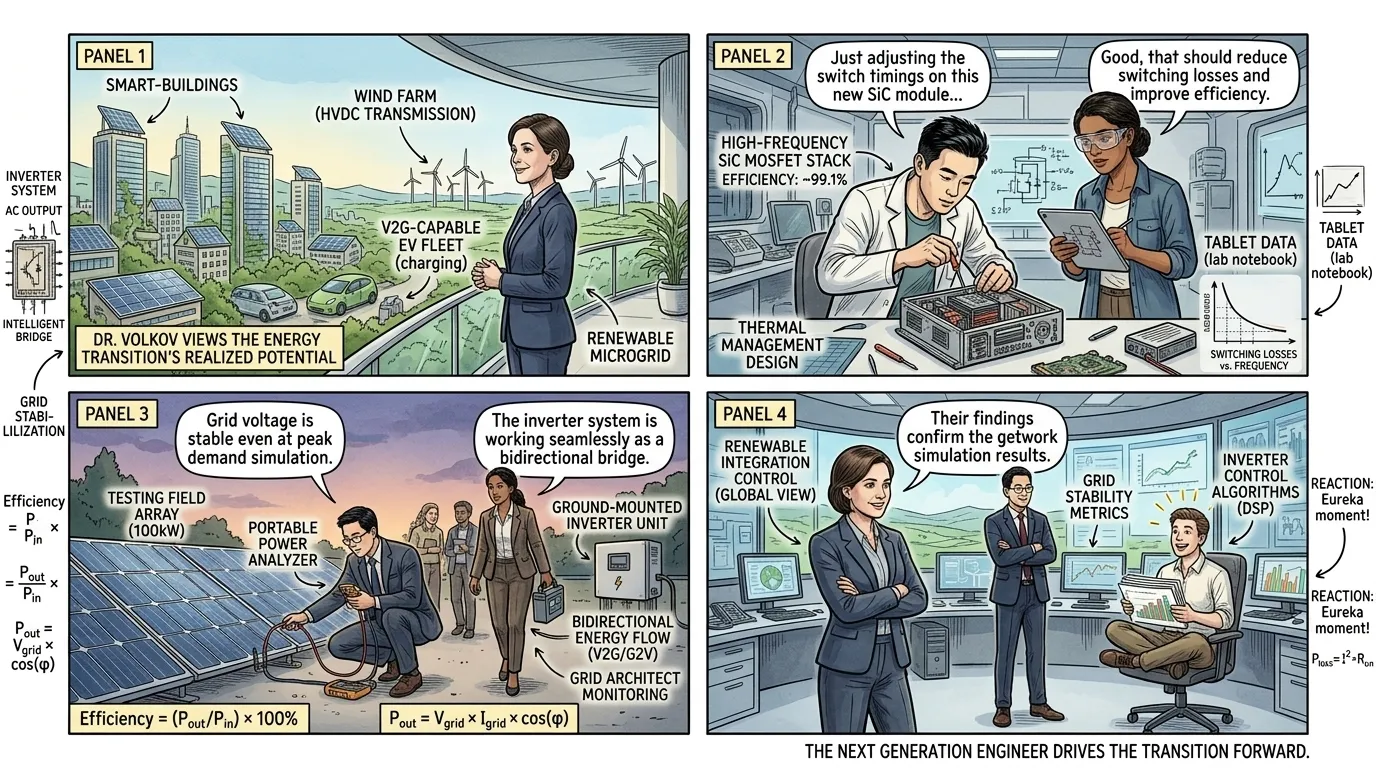
The Home Solar Inverter's legacy extends far beyond its immediate function. It has laid the groundwork for entirely new energy paradigms: seamless integration of renewable sources, the rise of energy-independent homes, and the potential for vehicle-to-grid (V2G) technology. From powering remote communities to stabilizing national grids, the inverter remains an indispensable component in humanity's pursuit of a sustainable, electrified future. It's a testament to continuous innovation, quietly transforming our relationship with energy.
"As we look ahead, the inverter's capabilities continue to expand, offering even greater control and flexibility. 'Its future evolution is intertwined with our planet's energy destiny,' muses Dr. Volkov, reflecting on the journey. 'From micro-grids to continental power flows, the inverter will continue to be the intelligent bridge, making every watt count.' This often-unseen invention has become a cornerstone of modern sustainability, a silent enabler of global energy transition."
About this story
- Location: Global
- Audience: general readers
Questions and answers
Read Wonder Inventions on your phone
Wonder Inventions is available on Android. Get Wonder Inventions on Google Play.