Telephone
Telephone — an illustrated inventions story, set in Global. 10 illustrated pages, free to read on Wonder Inventions.
Page 1
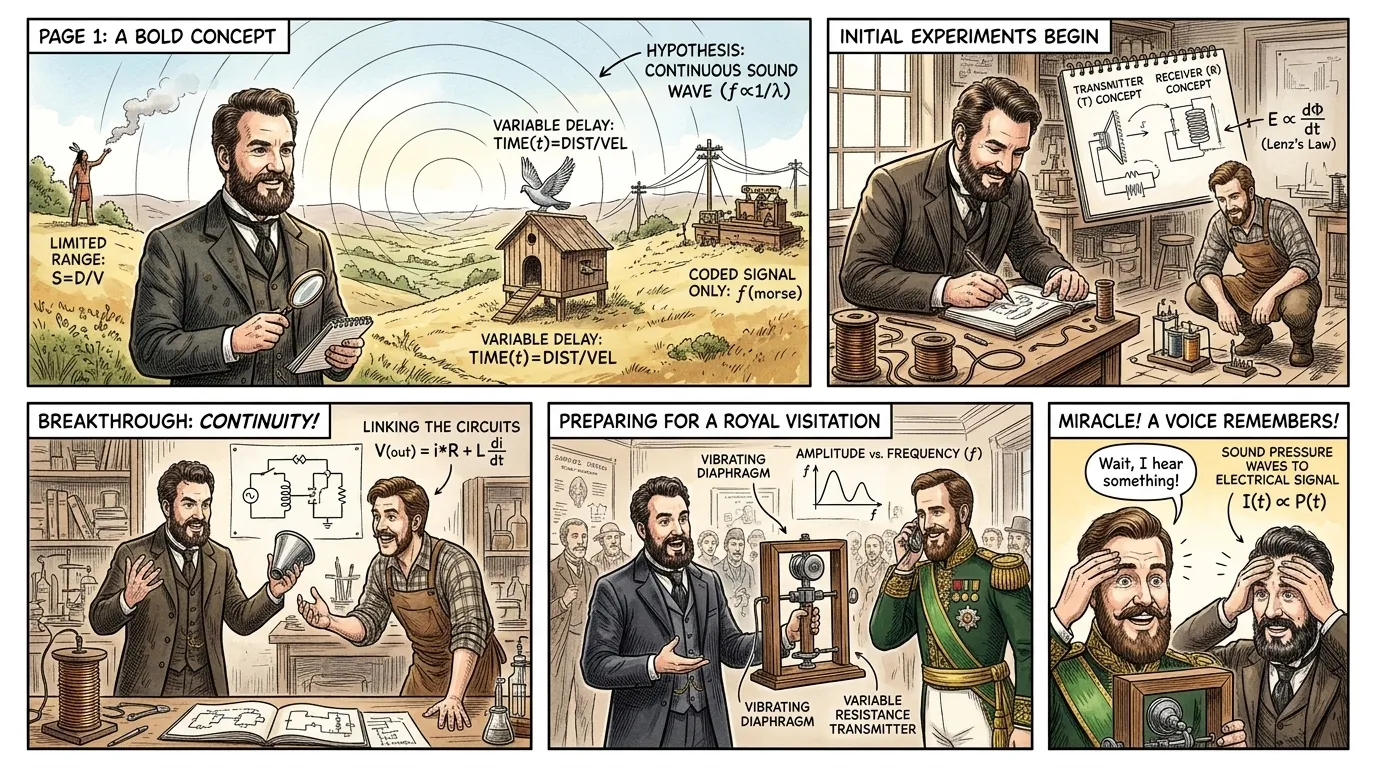
Before the telephone, distance meant silence. Communication beyond the reach of the human voice relied on cumbersome, slow methods. The telegraph, while revolutionary, demanded specialized training to translate dots and dashes, offering no direct human connection. This era yearned for an invention that could bridge the chasm of distance with the immediacy of speech, transforming human interaction forever. Alexander Graham Bell, driven by a profound understanding of sound and an inventive spirit, dedicated himself to this formidable challenge, conceiving a device that would carry the nuances of the human voice over great distances.
Page 2
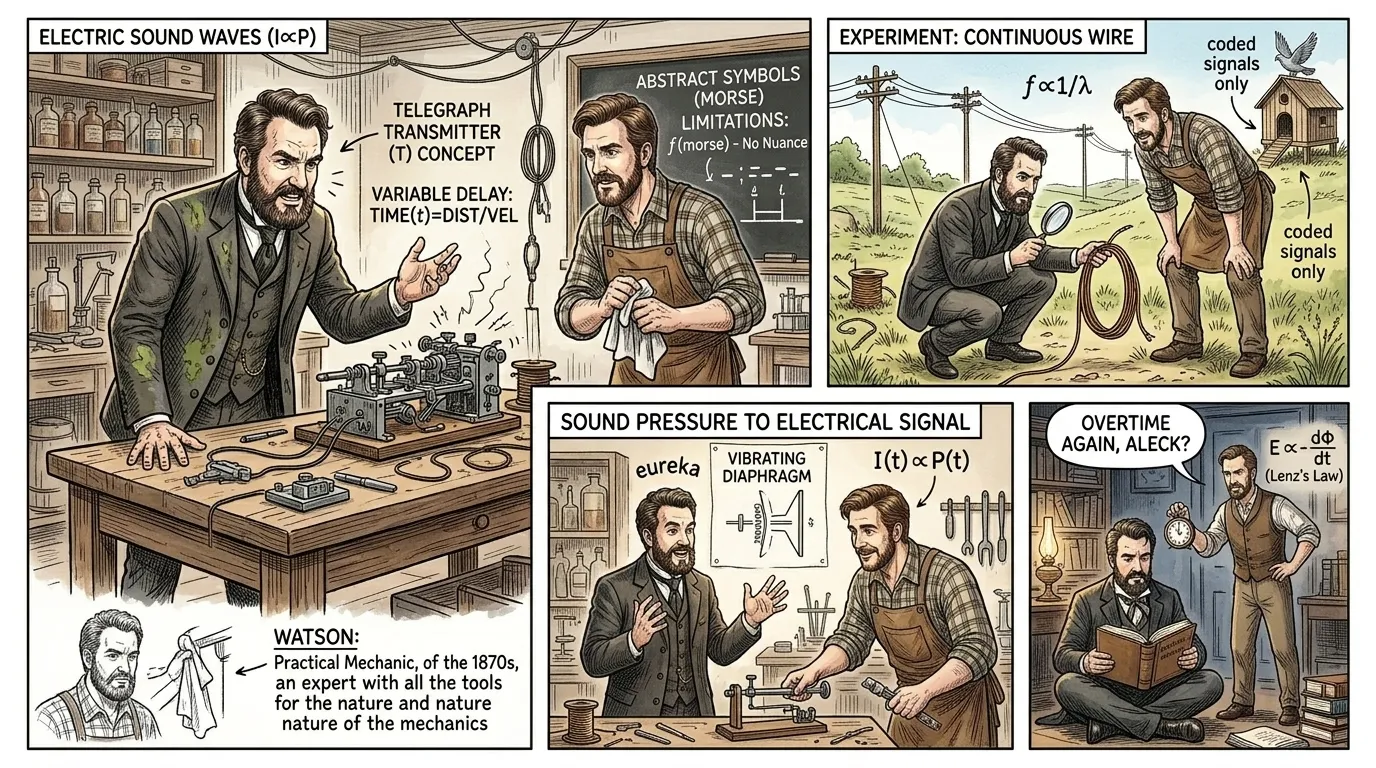
The electric telegraph, patented decades earlier, had dramatically sped up long-distance communication, yet it remained a cumbersome, indirect process. Messages had to be encoded into Morse code, transmitted as electrical pulses, and then decoded. This method limited communication to trained operators and starkly contrasted with the natural fluidity of speech, leaving a vast, unmet need for voice transmission. Bell and his assistant, Thomas Watson, observed these limitations closely, recognizing that true communication required more than mere signals.
""Watson, consider the telegraph," Bell stated, gesturing towards a clattering instrument. "It sends information rapidly, yes, but it transmits only abstract symbols, not the very essence of human expression. The true problem, then, is not merely speed, but fidelity." Watson, a robust man in his 20s with a practical demeanor, neatly parted brown hair, and a thick brown mustache, dressed in a sturdy work apron over a flannel shirt, paused his work. "Indeed, Mr. Bell. Imagine if we could hear not just words, but the speaker's tone, their very voice! The challenge is how to make an electrical current mimic the complex, continuous vibrations of speech itself.""
Page 3
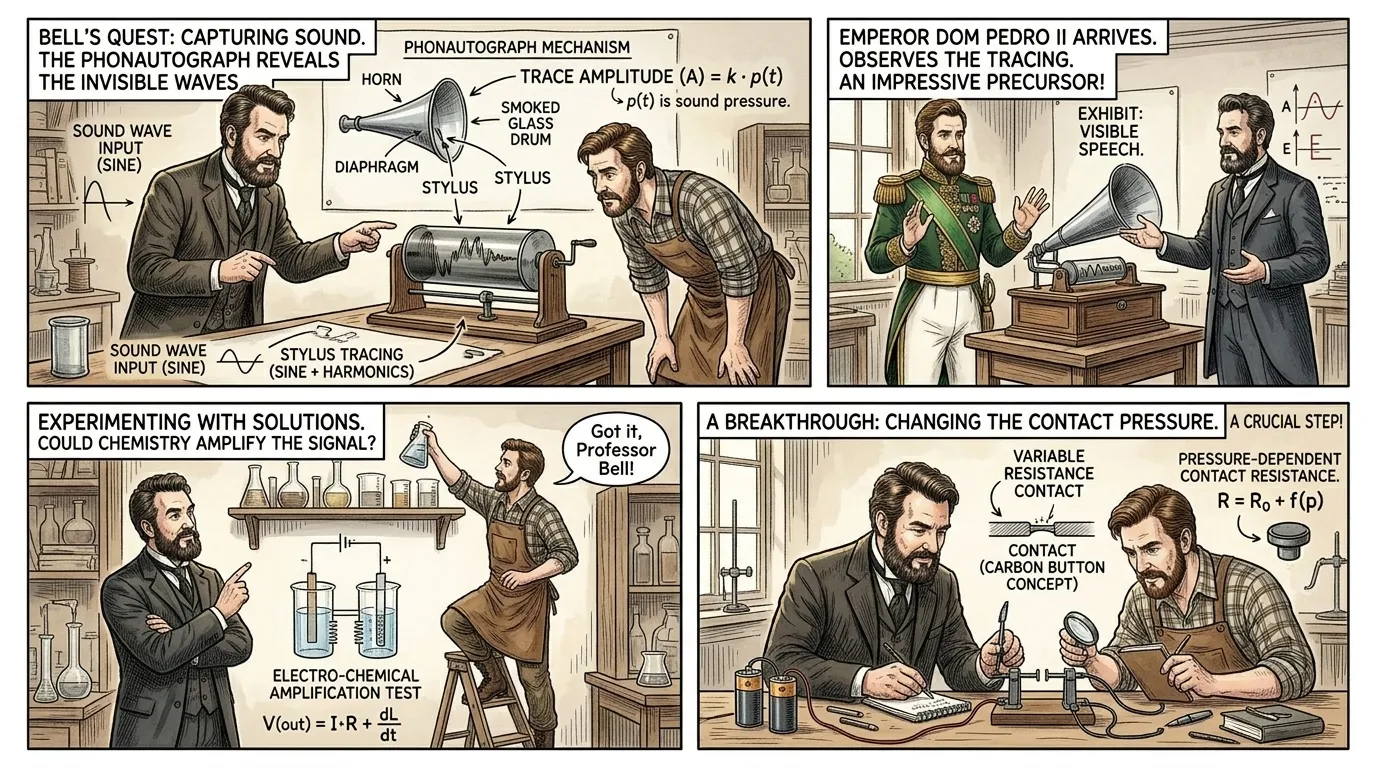
Bell's background as a teacher of the deaf gave him a unique insight into the mechanics of sound and speech. He understood that sound was merely vibration, and these vibrations could be visually represented, as demonstrated by devices like the phonautograph. This instrument used a vibrating membrane to trace sound waves onto smoked glass, a crucial step in conceptualizing how sound could be translated into a physical pattern. This early work laid the groundwork for his conviction that these complex vibrations could, in turn, be translated into electrical fluctuations.
""Watson, observe this phonautograph," Bell explained, carefully pointing to a device on his workbench. "The membrane here vibrates with sound, and the stylus traces its pattern onto the smoked glass. This shows us the true form of sound, not just its auditory effect." Watson leaned in, intrigued. "So, the intricate dance of air molecules can be mapped?" Bell nodded. "Precisely. As the ancient philosopher Lao Tzu once said, 'Nature does not hurry, yet everything is accomplished.' We, too, must meticulously observe and understand these natural phenomena, for within them lies the key to transforming sound into a tangible, transmissible form.""
Page 4
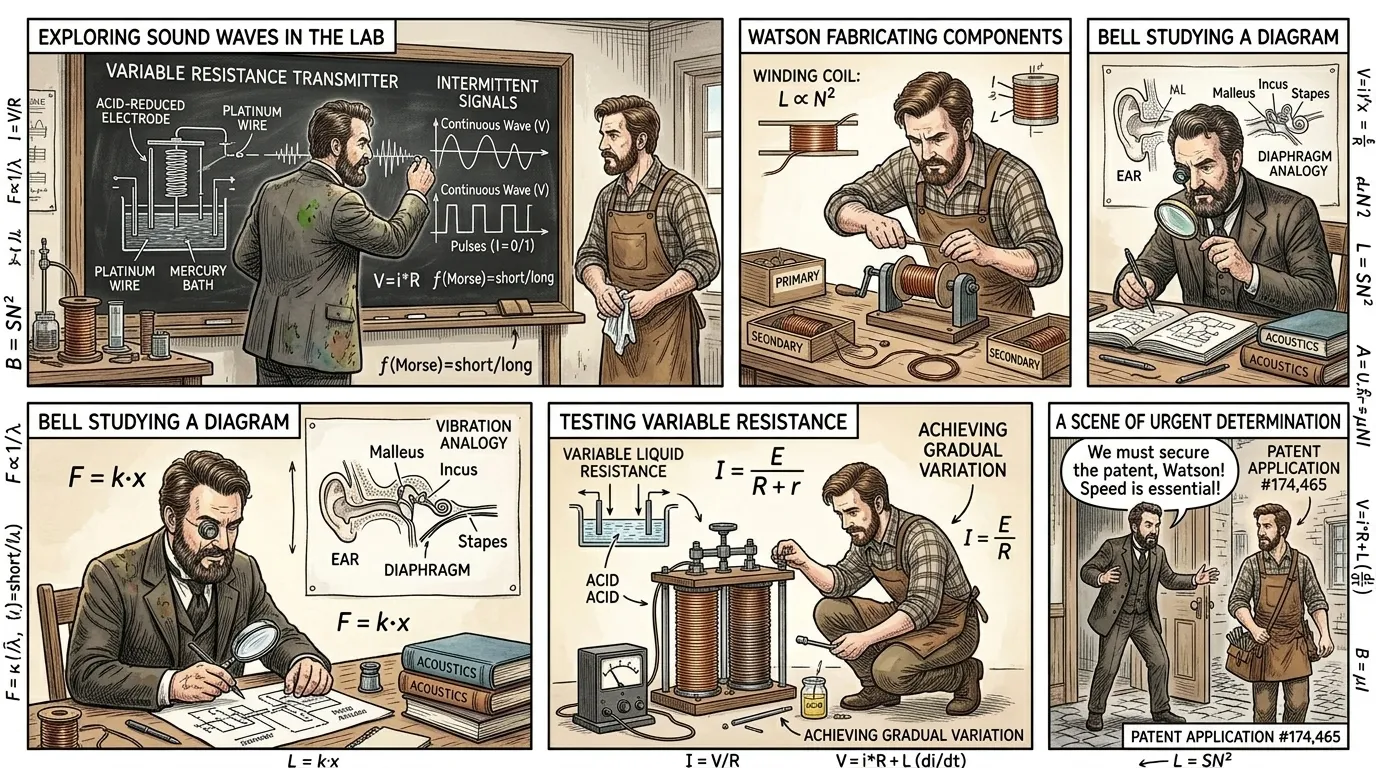
The fundamental problem with previous attempts to transmit voice, including Bell's own 'harmonic telegraph' experiments, was their reliance on 'make-and-break' circuits. These circuits could only transmit on or off pulses, not the continuous, undulating waves of sound. Bell realized that a successful telephone would require a mechanism capable of generating a continuous electrical current that varied in intensity precisely in proportion to the intensity and frequency of the sound waves. This concept of 'variable resistance' became the cornerstone of his invention.
""The challenge, Watson, is not merely to detect sound, but to make the electrical current itself fluctuate continuously, mirroring the very waveform of speech," Bell asserted, sketching furiously on a blackboard. "Imagine a stream of water; we need to make its flow stronger or weaker, not just turn it on or off." Watson, wiping his hands on his apron, studied the sketch. "So, the resistance in the circuit must change in proportion to the sound wave's pressure against a membrane?" Bell's eyes gleamed. "Precisely! If we can achieve that, the electrical signal will carry the full complexity of the human voice.""
Page 5
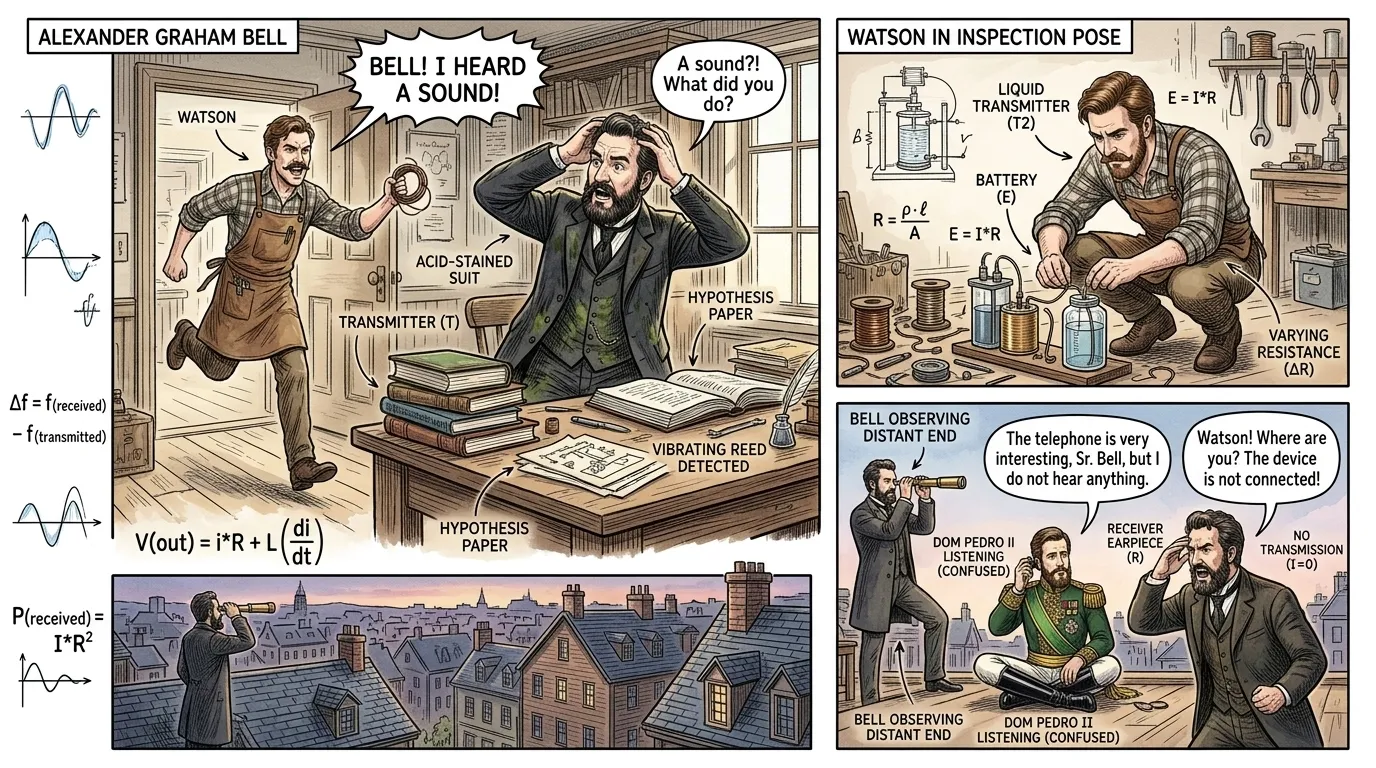
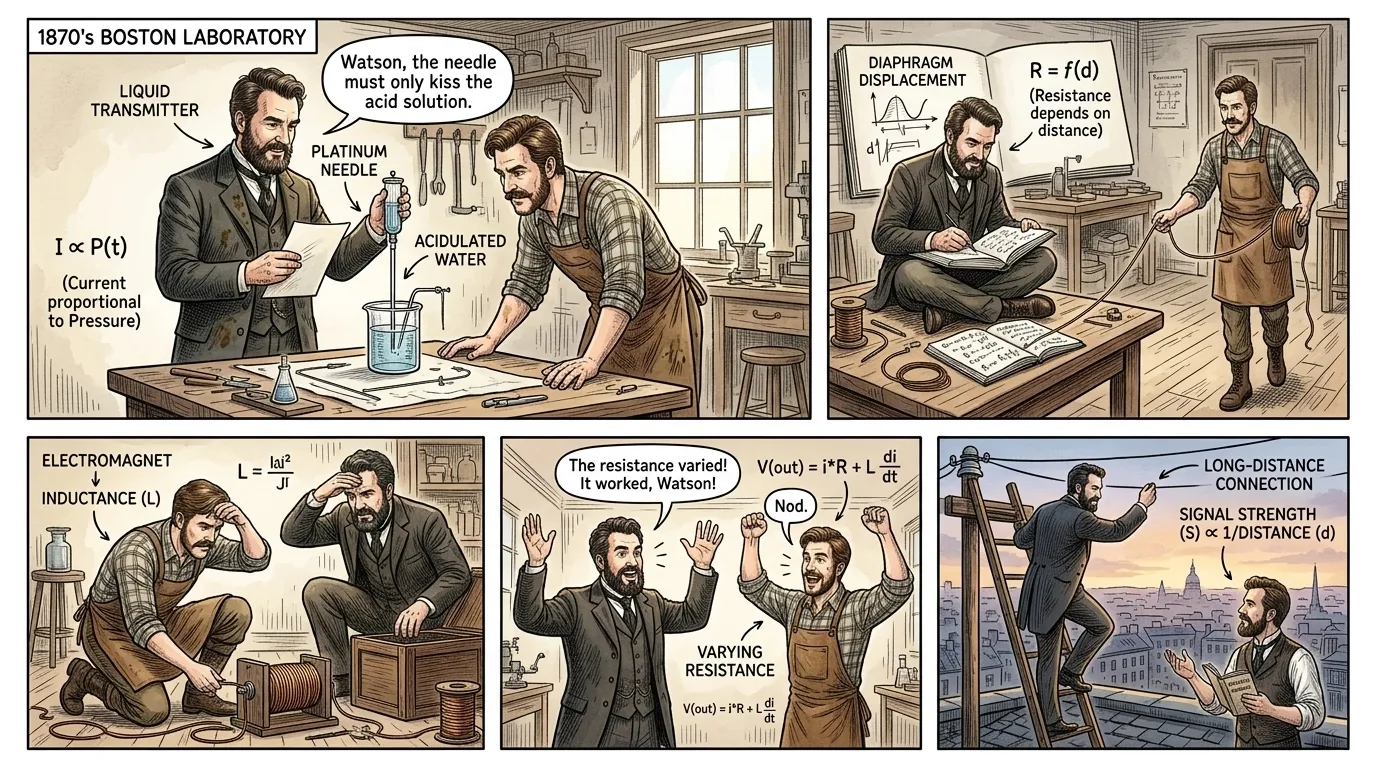
Many experiments preceded the definitive breakthrough, often yielding only static or faint, indistinct noises. However, a critical turning point occurred on June 2, 1875. While working on the harmonic telegraph, Thomas Watson accidentally plucked a steel reed in one room, and in an adjacent room, Bell heard the faint twang. This wasn't the harmonic telegraph working, but rather a different mechanism at play. The vibrating reed had caused a contact point to dip into a small container of acidulated water, creating a 'liquid transmitter' that varied resistance directly with the sound.
""Mr. Bell! I believe I heard it!" Watson exclaimed, rushing into Bell's study from his workshop. "When I plucked the reed, I saw the platinum wire dip into the liquid, and you... did you hear a sound?" Bell, seated at his desk amidst research papers, slowly rose, his expression a mix of disbelief and dawning realization. "Watson, a faint twang indeed! It was indistinct, but undeniably there. This was not the harmonic telegraph. This was something new. The vibrations from your reed modulated the current by altering the contact point in that liquid!" He gestured animatedly, his mind racing through the implications."
Page 6
The core of Bell's invention lay in the 'variable resistance' principle. In the telephone's transmitter, sound waves from a speaker's voice hit a thin, flexible diaphragm, causing it to vibrate. This diaphragm was mechanically linked to a component that, in turn, altered the electrical resistance within a circuit. In the early liquid transmitter, this was a platinum wire dipping into an acidulated water solution; later, it evolved to carbon granules. As the diaphragm vibrated, the resistance in the circuit changed continuously, creating a modulated electrical current that was a faithful analog of the original sound wave. This was the fundamental innovation.
""Here is the essence, Watson," Bell explained, pointing to a carefully assembled diagram of the improved transmitter. "When I speak, the sound waves create pressure variations against this sensitive diaphragm." He tapped the diagram. "The diaphragm's vibrations, in turn, cause this platinum needle to move within the acidulated solution. The varying depth of immersion continuously alters the electrical resistance in the circuit." Watson nodded, absorbing the details. "So, the sound wave itself is transformed directly into a corresponding electrical wave, not a series of pulses." "Precisely, a true electrical analog," Bell affirmed."
Page 7
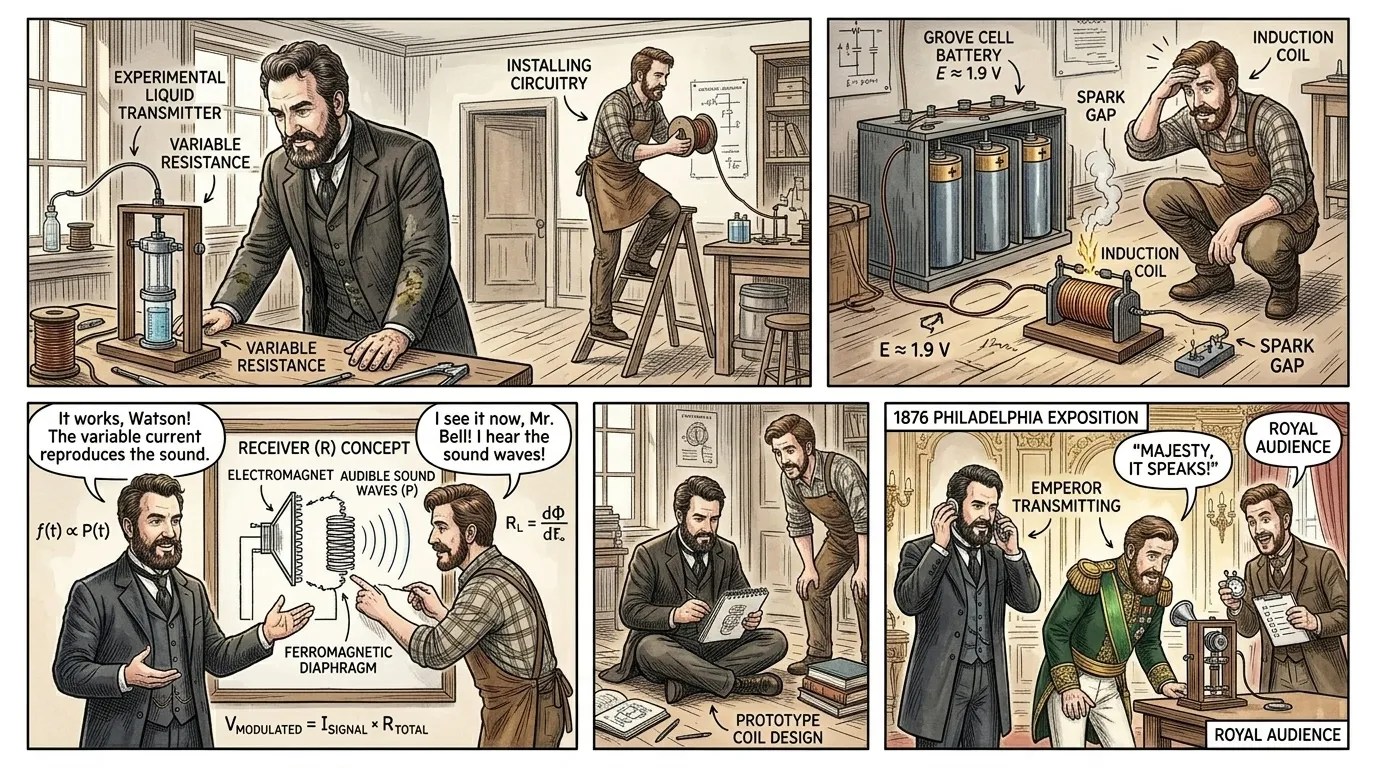
Once the sound waves were converted into a modulated electrical current and sent down the wire, the next crucial step was to reverse the process at the receiving end. The telephone's receiver was designed to convert this fluctuating electrical current back into audible sound. The modulated current would pass through an electromagnet. As the current's strength varied, the electromagnet's magnetic field would correspondingly strengthen and weaken. This fluctuating magnetic force would then cause a second, ferromagnetic diaphragm to vibrate, recreating the original sound waves. This elegant symmetry completed the circuit of voice transmission.
""And here, Watson, is the receiver, completing the cycle," Bell demonstrated, gesturing to a diagram of the receiving apparatus. "The modulated electrical current, having traveled the wire, now flows through the coils of this electromagnet. As the current strengthens and weakens with the voice's modulations, so too does the magnetic field." Watson traced the lines on the diagram. "Which then causes this ferromagnetic diaphragm to vibrate in sympathy, recreating the sound waves in the air for the listener." Bell smiled. "Indeed. The electrical energy is faithfully converted back into mechanical energy, giving us the miracle of transmitted speech.""
Page 8
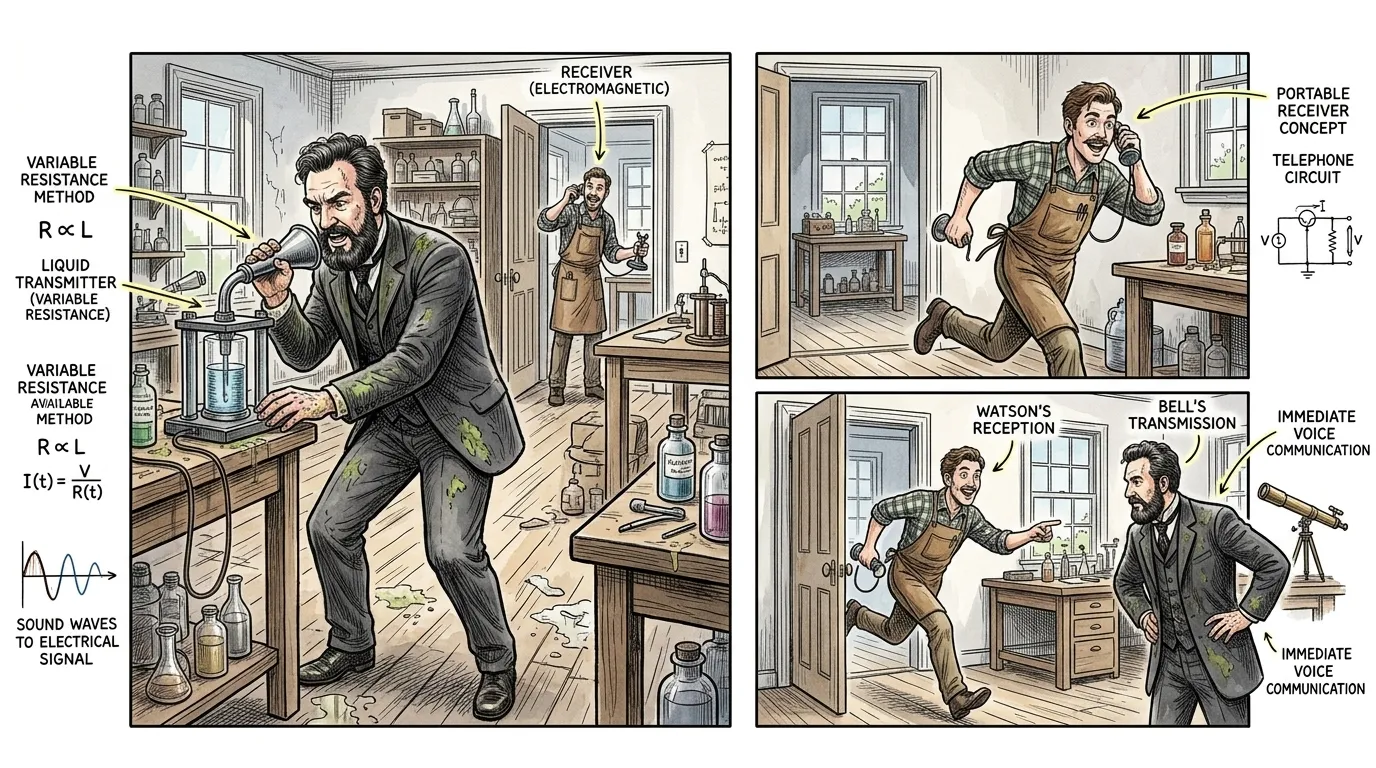
After months of tireless experimentation and refinement, the moment of truth arrived. On March 10, 1876, in his Boston laboratory, Alexander Graham Bell spilled acid on himself and instinctively called out, not for assistance, but for his loyal assistant. Speaking into his liquid transmitter, he uttered the now-famous words: "Mr. Watson, come here, I want to see you." In an adjacent room, Thomas Watson, with the receiver pressed to his ear, clearly heard every word. This historic event marked the world's first successful and intelligible transmission of human speech over an electrical wire, validating Bell's relentless pursuit.
""Mr. Watson, come here, I want to see you!" Bell exclaimed, his voice clear and resonant as he spoke into the improved liquid transmitter, the faint hiss of the acidulated water audible. In the adjacent room, Thomas Watson, holding the receiver to his ear, gasped in astonishment. "Mr. Bell, I heard you! Every word, perfectly clear!" he shouted back, a grin spreading across his face. He quickly made his way to Bell's side. "It works, Mr. Bell! It truly works! The continuous, variable current principle – it was the crucial insight!" Bell, his face alight with triumph, nodded, a monumental sense of accomplishment washing over him."
Page 9
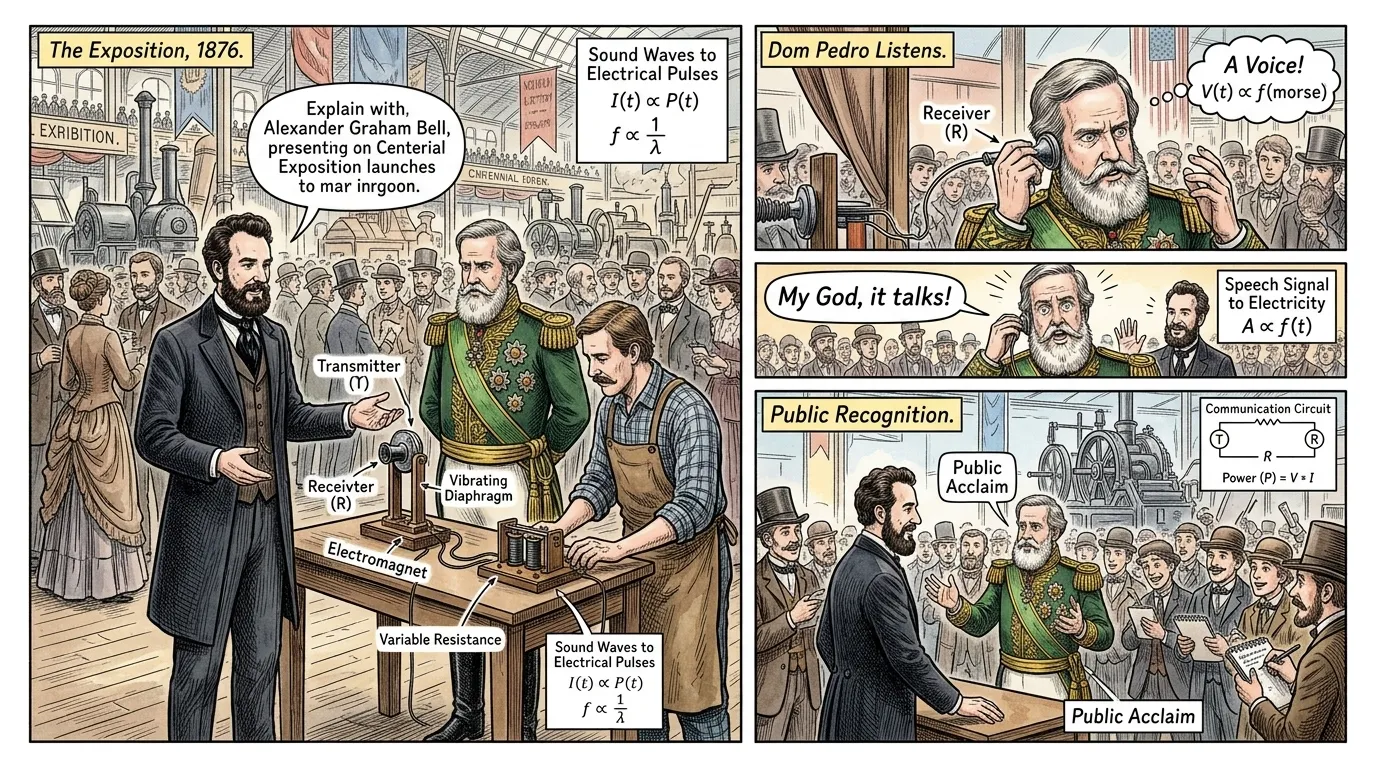
Just days before his breakthrough call, Bell had secured his patent for the telephone, beating rival Elisha Gray by mere hours. The invention was initially met with skepticism, but public demonstrations, particularly at the 1876 Centennial Exposition in Philadelphia, transformed doubt into awe. Emperor Dom Pedro II of Brazil famously exclaimed, "My God, it talks!" The clarity of spoken words across distances captivated audiences, paving the way for rapid adoption. Within years, telephone companies emerged, and the invention began its global spread, connecting cities, businesses, and homes in unprecedented ways.
""Gentlemen, you hear the very voice of my assistant, miles away, speaking through this wire!" Bell declared to a hushed crowd at the Centennial Exposition, gesturing towards the telephone. A distinguished observer, Emperor Dom Pedro II, leaned in, receiver to his ear. "My God, it talks!" he exclaimed, his face a picture of stunned amazement. "The skeptics once claimed such a feat was impossible, Mr. Bell," an aide whispered. Bell, with a dignified smile, replied, "Indeed. But as the American poet Ralph Waldo Emerson once wisely penned, 'The mind, once stretched by a new idea, never returns to its original dimensions.' The world's perception of communication has now been irrevocably expanded.""
Page 10
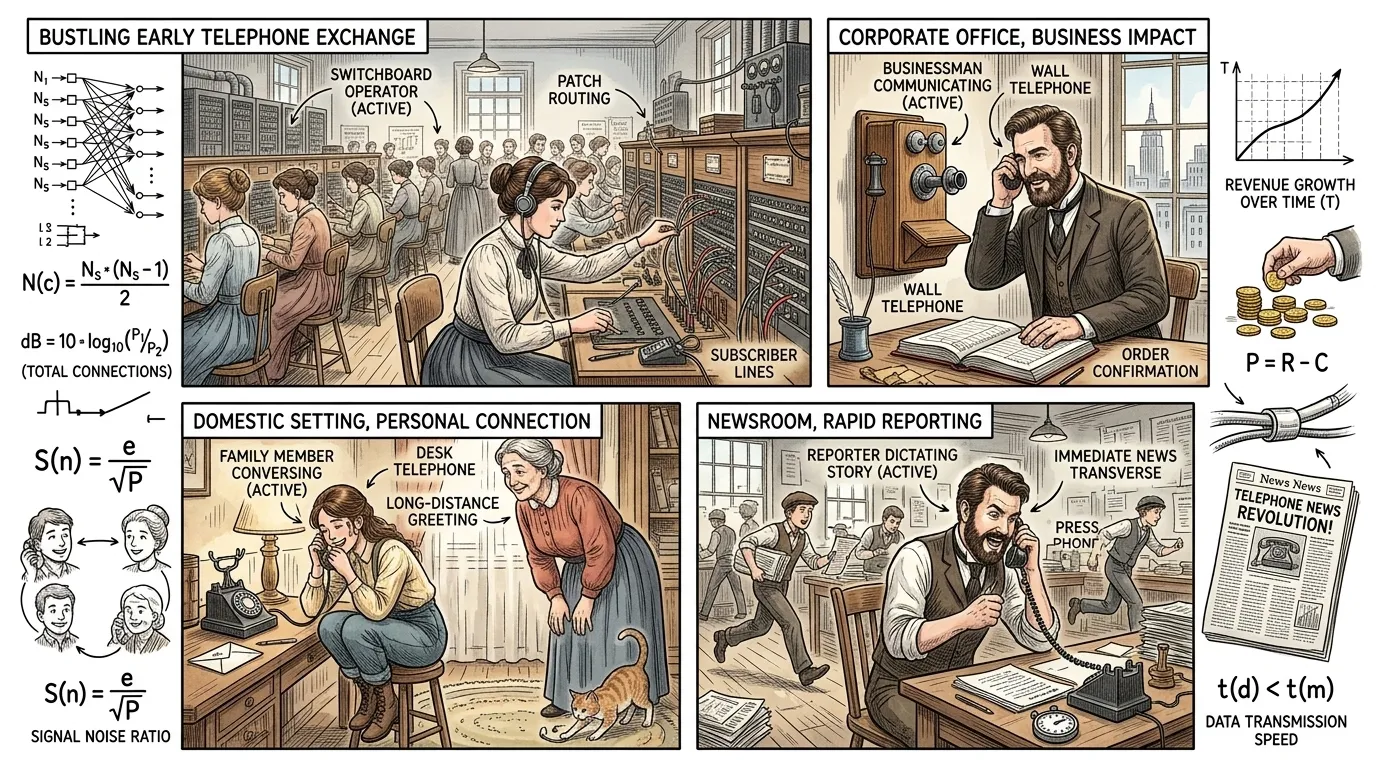
The telephone rapidly transformed society. It revolutionized business, allowing immediate transactions and coordination across vast distances. It fostered personal connections, bringing families and friends closer regardless of geography. Early telephone exchanges, staffed by operators, became bustling hubs of communication. The invention dramatically impacted emergency services, journalistic reporting, and military command. From its humble origins, the telephone evolved through countless innovations, from rotary dials to digital networks, becoming the foundational technology for our interconnected modern world, irrevocably altering how humanity communicates, works, and lives.
About this story
- Location: Global
- Audience: kids (ages 6–12)
Questions and answers
Read Wonder Inventions on your phone
Wonder Inventions is available on Android. Get Wonder Inventions on Google Play.