Johann Wolfgang von Goethe
Johann Wolfgang von Goethe — an illustrated biography story, set in Global. 10 illustrated pages, free to read on Wonder People.
Page 1

In Weimar, in 1808, Johann Wolfgang von Goethe unveiled the first part of Faust, a monumental work years in the making. Before an assembly of intellectuals, artists, and statesmen, including Duke Carl August, he presented a drama that would redefine German literature and philosophical thought. Its reception cemented his status not merely as a poet, but as the era's preeminent cultural architect, challenging the very foundations of human ambition and salvation. In that moment, he became impossible to ignore.
Biographical Fact: The unveiling of Faust Part One solidified Goethe's reputation and cultural dominance across Europe, marking a pinnacle of his literary career and influence.
Page 2

Born into a prosperous Frankfurt family in 1749, Johann Wolfgang von Goethe's early life was steeped in a rich tapestry of law, literature, and art. His father, a respected imperial counselor, ensured a rigorous education, exposing him to ancient classics, modern languages, and the burgeoning philosophical currents of the Enlightenment. This intellectual crucible forged a mind of extraordinary breadth, preparing him not for a single discipline, but for an encompassing mastery of human experience. This formative period cultivated his insatiable curiosity.
Biographical Fact: Goethe's privileged upbringing in Frankfurt provided an unparalleled educational environment, fueling his early intellectual development and preparing him for diverse pursuits.
Page 3

In 1774, Goethe's novel, The Sorrows of Young Werther, exploded across Europe, turning its 25-year-old author into an instant celebrity and igniting the Sturm und Drang literary movement. This epistolary work, raw with emotion and individualism, captured the anxieties and passions of a restless youth, leading to widespread fascination and emulation. He had articulated a new sensibility, challenging the rigid rationalism of the Enlightenment and paving the way for Romanticism. The world was now reacting to him.
Biographical Fact: The Sorrows of Young Werther became a literary sensation, establishing Goethe as a pivotal figure in the Sturm und Drang movement and shaping a new emotional landscape for European youth.
Page 4

By 1775, Goethe's literary fame reached the highest echelons of German aristocracy, drawing the attention of the young Duke Carl August of Saxe-Weimar-Eisenach. An invitation arrived, beckoning him to the ducal court, a pivotal moment that shifted his path from independent writer to influential statesman and cultural architect. This move from provincial notoriety to a center of intellectual power marked a profound turning point. He chose to act on this opportunity.
Biographical Fact: Goethe's acceptance of Duke Carl August's invitation to Weimar transformed his career, offering him an unprecedented platform for influence beyond literature.
Page 5

Settling into Weimar, Goethe swiftly transitioned from court poet to a key administrative figure, advising Duke Carl August on myriad affairs of state, including mining, finance, and war. He implemented reforms, managed the ducal theater, and reshaped the educational system, demonstrating a pragmatic genius that extended far beyond literature. His actions directly influenced the modernization of the small duchy, showcasing an extraordinary capacity for practical governance. What he built would outlive him.
Biographical Fact: Goethe's administrative roles in Weimar demonstrated his polymathic abilities, significantly contributing to the duchy's development in diverse areas like governance and education.
Page 6

Feeling constrained by his administrative duties in Weimar, Goethe secretly departed for Italy in 1786, embarking on a transformative journey that lasted two years. This immersion in classical art, architecture, and the Mediterranean landscape profoundly reshaped his aesthetic and philosophical outlook, reinvigorating his creative spirit. He shed the intensity of Sturm und Drang, embracing a new classical ideal of harmony and order that would define his later work. This journey was a decisive act of self-redefinition.
Biographical Fact: Goethe's 'Italian Journey' was a profound artistic and philosophical pilgrimage, where he reoriented his creative vision towards classical ideals of balance and harmony.
Page 7

Returning to Weimar in 1788, Goethe brought with him a renewed commitment to classical ideals, a shift that initially alienated some, but ultimately led to a productive collaboration with Friedrich Schiller. Together, these two literary titans championed a new German classicism, engaging in profound philosophical debates and shaping a distinct period of cultural flourishing. Their intellectual partnership became a powerful force, redirecting the trajectory of German literature. They stood as cultural pillars.
Biographical Fact: The collaboration between Goethe and Friedrich Schiller established Weimar Classicism, a period of immense literary and philosophical output that reshaped German intellectual thought.
Page 8

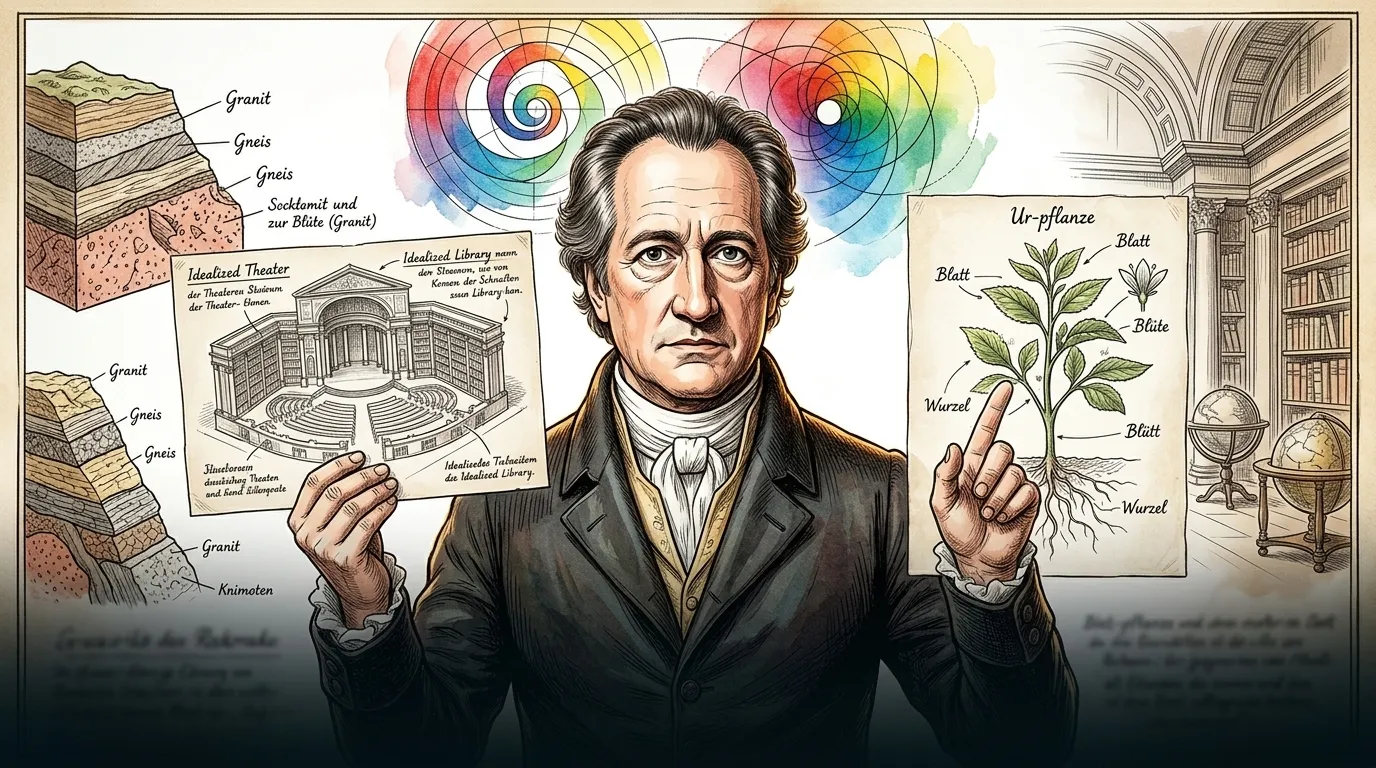
Beyond literature, Goethe tirelessly pursued scientific inquiry, making significant contributions to botany, anatomy, and optics, challenging established theories with his holistic approach. His work on plant metamorphosis, The Metamorphosis of Plants (1790), proposed that all plant organs derived from a modified leaf, influencing later biological thought. He was not merely a poet; he was a natural philosopher, asserting the interconnectedness of all phenomena. His investigations left an enduring mark on natural science.
Biographical Fact: Goethe's scientific studies, particularly his botanical theories, demonstrated his comprehensive intellectual reach and his commitment to understanding the natural world through observation.
Page 9

Goethe's long tenure at the Weimar court saw him become a figure of immense political and social influence, managing the ducal theater and educational institutions for decades. He fostered a cultural environment that attracted leading minds, transforming Weimar into a beacon of European thought. His impact transcended individual works, shaping an entire generation of artists, scientists, and statesmen who looked to him for guidance and inspiration. His decisions resonated far beyond his writings.
Biographical Fact: As a Privy Councillor and cultural administrator, Goethe's influence in Weimar extended to education, theater, and urban planning, cementing his role as a polymathic figure shaping society.
Page 10

Johann Wolfgang von Goethe passed away in 1832, but his influence only continued to grow, solidifying his position as Germany's greatest literary figure and a universal genius. His works, from Faust to his poetry and scientific writings, shaped literary movements, inspired countless artists, and provided profound insights into the human condition. He left behind a cultural and intellectual landscape irrevocably altered by his boundless curiosity and monumental achievements, a timeless testament to human potential. His legacy endures, an eternal flame.
Biographical Fact: Goethe's death in 1832 solidified his status as a foundational figure in Western literature and thought, whose works continue to inspire and challenge generations.
About this story
- Location: Global
- Audience: general readers
Questions and answers
Read Wonder People on your phone
Wonder People is available on Android. Get Wonder People on Google Play.