Johannes Gutenberg
Johannes Gutenberg — an illustrated biography story, set in Global. 10 illustrated pages, free to read on Wonder People.
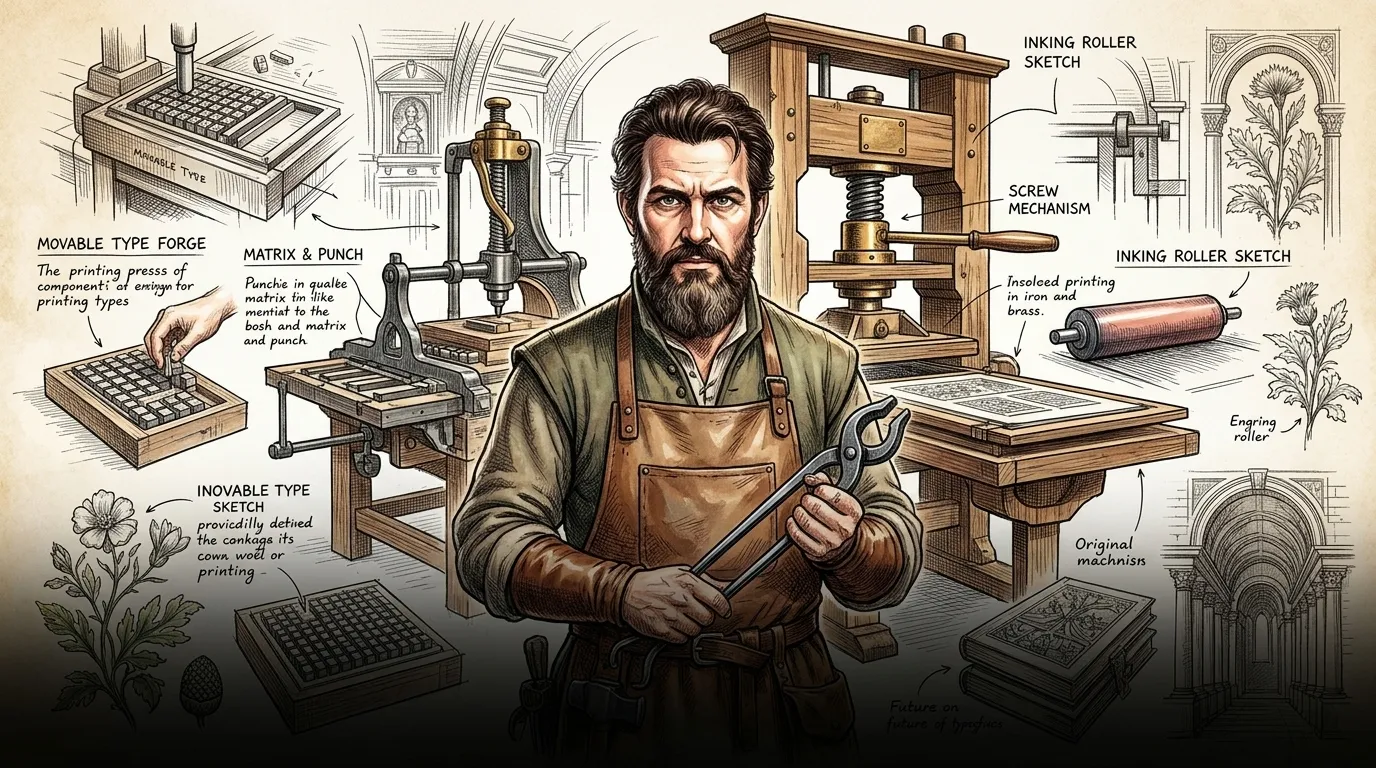
Page 1
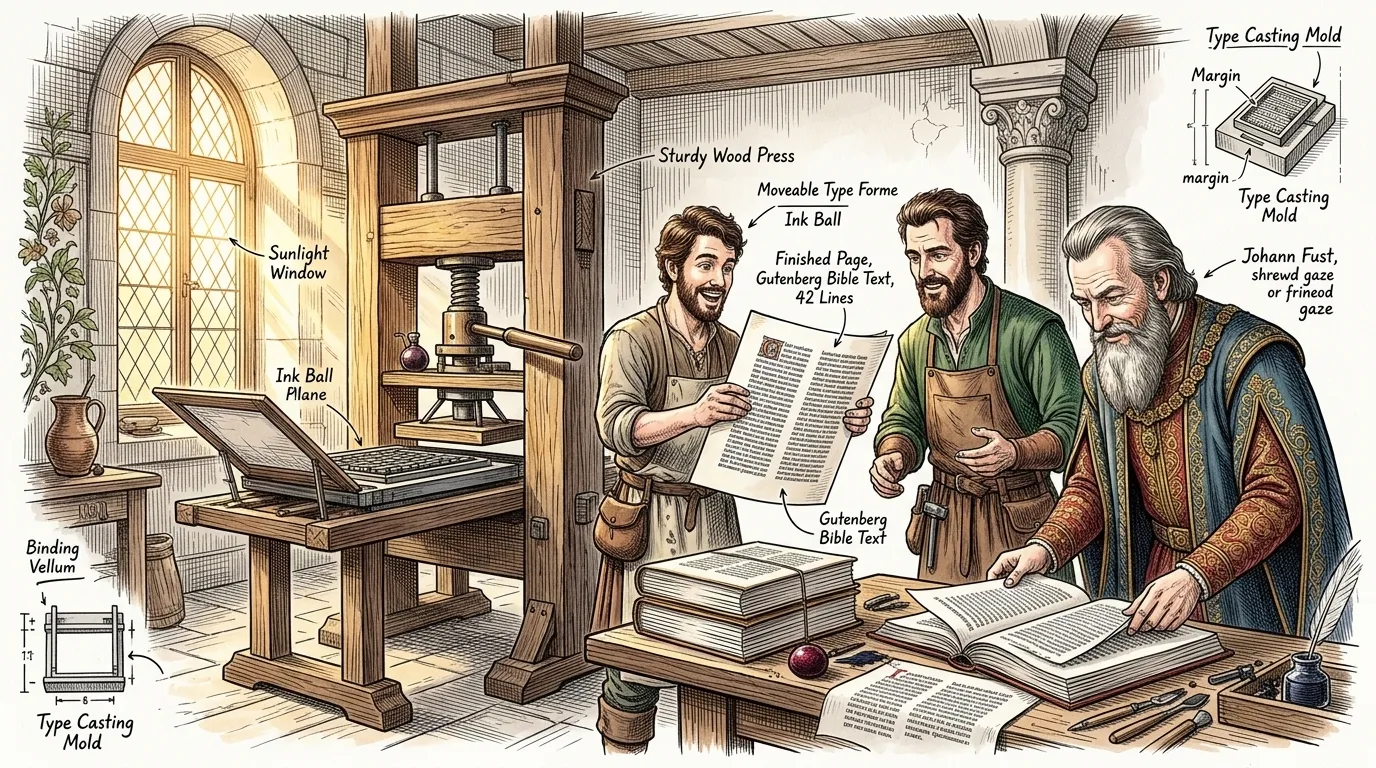
In the bustling print shop of Mainz, Germany, circa 1455, Johannes Gutenberg stood resolute. He watched as the final sheets of the massive 42-line Latin Bible were pulled from the press, an unprecedented feat of precision and speed. Johann Fust, his financier, examined the crisp pages with a discerning eye, while Peter Schoeffer, his skilled apprentice, carefully stacked the freshly printed quires. The world would soon read like never before.
"'Look, Master Gutenberg,' Peter Schoeffer exclaimed, holding up a page, 'the ink is flawless, and the lines are perfectly aligned! We have produced a marvel of consistency.' Johann Fust, stroking his beard, then declared, 'Indeed. With nearly 180 copies produced, each requiring immense labor, this marks a monumental achievement, Johannes. An investment yielding an astonishing return in printed glory!'"
Biographical Fact: The 42-line Bible, also known as the Gutenberg Bible, was the first major work printed using movable type in the West. Its production involved significant financial investment and technological innovation, marking the beginning of the 'Gutenberg Revolution'.
Page 2
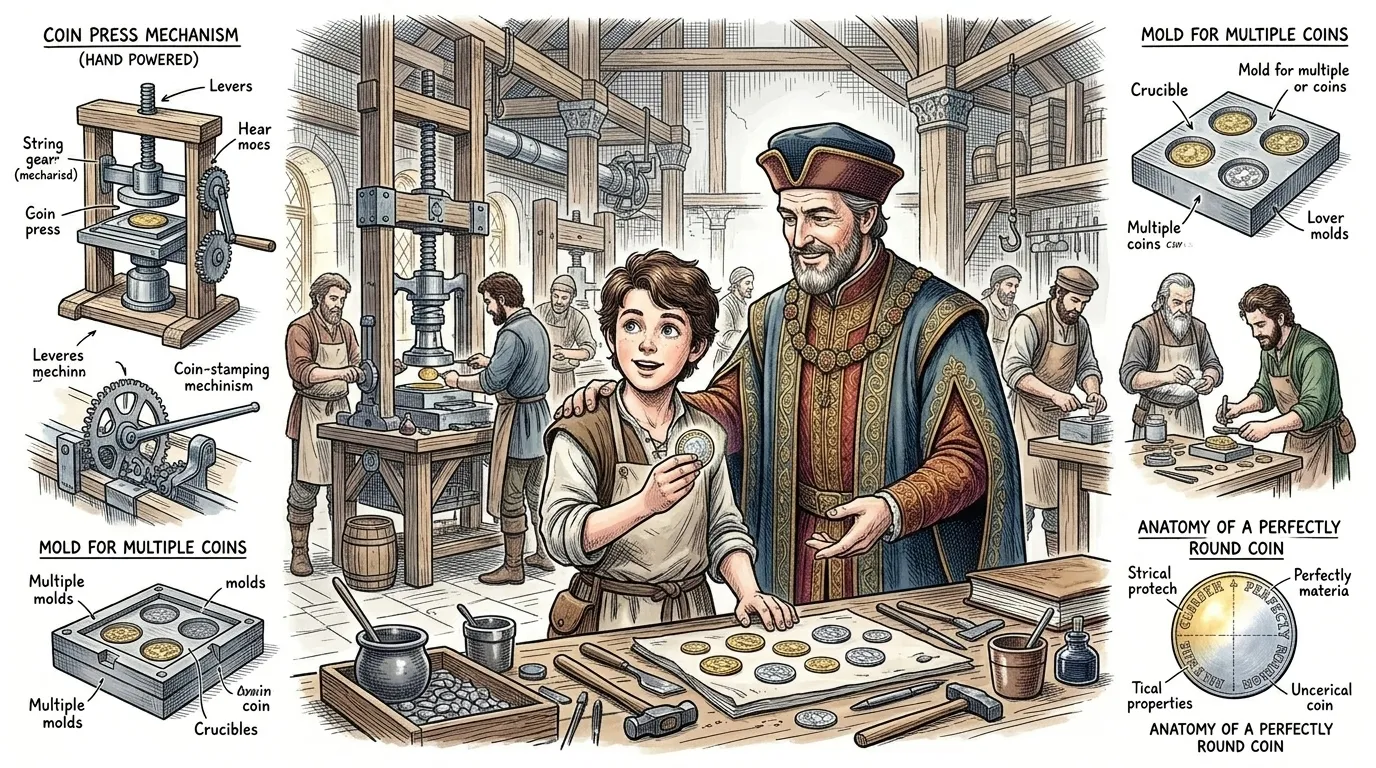
Growing up in Mainz, young Johannes Gutenberg, born around 1400, observed his family's trade. His father, a merchant and goldsmith, dealt in fine metals and the meticulous craft of coinage. This early exposure to metalworking, the precise casting of forms, and the challenges of producing identical, durable pieces for trade and luxury items, ignited a spark within him.
"'Father,' young Johannes asked, his hands examining a newly minted coin in the bustling Mainz mint, 'how do we ensure each coin is perfectly identical, so durable, so flawless?' His father, a seasoned patrician in fine woolen robes, replied, 'My son, precision in metalworking is paramount. The smallest imperfection can ruin a batch, making the piece worthless. As the ancient Roman philosopher Seneca the Younger once said, 'Every new beginning comes from some other beginning's end.' We constantly seek better methods, Johannes, to perfect our craft, to make something that endures.'"
Biographical Fact: Gutenberg's family background in metalworking and the minting trade provided him with foundational knowledge in metallurgy, mold-making, and precision engineering—skills crucial for developing movable type.
Page 3
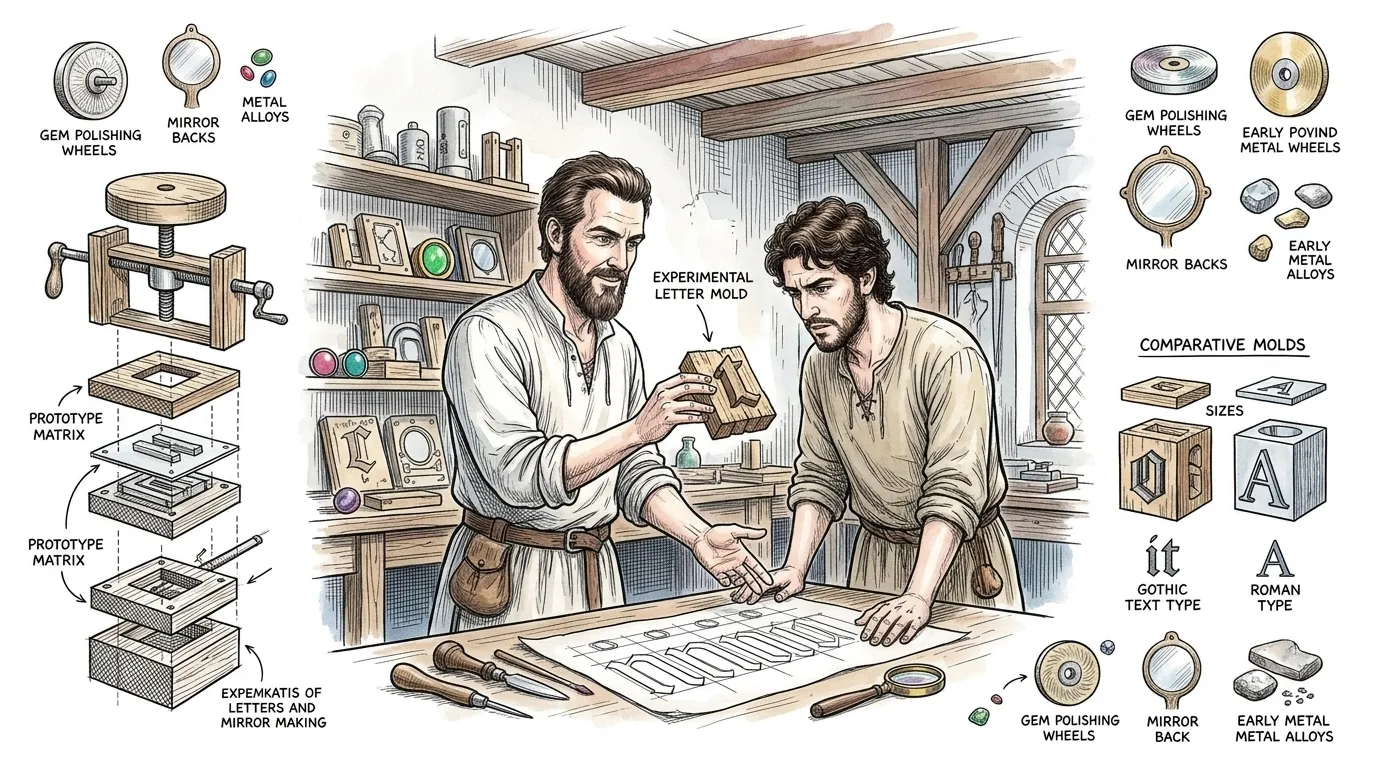
Johannes Gutenberg relocated to Strasbourg, a thriving center of commerce, in the 1430s. There, he engaged in various craft businesses, including gem polishing and mirror making, but his true ambition remained shrouded in secrecy. He experimented tirelessly, driven by a growing vision of automating text production. He knew that the key lay in achieving consistent, repeatable forms for every single letter.
"'The challenge is immense, Andreas,' Johannes Gutenberg confided, showing a rough wooden prototype of a letter mold to his associate, Andreas Dritzehn, in a dimly lit Strasbourg workshop. Andreas, a younger craftsman in a simple tunic, frowned. 'These are intricate pieces, Johannes. To make thousands perfectly identical, each one durable enough for repeated use... it defies simple craft.' Gutenberg nodded. 'But imagine the possibilities, Andreas. To produce countless copies, each as consistent as the last! As the ancient Greek philosopher Aristotle taught, 'We are what we repeatedly do. Excellence, then, is not an act, but a habit.' We must develop the habit of perfect replication for every letter.'"
Biographical Fact: During his time in Strasbourg, Gutenberg formed partnerships for various ventures, while secretly developing his printing technology, referring to it as his 'secret art' or 'Ars Nova' to protect his innovations.
Page 4
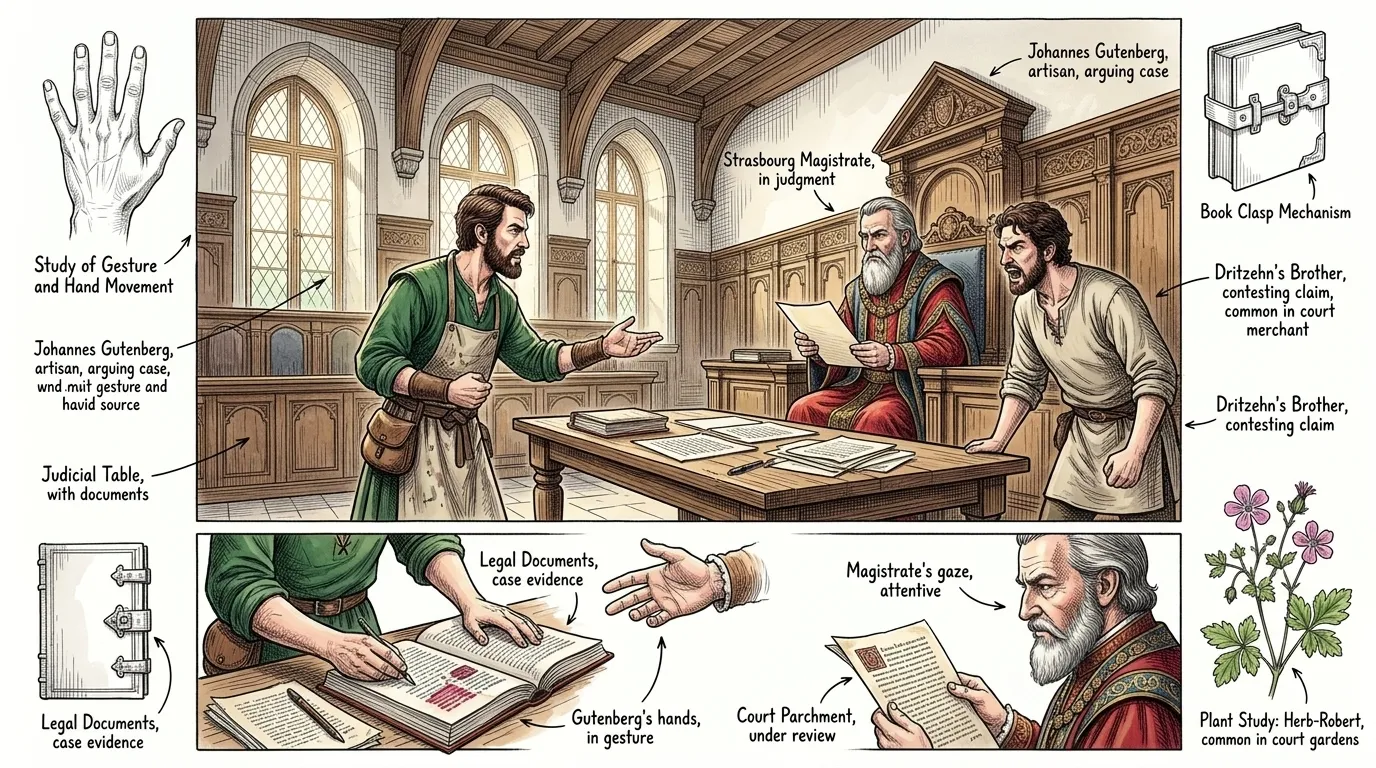
Gutenberg's 'secret art' became public knowledge through an unfortunate turn: a lawsuit in 1439 brought by the brothers of Andreas Dritzehn, who had been an early partner and had died. The Dritzehn brothers claimed they were owed a share of Gutenberg's secret project. This legal battle forced Gutenberg to reveal fragments of his revolutionary process in court, defending his ownership of the technology.
"'These agreements pertain to a confidential process involving 'forms' and a 'press',' Johannes Gutenberg argued before the solemn Strasbourg magistrate, a stern man in elaborate robes, gesturing to legal documents on a table. 'These were experimental. My associates, including the late Andreas, were aware of the risks.' One of Dritzehn's brothers, a furious merchant in a plain tunic, interjected, 'He promised us a share in his profitable 'secret art'! He owes us for the tools and the investment in these 'forms'!' The magistrate, holding a parchment, declared, 'The court must ascertain the nature of this 'secret art' to determine any rightful claims.'"
Biographical Fact: The Strasbourg lawsuit of 1439 is a critical historical document, providing the first concrete evidence of Gutenberg's experiments with movable type and printing equipment, referring to components like 'forms' and 'presses'.
Page 5
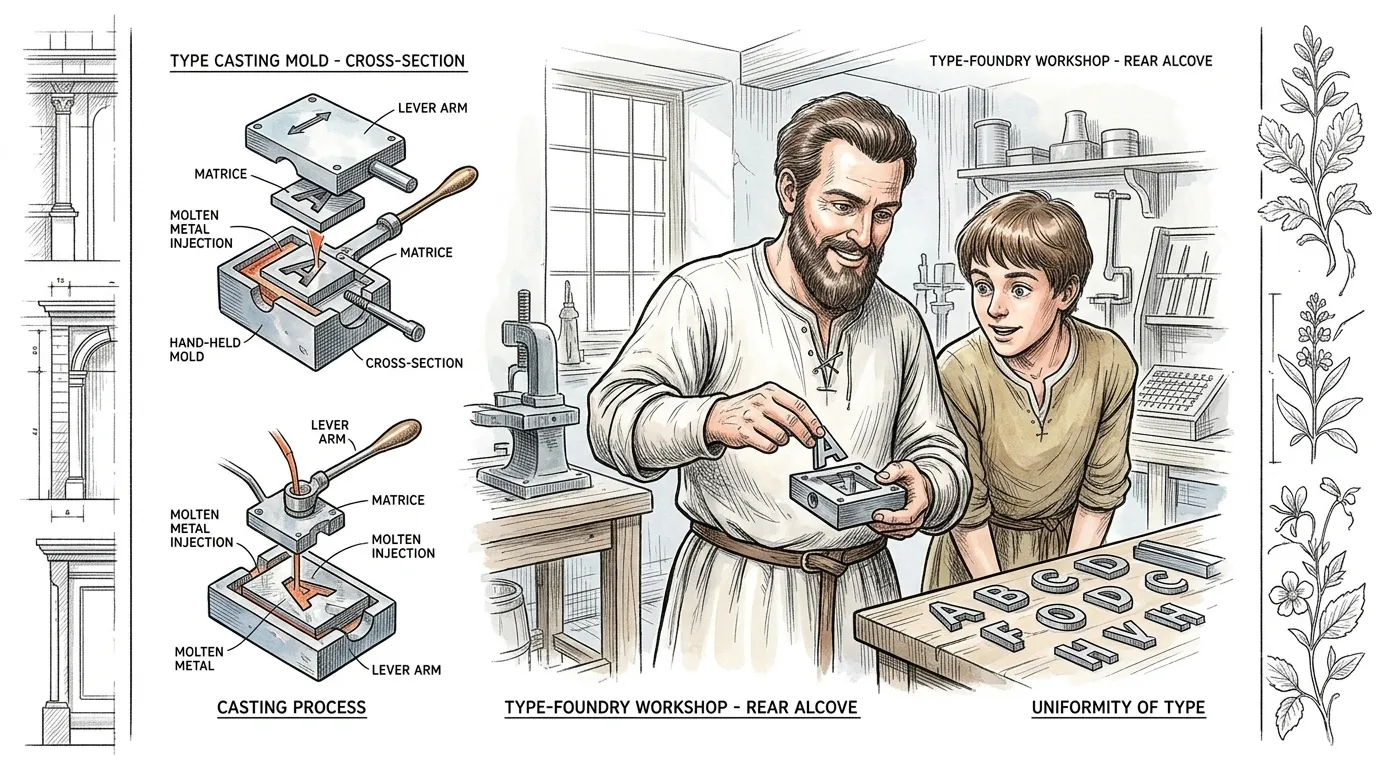
After years of meticulous experimentation, Gutenberg perfected the individual components of his revolutionary system. He ingeniously combined knowledge from metallurgy, punch-cutting, and winemaking presses into a cohesive unit. This included precision-cast movable metal types, a specialized oil-based ink, and a modified screw press that could apply even pressure across a page.
"'This is the core,' Johannes Gutenberg explained, his eyes gleaming with ambition, as he carefully placed a small, perfectly cast metal letter 'A' into a hand-held mold for his assistant, Heinrich, a young craftsman with curious eyes. 'Each letter, each symbol, must be identical, durable, and interchangeable. Remember what we discussed in Mainz, Heinrich, about the consistency in coinage? The smallest flaw in one type could mar an entire page.' Heinrich, dressed in a simple tunic, marvelled, 'Master, this truly solves the problem of mass replication! We can arrange them, print, then rearrange them for new pages. It's a machine for words!' Gutenberg nodded. 'Precisely. It is the very principle of perfect replication, scaled to encompass all knowledge.'"
Biographical Fact: Gutenberg's key innovations included the development of a durable metal alloy for type, a precise mold for casting individual letters, oil-based ink, and a modified press—elements that, combined, made mass production of texts feasible.
Page 6
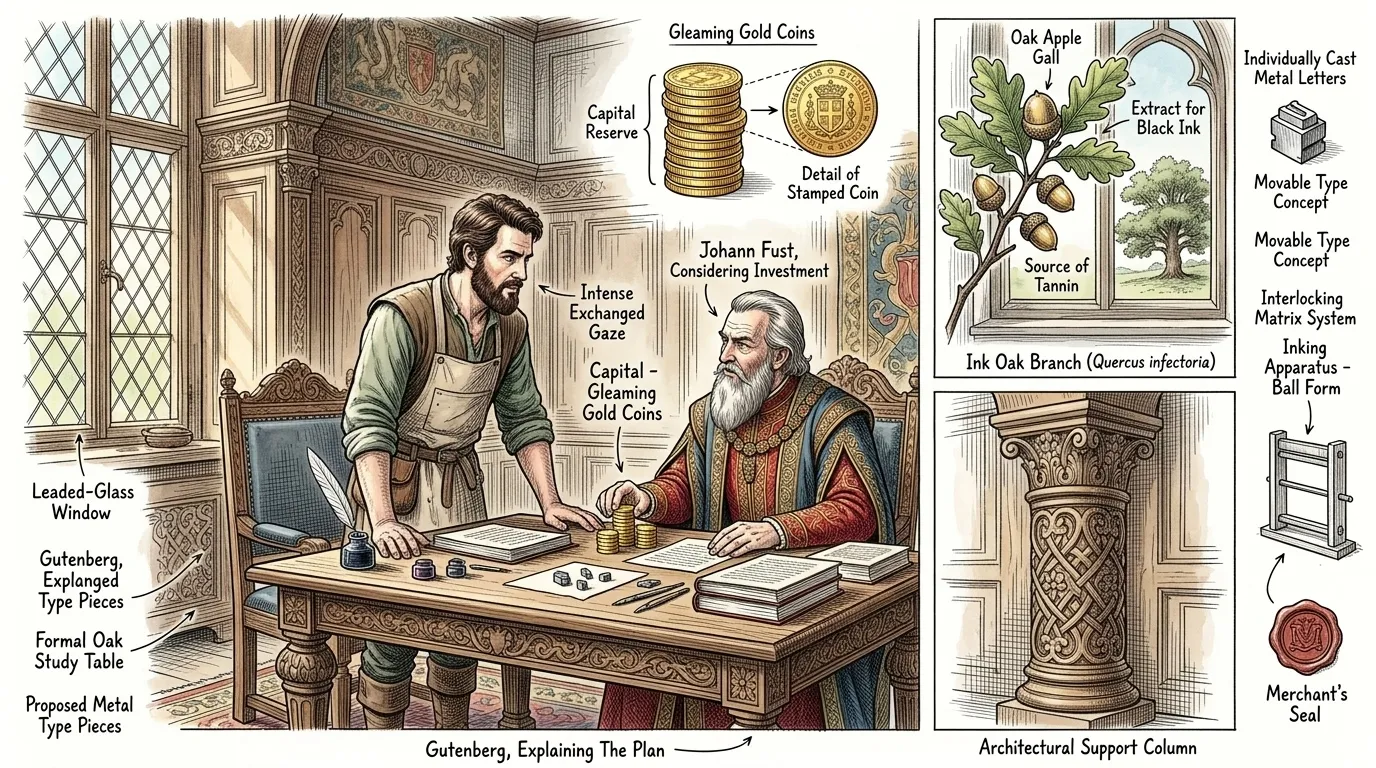
Returning to Mainz, Gutenberg needed substantial capital to bring his vision to life on a grand scale. He secured a crucial loan from the wealthy goldsmith Johann Fust. This partnership was a high-stakes gamble: Fust provided the funds, and Gutenberg committed to completing a massive printing project, likely the Latin Bible, which would demonstrate the full power of his invention.
"'Master Fust, this invention will not merely print books; it will reshape the world of knowledge,' Johannes Gutenberg declared, his voice firm as he looked across a heavy oak table at the skeptical Johann Fust. Fust, a shrewd merchant in a richly embroidered tunic, tapped a stack of coins. 'A considerable sum, Johannes. Your 'secret art' promises much, but the investment is immense. As the Roman poet Horace wrote, 'Carpe Diem' – seize the day. But for such a venture, I must seize more than a day; I must seize a certainty of return. What guarantee do I have for this audacious project?' Gutenberg responded, 'The guarantee, Master Fust, lies in the unprecedented speed and perfection of the printed word, a testament to its own value.'"
Biographical Fact: Johann Fust, a wealthy Mainz businessman, provided Gutenberg with two substantial loans in the early 1450s, totaling 1,600 guilders, to finance the production of the 42-line Bible, forming a business partnership.
Page 7
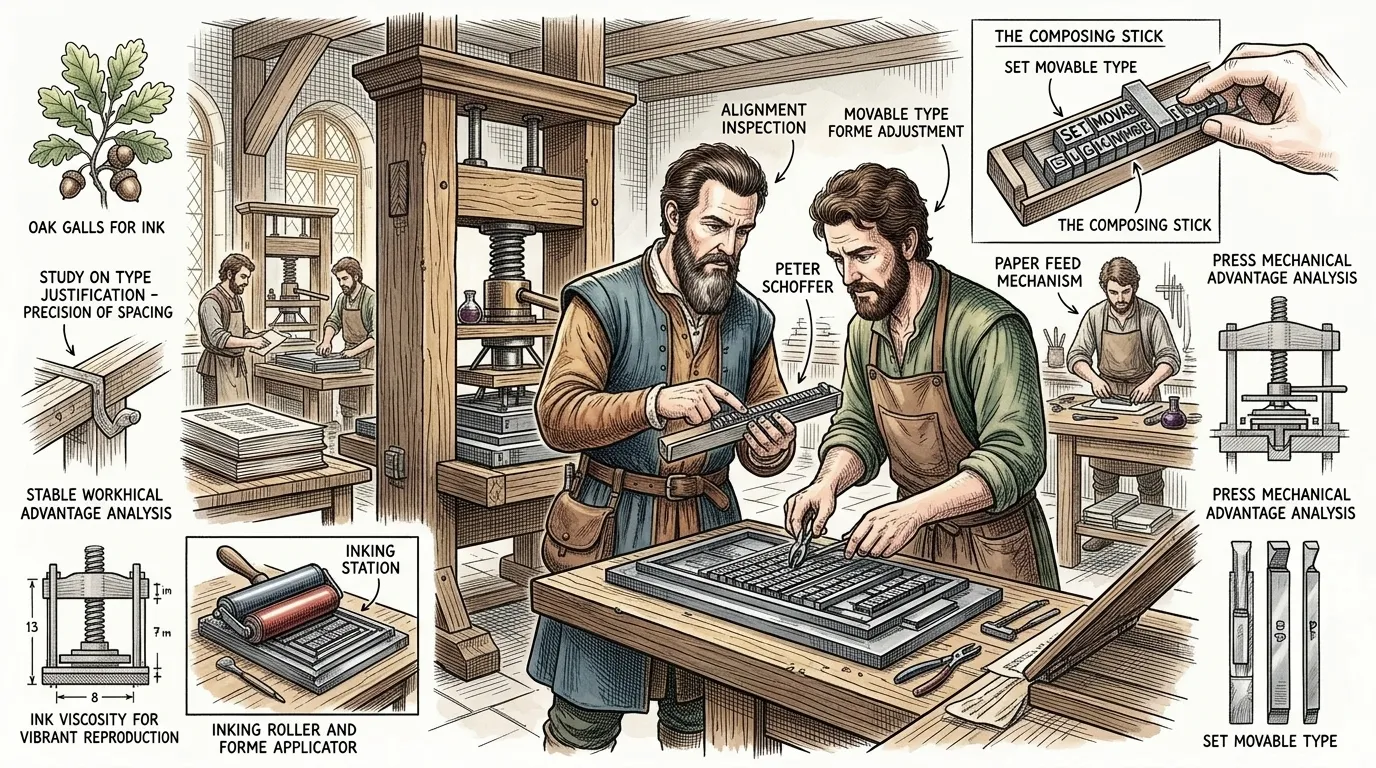
With Fust's financial backing, Gutenberg established his printing workshop in Mainz. The project to print the Latin Bible was a monumental undertaking, demanding meticulous organization, relentless labor, and unwavering dedication. Every page required the precise arrangement of thousands of individual type characters, careful inking, and consistent pressure from the press, all under Gutenberg's exacting eye.
"'Peter, the alignment must be absolutely perfect,' Johannes Gutenberg instructed, his finger tracing a line of set type in a composing stick, as Peter Schoeffer, his capable chief assistant, adjusted a metal form. Schoeffer, in his practical workshop attire, nodded intently. 'Master, we ensure every letter aligns flawlessly, just as you taught us. The goal is a finished page indistinguishable from hand-scribed parchment, yet produced with revolutionary speed.' Gutenberg then looked at the press operators. 'Each pull of the lever must be firm and even. Remember, the consistency of the impression is paramount for the beauty and durability of this sacred text. Every impression counts.'"
Biographical Fact: The production of the Gutenberg Bible was an immense feat of industrial-scale printing, requiring skilled craftsmen, specialized equipment, and a significant amount of paper and ink. Each book contained 1,286 pages, with 42 lines per page.
Page 8
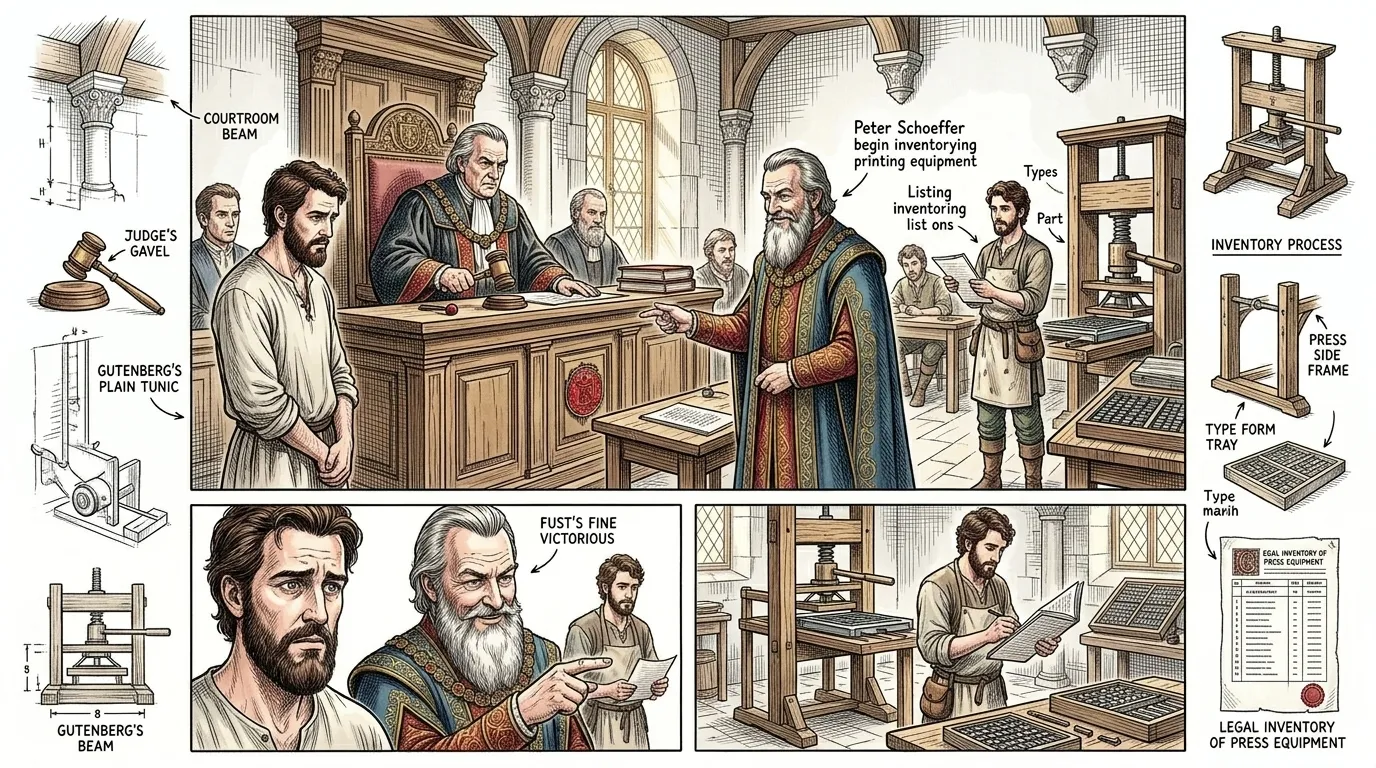
Despite the Bible's completion, Gutenberg's financial struggles mounted. In 1455, Johann Fust, seeking repayment, sued Gutenberg for the funds he had provided. The court ruled against Gutenberg, stripping him of his presses, type, and many of the completed Bibles. This devastating loss meant Gutenberg lost control of the very technology he had pioneered.
"'The court rules in favor of Master Fust,' the stern Mainz judge declared, striking his gavel, 'and orders the immediate transfer of the printing presses, the types, and a portion of the printed Bibles to satisfy the debt.' Johannes Gutenberg, standing defeated, his shoulders slumped in his plain tunic, could only watch as Johann Fust, looking victorious in his rich cloak, directed Peter Schoeffer to begin inventorying the assets. Fust smirked. 'These Bibles, Johannes, of astonishing consistency and quality, represent a valuable asset, just as we discussed was paramount. Your skill, though great, does not negate the debt for creating such durable goods.' Gutenberg whispered, 'A profound loss, yet the word will spread, regardless.'"
Biographical Fact: The Fust-Gutenberg lawsuit of 1455-56 resulted in Gutenberg losing the bulk of his printing equipment and the finished Bibles to Fust, effectively ending his direct involvement with the printing of his most famous work.
Page 9
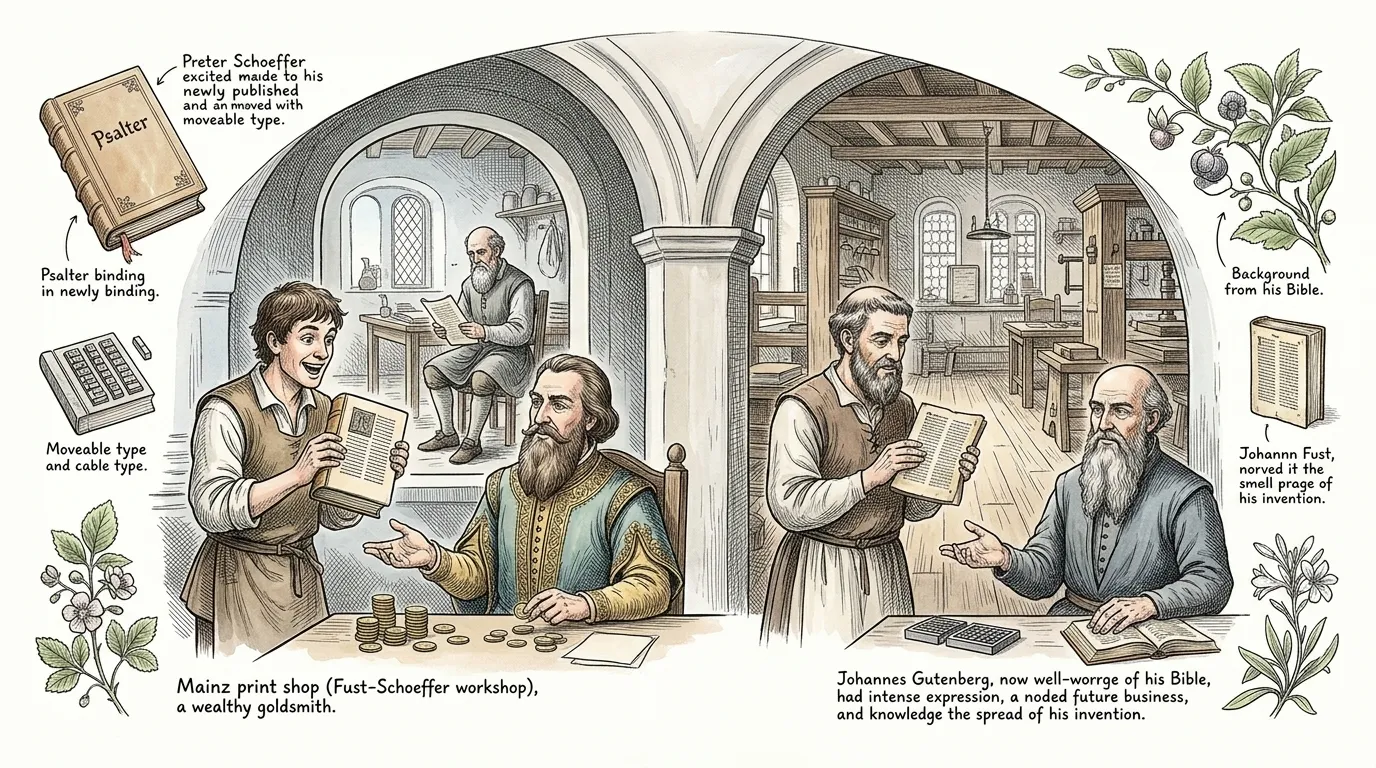
Though he lost his workshop, Gutenberg's invention could not be contained. Johann Fust and Peter Schoeffer quickly established a successful printing house, applying Gutenberg's methods. The demand for printed materials rapidly grew, and skilled printers, once trained by Gutenberg, dispersed across Europe, carrying the revolutionary technology with them. The idea was now an unstoppable force, spreading far beyond its originator.
"'The demand for these printed books is insatiable, Master Fust!' Peter Schoeffer exclaimed, holding up a newly published Psalter, a testament to their thriving business, as he spoke to Johann Fust in their busy Mainz print shop. Fust, counting coins, replied, 'Indeed, Peter. The quality and consistency we learned to maintain ensure our success. Now, let us expand. Send our most capable men to establish new presses in other cities; the world hungers for the printed word.' Far away, in a quiet corner of a different workshop, Johannes Gutenberg, now older and in simpler clothes, observed a single, well-worn page of his Bible. He nodded to himself. 'As the Roman playwright Seneca the Younger once penned, 'Every new beginning comes from some other beginning's end.' Though my own chapter closed, the book of knowledge has only just begun.'"
Biographical Fact: After the lawsuit, Fust and Schoeffer continued the printing business, becoming the first commercially successful printing firm. The technology diffused rapidly, with former associates and apprentices establishing presses across Europe, initiating the print revolution.
Page 10
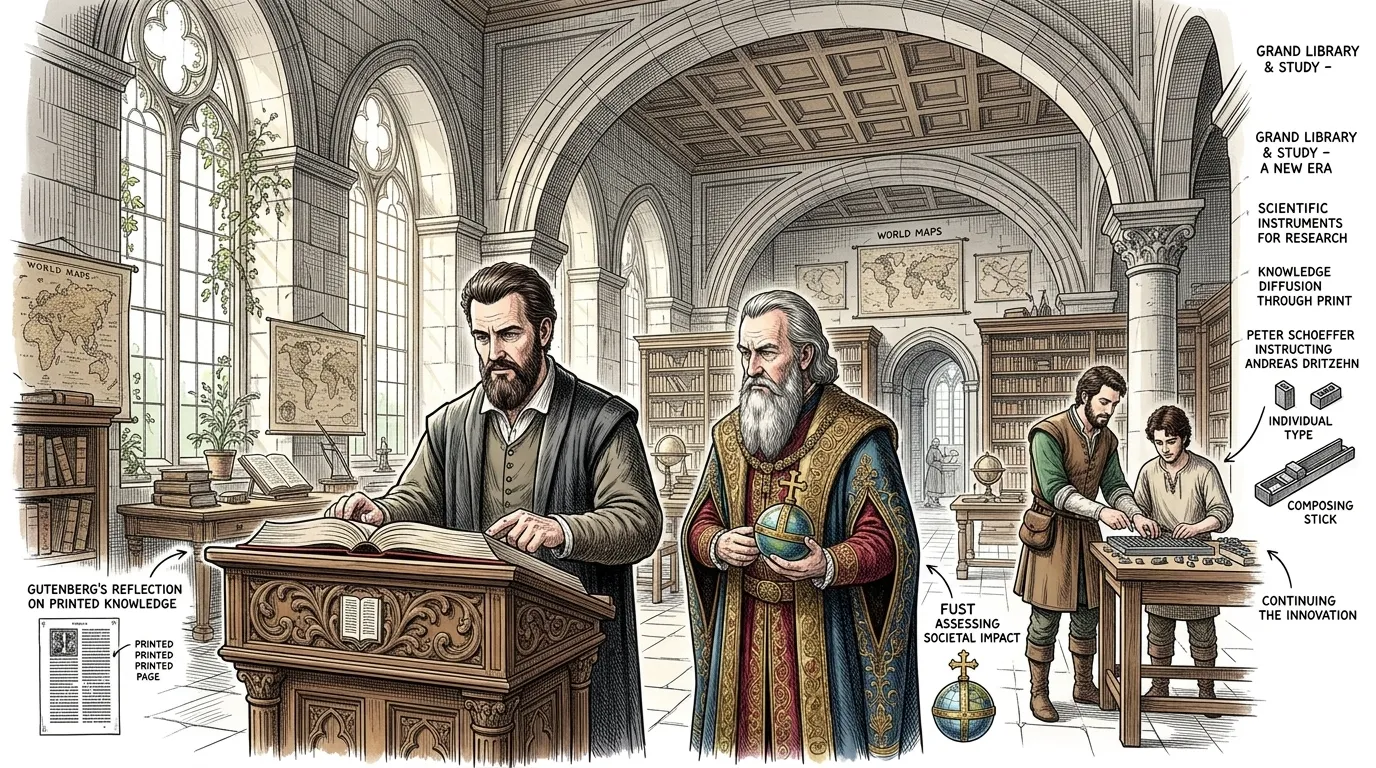
Johannes Gutenberg died in 1468, his personal life ending in relative obscurity and financial difficulty. Yet, his invention became one of the most transformative in human history. The movable type printing press democratized knowledge, fueled the Renaissance, enabled the Reformation, and laid the foundation for the scientific revolution. He did not merely print books; he printed the future.
"'Imagine a world before this machine, a world where knowledge was guarded by scribes and inaccessible to most,' a learned scholar in an academic gown reflected, pointing to an open printed book. 'Gutenberg gave us the power to multiply words, to spread ideas like wildfire.' Another scholar, holding a globus cruciger, nodded gravely. 'Indeed. The impact is profound: from challenging authorities to fostering new sciences. He built the bedrock of our modern age.' A younger apprentice, setting type, then said, 'We stand on the shoulders of giants. Every printed page carries his silent, enduring mark, forever shaping how humanity learns and communicates. It's a miracle of perpetual knowledge.'"
Biographical Fact: Gutenberg's printing press triggered a global revolution, making books affordable and accessible, increasing literacy, and accelerating the spread of ideas that underpinned the Renaissance, the Reformation, and the Scientific Revolution. His invention fundamentally altered human communication and society.
About this story
- Location: Global
- Audience: general readers
Questions and answers
Read Wonder People on your phone
Wonder People is available on Android. Get Wonder People on Google Play.