Dusty Attic's Labyrinthine Fossil Secrets

Dusty Attic's Labyrinthine Fossil Secrets — an illustrated science story. 10 illustrated pages, free to read on Wonder Science.
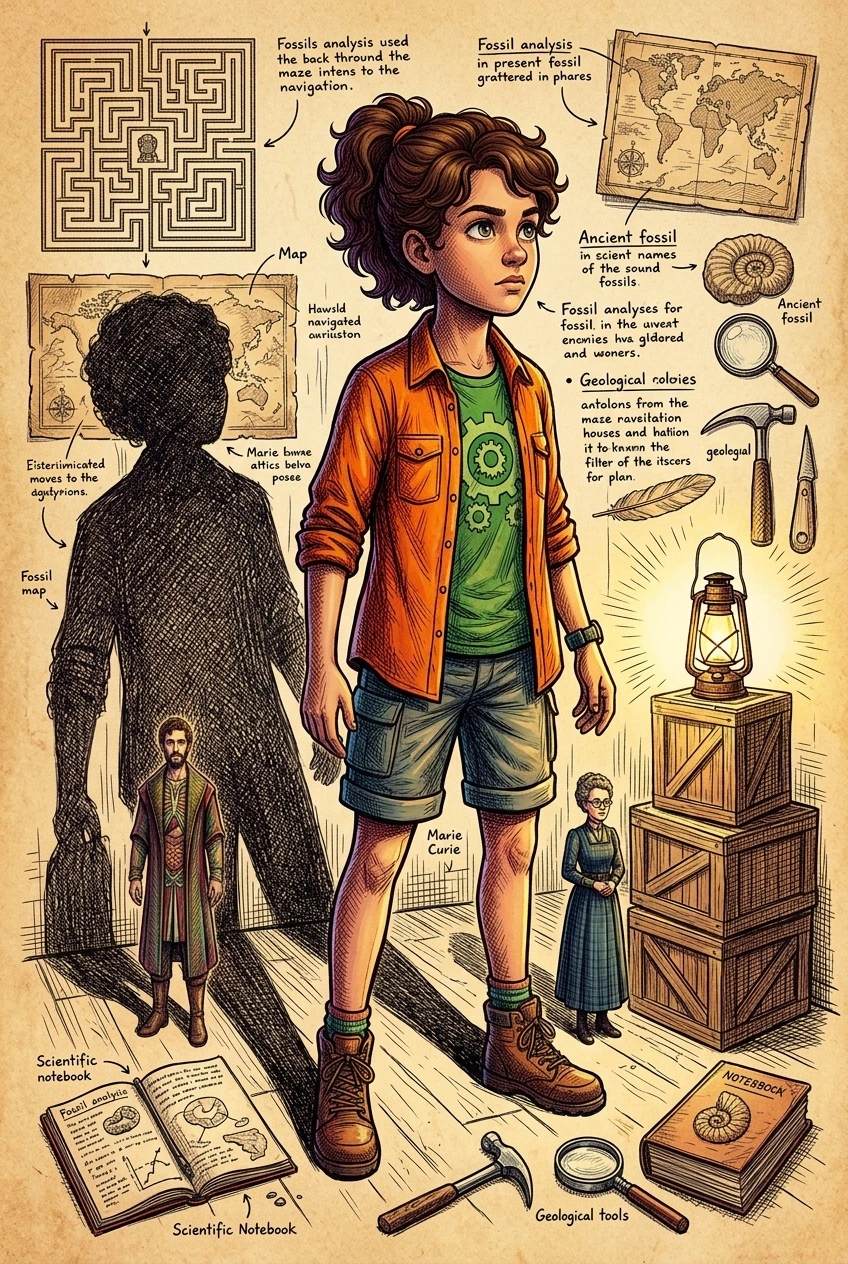
Dusty Attic's Labyrinthine Fossil Secrets — book cover — Wonder Science
Dusty Attic's Labyrinthine Fossil Secrets — an illustrated science story. 10 illustrated pages, free to read on Wonder Science.

Page 1
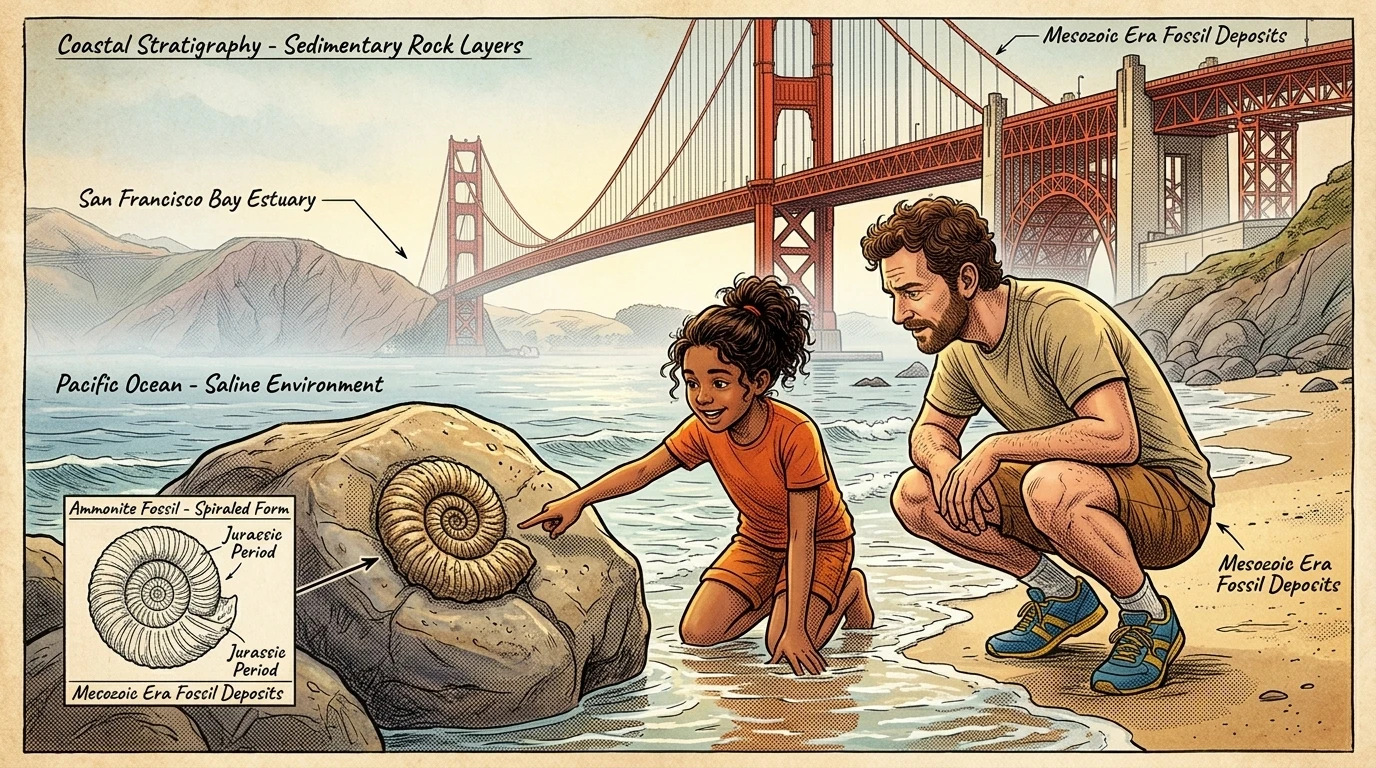
On Baker Beach, with the Golden Gate Bridge looming through the mist, Amara knelt and pointed at a strange rock. "Dad, look at this one!
On Baker Beach, with the Golden Gate Bridge looming through the mist, Amara knelt and pointed at a strange rock. "Dad, look at this one! It has swirly patterns, like a tiny seashell is trapped inside." Her father crouched beside her, squinting at the find as a wave washed over their sneakers. "That's not just any rock, Amara," he said, his voice full of excitement. "I think you've just found a fossil!"

On Baker Beach, with the Golden Gate Bridge looming through the mist, Amara knelt and pointed at a strange rock. "Dad, look at this one! It has swirly patterns, like a tiny seashell is trapped inside." Her father crouched beside her, squinting at the find as a wave washed over their sneakers. "That's not just any rock, Amara," he said, his voice full of excitement. "I think you've just found a fossil!"

Page 2
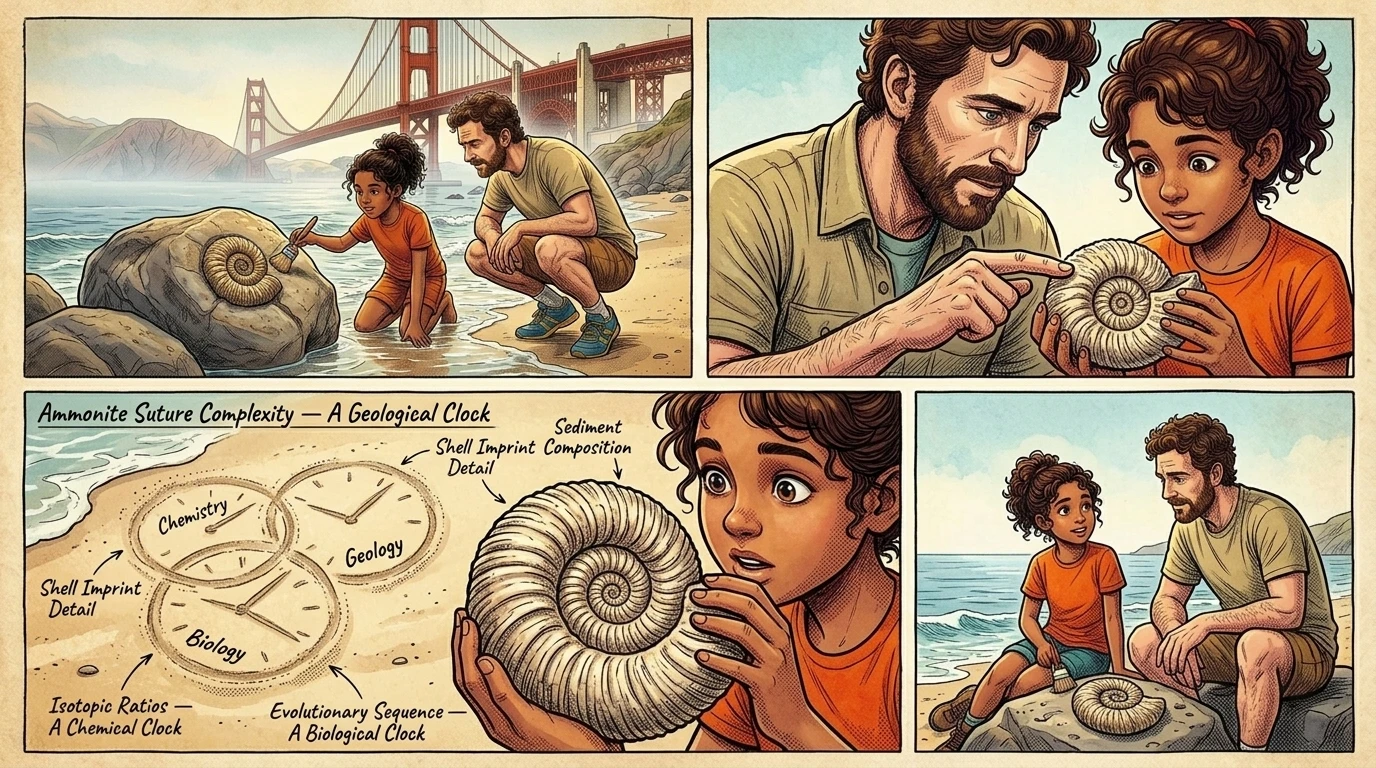
"A fossil? You mean like a dinosaur bone?" Amara asked, her eyes wide with wonder as she carefully picked it up. "It could be!" her father replied, examining…
"A fossil? You mean like a dinosaur bone?" Amara asked, her eyes wide with wonder as she carefully picked it up. "It could be!" her father replied, examining the imprint. "But that raises a big question: how do we know how old it is? To figure that out, we need clues from chemistry, geology, and biology all working together—each one is like a different kind of clock telling part of the story."

"A fossil? You mean like a dinosaur bone?" Amara asked, her eyes wide with wonder as she carefully picked it up. "It could be!" her father replied, examining the imprint. "But that raises a big question: how do we know how old it is? To figure that out, we need clues from chemistry, geology, and biology all working together—each one is like a different kind of clock telling part of the story."

Page 3
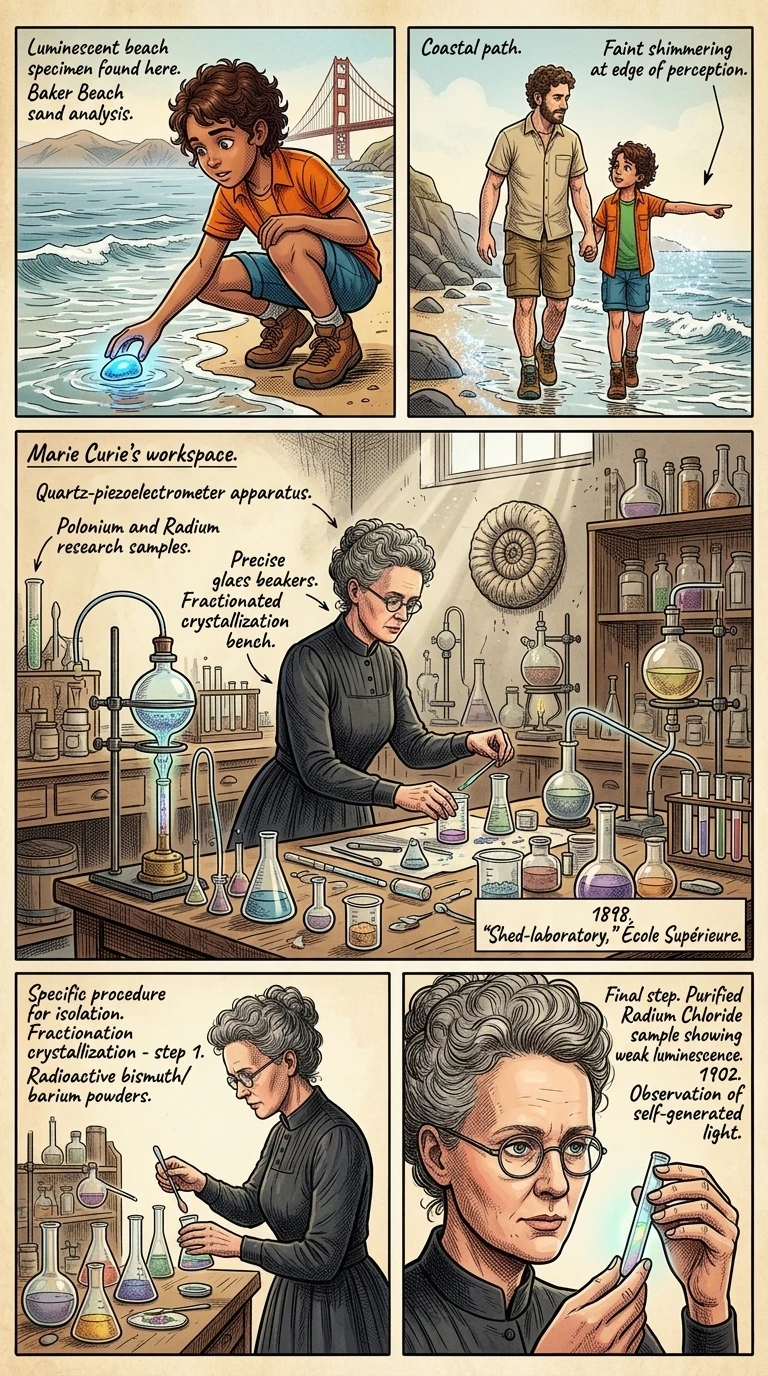
"So how did anyone even discover these invisible clocks?" Amara wondered aloud. Her father smiled, "For that answer, we have to travel back in time, to a…
"So how did anyone even discover these invisible clocks?" Amara wondered aloud. Her father smiled, "For that answer, we have to travel back in time, to a cluttered laboratory in Paris over a hundred years ago." The breezy beach scene seemed to shimmer and fade, replaced by the quiet intensity of a dimly lit room filled with strange glass instruments. A woman in a dark dress was bent over her work, completely absorbed.

"So how did anyone even discover these invisible clocks?" Amara wondered aloud. Her father smiled, "For that answer, we have to travel back in time, to a cluttered laboratory in Paris over a hundred years ago." The breezy beach scene seemed to shimmer and fade, replaced by the quiet intensity of a dimly lit room filled with strange glass instruments. A woman in a dark dress was bent over her work, completely absorbed.

Page 4
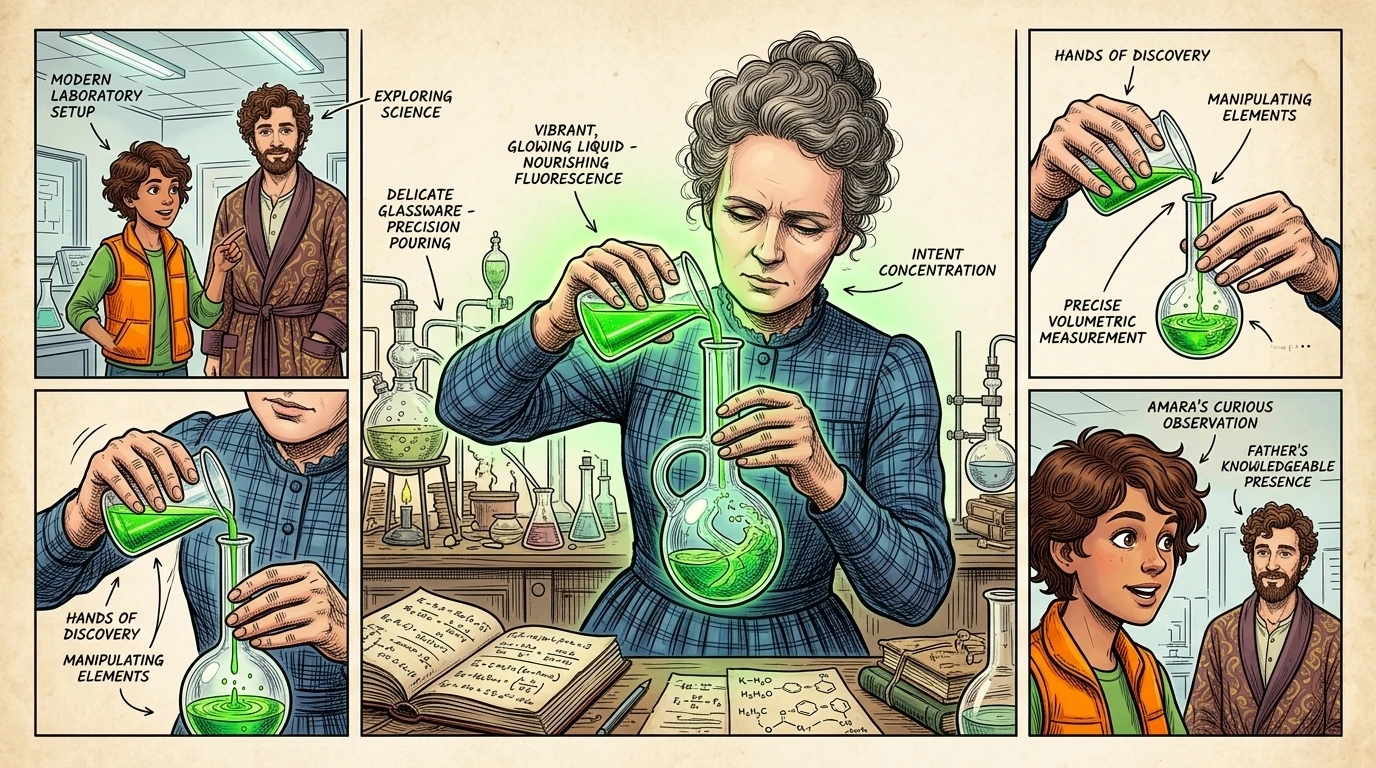
"That's Marie Curie," her father's voice explained. "She was a physicist and chemist in the late 1800s and early 1900s, and she was one of the most brilliant…
"That's Marie Curie," her father's voice explained. "She was a physicist and chemist in the late 1800s and early 1900s, and she was one of the most brilliant scientists who ever lived. She was the first woman to win a Nobel Prize, and she's the only person ever to win the Nobel Prize in two different scientific fields!" Marie carefully poured a glowing green substance from one beaker to another, her expression one of deep concentration.

"That's Marie Curie," her father's voice explained. "She was a physicist and chemist in the late 1800s and early 1900s, and she was one of the most brilliant scientists who ever lived. She was the first woman to win a Nobel Prize, and she's the only person ever to win the Nobel Prize in two different scientific fields!" Marie carefully poured a glowing green substance from one beaker to another, her expression one of deep concentration.

Page 5
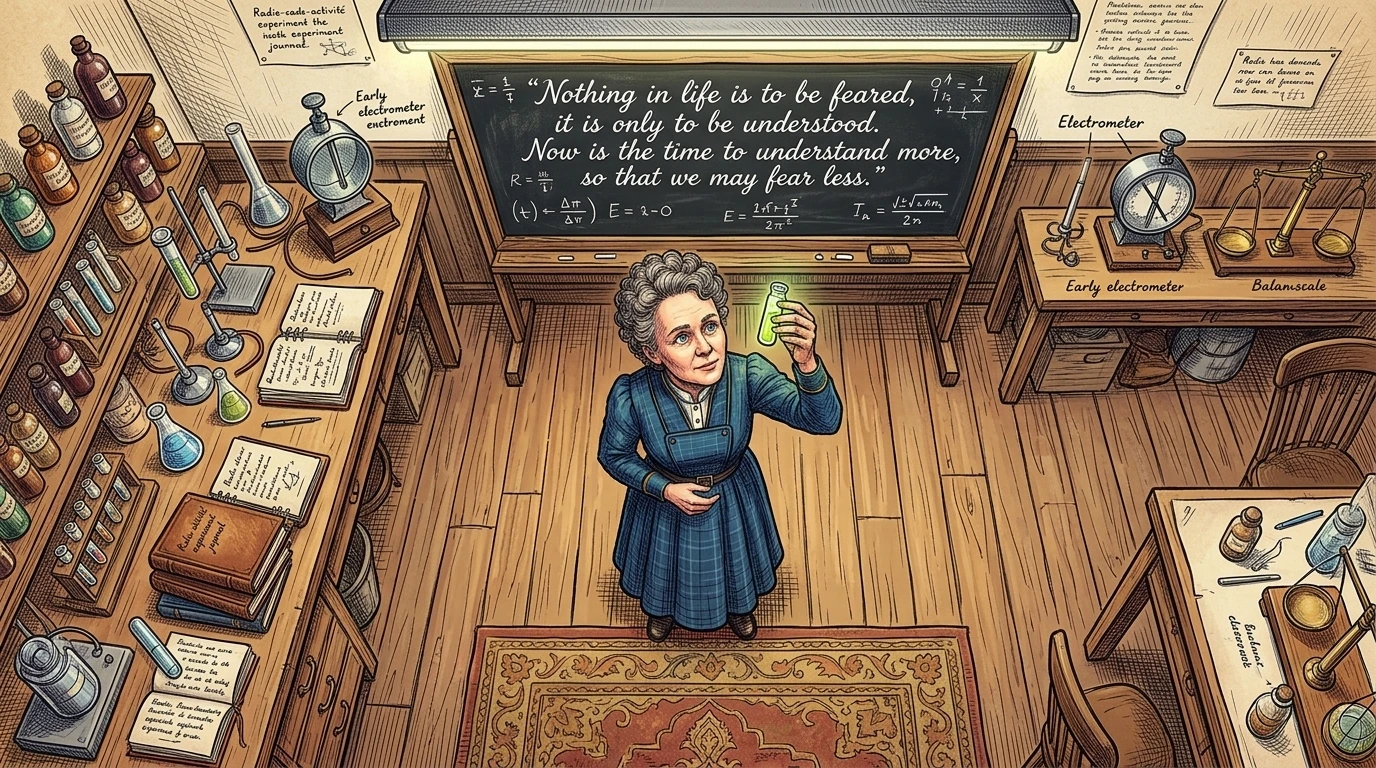
"She must have been so brave, working with things nobody understood," Amara whispered. "She was," her father agreed. "Marie Curie once said, 'Nothing in life is…
"She must have been so brave, working with things nobody understood," Amara whispered. "She was," her father agreed. "Marie Curie once said, 'Nothing in life is to be feared, it is only to be understood. Now is the time to understand more, so that we may fear less.' Her curiosity was much bigger than her fear."

"She must have been so brave, working with things nobody understood," Amara whispered. "She was," her father agreed. "Marie Curie once said, 'Nothing in life is to be feared, it is only to be understood. Now is the time to understand more, so that we may fear less.' Her curiosity was much bigger than her fear."

Page 6
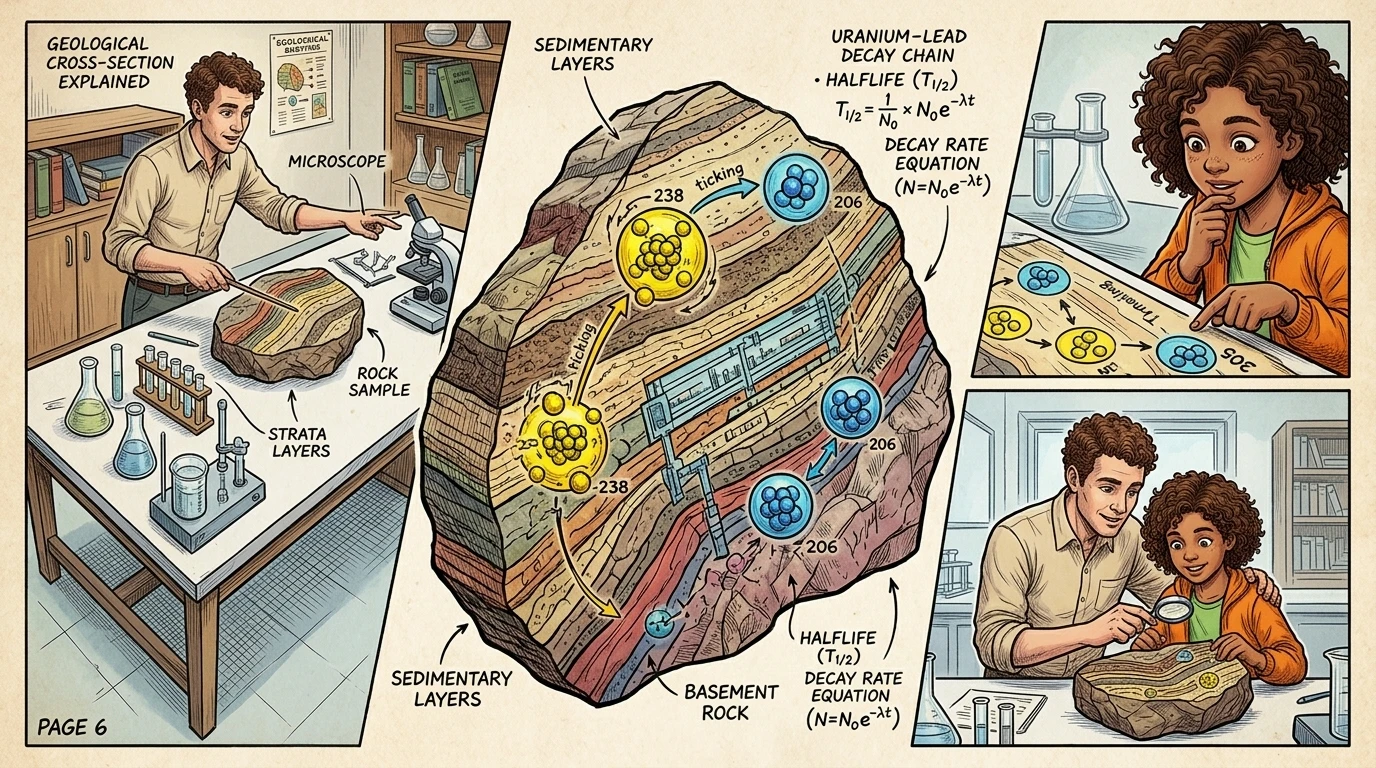
"Curie discovered that some elements, like uranium, are unstable," her father explained. "They decay at a perfectly steady rate, like a ticking clock, releasing…
"Curie discovered that some elements, like uranium, are unstable," her father explained. "They decay at a perfectly steady rate, like a ticking clock, releasing energy. By measuring how much an element has decayed, scientists can calculate the age of the rocks they're found in with incredible accuracy!"

"Curie discovered that some elements, like uranium, are unstable," her father explained. "They decay at a perfectly steady rate, like a ticking clock, releasing energy. By measuring how much an element has decayed, scientists can calculate the age of the rocks they're found in with incredible accuracy!"

Page 7
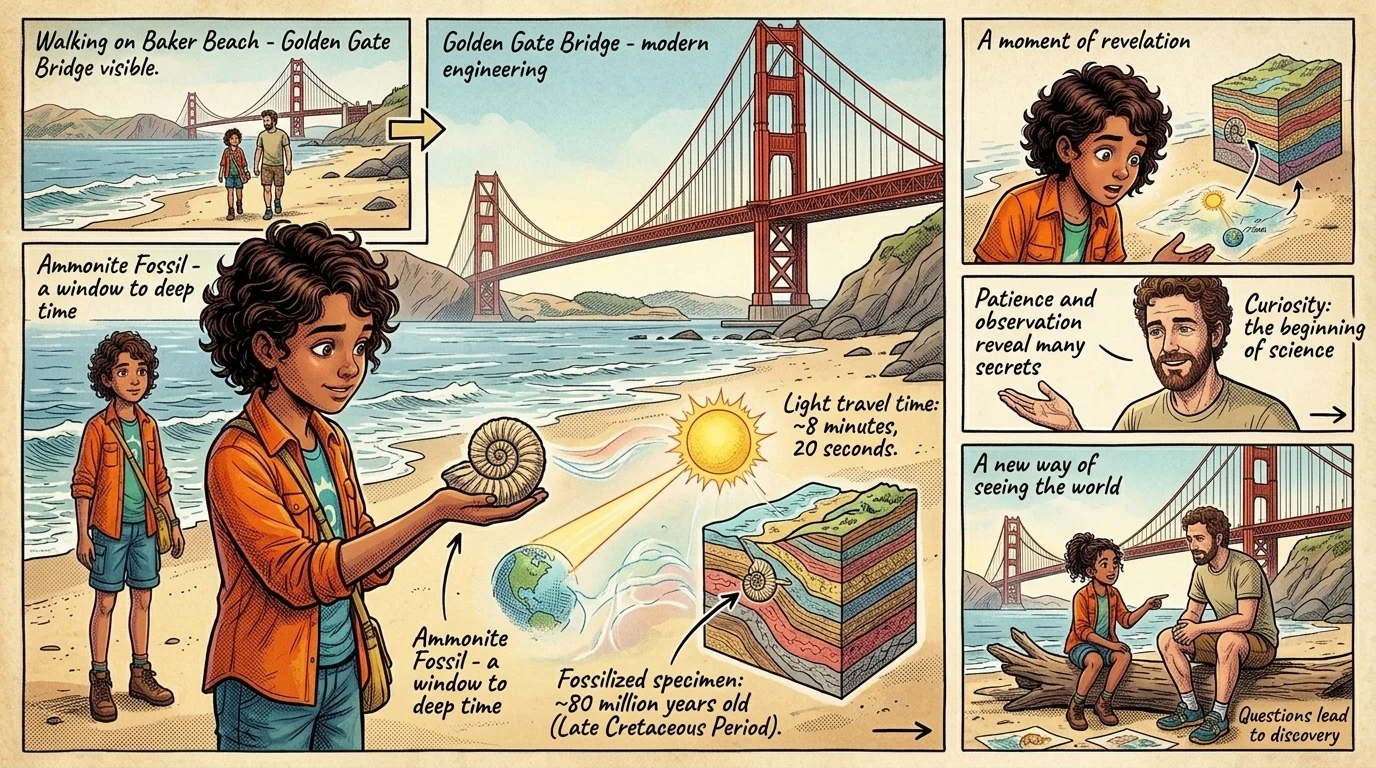
"So a chemist like Marie Curie gives a paleontologist the 'time,' and a geologist tells them the 'place' from the rock layers?" Amara asked.
"So a chemist like Marie Curie gives a paleontologist the 'time,' and a geologist tells them the 'place' from the rock layers?" Amara asked. "Exactly!" her father confirmed. "It's teamwork across time. These measurements are so precise, we know it takes light 8 minutes and 20 seconds to get from the Sun to Earth, and we can also know that a fossil is 80 million years old!"

"So a chemist like Marie Curie gives a paleontologist the 'time,' and a geologist tells them the 'place' from the rock layers?" Amara asked. "Exactly!" her father confirmed. "It's teamwork across time. These measurements are so precise, we know it takes light 8 minutes and 20 seconds to get from the Sun to Earth, and we can also know that a fossil is 80 million years old!"

Page 8
Back on the cool sand of Baker Beach, Amara held the fossil with a new reverence. "Wow. So this little shell isn't just a biology story," she realized.
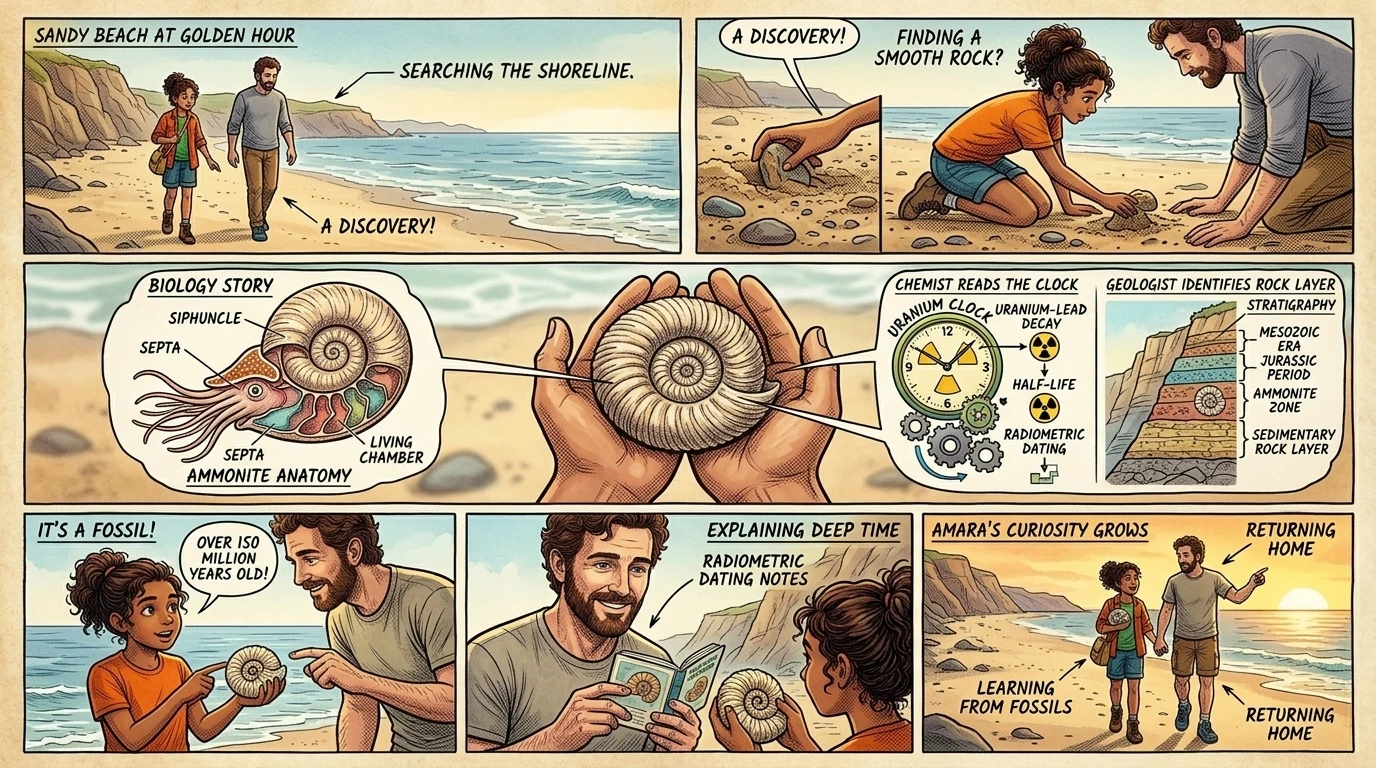
Back on the cool sand of Baker Beach, Amara held the fossil with a new reverence. "Wow. So this little shell isn't just a biology story," she realized. "It has a 'Uranium Clock' inside it that a chemist can read, and it was found in a rock layer that a geologist can identify. They all speak a different language, but they're telling the same story!"

Back on the cool sand of Baker Beach, Amara held the fossil with a new reverence. "Wow. So this little shell isn't just a biology story," she realized. "It has a 'Uranium Clock' inside it that a chemist can read, and it was found in a rock layer that a geologist can identify. They all speak a different language, but they're telling the same story!"

Page 9

"It happens everywhere!" her dad said, pointing to the bridge. "To build that, engineers needed physics to understand the forces, geologists to test the rock…
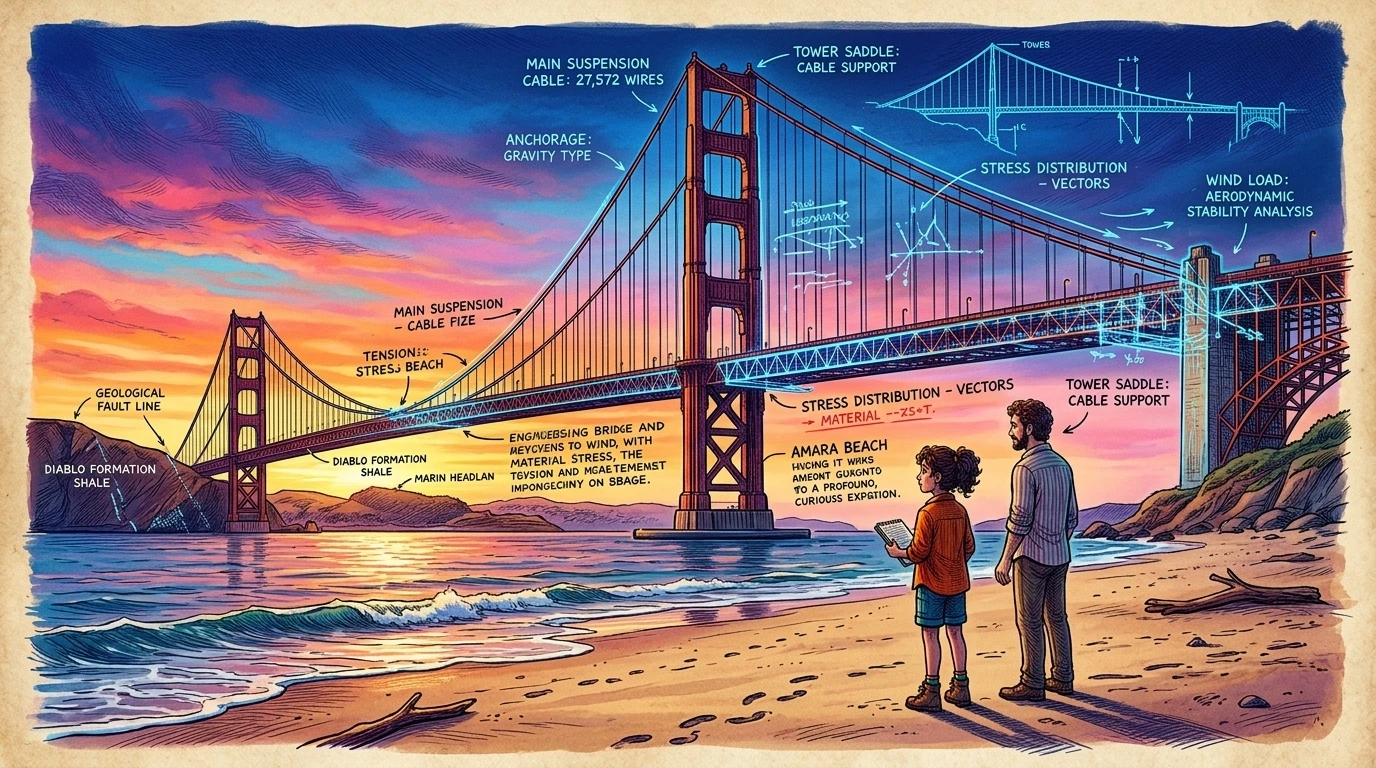
"It happens everywhere!" her dad said, pointing to the bridge. "To build that, engineers needed physics to understand the forces, geologists to test the rock for the foundations, and chemists to create the right kind of steel. The engineers even had to account for how the metal expands in the heat—the Eiffel Tower in Paris grows 15 centimeters taller in summer for the same reason!"

"It happens everywhere!" her dad said, pointing to the bridge. "To build that, engineers needed physics to understand the forces, geologists to test the rock for the foundations, and chemists to create the right kind of steel. The engineers even had to account for how the metal expands in the heat—the Eiffel Tower in Paris grows 15 centimeters taller in summer for the same reason!"

Page 10
"So the biggest secrets aren't solved by one kind of science, but by many working together," Amara concluded, closing her notebook.
"So the biggest secrets aren't solved by one kind of science, but by many working together," Amara concluded, closing her notebook. Her father nodded, looking at the immense steel structure spanning the bay. "That's right. It makes you wonder, doesn't it? If chemists know how to make steel, how do engineers know exactly how strong it needs to be to hold up against wind, waves, and time?"

"So the biggest secrets aren't solved by one kind of science, but by many working together," Amara concluded, closing her notebook. Her father nodded, looking at the immense steel structure spanning the bay. "That's right. It makes you wonder, doesn't it? If chemists know how to make steel, how do engineers know exactly how strong it needs to be to hold up against wind, waves, and time?"

About this story

  • Audience: kids (ages 6–12)

Questions and answers

Questions and answers about Dusty Attic's Labyrinthine Fossil Secrets

Read Wonder Science on your phone

Wonder Science is available on Android. Get Wonder Science on Google Play.

More Wonder Science stories

All Wonder Science stories · Open the library