How Fossils Form
How Fossils Form — an illustrated science story, set in England. 10 illustrated pages, free to read on Wonder Science.
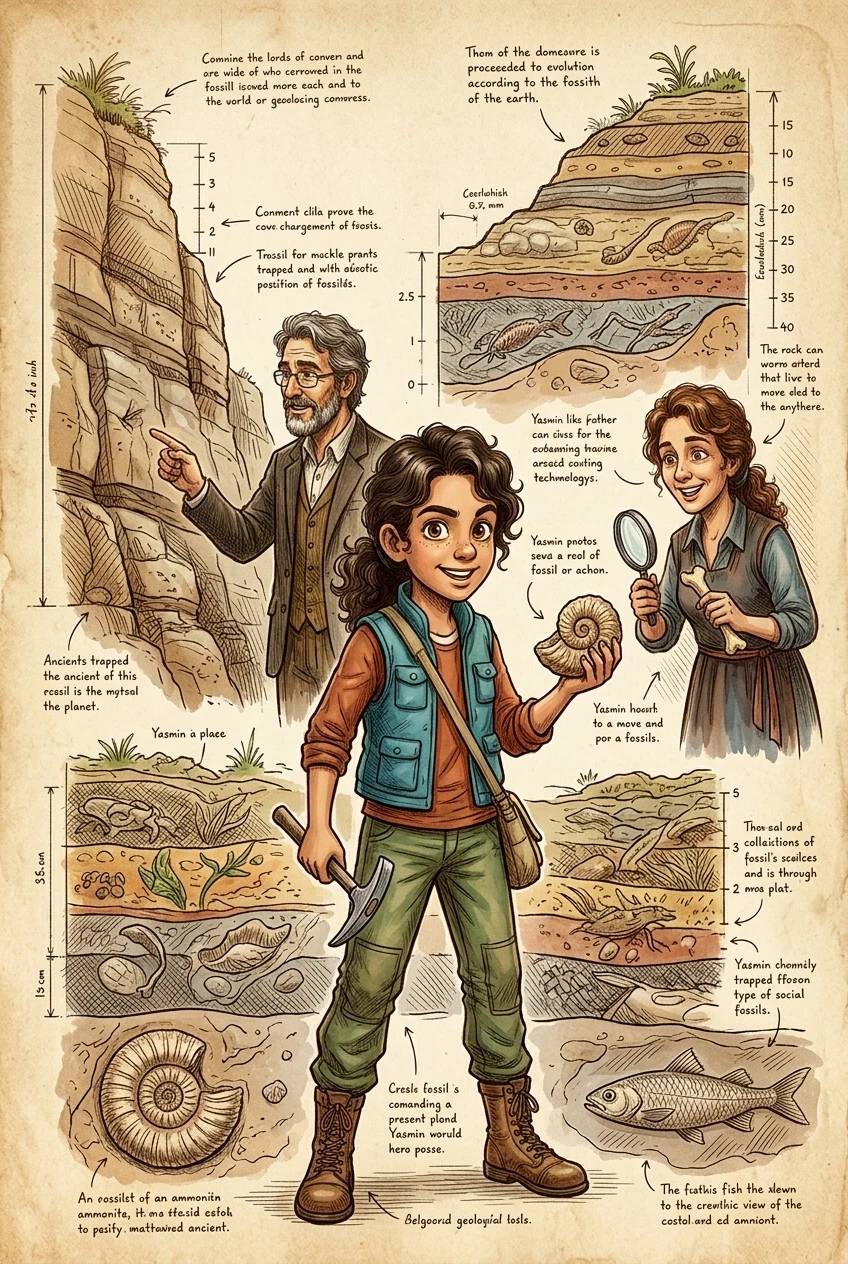
Page 1

On the windy shore of Baker Beach, Yasmin held up a pearly white seashell she'd found near the waves. "Look at the perfect spiral!" she exclaimed to her parents, the Golden Gate Bridge rising through the fog behind them. Her father smiled, picking up a smooth, gray rock. "It's amazing how a tiny animal can build its own home, isn't it?" Yasmin traced the shell's delicate ridges, then looked at the huge, rocky cliffs bordering the sand, wondering what happened to shells over a much, much longer time.
Page 2

Back home in their bright Noe Valley kitchen, Yasmin placed the shell on the table next to a fossil ammonite. "How does this little shell ever become something hard like this rock fossil?" she asked. Her father pointed from the shell to the fossil. "That shell is made of calcium carbonate, the same mineral that builds huge limestone cliffs over time." This was the key—the shell itself was the first ingredient in a recipe that was millions of years old.
Page 3

To find the answer, we have to travel back in time to the early 1800s, to a stormy, dramatic coastline in England called Lyme Regis. Here, the cliffs weren't just rock; they were a library of ancient life, holding stories of sea creatures from a time before humans. After every storm, the churning waves and landslides would reveal a new page from Earth's deep history. Yasmin appears, a silent observer, watching the waves crash against the dark, imposing cliffs.
Page 4

This is where a young woman named Mary Anning lived, and she was one of the greatest fossil hunters in history. She didn't have fancy tools, just a sharp eye, a strong will, and her trusty dog, Tray. From a very young age, Mary scrambled over the dangerous, crumbling cliffs of her hometown. She was searching for 'curiosities'—what we now know were the fossilized remains of incredible prehistoric reptiles.
Page 5

Mary knew the secrets of the stones better than anyone. "As Leonardo da Vinci wrote, 'Nature is the source of all true knowledge,'" she might have whispered to Tray, her breath fogging in the chilly sea air. "And nature hides her best secrets right after a storm!" She tapped a peculiar-looking rock with her hammer, listening to the sound it made. It wasn't the dull thud of a normal stone; it was different.
Page 6

With a final, careful chip, a section of rock fell away, revealing a row of cone-shaped teeth in a long, reptilian jaw. It was the skull of an Ichthyosaur, an ancient marine reptile! Mary had found a monster. For this to happen, the creature had to die and sink to the seafloor, quickly getting buried by mud and sediment. Over millions of years, as more layers pressed down, water seeped in and minerals replaced the original bone, creating a perfect stone copy.
Page 7

Mary Anning's discoveries were world-changing, proving that animals could become extinct and that Earth's history was far older than anyone had imagined. "It's amazing," Yasmin's father's voice explained. "Some ancient things, like the 3,000-year-old honey found in Egyptian tombs, are preserved perfectly. But fossils are a different kind of ancient—they're a story that has turned to stone." Her work helped create the entire field of paleontology, filling museums with evidence of a lost world.
Page 8

Back in their living room, the ammonite on the table suddenly made perfect sense to Yasmin. "I get it now!" she announced, picking it up. "The calcium in an ancient animal's shell or bones gets slowly washed away and replaced by other minerals from the mud and water!" Her mom looked from the fossil to Yasmin, her eyes wide with understanding. "So that's why it's so heavy—it's not a shell anymore, it's a rock shaped exactly like the original shell!"
Page 9

"Exactly! Like the huge dinosaur skeletons at the museum," her dad added, gesturing excitedly. "And what about coal?" her mom chimed in. "Our teacher said that comes from plants that were buried for millions of years—plant fossils!" Yasmin remembered a picture from a book. "And sometimes, insects get trapped in tree sap that hardens into amber, preserving them perfectly!"
Page 10

Yasmin closed her notebook, feeling like she had solved a great mystery. "So, a fossil is a copy of ancient life, written in stone," she summarized with a grin. Her father nodded, looking thoughtful. "It makes you wonder, if these layers of rock were once at the bottom of the ocean, it means the continents themselves must be moving. But how fast are they actually going?"
About this story
- Location: England
- Audience: kids (ages 6–12)
Questions and answers
Read Wonder Science on your phone
Wonder Science is available on Android. Get Wonder Science on Google Play.